
On this page
Start here
Quick answer
A Kenmore washer normally agitates during the wash portion and spins the basket during the spin portion, so “not agitating during spin” needs to be separated into two observations before a part is blamed. Identify the full model, washer design and cycle phase, then note whether the machine fills, moves the load during wash, drains and spins. With the washer stopped, check only the load, selected cycle, lid or door closure, visible standing water and power status. Kenmore’s current washer lineup includes both agitator and impeller designs, and Kenmore directs owners to the exact model manual and customer-care path for model-specific instructions. If there is a burning smell, smoke, sparking, abnormal heat or a failed lid/door safety condition, stop using the washer and arrange qualified service; do not open the cabinet or live-test internal parts.
Before you begin
Safety first
- Do not open the cabinet, reach into a moving tub, bypass a lid/door safety device, perform live electrical tests, or continue restarting a washer with smoke, burning odor, sparking, abnormal heat or repeated breaker trips.
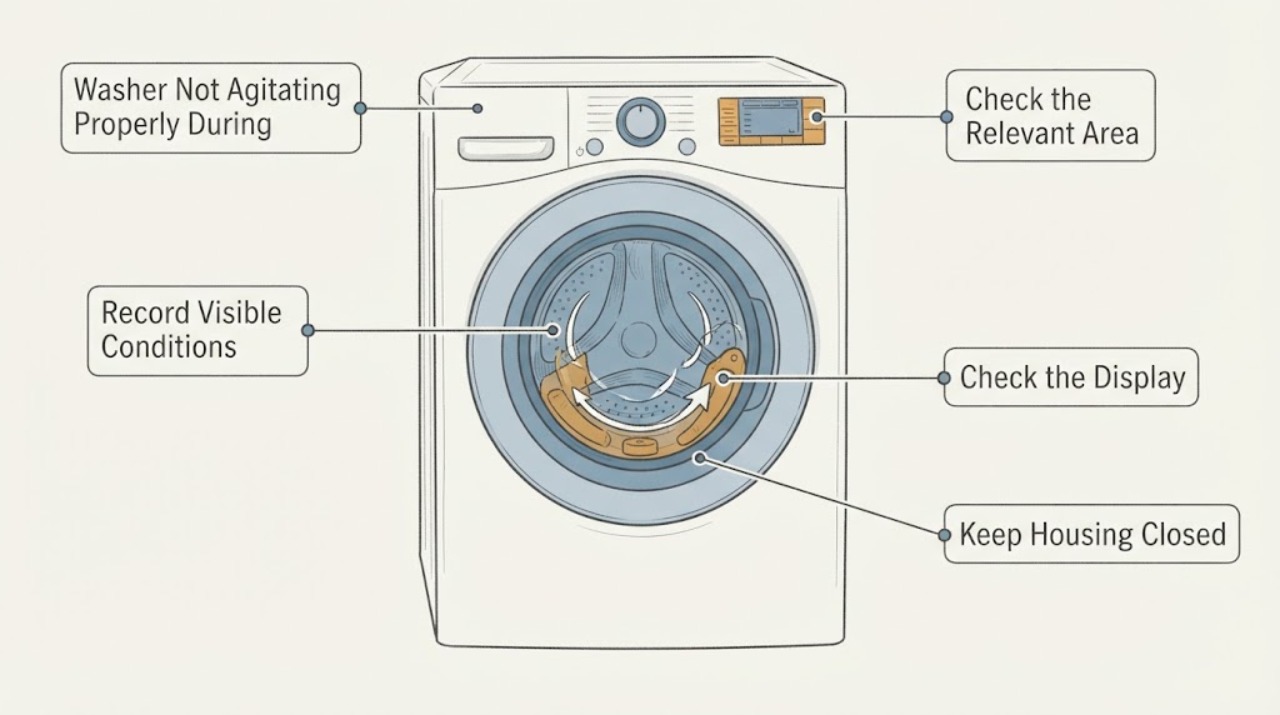
Work through in order
Diagnostic checks
Use only checks that match the exact appliance or system and its official guide.
-
Check 1
With the washer stopped and hands away from the basket, write down the exact model and cycle, then distinguish the phase: does the tub fill and fail to move the load during wash, does the basket fail to spin during spin, or do both phases fail? Note whether it drains and whether a lid or door lock indication appears.
Expected result: Wash movement is absent but drain/spin work, basket spin is absent after wash, both motions are absent, or the machine never reaches the claimed phase.
Next step: Keep the exact model and phase result for the remaining checks. Do not select a coupling, clutch, motor, timer or transmission based only on the word agitation.
Why this matters
Why: The observations separate a wash-motion complaint from a spin/drain complaint. A Kenmore model and design are needed before a control sequence or component can be scoped.
-
Check 2
With power off, check that the load is not tightly packed, tangled or visibly unbalanced, and record the selected cycle and any wash-only, drain-only or spin-only setting. Use only the cycle and loading limits in the exact model manual; do not place hands in a moving tub.
Expected result: The symptom appears only with a heavy or uneven load or one special cycle, or it also occurs with a normal small balanced load on the appropriate cycle.
Next step: If the manual permits it and there is no hazard, run one normal cycle with a balanced load only after the inspection is complete. If the same phase fails again, stop repeating cycles and use the model support path.
Why this matters
Why: A cycle or load-dependent symptom is different from a failure that occurs at the same phase on every load. A repeatable failure on a balanced load needs model-specific service rather than a guessed part.
-
Check 3
Check externally that the washer is receiving power, the lid or door is fully closed, the visible control selection matches the intended cycle, and the tub is not left full of water. Do not bypass or defeat a lid/door safety device and do not remove panels.
Expected result: The washer has no power, a lid/door closure or lock indication, standing water, an interrupted cycle, or none of those visible conditions.
Next step: Correct only an obvious external selection or closure issue allowed by the manual. If water remains, the lid/door will not safely close, or the issue recurs with normal external conditions, stop and arrange service.
Why this matters
Why: A power, closure, cycle or drainage condition can prevent the machine from reaching normal movement; the absence of an external condition still does not identify an internal component.
-
Check 4
From a safe position, note whether the washer buzzes, clicks repeatedly, smells of burning, becomes unusually hot, sparks or trips a breaker while trying to move the load. Do not keep restarting it to reproduce a sound.
Expected result: There is burning odor, smoke, sparking, abnormal heat, repeated electrical tripping or only an ordinary quiet failure without a hazard.
Next step: For smoke, sparking, burning odor, abnormal heat or repeated tripping, stop using the washer and disconnect power only if it is safe to do so, then arrange qualified service. For a quiet repeatable failure, give the technician the exact phase and model instead of opening the cabinet.
Why this matters
Why: A safety symptom exceeds an observation-level movement check. A sound or odor by itself does not prove a motor, clutch, coupling, timer or transmission failure.
-
Check 5
Prepare the full model number, washer type, cycle and load, the failed phase, whether it fills/drains/spins, lid or door behavior, visible water level, sounds or odors, and the result of any safe external check before contacting Kenmore support or a qualified appliance technician.
Expected result: The phase-specific failure persists, the model manual does not resolve it, or any next step would require a cabinet, electrical, motor or safety-device inspection.
Next step: Keep the washer out of service if it has a hazard or cannot safely complete the cycle, and use the exact-model manual/customer-care or qualified service route. Do not live-test internal wiring or bypass the lid/door safety system.
Why this matters
Why: Kenmore’s official support path is model-specific; a generic “not agitating during spin” description is not enough to identify a repair part or internal fault.
Use your observations
Decision map
Find the observation that best matches what you see, then follow the next safe action.
-
PATH 01Next step
What you see
The washer fills and drains and the basket spins, but the load does not move during the wash phase.
Do this next
Stop guessing parts, record the full model and cycle, and use the exact manual or qualified service route; do not open the cabinet or copy that other model’s repair attempts.
Why this path and its safety boundary
Why it matters: This is a wash-motion complaint; the opened Kenmore 700 case shows that this symptom pattern can occur without proving a particular internal part, and its exact model differs from this unspecified task.
-
PATH 02Next step
What you see
Wash movement occurs, but the basket does not spin normally, clothes remain soaked, or water remains in the tub.
Do this next
Check only the exact model’s external cycle and drain guidance, then arrange service if the phase repeats or water remains. Do not reach into the tub or open the cabinet.
Why this path and its safety boundary
Why it matters: The reported condition is a spin or drain problem rather than agitation during spin; the word agitation should not be used to assign a wash-drive diagnosis.
-
PATH 03Next step
What you see
The washer completes the expected motion with a normal balanced load or on another permitted cycle, but the symptom appears only with one load or selection.
Do this next
Use the matching manual’s loading and cycle instructions and monitor one normal load. If the same phase fails with a balanced load, stop testing and provide the model and observations to service.
Why this path and its safety boundary
Why it matters: A load or cycle condition is more plausible than a confirmed failed component, but the exact manual still controls the permitted load and cycle behavior.
-
PATH 04Next step
What you see
There is burning odor, smoke, sparking, abnormal heat, repeated breaker tripping, unsafe lid/door behavior, or a repeatable phase failure after the external checks.
Do this next
Stop using the washer and disconnect power only from a safe position when appropriate; arrange qualified service and do not bypass a lid/door device or perform live internal tests.
Why this path and its safety boundary
Why it matters: The problem exceeds a safe user-level observation and may involve an electrical, mechanical or safety-system fault that cannot be identified from this generic topic.
Helpful context
Understand the symptom
Separate wash agitation from spin
The title describes agitation during spin, but these are different observations on a washer. Agitation is the back-and-forth or other wash motion; spin is the basket turning to remove water. Record which phase fails, whether the washer fills and drains, whether the lid or door locks, and whether the machine hums, stops or smells hot. Kenmore’s product range includes both agitator and impeller top-load designs, so a control or movement description from one model cannot be transferred to another.
Use the full model before choosing a procedure
Find the full model number and use Kenmore’s manual lookup before attempting a model-specific check. Kenmore’s customer-care page also separates manuals, parts and repair support. A missing model does not prevent safe observation, but it does prevent a reliable conclusion about the drive design, lid or door behavior, cycle sequence or any replacement part.
Do not copy internal repairs from a symptom report
An opened Reddit post about a Kenmore Series 700 reported buzzing and a burning smell with no agitation while spin and drain still worked, but it concerned the exact model 110.29732800 and included unverified internal repair attempts. That report is useful for separating observations, not for diagnosing a timer, motor, coupler, clutch or transmission in an unspecified Kenmore washer.
When checks do not resolve it
Need a professional?
Use Kenmore’s exact-model support path or qualified appliance service when the phase-specific failure repeats, the washer retains water, the lid or door will not safely close, the manual does not resolve the condition, or any next step would require cabinet access or electrical/mechanical diagnosis. Stop immediately for smoke, burning odor, sparking, abnormal heat or repeated breaker trips.
Safety scope: Do not open the cabinet, reach into a moving tub, bypass a lid/door safety device, perform live electrical tests, or continue restarting a washer with smoke, burning odor, sparking, abnormal heat or repeated breaker trips.
Have this ready
- Provide the full model number, washer design, cycle and load, failed phase, whether it fills/drains/spins, lid or door behavior, visible water level, sounds or odors, and any safe external observations.
Common questions
FAQ
Can a washer agitate during the spin phase?
Agitation and spin are different observations. Record whether the load moves during wash and whether the basket spins during spin; use the exact model manual before interpreting either symptom.
Does no agitation prove that the coupling, clutch or motor is bad?
No. Kenmore sells multiple washer designs, and an opened model-specific Reddit report included spin and drain with absent agitation but did not establish a universal component diagnosis. Do not choose a part without the exact model and applicable service evidence.
What should I do if the washer smells burned or sparks?
Stop using it and disconnect power only from a safe position when appropriate. Do not keep restarting it, open the cabinet or bypass the lid/door safety system; arrange qualified service.
Read the exact guide
Official sources
- Kenmore Series 700 Washer Not Agitating (I've tried so much and am coming here for help)Reddit · Opened exact Reddit post. The poster reports exact model 110.29732800, buzzing/burning smell and no agitation while spin and drain worked; this is a model-specific community report and not official evidence for all Kenmore washers.
- Find Your Manual | Kenmore Appliance Manuals & GuidesKenmore · Opened Kenmore’s official manual lookup page. It directs owners to enter the full model number and lists washer manuals among the supported appliance materials; it supports exact-model lookup, not an unseen model-specific repair procedure.
- Customer Care & Support | Kenmore AppliancesKenmore · Opened Kenmore’s official customer-care page. It provides support and links for literature, parts and repairs/services; it is used here for the model-specific service boundary rather than for a guessed internal diagnosis.
- Top Load WashersKenmore · Opened Kenmore’s official top-load washer category. It lists current models with both agitator and impeller descriptions, supporting the need to match a procedure to the exact washer design; it does not identify a fault for this unspecified model.
Community feedback
Share a repair observation
Share a plain-text repair observation. Accepted observations are published automatically; this page may take a moment to update.