
On this page
Start here
Quick answer
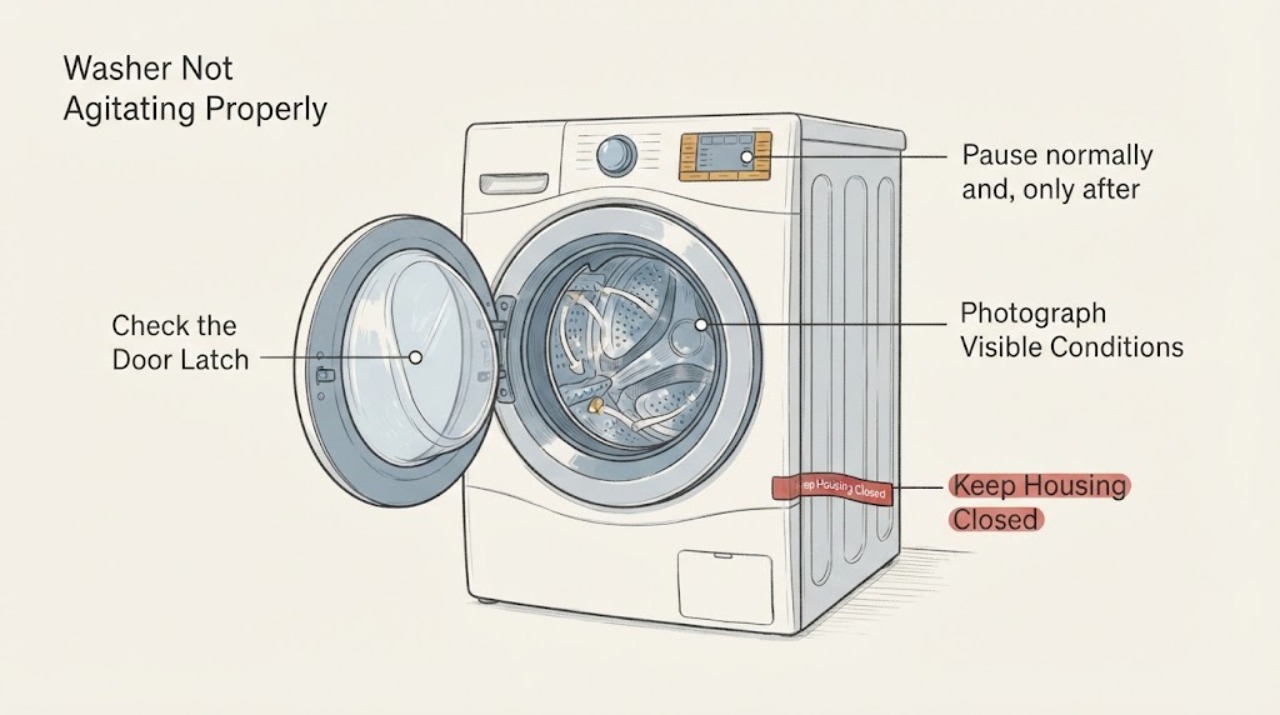
For Kenmore 110.16962502, first determine whether the washer is not agitating at all, pauses normally, moves only weakly with a heavy or tangled load, or also fails to drain or spin. Kenmore directs owners to use the complete model number to retrieve the matching manual; do not borrow a cycle sequence or transmission-part diagnosis from another Kenmore 110 platform. With the washer stopped and the lid closed, confirm the selected cycle is intended to agitate, the load is loose rather than wrapped around the agitator, and the basket is not overloaded. Whirlpool's official top-load guidance explains that an out-of-balance or overloaded load can cause vibration, reduced performance, or a correction routine, while an open lid prevents agitation. If a normal, evenly distributed load still will not agitate, the machine also will not spin or drain, or it makes grinding, burning, or electrical sounds, stop using it and arrange qualified Kenmore appliance service rather than selecting a coupling, gearcase, motor, agitator, or timer from the symptom alone.
Work through in order
Diagnostic checks
Use only checks that match the exact appliance or system and its official guide.
-
Check 1
From a dry, stable position, photograph the rating label and record Kenmore 110.16962502, the selected cycle and water-level setting, whether the lid is closed, and exactly what moves: the entire agitator, only an upper section if the design has one, the basket, or nothing. Note whether the symptom begins during wash, after a pause, during drain, or during spin.
Expected result: The washer pauses briefly, agitates weakly, does not move at all, moves only one section, or also fails to drain or spin.
Next step: Use the exact model manual from Kenmore's lookup and continue only with checks it authorizes. If the lid is open, locked abnormally, water is uncontrolled, or there is smoke, burning odor, sparking, a damaged cord, or a hot outlet, stop using the washer and arrange qualified help.
Stop if: Do not open the lid during motion, defeat or jumper the lid switch, enter an undocumented diagnostic mode, or reach into the basket.
Why this matters
Why: A pause or a stage change can be normal, while no movement or a combined no-drain/no-spin symptom needs a different path. Because Kenmore documentation is model-number specific, the complete identity and timing are more reliable than a generic part chart.
-
Check 2
With the washer stopped, confirm that the lid closes and latches normally and that the selected cycle is one that should include agitation. Allow a documented sensing or soak pause to finish once; do not add water or move the timer repeatedly just to make the agitator start.
Expected result: The lid is open or not latching, the cycle is in a normal pause or soak period, the cycle omits agitation, or the lid and cycle are correct but the wash motion never begins.
Next step: Remove only loose visible clothing or residue that prevents closure, then use the exact manual's normal cancel or restart instruction once. Request service for a returning latch or interlock fault, or for no agitation after the correct cycle is selected.
Stop if: Do not insert tools into the latch, force the lid, bypass the interlock, or run the washer with the lid unable to close safely.
Why this matters
Why: Official top-load guidance states that an open lid prevents agitation and spin, and that some cycles include pauses or periods of soak. A closed lid and correct cycle with no agitation leaves load, water level, drain, or machine diagnosis in consideration; a lid that cannot latch is an interlock service issue.
-
Check 3
Pause normally and, only after all motion stops, spread the clothing loosely around the agitator or wash area. Check whether one bulky item, a tightly wrapped bundle, a very small load, or an overloaded basket is preventing the load from moving. Do not wrap items around the agitator and do not reach into a moving basket.
Expected result: The load is tightly packed, wrapped around the agitator, visibly collected on one side, unusually small, or appropriate and loose but agitation remains weak.
Next step: Remove excess or unsuitable items and use the cycle recommended by the exact Kenmore manual for the remaining load. If the same symptom returns with a normal, evenly distributed load, stop repeated trials and continue to the drain, level, and service decision.
Stop if: Stop if the basket bangs violently, the cabinet walks, the load cannot be removed without reaching past a lock, the washer leaks, or the floor becomes wet near electrical parts.
Why this matters
Why: Whirlpool's top-load guidance links unbalanced or overloaded loads to noise, vibration, reduced performance, and sometimes a correction routine. Its older agitator guidance says clothing should move freely and not be wrapped around the agitator. A normal loose load that still does not agitate makes load arrangement less likely as the sole cause.
-
Check 4
Check the water-level and cycle choice against the exact Kenmore manual without adding water by guesswork. Observe whether the selected cycle is a low-water, delicate, soak, or bulky program, whether the clothes can move freely, and whether excess suds are present. Do not treat a low visible water line as proof that the agitator or motor has failed.
Expected result: The cycle is intentionally gentle or paused, the water level is appropriate and the load moves, the basket is overloaded, or excessive suds are visible and agitation is poor.
Next step: Use the matching cycle and measured detergent amount from the manual, then compare one ordinary load only if the machine is dry, stable, and safe. If agitation remains absent on the correct cycle, arrange service rather than increasing water or detergent.
Stop if: Do not add water to force agitation, pour in extra detergent, run an excluded waterproof item, or continue if the washer leaks, overheats, or has an electrical odor.
Why this matters
Why: Official top-load guidance says cycle selection changes water level and agitation behavior, and too much added water can let clothes float away from the wash action. Overloading and excessive suds can also reduce washing performance; these observations do not identify a transmission or motor part.
-
Check 5
With the washer off and the floor dry, check whether the cabinet rocks diagonally and whether all accessible feet remain firmly on the floor. Also note whether the drain hose is kinked or the household drain backs up. Do not pull, tip, or place hands underneath the washer.
Expected result: The cabinet rocks, the floor flexes, the basket becomes unstable only with one load, the drain path backs up, or the washer is stable and drains normally.
Next step: Use only the exact manual's accessible leveling instructions on a dry floor; correct only a plainly visible hose position. Arrange plumbing help for a backing-up household drain and appliance service for a stable washer that still will not agitate.
Stop if: Do not tip the washer, loosen structural hardware, disconnect a water-filled hose, open the cabinet, or continue with an unstable machine or water near electrical parts.
Why this matters
Why: Whirlpool says an unleveled washer can make a load unbalanced and reduce correct operation, while a blocked or incorrectly routed drain can leave water and prevent later stages. A stable cabinet and clear drain with persistent no-agitation shifts the case toward a machine-level diagnosis.
-
Check 6
After the safe external checks, perform at most one model-authorized comparison cycle while staying nearby: use a normal, evenly distributed load, keep the lid closed, and watch the wash-to-drain-to-spin sequence from outside. Record whether the tub fills, the agitator moves, the washer drains, the basket spins, and any code or unusual sound.
Expected result: The comparison load agitates and completes, agitation returns after load or cycle correction, the washer fills but never agitates, or it also fails to drain or spin.
Next step: Stop testing and request qualified Kenmore appliance service. Provide the complete model, selected cycle, load, lid behavior, water level, timing, drain result, vibration, sounds, and any display message. Use plumbing service when the household drain backs up independently.
Stop if: Do not repeat the test for grinding, scraping, burning odor, smoke, sparks, violent movement, a leak, a hot cord or outlet, or a lid that does not safely latch.
Why this matters
Why: A successful comparison after correcting a cycle or load supports a reversible operating condition. No agitation on a normal load, especially with no drain or no spin, is not enough to identify an agitator dog, coupling, gearcase, motor, timer, or lid switch; it requires model-specific diagnosis.
Use your observations
Decision map
Find the observation that best matches what you see, then follow the next safe action.
-
PATH 01Next step
What you see
The washer pauses briefly or soaks, the lid is closed, and agitation begins after the documented stage or cycle resumes.
Do this next
Allow the exact Kenmore cycle to complete and compare with its matching manual. Do not interrupt the cycle repeatedly or add water to shorten a normal pause.
Why this path and its safety boundary
Why it matters: This pattern is compatible with normal cycle timing rather than a confirmed agitation failure.
-
PATH 02Next step
What you see
The load is wrapped around the agitator, overloaded, unusually small, or collected on one side, and agitation improves after safe redistribution.
Do this next
Use the correct load size and cycle, place clothing loosely, and avoid single bulky or excluded items. Request service if a normal load repeatedly produces the same symptom.
Why this path and its safety boundary
Why it matters: The result supports a load-distribution or loading problem. Whirlpool says an off-balance load can reduce performance and trigger correction behavior; this does not prove an internal drive failure.
-
PATH 03Next step
What you see
The lid does not latch, the correct cycle is not selected, or the washer remains in a documented pause or soak state.
Do this next
Use only the exact Kenmore manual's closure and cycle procedure once. Arrange service for a returning latch fault or no agitation after the lid and cycle are correct.
Why this path and its safety boundary
Why it matters: An interlock or cycle-state condition can prevent agitation without establishing a failed agitator or transmission.
-
PATH 04Next step
What you see
Water remains, the washer cannot drain or spin, the drain hose or household drain backs up, or the machine hums without advancing to the next stage.
Do this next
Keep the washer off, correct only a safe visible hose issue, and use plumbing service for a household backup or appliance service for a machine-side no-drain/no-spin condition.
Why this path and its safety boundary
Why it matters: The immediate decision is a drain or plumbing path, not an agitator-part diagnosis. A no-drain condition can prevent or interrupt later motion and leave the load wet.
-
PATH 05Next step
What you see
A normal, evenly distributed load has a closed lid and suitable cycle, the cabinet is stable, the drain path is clear, but the washer still will not agitate or makes grinding, burning, or electrical sounds.
Do this next
Leave the Kenmore off and arrange qualified appliance service with the full model number and the recorded comparison results. Do not open the cabinet or order a drive component from a symptom chart.
Why this path and its safety boundary
Why it matters: An internal fault is more likely, but the visible symptom cannot distinguish the agitator assembly, coupling, gearcase, motor, timer, lid switch, wiring, or another platform-specific cause.
Helpful context
Understand the symptom
The assigned identity is Kenmore model 110.16962502. Kenmore's official manual page accepts the complete model number and says its manuals provide model-specific use, troubleshooting, and parts information. Until the matching document is retrieved, this guide stays at safe symptom-level checks and does not assume that a part or diagnostic sequence from another Kenmore 110 washer fits this machine.
“Not agitating properly” can describe several different observations: a normal pause, a lid-interlock stop, a load that is too heavy or tangled for the selected cycle, a drain problem that prevents the next stage, or a genuine internal fault. Watch the complete motion from a safe position; never reach into the basket or bypass the lid switch to see whether the agitator moves.
When checks do not resolve it
Need a professional?
Keep the Kenmore washer off and arrange qualified service if a normal balanced load with the lid closed and correct cycle still will not agitate, if it also will not drain or spin, or if the cabinet rocks, walks, leaks, or makes grinding, scraping, burning, or electrical sounds. Stop immediately for smoke, sparks, a hot cord or outlet, uncontrolled water, or water near electrical parts; stay clear and seek qualified appliance, plumbing, or electrical help as appropriate. Do not bypass the lid switch, open the cabinet, tip the washer, reach into a moving basket, or keep repeating cycles to locate an internal fault.
Common questions
FAQ
Could a normal pause look like a Kenmore washer that is not agitating?
Yes. Official top-load guidance notes that some cycles include pauses or soak periods. Record the cycle and allow the documented stage to finish once; if the lid is closed and the correct cycle still never agitates, arrange service rather than repeatedly advancing the timer.
What load pattern most often explains weak agitation?
An overloaded, tightly packed, wrapped, very small, or one-sided load can reduce top-load performance and trigger an imbalance correction. Redistribute clothing loosely and use the exact manual's load and cycle guidance; do not add water or an unsuitable item to force movement.
When should I stop troubleshooting and call for service?
Call qualified Kenmore appliance service when a normal balanced load with a closed lid and suitable cycle still will not agitate, or when the washer also will not drain or spin, rocks, leaks, or makes grinding, burning, or electrical sounds. The complete model number and the cycle-stage observations are more useful than naming a drive part yourself.
Read the exact guide
Official sources
- Not Draining - Washer - Product HelpWhirlpool Product Help · Official top-load guidance used to separate a no-drain or wet-load symptom from agitation-only complaints. It covers drain-hose routing, clogs, suds, tightly packed loads, and model-manual limits; it is not an exact Kenmore 110 service manual.
- Low Water Level - Washer - Product HelpWhirlpool Product Help · Official top-load guidance used only to explain that water level and cycle choice affect load engagement and that adding too much water can float clothing. The exact Kenmore model manual remains controlling for its settings.
- Knocking or Thumping - Noise - Product HelpWhirlpool Product Help · Official top-load guidance used to interpret rocking, uneven loads, walking, and level-related vibration at symptom level. It does not identify a Kenmore model part.
- Not Agitating - Washer - Product HelpWhirlpool Product Help · Official top-load guidance used only for general symptom branches: off-balance loads can reduce performance or trigger correction, and the selected cycle and water level affect agitation. It is not a claim that a Whirlpool part or sequence fits Kenmore 110.16962502.
- TROUBLESHOOTINGWhirlpool · An official top-load agitator washer manual opened for symptom-level comparison only. It states that an open lid prevents agitation/spin, some cycles pause, loads should not be overloaded or wrapped around the agitator, and a suitable cycle matters; it is not the exact Kenmore manual.
- Find Your Manual | Kenmore Appliance Manuals & GuidesKenmore · Kenmore's official page is the model-documentation lookup for the assigned exact model 110.16962502 (entered without punctuation as 11016962502) and says to enter the complete model number to retrieve the matching owner's manual and related laundry resources. It does not itself expose a 110.16962502-specific agitation procedure, so no platform-specific part or cycle claim is taken from it.
Community feedback
Share a repair observation
Share a plain-text repair observation. Accepted observations are published automatically; this page may take a moment to update.