
On this page
Start here
Quick answer
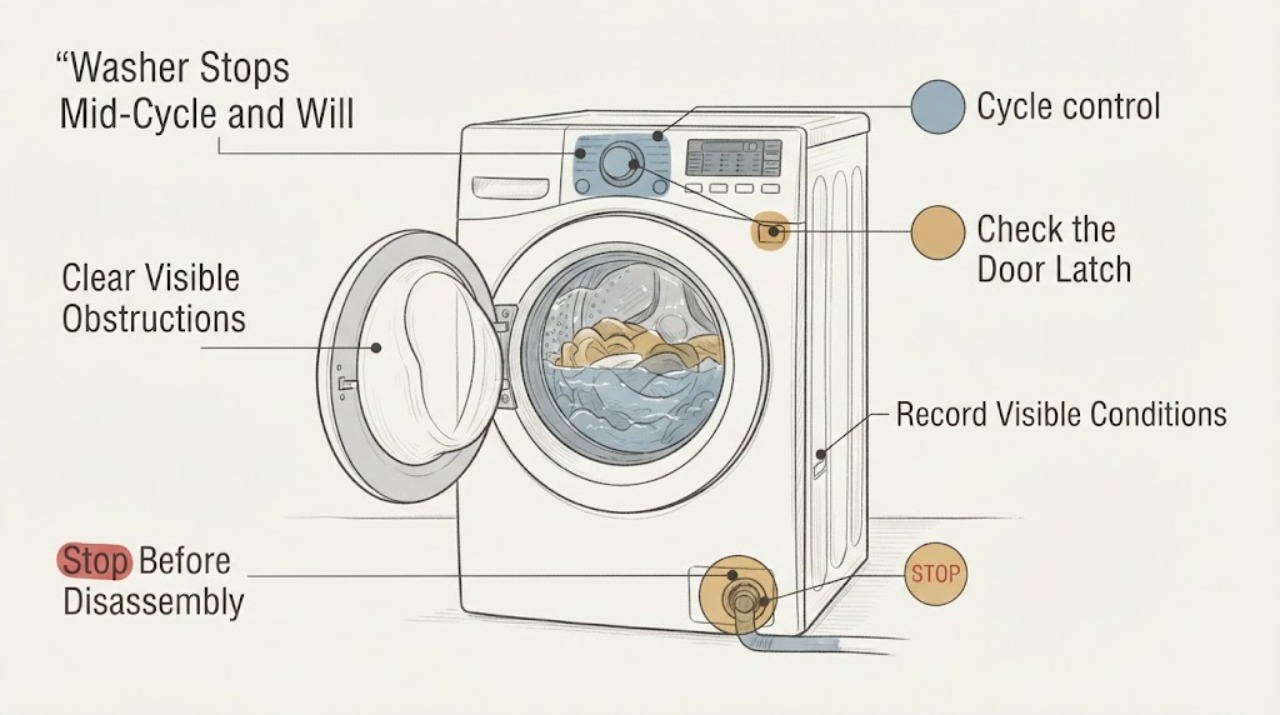
The opened report identifies a 2014-era Kenmore HE top-loader as model 25102, later giving the fuller label 110.25102311: it completed wash, left wet clothes, flashed Sensing, and would not engage the lid lock to continue. That symptom does not prove a failed lid-lock component or inlet valve. First keep hands out of a moving or locked tub, note whether water remains visible, confirm the lid closes without clothing caught at the latch, and record the complete model label. Kenmore says its manual lookup requires the complete model number, and the available general top-load guidance says a closed and latched lid may be required before a cycle starts; some models also require holding Start. A safe power reset may be tried only with no leak or other hazard. If the lid still will not lock, the Sensing light keeps flashing, water remains, or the washer only hums and will not advance, stop replacing parts by guesswork and arrange Kenmore/Sears appliance service.
Work through in order
Diagnostic checks
Use only checks that match the exact appliance or system and its official guide.
-
Check 1
Stop the washer and keep hands away from the tub and latch. From outside, note whether water is visibly standing in the basket, whether the clothes are only wet or submerged, whether there is a leak, and whether the tub has fully stopped before any lid movement is attempted.
Expected result: Water remains visible or leaking, or the basket is empty of standing water but the load is wet and the cycle stopped.
Next step: If water is leaking, stop using the washer and close the supply faucets when safe. Do not disconnect hoses or remove the pump. If there is no leak, continue only with the external lid and model checks below; request service if water remains or the washer only hums.
Why this matters
Why: Standing water or a leak makes a drain or fill condition possible but does not identify a failed pump or valve. Wet clothes without visible water can also result from a cycle that never reached spin.
-
Check 2
With the washer fully stopped, inspect the lid and latch area from above for clothing, detergent residue or another visible obstruction, and close the lid normally without forcing it. Record whether the control responds, whether a lock indication or sound appears, and whether any control-lock indicator is active.
Expected result: The lid closes and latches normally, the control responds, and the washer can be started according to the exact manual, or the lid will not latch/lock or the control remains unresponsive.
Next step: If the latch area is clear but the washer still will not lock or start, keep the lid mechanism intact and obtain the exact manual/service diagnosis. Do not tape, bypass or jumper the lid lock and do not reach into a locked tub.
Why this matters
Why: General top-load guidance says a fully closed and latched lid is required, but some models fill without locking while others will not start until the lock engages. A persistent failure to recognize the lid is not proof that the lock itself is the only failed component.
-
Check 3
Record the complete model and serial label, the cycle selected, which indicator was flashing, whether the washer made a hum or pump sound, and whether the stop occurred before drain or spin. Use this information to locate the exact Kenmore manual rather than relying on the short 25102 label.
Expected result: The full model is available and the manual matches the control layout, or only the short number is available and the manual cannot be matched.
Next step: Use the exact manual for only the visible, user-level checks it provides. If the full model cannot be matched, contact Kenmore support/service with the label information and symptom sequence rather than ordering a component.
Why this matters
Why: A full model match can establish the correct lid, control, drain and cycle instructions. A generic or mismatched manual cannot safely define diagnostic mode, code meaning or part fit.
-
Check 4
If there is no leak, no smoke or electrical odor, the tub is fully stopped and the plug is safely reachable, disconnect power for the model-appropriate reset period described by the exact manual; if no exact manual is available, do not extend this into repeated tests. Reconnect only once and observe whether the controls return to normal.
Expected result: The washer resumes normal control response and completes the cycle, or Sensing still flashes, the lid still will not lock, the motor only hums, or the cycle stops again.
Next step: If the fault returns, keep the washer out of use and request Kenmore/Sears appliance service. Do not enter an undocumented diagnostic mode, remove panels, test live wiring or replace the inlet valve or lock based only on the symptom.
Why this matters
Why: A single safe reset may clear a control state, but it does not prove that a lid, pump, valve or board is good. A repeat failure after reset requires diagnosis rather than repeated power cycling.
Use your observations
Decision map
Find the observation that best matches what you see, then follow the next safe action.
-
PATH 01Next step
What you see
Water is leaking, the tub is still moving, the lid is locked with water inside, or there is smoke, a burning/electrical odor or a tripped breaker.
Do this next
Keep clear of the tub, close water supply faucets when safe for a leak, isolate power only from a safe accessible point for an electrical hazard, and request qualified appliance service. Do not force the lid or disconnect hoses/panels.
Why this path and its safety boundary
Why it matters: This is a stop-use condition, not a lid-lock reset or parts-selection problem.
-
PATH 02Next step
What you see
The lid closes and latches, the full model manual matches the controls, and one safe reset restores normal Sensing and cycle operation.
Do this next
Monitor the next normal load using the exact manual. If the lid fails to lock, Sensing flashes, water remains or the cycle stops again, stop using the washer and schedule service.
Why this path and its safety boundary
Why it matters: The immediate symptom may have been a control state or temporary interruption, but the reset does not establish the cause or approve part replacement.
-
PATH 03Next step
What you see
The lid will not lock or the washer will not advance after the latch area is visibly clear and the controls respond, especially if the full model is 110.25102311 or another confirmed 25102 variant.
Do this next
Keep the washer out of use and give Kenmore service the complete model, indicator sequence and whether water remains. Do not bypass the lid lock or replace a lock without model-specific diagnosis.
Why this path and its safety boundary
Why it matters: The washer is not establishing the safety/control condition required for the next stage, but the available generic evidence cannot distinguish the latch, wiring, control, drain or another cause.
-
PATH 04Next step
What you see
The basket has no visible standing water, the lid condition is normal, but the washer only hums, leaves wet clothes or stops before drain/spin.
Do this next
Do not disconnect the drain hose or open the cabinet as a test. Request service with the exact model and the point at which the cycle stops.
Why this path and its safety boundary
Why it matters: The symptom remains unresolved and could involve a drain, drive or control condition; the report does not support naming a pump, valve or motor as the cause.
Helpful context
Understand the symptom
Confirm the full model before using a parts diagram
The discussion calls the washer 25102, but a later reply gives the fuller label as 110.25102311. Kenmore's own manual page says its model search expects at least 11 characters. Use the rating label under or near the lid or on the cabinet to confirm the complete identifier before looking up a manual or parts. The short 25102 label and a symptom such as a flashing Sensing light are not enough to prove that a particular lock, valve, pump or board fits.
Separate a lid/start condition from water left in the tub
The reported washer stopped after wash and did not advance to spin, with wet clothes, a soft hum and no lid-lock engagement. Those observations can coexist with water that has not drained, a lid that is not being recognized as closed, a paused or cancelled control state, or another model-specific fault. Look only at what is visible and accessible. Do not disconnect hoses, reach under a locked lid, enter an undocumented diagnostic mode or replace a valve because the washer stopped.
Common questions
FAQ
Is 25102 the complete Kenmore model number?
The opened discussion first calls the washer 25102 and later reports the fuller label as 110.25102311. Kenmore's official manual finder says model numbers are at least 11 characters long, so read the complete label before selecting a manual or part.
Can I tape or bypass the lid lock so the washer will spin?
No. The lid lock is part of the operating safety condition, and the available evidence does not establish why this washer will not recognize the lid. Keep the lid mechanism intact and arrange model-specific service instead of bypassing it.
Should I replace the inlet valve because the washer stopped mid-cycle?
Not from this symptom alone. The report says a valve was replaced without resolving the problem, and later observations raised a drain issue in that particular washer. That does not establish a universal valve or pump diagnosis; use the full model and service diagnosis before ordering parts.
Can I reset the washer?
A single power reset may be reasonable only when the washer is fully stopped, there is no leak or electrical hazard, and the exact instructions permit it. General top-load guidance describes disconnecting power briefly to reset the control, but a repeat failure after reset needs service rather than repeated cycling or an undocumented diagnostic mode.
Read the exact guide
Official sources
- Contact Us | Kenmore Customer SupportKenmore · Opened Kenmore's official contact page to support escalation when the full model and symptom sequence require service; no phone number is reproduced in the article.
- Find Your Manual | Kenmore Appliance Manuals & GuidesKenmore · Opened Kenmore's official manual portal. It states that model numbers are at least 11 characters and that the complete number should be used to obtain the applicable manual; it does not define a 25102-specific fault or part.
- Not Starting - WasherWhirlpool Product Help · Opened official Whirlpool top-load washer guidance as family-level reference only. It says lid closure/latching and model-specific Start behavior differ by model and describes a brief power reset; it is not treated as a Kenmore 25102 manual or proof of a specific component failure.
- Old Kenmore top-loading washer won't lock or cycleReddit r/appliancerepair · Exact opened post matching the assigned Kenmore 25102 shorthand and mid-cycle stop/lid-lock symptoms. The later full model and drain-pump observation are treated as one user's report, not as a universal diagnosis or official part fit.
Community feedback
Share a repair observation
Share a plain-text repair observation. Accepted observations are published automatically; this page may take a moment to update.