
On this page
Start here
Quick answer
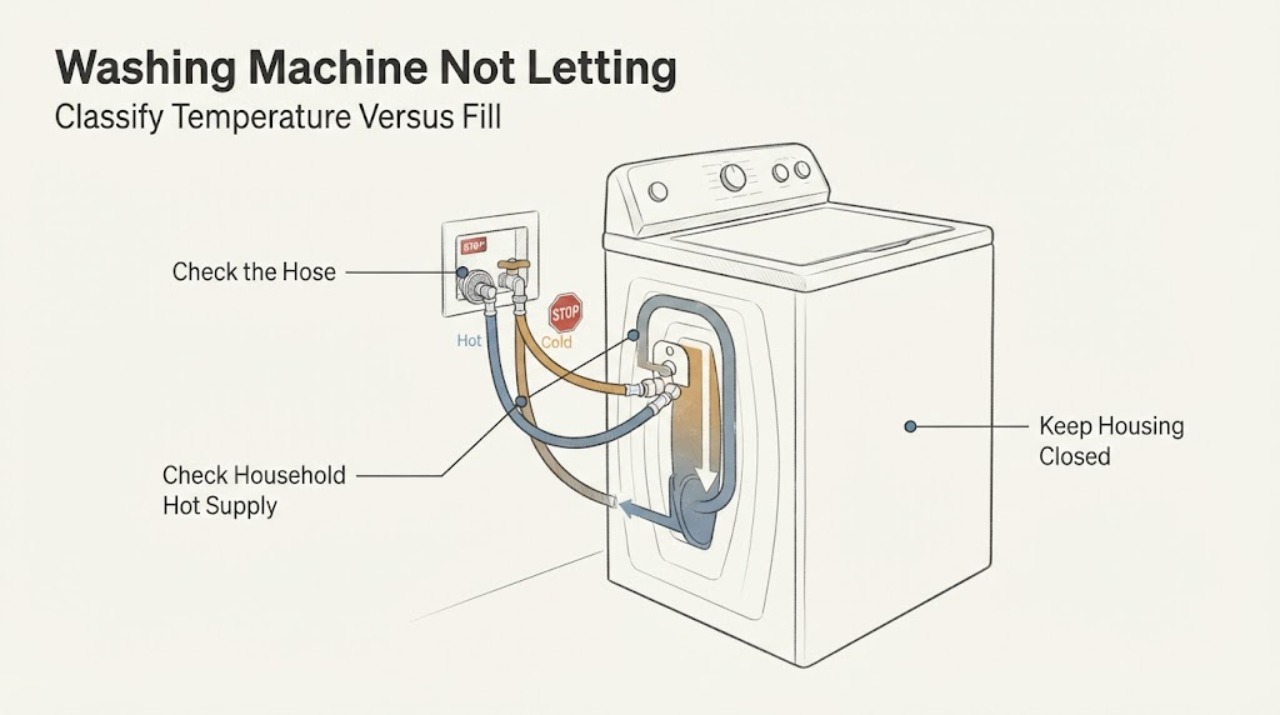
First separate temperature from fill volume. If the tub fills at its normal rate and level but the selected hot or warm wash is cool, check the cycle's temperature selection, confirm which hose is connected to the household hot supply, and compare the nearby hot faucet with the washer's result while no other hot water is being used. If the washer fills slowly, stops filling or leaves the load underfilled, check both supply faucets, visible hose kinks and the model's accessible inlet screens; do not assume the temperature control is the cause. Kenmore is a multi-platform brand, so use the complete model number to select the correct manual before changing a control, removing a hose or naming a valve. If a hose leaks, a valve lets water in while the washer is off, a screen is damaged, or the symptom remains after model-approved external checks, shut off the water and arrange qualified service rather than opening the valve or testing live wiring.
Work through in order
Diagnostic checks
Use only checks that match the exact appliance or system and its official guide.
-
Check 1
Run or observe the affected cycle long enough to record whether water enters at a normal rate and reaches the model's expected level, and separately whether the selected hot or warm water feels cooler than expected; do not reach into a moving tub.
Expected result: The tub fills normally but the selected hot/warm water is cool, or filling is slow, intermittent or incomplete.
Next step: Follow the matching temperature or low-flow branch below. Do not replace a valve or sensor based only on the initial impression.
Why this matters
Why: Normal volume with low temperature points first to the hot-water supply or the model's temperature selection/mixing behavior. Slow or incomplete filling points first to supply flow, hose restriction, inlet screens or a model-specific fill fault.
-
Check 2
Use the exact model manual to verify that the selected cycle calls for hot or warm wash water, then compare the visible hot/cold hose labels and connections with that manual; keep the washer off and the taps closed if a connection is wet.
Expected result: The cycle is cold by design, the hoses are reversed or loose, or the temperature selection and hose connections match the manual.
Next step: Choose only a model-documented hot or warm cycle and correct an obvious hose-identification issue according to the manual. If a connection leaks or cannot be safely corrected, shut off the water and arrange service.
Why this matters
Why: A cold-by-design cycle or reversed hoses can make a user perceive insufficient hot water without proving a failed component. A loose or wet connection is a leak risk, not a temperature-control diagnosis.
-
Check 3
With no other fixture using hot water, run the nearby hot faucet and compare its result with the washer's selected hot/warm fill; if using a thermometer, follow safe handling and do not make a model-independent temperature adjustment to the washer.
Expected result: The nearby hot faucet is also cool or takes a long time to heat, or it is hot while the washer's selected hot/warm fill remains cool.
Next step: Address a household hot-water issue with the responsible plumbing/heating professional. If the faucet is hot, continue with the washer's external supply and inlet-screen checks; do not open the valve or control assembly.
Why this matters
Why: A cool nearby faucet points to the home's hot-water path or simultaneous-use condition rather than a washer inlet diagnosis. Hot water at the faucet with a cool washer result leaves a model-specific hose, screen or control path to check in the exact manual.
-
Check 4
For a slow or incomplete fill, follow the exact model manual's user-accessible checks for fully open supply faucets, visible hose restrictions and inlet screens; turn off both taps before disconnecting any hose and reinstall every screen before operation.
Expected result: A faucet is partly closed, a hose is restricted, an inlet screen is visibly blocked, or all visible supply checks are clear.
Next step: Correct only the accessible supply issue documented for the exact model and check for leaks before restarting. If a screen is damaged, cannot be cleaned safely, or the fill remains slow, leave the water off and call service.
Why this matters
Why: Kenmore's product information shows that water-level behavior and options vary by platform. The exact manual determines whether a hose or screen check applies; a clear external path does not prove that an inlet valve or control is good or bad.
-
Check 5
Stop user troubleshooting when water enters while the washer is off, a hose or valve connection leaks, the fill remains incomplete after model-approved external checks, the display reports a temperature/fill fault, or the washer requires internal wiring or valve access.
Expected result: The fault repeats, water cannot be controlled at the taps, a screen or hose is damaged, or an internal component is suspected.
Next step: Close both water taps, unplug only from a dry and safe location if needed, contain visible water and arrange Kenmore or qualified appliance service. Do not bypass a valve, bridge a sensor, open the console or perform live tests.
Why this matters
Why: The public Kenmore materials route model-specific persistent or damaged fill problems to the manual and repair path; no-model Kenmore identity does not support naming a universal component diagnosis. Uncontrolled water entry can cause flooding, and live electrical access adds shock risk.
Use your observations
Decision map
Find the observation that best matches what you see, then follow the next safe action.
-
PATH 01Next step
What you see
The washer fills normally, but the selected hot or warm wash is cool and the nearby hot faucet is also cool or slow to heat.
Do this next
Resolve the household hot-water condition and follow the garment-safe cycle guidance. If the faucet is hot but the washer remains cool, continue with the hose, screen and model-specific service path.
Why this path and its safety boundary
Why it matters: The household hot-water path or simultaneous use is the leading scope supported by the manual's temperature troubleshooting; the washer is not yet shown to be defective.
-
PATH 02Next step
What you see
The nearby hot faucet is hot, the selected cycle should use hot or warm water, and the washer fills at a normal rate but the result is cooler than expected.
Do this next
Verify the exact manual's hose and cycle instructions, then arrange service if the external checks pass. Do not substitute another platform's temperature code or part.
Why this path and its safety boundary
Why it matters: This narrows the issue to the model's hose connection, temperature selection/mixing behavior or an internal fill-control path; it does not identify a universal Kenmore valve or sensor.
-
PATH 03Next step
What you see
The washer fills slowly, intermittently or below its normal level, regardless of whether hot or cold is selected.
Do this next
Perform only the exact model's external supply and screen checks. If flow remains low or water enters when off, close the taps and arrange service.
Why this path and its safety boundary
Why it matters: Kenmore's product information confirms that water-level behavior and options differ by washer platform; the exact manual supplies the applicable external checks before any part diagnosis.
-
PATH 04Next step
What you see
A leak, uncontrolled fill, damaged screen/hose, recurring fault or internal valve/control suspicion remains after model-approved external checks.
Do this next
Shut off both water supplies, keep the washer out of service if water or electrical safety is uncertain, and contact Kenmore support or a qualified appliance technician with the full model number.
Why this path and its safety boundary
Why it matters: The official material has reached the service boundary; no-model Kenmore identity does not support naming or fitting a replacement part.
Helpful context
Understand the symptom
A cool wash and a low fill are different symptoms
Look at both how much water enters and how warm it is. A washer that reaches its expected fill level but produces a cool hot/warm selection has a temperature-supply or cycle-selection question. A washer that fills slowly, stops or leaves the load underfilled has a flow or fill-path question. Kenmore's product information shows that water-level options and cycle features vary by platform, so do not transfer a valve, sensor, code or control procedure from another model.
Use the exact model before changing settings
Kenmore's official manual portal asks for the complete model number. That matters because older and newer Kenmore washers can use different temperature combinations, fill behavior and user-accessible filter procedures. Keep the model number from the rating label with the symptom notes before opening a hose connection or interpreting a display message.
Do not turn a supply symptom into a part diagnosis
The public Kenmore materials point users to the model manual and customer-care/repair path for model-specific checks. They do not establish a universal Kenmore inlet-valve, thermistor or control-board failure for a no-model complaint. Keep the water off when a connection leaks and leave internal electrical diagnosis to qualified service.
When checks do not resolve it
Need a professional?
Call service when the hot-water supply is available and the correct external hose/screen checks do not restore the model-documented fill or temperature behavior., Close both water taps and stop using the washer for an uncontrolled fill, active hose leak, damaged inlet screen or water near electrical parts., Do not open the console, test live valve wiring, bypass a temperature sensor or install a valve/part without the exact Kenmore model match.
Have this ready
- complete Kenmore model and serial information
- selected cycle and temperature setting
- whether fill volume/rate is normal or low
- nearby hot-faucet result with no simultaneous hot-water use
- hose connection, faucet, inlet-screen and leak observations
Common questions
FAQ
Why is my Kenmore washer getting warm or cold water instead of enough hot water?
First determine whether the washer is filling normally. If it is, check the cycle selection, hot/cold hose identity and the hot water at a nearby faucet while no other fixture is using it. If it fills slowly or remains underfilled, check faucets, visible hose restrictions and the model's inlet screens instead.
Are all Kenmore washer hot-water checks the same?
No. Kenmore's official manual portal requires the complete model number, and Kenmore has multiple washer platforms. Use the exact manual before changing a temperature control, disconnecting a hose or interpreting a fill message.
Should I replace the hot-water inlet valve?
Not from this symptom alone. Check the household hot supply, cycle selection, hose connections and model-approved inlet-screen checks first. If those pass or the valve leaks, close the taps and have the exact model diagnosed by qualified service rather than fitting a guessed part.
Read the exact guide
Official sources
- 4.8 cu. ft. Top Load Washer w/Detergent & Softener Dispenser - White ENERGY STAR CertifiedKenmore / Transform SR Brands LLC · Official Kenmore product page opened directly. Used only to show that Kenmore washer platforms can have cycle-specific hot-water features and optimized/deep-fill behavior; it is not used to infer a universal procedure for an unidentified model.
- Customer Care & Support | Kenmore AppliancesKenmore / Transform SR Brands LLC · Official Kenmore customer-care page opened directly. Used for the manual, parts-literature and repair-service escalation boundary, not for a model-independent component claim.
- Find Your Manual | Kenmore Appliance Manuals & GuidesKenmore / Transform SR Brands LLC · Official Kenmore manuals page opened directly. It states that the full model number is needed to retrieve the washer's manual and resources; used for the multi-platform/model-scope boundary.
Community feedback
Share a repair observation
Share a plain-text repair observation. Accepted observations are published automatically; this page may take a moment to update.