
On this page
Start here
Quick answer
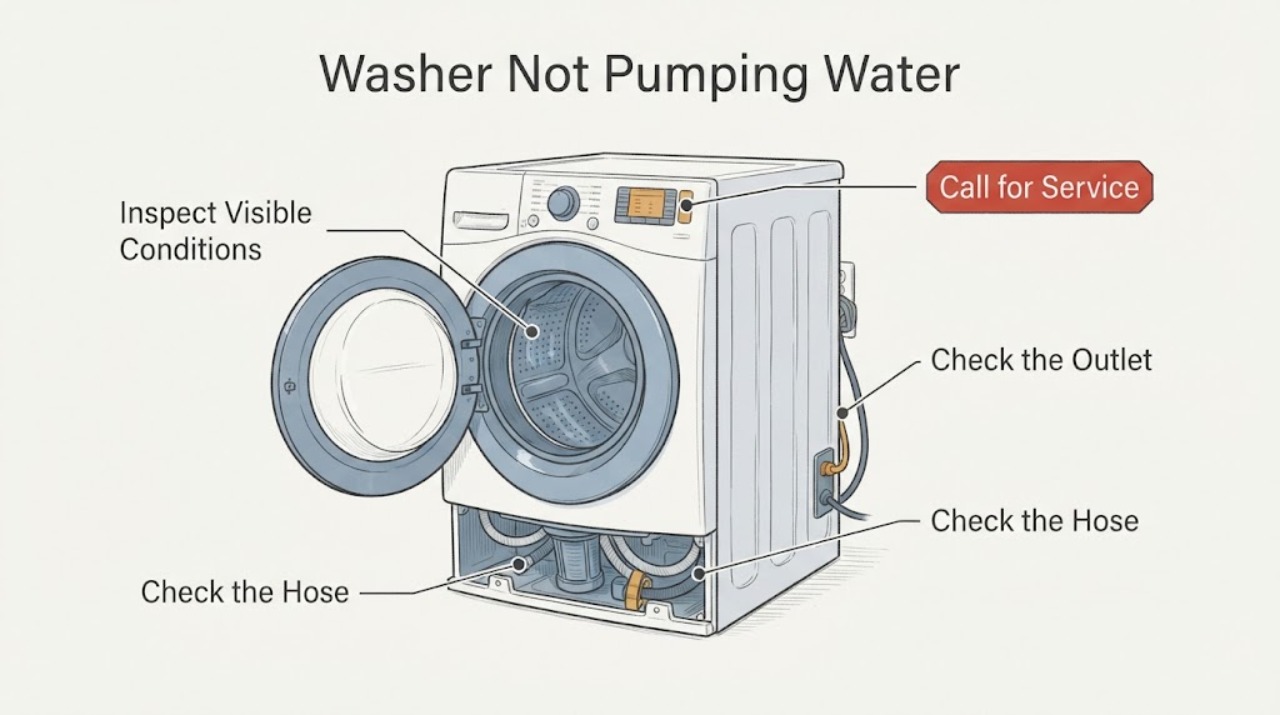
First identify whether the washer is failing to pump water out or is failing to fill with water. A tub that remains full after a drain or spin stage is a drain-path symptom; a tub that never receives water is a fill-path symptom and should not be diagnosed as a drain-pump failure. Stop the cycle, keep the washer out of normal use if water is standing or leaking, and isolate power only when the area and plug are dry and safe. Kenmore describes its washer drain pump as removing water during the drain portion of the cycle and says the washer must be unplugged before pump installation. With no model supplied, inspect only the accessible hose and controls, record the full model number, and use the model manual or qualified service path before opening the cabinet or ordering a pump.
Work through in order
Diagnostic checks
Use only checks that match the exact appliance or system and its official guide.
-
Check 1
Stop the cycle and observe the water state without opening the cabinet. Ask whether the washer had water entering but left water in the tub after drain/spin, or whether the washer never filled in the first place.
Expected result: Water remains in the tub after a drain-related stage, or the tub is empty because water never entered.
Next step: For standing water, keep the washer out of normal use and continue only with dry, accessible checks. For no fill, use the exact model manual’s fill checks instead of a drain-pump diagnosis.
Why this matters
Why: Water remaining after drain/spin is a drain-path symptom; no incoming water is a fill-path symptom. Kenmore’s drain-pump description applies to the drain stage and does not make a no-fill symptom a pump failure.
-
Check 2
If water is on the floor, near the outlet, or the washer has an electrical smell, stop using it and close accessible water supply valves if this can be done without reaching through water. Isolate power only from a dry, safe location; do not touch a wet plug or outlet.
Expected result: The floor/outlet is dry and the symptom is limited to water remaining in the tub, or there is a leak, wet electrical area or burning smell.
Next step: For any wet electrical area or burning smell, leave the washer off and arrange qualified appliance/electrical service. Do not repeatedly reset or run the machine.
Why this matters
Why: A dry standing-water symptom can be documented for service; water near electricity or a burning smell is a safety stop and is not a pump test.
-
Check 3
With the washer off and the area dry, inspect only the visible drain hose and its connection for a sharp kink, crushing, displacement or an obvious leak. Do not pull the hose out of a standpipe, pour water into it, or reach into the washer to test flow.
Expected result: The hose is visibly kinked/crushed/displaced, or it looks intact while the tub still remains full.
Next step: Correct only a loose external position without opening the machine. If the hose is intact or leaking, stop and use the exact model manual or service path; do not assume the pump is bad.
Why this matters
Why: Kenmore identifies the drain hose as a washer drain accessory with a shaped outlet connection; a visible hose problem can prevent the intended external drain path, but an intact hose does not identify the internal cause.
-
Check 4
Record when the water stops moving: immediately after filling, during drain, after spin, or only after a pause. Note whether the washer hums, displays a code, leaks, or leaves the tub completely full. Do not repeat a cycle merely to reproduce a dangerous noise, leak or electrical symptom.
Expected result: The symptom is repeatable only at drain, occurs with a code or leak, or is actually a no-fill condition.
Next step: Give the timeline and display wording to service. Keep the washer off if water, heat, odor or electrical risk is present.
Why this matters
Why: A drain-stage-only symptom narrows the service description to the drain path; a code or leak needs the exact model interpretation; no-fill remains a separate supply/fill issue. These observations do not prove a pump, control or motor failure.
-
Check 5
Read the complete model number and serial information from the washer label without removing panels. Tell Kenmore support or a qualified servicer the washer type, water state, cycle stage, visible hose condition, any code and whether the area is dry.
Expected result: The model is readable, or only a generic Kenmore washer identity is available.
Next step: Use the model number to obtain the correct manual and parts information. Arrange service if water remains, the hose is intact, the washer leaks, or internal pump access would be required.
Why this matters
Why: Kenmore’s manuals page requires the model number, and Kenmore lists distinct front-load and top-load families. Without the exact model, pump access, filter location, drain routing and part fit cannot be verified.
Use your observations
Decision map
Find the observation that best matches what you see, then follow the next safe action.
-
PATH 01Next step
What you see
If the washer never fills and the tub is empty
Do this next
Use the exact model manual for supply, inlet and control checks; do not order a drain pump for a no-fill symptom.
Why this path and its safety boundary
Why it matters: This is a fill-side symptom, not evidence that the drain pump is failing.
-
PATH 02Next step
What you see
If water remains after drain or spin and the visible hose is kinked, crushed or displaced
Do this next
Correct only the safe external hose position, then use the exact model instructions or service if the tub remains full.
Why this path and its safety boundary
Why it matters: The external drain path may be restricted or misrouted, but the hose observation does not prove an internal pump failure.
-
PATH 03Next step
What you see
If water remains after drain or spin while the hose looks intact
Do this next
Keep the washer off and arrange model-specific service; do not open the cabinet or test wiring by guesswork.
Why this path and its safety boundary
Why it matters: The available evidence cannot distinguish an obstruction, pump, control or other internal cause on an unknown Kenmore model.
-
PATH 04Next step
What you see
If there is water near the outlet, a leak, burning odor, or an unsafe electrical condition
Do this next
Stop use, avoid wet electrical contact and arrange qualified appliance/electrical service; do not reset or rerun the washer.
Why this path and its safety boundary
Why it matters: The immediate problem is a safety hazard, not a troubleshooting opportunity.
Helpful context
Understand the symptom
“Not pumping water” can describe two different failures
If water is left in the tub after a drain or spin stage, the useful question is whether water can leave through the external drain path. If the washer never fills, the symptom is on the fill side and a drain-pump article would send you to the wrong component. Kenmore’s drain-pump page describes the pump’s role only during draining; it does not establish one universal procedure for every Kenmore washer family.
Start with safe, visible checks
Do not keep restarting a washer with standing water, a leak, a hot electrical smell or a wet outlet. From outside the cabinet, note whether the drain hose is kinked, crushed or displaced, and whether the tub is full, partly empty or empty. Do not reach into the pump, remove a panel or probe wiring without the exact manual and appropriate service training.
Model identification controls the next step
Kenmore’s manual portal asks for the appliance model number and says manuals contain information about parts and accessories. Kenmore also lists front-load and top-load washer families separately. The model is therefore needed before choosing a drain-filter location, pump procedure or replacement part.
Do not turn a symptom into a pump diagnosis
A full tub can result from an obstruction, hose routing issue, a control or drive condition, or a pump problem; the available Kenmore public page confirms the pump’s role but does not verify which internal cause applies to an unknown washer. A washer that never fills belongs on a different branch. Use the exact manual and service route rather than replacing a pump by symptom alone.
Only after diagnosis
Potential parts
- washer drain pump
Consider only after the exact model manual or service diagnosis identifies the drain pump as the failed component.
Kenmore’s published pump page is for a specific part and does not establish fit for an unknown washer model. - washer drain hose
Consider only if the exact model or installation documentation confirms a damaged hose or required routing part.
Verify the full washer model and outlet arrangement before ordering; do not treat a generic hose listing as a diagnosis.
When checks do not resolve it
Need a professional?
Arrange Kenmore or qualified appliance service when water remains after a drain stage with no obvious external hose issue, the washer leaks, a code appears, the pump or wiring would need access, or any electrical hazard is present.
Have this ready
- Provide the full model and serial information, front/top-load type, whether the tub is full or empty, the cycle stage, visible hose condition, display wording, leak/odor history and confirmation that the work area is dry.
Common questions
FAQ
Does “not pumping water” mean the Kenmore drain pump is bad?
No. First separate a tub that stays full after drain/spin from a washer that never fills. Kenmore describes the pump’s role during the drain portion of a cycle, but a symptom alone does not identify the pump or establish a compatible part.
Can I check the drain hose myself?
You can inspect the visible hose for a kink, crushing, displacement or obvious leak when the washer is off and the area is dry. Do not pour water into the hose, reach into the washer or open panels; use the exact model manual or service if the hose looks intact and water remains.
Should I replace the pump before getting the model number?
No. Kenmore’s manual portal requires the model number for washer literature, and Kenmore sells multiple washer families. Identify the model and confirm the drain-stage symptom before considering any pump.
What if the washer is leaking while it will not pump?
Stop using it. Keep water away from the outlet and do not touch wet electrical components; close accessible supply valves only from a dry, safe position and arrange qualified service. Do not rerun the washer to test the leak.
Read the exact guide
Official sources
- Find Your Manual | Kenmore Appliance Manuals & GuidesKenmore · Opened Kenmore’s official manual portal. It requires a model number and states that manuals cover washers and parts/accessory information.
- Washers | Laundry | KenmoreKenmore · Opened Kenmore’s washer category page. It lists separate front-load and top-load washer families and example model labels, supporting the model-bounded branch.
- 6' Washing Machine Drain HoseKenmore · Opened the official Kenmore drain-hose page. It identifies a corrugated hose with a shaped end and compatible drain-outlet sizes; it does not establish a universal washer routing or internal diagnosis.
- Customer Care & Support | Kenmore AppliancesKenmore · Opened Kenmore Customer Care. It provides parts/literature and repairs/services paths for unresolved appliance problems.
- Washer Drain Pump Genuine Original Equipment Manufacturer (OEM) partKenmore · Opened the official Kenmore product page. It says the listed drain pump removes water during the drain portion of the cycle and says to unplug the washer before installing the part and wear work gloves. The part page does not establish fit for an unknown model.
Community feedback
Share a repair observation
Share a plain-text repair observation. Accepted observations are published automatically; this page may take a moment to update.