
On this page
Start here
Quick answer
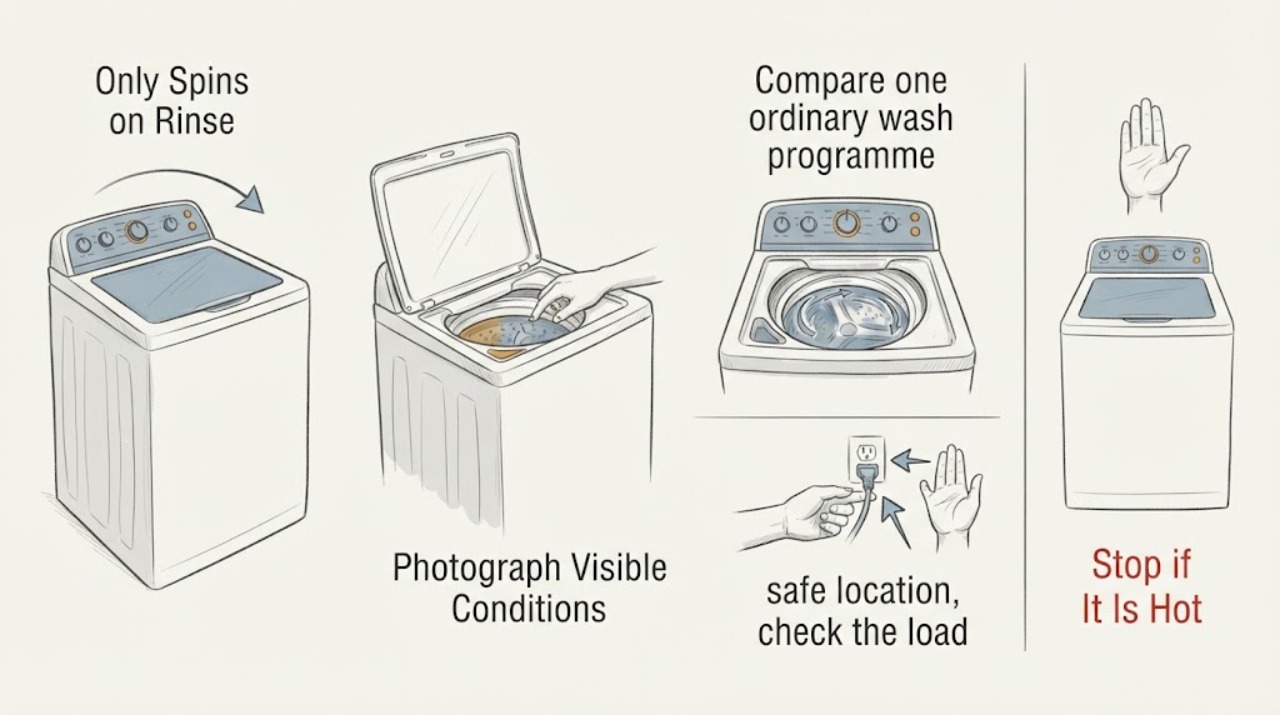
Treat F7E3, F7E0, F7E8, and F0E2 as four recorded diagnostic-history entries, not four confirmed current causes. In the exact 110.26132410 case, the washer drained and completed Rinse and Spin, while ordinary wash programmes failed to spin; the poster also reported that the individual service spin tests worked. That pattern makes the cycle-dependent decision or a condition detected during the ordinary wash worth investigating, but it does not prove a control panel, motor, shifter, clutch, or drain-pump failure. Confirm the full model from the rating label, retrieve the matching Kenmore manual, record which codes appear after the current failed cycle, and check water remaining, lid-lock state, load balance, and unusual noise without opening the cabinet. Do not import meanings for any of the four codes from a different Whirlpool or Kenmore platform.
Work through in order
Diagnostic checks
Use only checks that match the exact appliance or system and its official guide.
-
Check 1
Photograph the rating label and write the complete model exactly as printed, including punctuation or suffixes. After the next safe failed cycle, record whether the code is displayed at that moment or appears only in diagnostic history, and record the sequence of F7E3, F7E0, F7E8, and F0E2 separately.
Expected result: One code is current, all four appear only as stored history, a different code appears, or the model label does not exactly match 110.26132410.
Next step: Use only the matching model manual for the current code. If the codes are history-only, clear no records merely to hide them; document recurrence after the failed cycle and arrange diagnosis if the no-spin symptom continues.
Why this matters
Why: A current code is stronger evidence than an old history entry, while a different model or code set cannot use this topic's identity. The four codes in the reported case are not independently confirmed meanings for this platform.
-
Check 2
Compare one ordinary wash programme with Rinse and Spin only if the lid closes and locks normally, the washer is stable, and there is no leak or unsafe noise. Note whether the tub drains, whether it reaches spin, whether the lid remains locked, and whether clothes remain wet.
Expected result: Rinse and Spin completes at speed but an ordinary wash does not spin, both programmes fail, or the washer stops with water or a locked lid.
Next step: Stop repeated tests after one documented comparison. Arrange service with the programme, water state, lid state, and current code; do not remove the cabinet or reach into a moving basket.
Why this matters
Why: Rinse-and-Spin success supports a cycle-dependent branch but does not identify the failed sensor, control decision, or drive part. Failure in all cycles makes a broader drain, lid, drive, or mechanical diagnosis more likely, while retained water changes the safety priority.
-
Check 3
With the washer off and unplugged only from a dry, safe location, check the load for tight packing or a single heavy item, confirm the basket is not visibly jammed, and note unusual scraping, burning smell, or repeated clicking. Do not tip the washer or remove the washplate, belt, motor, or shifter.
Expected result: The load is tightly packed or unbalanced, the basket has visible mechanical resistance or abnormal noise, or the load and basket appear normal.
Next step: Redistribute one plainly unbalanced load only if the washer is otherwise safe. Stop for resistance, burning odor, smoke, or electrical symptoms and arrange qualified service rather than selecting a drive part.
Why this matters
Why: Load conditions can change whether a cycle reaches spin, while resistance or abnormal noise requires mechanical service. A normal visual check does not prove that any F7E code names a particular part.
-
Check 4
Check externally that both water faucets are open, hoses are not kinked, the drain hose is not visibly blocked or pushed into an unsafe position, and there is no standing water left after the failed cycle. Do not disconnect hoses or open a pump area while full or powered.
Expected result: Water remains, the drain path is visibly compromised, the lid stays locked, or the washer drains normally and the lid unlocks after power-down.
Next step: Close water valves and arrange service for retained water, a locked lid, a damaged hose, or recurring drain failure. Do not use a generic F7E meaning to bypass the lid or replace a pump.
Why this matters
Why: A drain or lid state can prevent a safe spin transition and can make a cycle appear to fail after washing; the reported case said it drained, but that observation must be rechecked on the current machine. External checks cannot prove a pump, lid switch, or control fault.
-
Check 5
Retrieve the official Kenmore manual by entering the model number without special characters, then give a technician the manual result, the current failed-cycle video or notes, the exact current code, and the fact that Rinse and Spin does or does not work. Do not run calibration or service tests from another model's sheet.
Expected result: The official search returns a matching manual, returns no exact match, or the current service result differs from the historical four-code set.
Next step: Use the matched document only, or ask Kenmore/qualified service to identify the exact platform before any diagnostic test. Have the provider reproduce an ordinary wash failure and compare it with Rinse and Spin.
Why this matters
Why: Kenmore's official portal uses the complete model number to select manuals; a missing match or different code set means the platform boundary is unresolved. A service-history code list is not a substitute for current reproduction.
Use your observations
Decision map
Find the observation that best matches what you see, then follow the next safe action.
-
PATH 01Next step
What you see
Rinse and Spin reaches speed and completes, but a normal wash drains and stops with wet clothes and no newly confirmed code.
Do this next
Provide the programme comparison and video to service and ask for reproduction under the ordinary cycle; do not replace a panel or motor based on this pattern alone.
Why this path and its safety boundary
Why it matters: The pattern is cycle-dependent. It makes a simple always-cannot-spin failure less likely, but it does not prove a control-panel or software cause and does not validate the historical four-code list as current.
-
PATH 02Next step
What you see
F7E3, F7E0, F7E8, or F0E2 reappears after the current failed cycle, rather than being present only in old history.
Do this next
Record the exact code, cycle, lid/water state, and load; use the matching 110.26132410 documentation or qualified service. Do not translate the code from another Whirlpool-family sheet.
Why this path and its safety boundary
Why it matters: A repeating current code is stronger evidence that the platform is detecting a repeat condition, but no opened official exact-platform table here assigns a verified meaning to any one of these codes.
-
PATH 03Next step
What you see
Water remains, the lid stays locked, the washer cannot drain, or a leak, burning smell, smoke, or abnormal mechanical noise accompanies the no-spin symptom.
Do this next
Stop use, close the water valves, and isolate power only from a dry safe location. Arrange qualified service; do not force the lid, reach into the basket, or open the cabinet.
Why this path and its safety boundary
Why it matters: The problem has moved beyond a cycle-selection comparison into a drain, lid-safety, water, electrical, or mechanical boundary.
-
PATH 04Next step
What you see
The four codes disappear after a reset or test, but the normal wash still fails to spin while Rinse and Spin works.
Do this next
Do not keep resetting or calibrating to suppress the record. Arrange diagnosis using the current programme comparison and the exact model manual.
Why this path and its safety boundary
Why it matters: Clearing history does not prove the fault is repaired. The current cycle-dependent behavior remains the primary symptom, and the old codes may be historical, test-related, or incomplete evidence.
-
PATH 05Next step
What you see
The official Kenmore search does not return a matching 110.26132410 manual, or the label differs from the assigned model.
Do this next
Stop model-specific troubleshooting and provide the rating-label photo to Kenmore or a qualified technician for identity confirmation before testing or ordering parts.
Why this path and its safety boundary
Why it matters: The platform identity is unresolved, so the four-code combination cannot safely be mapped to this topic.
Helpful context
Understand the symptom
What the four codes establish—and what they do not
For the exact 110.26132410 Reddit case, F7E3, F7E0, F7E8, and F0E2 were read from service diagnostic history after the washer would not spin at the end of ordinary wash cycles. The source does not provide a verified, model-matched code table. Therefore: F7E3 is a recorded history entry, not a confirmed current F7E3 fault; F7E0 is a recorded history entry, not a confirmed current F7E0 fault; F7E8 is a recorded history entry, not a confirmed current F7E8 fault; and F0E2 is a recorded history entry, not a confirmed current F0E2 fault. A code seen only in history may describe an earlier condition, a test interruption, or a symptom that has changed.
Why Rinse and Spin working is a meaningful branch
The exact report says Rinse and Spin reached full speed and completed, while several wash cycles drained for longer than usual and stopped with wet clothes. The poster also reported that slow, medium, and fast service spin tests worked. That separates a cycle-dependent failure from a simple claim that the basket can never spin, but it does not prove the motor drive is healthy under every load or that the control panel is the cause. Use the distinction to document the current state and decide what a technician must reproduce.
Do not turn a historical code list into a parts list
Without a matching official code table and a current failed-cycle observation, selecting a control panel, shifter, motor, clutch, drain pump, lid-lock part, or wiring harness is guesswork. The Kenmore manual portal directs owners to search by the complete model number, so the correct next document is the manual or service information for 110.26132410, not a generic code page for another top-loader. A technician should reproduce the ordinary-cycle failure and compare it with Rinse and Spin before naming a component.
Only after diagnosis
Potential parts
- washer drive, shifter, motor, or control component
This category is conditional only after a technician reproduces the normal-cycle failure and confirms the affected circuit or mechanism; the four historical codes and cycle symptom do not select one part.
Confirm the complete 110.26132410 model and the exact service documentation before considering any component. Do not use a generic Whirlpool-family code table or substitute a part by visual similarity.
When checks do not resolve it
Need a professional?
Call when one documented programme comparison does not resolve the problem, any of the four codes returns after the current failure, the lid remains locked, water remains, all cycles fail to spin, or the washer has smoke, burning odor, leaks, sparks, or repeated breaker trips.
Have this ready
- Provide the complete rating-label model, exact code spelling and whether each code is current or historical, the ordinary-cycle versus Rinse-and-Spin result, water and lid state, load type, unusual noises, and any video or prior calibration/reset history.
Common questions
FAQ
Do F7E3, F7E0, F7E8, and F0E2 identify four failed parts?
No. In the exact report they were read from diagnostic history. No opened official exact-platform table here confirms a separate meaning for each code, so do not turn the list into a parts list.
Why can Rinse and Spin work when a normal wash will not spin?
It shows that the washer can reach spin under at least one programme condition, making a cycle-dependent failure worth investigating. It does not prove the motor, shifter, control, or panel is good or bad under every load and sequence.
Should I run service calibration until the codes disappear?
Do not use a test or calibration procedure from another model, and do not treat cleared history as a repair. Record whether a current failed cycle reproduces the symptom and use the exact 110.26132410 documentation or qualified service.
Read the exact guide
Official sources
- Find Your Manual | Kenmore Appliance Manuals & GuidesKenmore · Opened official Kenmore manual portal for the exact model and the reported F7E3/F7E0/F7E8/F0E2 set. It requires entering the complete model number without special characters and says Kenmore model numbers are at least 11 characters; the portal is the correct identity boundary, but the opened page does not define any of those codes or display an exact code table for this model.
- Kenmore 600 series Washer 110.26132410 will only spin on "rinse and spin" cycleReddit r/appliancerepair · Opened exact Reddit post for the model, current cycle behavior, historical code list, and reported service-test observations. It is not an official code table and does not prove the poster's suspected control-panel cause.
Community feedback
Share a repair observation
Share a plain-text repair observation. Accepted observations are published automatically; this page may take a moment to update.