
On this page
Start here
Quick answer
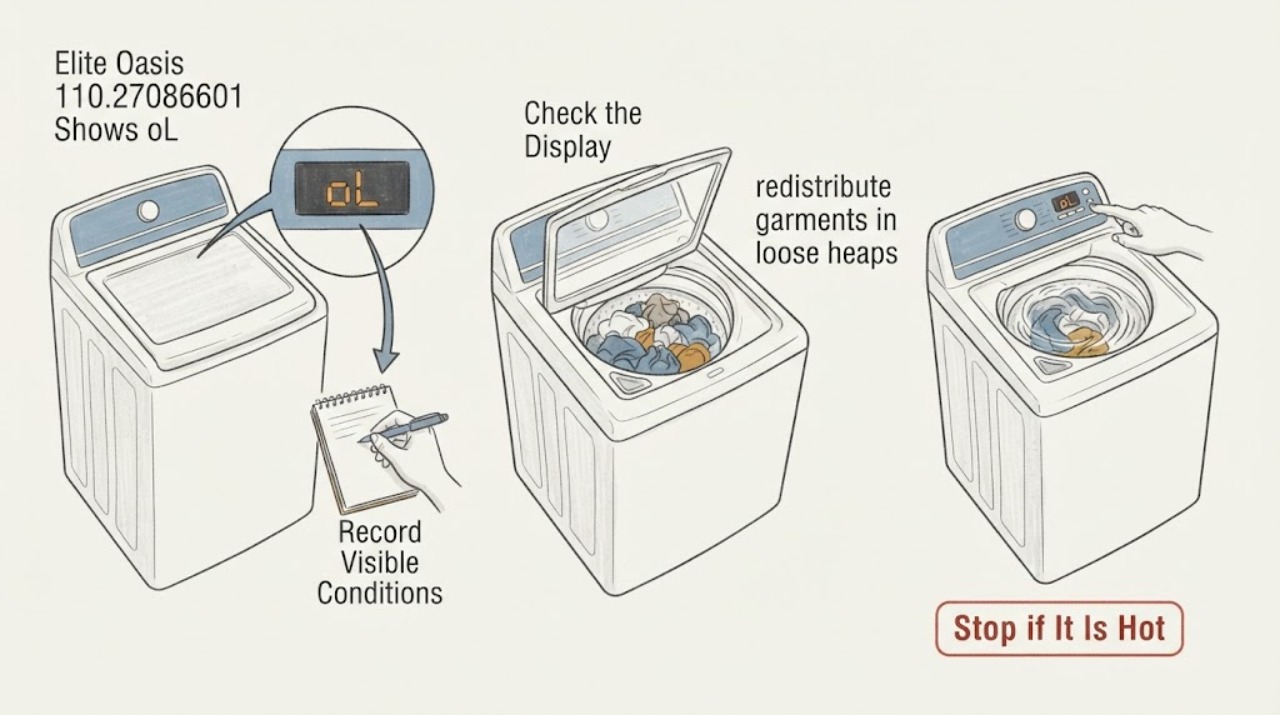
On the Kenmore Elite Oasis washer identified as 110.27086601, oL means Over Load in the opened Whirlpool top-load guidance used for this Oasis platform—not the same as uL, which means an unbalanced load. The washer may drain and refuse or reduce spin when the load is too large or packed poorly. Cancel the cycle, let a drain-only step finish if water remains, redistribute or remove items, close the lid, and retry; use Drain & Spin only after the load is rearranged. Compare Normal, Rinse/Drain & Spin, and Express with a dry, moderate load, and note whether oL appears before spin, only on one programme, or even with an empty basket. If oL persists with a small balanced load, the basket is hard to turn by hand with power isolated, the washer cannot drain, or it bangs, leaks, or trips protection, stop repeated cycles and arrange qualified service. Do not add water to test, reach into a moving basket, force the lid, run the machine with a bypassed lid lock, or replace a control, motor, sensor, or bearing from oL alone.
Work through in order
Diagnostic checks
Use only checks that match the exact appliance or system and its official guide.
-
Check 1
From a safe position, record the rating label as Kenmore Elite Oasis 110.27086601, the exact display formatting (oL, uL, Ld, or another code), the programme, whether water remains, and whether the lid is locked. Do not reach into the basket or start another cycle while the lid or tub is moving.
Expected result: The display clearly shows oL, shows uL or Ld instead, flashes without a code, or the model/code cannot be read reliably.
Next step: Photograph the display and label, then use the matching code branch. If the code remains uncertain, stop repeated testing and obtain the exact Kenmore manual or qualified service.
Stop if: Do not force the lid, bypass the lid lock, or continue operation with a leak, exposed wiring, smoke, burning odor, or repeated breaker trip.
Why this matters
Why: oL directs the first check to overload; uL directs it to balance; Ld or standing water directs attention to drainage. A different or unreadable code cannot be safely interpreted as oL.
-
Check 2
When oL is present and no safety hazard exists, cancel the cycle using the normal control. If water remains, allow or select a drain-only step as the manual permits. Wait until the basket stops and the lid unlocks before removing several items; do not add water or detergent to test the overload response.
Expected result: The washer drains, oL clears, and the lid unlocks; water remains after the drain step; or oL returns before a new spin can begin.
Next step: Use a smaller, loose load for one controlled comparison. If the washer cannot drain or oL returns without a meaningful load, leave it off and arrange service.
Stop if: Do not open the lid against the lock, scoop water while the basket moves, or run with a disconnected or defeated lid-lock system.
Why this matters
Why: A completed drain followed by a cleared code supports the documented overload path. Water that does not leave or a code that returns with an emptying load keeps drainage or a platform fault in scope.
-
Check 3
With the lid open and the washer stopped, redistribute garments in loose heaps around the washplate and remove enough items to make a moderate load. Keep dry items at or below the basket's documented loading limit; avoid a single bulky item unless the exact manual provides a suitable cycle.
Expected result: The load was tightly packed, mostly one bulky item, wet items were added after filling, or the load was already small and evenly distributed.
Next step: Close the lid and press START/PAUSE for one comparison. If oL clears, use balanced smaller loads; if it remains with a small load, proceed to the programme comparison and service boundary.
Stop if: Do not press down on the lid, hold the lid switch, reach into a moving basket, or keep adding water to force a test.
Why this matters
Why: Packing, size, and added wet weight can trigger overload or imbalance protection and reduce spin. A small balanced load that still produces oL is not explained by simply removing more laundry.
-
Check 4
Using the same moderate, balanced dry load, compare only the programmes named in the task: Normal, Rinse/Drain & Spin, and Express. Observe at which stage the basket begins or fails to accelerate, whether water drains first, whether the display shows oL, and whether the lid remains locked normally.
Expected result: All programmes spin after load correction, only Normal or Express produces oL, Rinse/Drain & Spin also fails, or the basket never accelerates despite a drained balanced load.
Next step: Record the stage and code rather than buying a part. For repeated cross-programme failure, stop using the washer and arrange qualified Kenmore appliance service.
Stop if: Do not run a high-speed spin with loose items, an unstable cabinet, loud banging, leaking water, or a lid-lock fault.
Why this matters
Why: A load- or programme-specific result supports a selection/load interaction; failure across programmes with the same balanced load shifts concern to drain sensing, lid/drive control, mechanical resistance, or another fault that oL cannot identify.
-
Check 5
After the washer is disconnected from power from a dry, safe location and the basket is empty, observe only whether the basket turns freely by gentle hand movement without forcing it. Inspect the visible floor, hoses, and cabinet for a leak, severe rocking, or damage; do not remove panels or reach under the machine.
Expected result: The basket turns smoothly, feels tight or catches, the cabinet rocks or leaks, or the empty basket still triggers oL/no-spin on the next safe control observation.
Next step: Keep the washer off for tight movement, leak, persistent oL, or repeated no-spin. Give service the programme comparison, water state, code formatting, and hand-movement result; do not name a replacement part from these observations.
Stop if: Do not force the basket, tip the washer, remove the rotor or cabinet, probe live circuits, or continue if water is near electrical parts.
Why this matters
Why: Smooth empty movement makes a load or control-state explanation more plausible but does not prove the drive system is healthy. Tight movement, leak, or empty-basket failure makes an internal mechanical, drain, sensing, or control fault possible.
Use your observations
Decision map
Find the observation that best matches what you see, then follow the next safe action.
-
PATH 01Next step
What you see
oL appears with a tightly packed or oversized load, the washer drains, and the code clears after items are removed or redistributed.
Do this next
Use smaller loose loads and the documented programme for bulky items. Stop if oL returns with a genuinely moderate balanced load.
Why this path and its safety boundary
Why it matters: This matches the official Over Load path; a reduced or delayed spin is a load-protection response, not proof of a failed motor.
-
PATH 02Next step
What you see
The display is uL rather than oL, or the washer shakes and stops during the balance-correction routine.
Do this next
Wait for motion to stop, redistribute the load evenly, close the lid, and press START. Persistent uL with a suitable load needs service.
Why this path and its safety boundary
Why it matters: uL is the separate Unbalanced Load branch in the Oasis-family manual; adding or removing items should be guided by balance, not by treating the code as overload.
-
PATH 03Next step
What you see
oL returns with a small balanced load, appears in Normal, Rinse/Drain & Spin, and Express, or the empty basket is tight and will not turn freely.
Do this next
Leave the washer off and arrange qualified service with the exact model, code, programme stage, water state, and basket observation. Do not run diagnostic cycles or order a control, motor, bearing, or pump from oL alone.
Why this path and its safety boundary
Why it matters: The load-only explanation is not supported. Drain sensing, lid/drive control, mechanical resistance, or another platform fault is possible, but oL does not select a specific component.
-
PATH 04Next step
What you see
Water remains, the washer shows Ld or another drain code, or it cannot complete drain before the no-spin complaint.
Do this next
Keep hands out of standing water, perform only the exact manual's safe external hose check, and arrange appliance or plumbing service for a blocked or inaccessible drain.
Why this path and its safety boundary
Why it matters: A drainage condition can prevent a normal spin and should not be collapsed into oL; the Oasis-family manual treats Ld as a separate long-drain path.
-
PATH 05Next step
What you see
There is a leak, severe banging or walking, a lid-lock fault, water near electrical parts, smoke, burning odor, sparks, or repeated breaker trips.
Do this next
Stop use, close water valves if safely reachable, isolate power only from a dry safe location, and obtain qualified appliance, plumbing, or electrical help. Do not bypass the lid lock or restart to test.
Why this path and its safety boundary
Why it matters: The washer has crossed a water, mechanical, fire, or electrical safety boundary; further load testing is unsafe.
Helpful context
Understand the symptom
First read the display carefully. In the opened Oasis-family owner's manual, oL is Over Load, while uL is Unbalanced Load. Whirlpool's current oL guidance likewise says the load is too large when oL appears and directs the owner to cancel, drain if needed, reduce or rearrange the load, and restart. Do not treat oL as a part number or as proof that the motor or bearing has failed.
The exact model identity still matters. Kenmore's official manual finder asks for the complete model number; the task supplies 110.27086601, while the opened Whirlpool material is a platform-scoped reference for this Oasis design. Use the exact Kenmore document when it is available before attempting any model-specific service procedure.
A useful independent decision is whether the problem follows the load or follows the machine. If a dry, moderate, balanced load completes Rinse/Drain & Spin but Normal or Express produces oL, document that programme difference. If the empty basket also will not spin, drains poorly, or feels mechanically tight, stop treating it as an overload and arrange service.
When checks do not resolve it
Need a professional?
Arrange qualified Kenmore appliance service when oL persists with a small balanced load, the empty basket is tight, all named programmes fail to spin, drainage remains incomplete, the lid-lock behavior is abnormal, or the code returns after load correction. Stop immediately for leaking water near electrical parts, severe banging or walking, smoke, burning odor, sparks, damaged wiring, or repeated breaker trips. Do not bypass the lid lock, tip or open the washer, run a forced diagnostic, or select a motor, pump, bearing, sensor, or control part from oL alone.
Common questions
FAQ
What does oL mean on the Kenmore Elite Oasis 110.27086601?
In the opened Oasis-family manual and Whirlpool's official top-load guidance, oL means Over Load. It is distinct from uL, Unbalanced Load. Cancel, drain if needed, reduce or redistribute the load, close the lid, and retry; persistent oL with a small balanced load needs service.
Why will Rinse/Drain & Spin work but Normal or Express will not?
That programme difference is useful evidence, not a part diagnosis. Compare the same moderate balanced dry load and note when the code appears and whether water drains first. If only one load or programme triggers oL, correct the load/programme choice; if every programme fails, arrange service.
Should I replace the control board or motor when oL appears with an empty basket?
No. An empty-basket oL or no-spin result means the official overload correction did not explain the symptom, but it does not identify a control, motor, bearing, drain, or sensing part. Leave the washer off and provide the exact code, programme comparison, drainage result, and hand-movement observation to qualified service.
Read the exact guide
Official sources
- Top-Load Washer Owner's Manual W10026592Whirlpool · Whirlpool official Oasis-family top-load washer owner's manual used as a platform-scoped reference for Kenmore Elite Oasis 110 27086601; exact Kenmore revision should be confirmed by the model label and Kenmore manual finder.
- Find Your Manual | Kenmore Appliance Manuals & GuidesKenmore · Kenmore official manual finder and model-documentation route for the assigned Kenmore 110 27086601 Oasis washer; the page requires the complete model number and does not itself establish a code or part diagnosis.
- oL - Error Code - Product HelpWhirlpool · Whirlpool official top-load washer oL overload guidance used as a scoped Oasis-platform code reference for the assigned Kenmore 110 27086601; it is not a blanket Kenmore revision or part cross-reference.
Community feedback
Share a repair observation
Share a plain-text repair observation. Accepted observations are published automatically; this page may take a moment to update.