
On this page
Start here
Quick answer
Stop using the Kenmore 11025842400 while its lid-switch safety circuit is bypassed or its original condition is unknown. Leave it disconnected in a dry, safe area and do not try to restore operation by bridging, testing, or repeatedly resetting the circuit. First record the full model number, then have a qualified appliance technician restore and verify the original lid safety system. Only after that should the household outlet, breaker, visible cord condition, and the washer's blank-console symptom be separated; a live outlet with a blank console or any heat, burning odor, water near electrics, cord damage, or repeat breaker trip needs service rather than more testing.
Before you begin
Safety first
- Do not operate the Kenmore 11025842400 with a bypassed or unverified lid-switch safety system. Do not bridge or jump the circuit, open the cabinet, perform live measurements, or continue testing after smoke, burning odor, arcing, heat, water near electrics, cord damage, or a repeat trip.
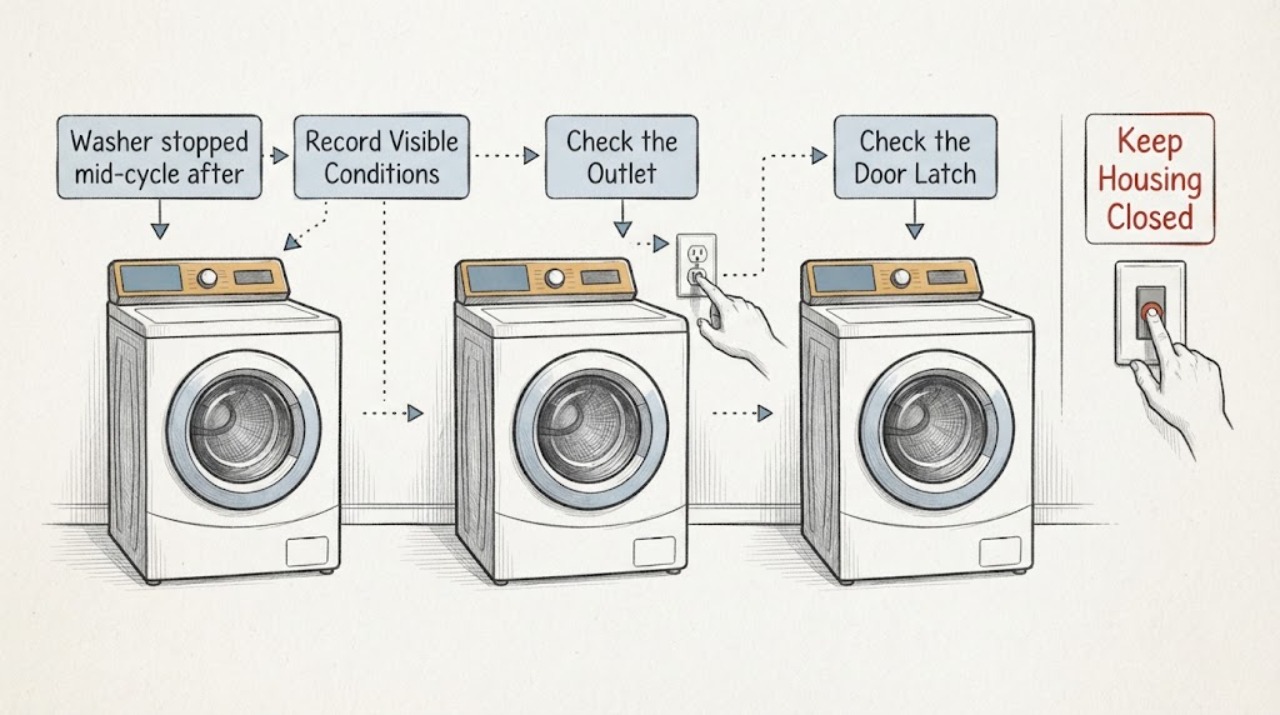
Work through in order
Diagnostic checks
Use only checks that match the exact appliance or system and its official guide.
-
Check 1
Stop using this washer while the lid-switch circuit is bypassed or its original condition is unknown. Leave it disconnected from power at a dry, safe plug area, and record the full model number 11025842400 plus what was changed, if known. Do not reconnect the washer to see whether the bypass still works.
Expected result: A bridge, wire alteration, foreign part, missing switch hardware, or an unknown change is still present; or the lid safety system cannot be shown to be factory-intact.
Next step: Keep the washer out of service and have a qualified appliance technician restore the original lid safety system and inspect the altered wiring before any power-path diagnosis.
Why this matters
Why: The washer's safety chain has not been verified. A mid-cycle stop after long-term bypass use cannot safely be narrowed to a household power issue, a lid mechanism, overheating, or control damage by restarting it.
-
Check 2
With the washer still disconnected and the area dry, inspect the intended wall outlet and the household breaker or fuse position. If it is safe, use a known-good small appliance in that same outlet; do not repeatedly reset a breaker and do not open the outlet or measure live wiring.
Expected result: The outlet is dead, the breaker or fuse is open, the outlet works but the washer remains blank, or the breaker trips again.
Next step: Leave a dead circuit or repeat trip to qualified electrical or appliance service. If the outlet is live, report that result to the appliance technician after the lid safety system has been restored; do not open the washer.
Why this matters
Why: A dead outlet or open protective device can explain a blank console, while a live outlet with a blank washer points back to the cord, appliance power path, control, or damage associated with the prior alteration. A repeat trip is an electrical-fault warning, not a reason to keep resetting.
-
Check 3
Only with power disconnected at a dry, safe plug area, inspect the visible lid edge, lid strike or latch area, and nearby exterior for a crack, missing piece, obstruction, looseness, moisture, or heat discoloration. Close the lid normally if it is safe to do so; do not force it, remove the cabinet, or reach into the switch area.
Expected result: The lid or strike area is damaged, misaligned, wet, loose, obstructed, or visibly altered; or it appears intact but the original interlock cannot be verified.
Next step: Do not operate the washer with a damaged or unverified interlock. Give the technician the visible findings and ask for model-specific restoration rather than a substitute bridge or guessed switch.
Why this matters
Why: A visible lid-side problem can prevent the washer from recognizing a safe closed condition, but an intact exterior does not prove that the bypassed internal safety circuit is correct.
-
Check 4
Without reconnecting or restarting the washer, write down what happened immediately before the mid-cycle stop: water left in the tub, drain or motor sound, a click, a blank or flashing console, heat, burning odor, smoke, a damaged cord, a leak, or a breaker event.
Expected result: There was only a silent blank console; or there was water, unusual sound, heat, odor, smoke, visible electrical damage, a leak near electrics, or a protective-device trip.
Next step: Keep the washer disconnected for any heat, odor, smoke, arcing, water near electrical parts, cord damage, abnormal noise, or repeat trip. Provide the complete time line to qualified service instead of trying to reproduce the stop.
Why this matters
Why: The time line helps the technician separate external power loss from a lid-safety interruption and from possible overheating, moisture, mechanical, or electrical damage. The bypass history is a risk factor and does not by itself identify a failed part.
-
Check 5
After a qualified person has confirmed that the original lid safety system is restored, all altered wiring is corrected, and the cabinet is secure, use the exact Kenmore manual's normal start sequence for one supervised test only. Do not run a test while the interlock is bypassed or while panels or covers are not secured.
Expected result: The console remains blank, the washer stops again, the lid does not secure, a code appears, or the first supervised cycle completes without an unsafe symptom.
Next step: For any blank console, repeat stop, failed lid engagement, code, heat, odor, leak, or trip, stop and arrange service. Continue normal use only if the safety system has been verified and the technician's repair check is satisfactory.
Why this matters
Why: A restored safety system plus a live outlet still leaves a blank console or repeat stop as an appliance fault requiring model-specific diagnosis. A completed supervised cycle is only evidence that the immediate symptom did not recur; it does not validate the old bypass.
Use your observations
Decision map
Find the observation that best matches what you see, then follow the next safe action.
-
PATH 01Next step
What you see
The lid-switch bypass is still present, its wiring is altered, or nobody can verify that the original safety system was restored.
Do this next
Keep it disconnected and arrange qualified appliance service to restore and verify the model-specific lid safety system. Do not bridge the circuit again or ask for a live test.
Why this path and its safety boundary
Why it matters: This is a safety-restoration problem before it is a no-power diagnosis; the washer must not be treated as ready for another cycle.
-
PATH 02Next step
What you see
The outlet is dead, a breaker or fuse is open, or the protective device trips again.
Do this next
Leave the circuit and washer disconnected and have qualified electrical or appliance service assess the power path. Do not open the outlet or washer.
Why this path and its safety boundary
Why it matters: The external electrical path may be the immediate reason for the blank console, and a repeat trip indicates a fault that cannot be safely isolated by repeated resets.
-
PATH 03Next step
What you see
The outlet is live and the cord is visibly dry and intact, but the console stays blank after the original lid safety system is restored.
Do this next
Stop consumer testing and give the full model, the bypass timeline, outlet result, and pre-stop observations to a qualified appliance technician. Do not open the cabinet or test live wiring.
Why this path and its safety boundary
Why it matters: The symptom is now more consistent with an appliance-side power, control, or damage assessment than with a simple outlet check; the long-term bypass remains relevant repair history.
-
PATH 04Next step
What you see
There was smoke, a burning smell, abnormal heat, arcing, water near electrical parts, cord damage, a leak, or abnormal mechanical sound before the stop.
Do this next
Keep away from wet or energized equipment, leave the washer disconnected only if that can be done without contact with a hazard, and obtain qualified or emergency help as appropriate. Do not attempt another cycle.
Why this path and its safety boundary
Why it matters: The incident may involve damage beyond the lid circuit, and reconnecting the washer could increase shock or fire risk.
-
PATH 05Next step
What you see
The lid safety system has been professionally restored, the outlet is sound, the cord is visibly intact, and one supervised normal test completes without a warning sign.
Do this next
Resume use only within the exact model manual's normal operation. Stop and arrange service if the washer again stops, loses its display, fails to secure the lid, shows a code, or develops heat, odor, leak, or unusual noise.
Why this path and its safety boundary
Why it matters: The immediate no-start symptom did not recur under a verified safety configuration, but this does not prove that the prior bypass caused or cured the fault.
Helpful context
Understand the symptom
What changes in this case
The important fact is not only that the washer stopped mid-cycle. It had been operated for months with the lid-switch protection bypassed, so the safety system and any wiring changes must be resolved before a blank console is treated as an ordinary no-start complaint. The exact Kenmore model number is 11025842400; use that number when requesting the model manual or service.
Do not make the bypass the test
Top-load washer lid locking is intended to prevent access while the tub moves at high speed, and manufacturer guidance notes that operation varies by model. Do not bridge the switch again, run the washer with the protection defeated, open the cabinet to trace wires, or use live measurements to decide whether the washer is safe.
When checks do not resolve it
Need a professional?
Call qualified appliance service before reuse whenever the bypass remains or its restoration is uncertain; call sooner for a blank console with a live outlet, a failed lid engagement, repeat stopping, a returning code, or any electrical, moisture, heat, odor, smoke, or mechanical warning.
Safety scope: Do not operate the Kenmore 11025842400 with a bypassed or unverified lid-switch safety system. Do not bridge or jump the circuit, open the cabinet, perform live measurements, or continue testing after smoke, burning odor, arcing, heat, water near electrics, cord damage, or a repeat trip.
Have this ready
- Provide the exact model 11025842400, the full bypass and repair timeline, whether the outlet was live, the breaker or fuse result, the console state, lid-side observations, water or drain status, and every sound, odor, heat, leak, or code seen before the stop.
Common questions
FAQ
Can I reconnect it briefly to see whether it powers up?
Not while the lid-switch bypass remains or its restoration is uncertain. Restore and verify the original safety system first; then let qualified service decide whether a supervised test is appropriate.
Does a blank console prove the lid switch caused the failure?
No. A blank console can also involve the outlet, breaker, cord, appliance power path, control, or damage. The bypass history changes the safety boundary, but it does not identify a failed part.
What model information should service use?
Use the complete model number 11025842400 exactly as shown on the appliance. Kenmore's manuals page says to enter the exact model number to locate the applicable appliance manual; do not substitute a nearby model or a generic wiring diagram.
Read the exact guide
Official sources
- Lid Locking on a Top Load High Efficiency WasherMaytag · Manufacturer safety context for top-load washer lid locking only. The page explicitly says features and operation vary by model, so it is not used to assign Kenmore parts, codes, or internal wiring.
- Find Your Manual | Kenmore Appliance Manuals & GuidesKenmore · The opened Kenmore page instructs users to enter the exact model number, at least 11 characters and without special characters, to retrieve the applicable washer manual. It is an identity and manual lookup page, not a model-specific wiring or fault-code document.
Community feedback
Share a repair observation
Share a plain-text repair observation. Accepted observations are published automatically; this page may take a moment to update.