
On this page
Start here
Quick answer
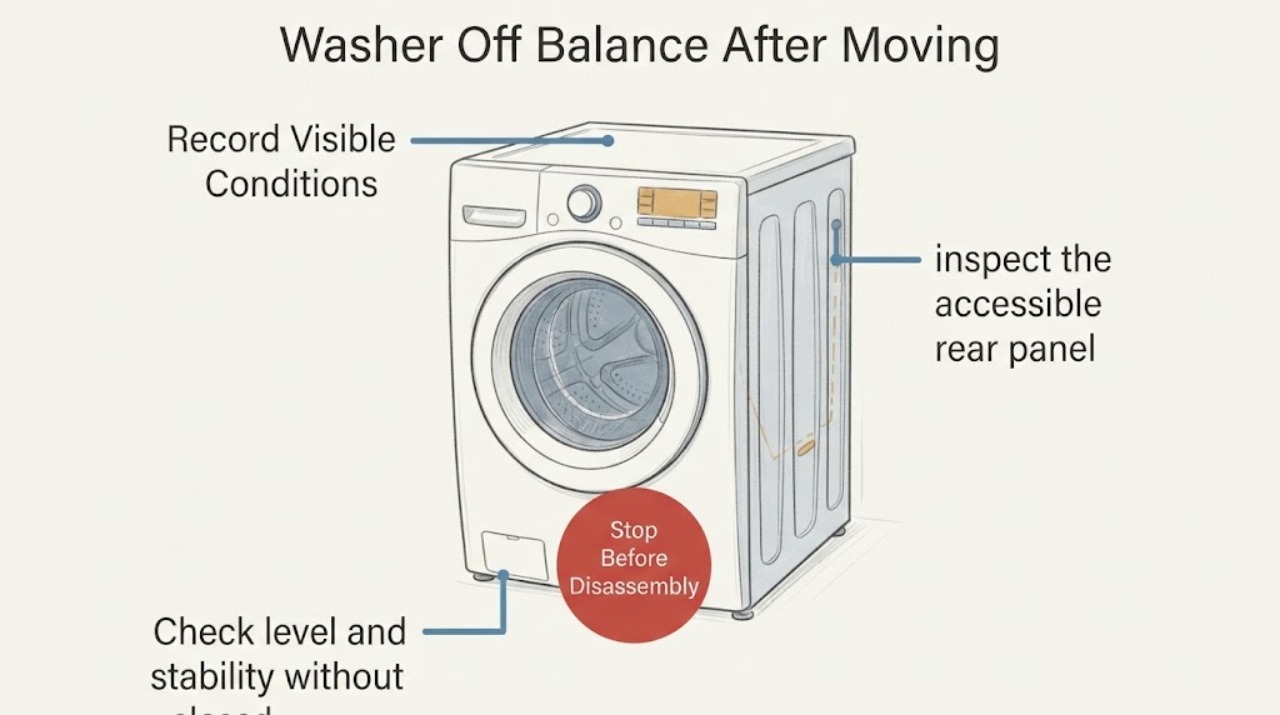
Treat a Kenmore HE3T that becomes off balance after moving as an installation and transport problem until the setup is verified—not as proof that a shock, spring, basket, or other part needs replacement. HE3T is a series, so find the complete model number before using a manual or service procedure. With the washer upright, empty, and safe to inspect, confirm that the transport system was handled for the move, that the washer is level with all four feet firmly on a solid floor, and that the drum is not being tested with one heavy or tightly packed load. Official front-load guidance warns that shipping bolts left in place cause excessive vibration, that the washer should be transported upright, and that all feet must contact the floor. If the machine still bangs, walks, scrapes, shows a sagging or displaced drum, or becomes unsafe with a normal load after the external setup checks, stop using it and arrange qualified service. Do not tip the washer, open the cabinet, remove the tub, or guess a damper or suspension part.
Work through in order
Diagnostic checks
Use only checks that match the exact appliance or system and its official guide.
-
Check 1
Read the complete model and serial label from the door opening, rear, or other accessible label area without moving the washer. Record whether the machine is a front-loader, the exact model suffix, when it was moved, whether it was transported upright, and whether transport hardware was reinstalled for the move.
Expected result: Only HE3T is known, a complete model number is available, the washer was moved on its side or without documented transport preparation, or the move was upright with transport preparation documented.
Next step: Use the full model number to obtain the matching instructions. If the transport history is unknown, do not improvise bolt installation or tip the washer; give that history to service. Continue only with upright, external checks.
Why this matters
Why: HE3T is a series and does not by itself establish one manual, suspension configuration, or part fit. A move without the model's transport procedure raises the need to inspect for installation or transport damage, but it does not identify a failed component.
-
Check 2
From a safe upright position, inspect the accessible rear panel for transport bolts or other transport hardware, without removing panels, tipping the washer, or loosening a bolt that might support the cabinet. Compare what is visible with the exact model manual; do not operate the washer if bolts are visibly still installed or the rear panel is damaged.
Expected result: Transport bolts appear to remain installed, the hardware was removed but the washer was moved without reinstallation, the rear panel is bent or damaged, or the rear setup looks normal for the documented model.
Next step: If bolt status is wrong or the rear panel was damaged, stop using the washer and have qualified service verify the transport system and suspension. Do not remove or install transport hardware by reaching into the cabinet or moving the machine alone.
Why this matters
Why: Official front-load guidance says transport bolts stabilize the suspension during transportation and that bolts left in place can cause excessive vibration. Neither observation proves a particular spring or damper failed.
-
Check 3
Check level and stability without sliding the washer: place a level side-to-side and front-to-back if the top surface is safe to reach, then gently rock the cabinet diagonally from the top. All four feet should remain firmly on the solid floor, and the foot lock nuts should be tight against the cabinet; do not place the washer on a flexible or carpeted surface.
Expected result: The cabinet rocks, one foot is not carrying weight, the floor flexes or slopes, a lock nut is loose, or the cabinet is stable and level.
Next step: If the floor is dry and the washer can remain safely connected, use only the exact model's leveling procedure; do not lift, tip, or shim improvised materials under the machine. If it cannot be leveled without moving it or the floor is unsuitable, arrange installation or appliance service.
Why this matters
Why: An uneven floor, a foot that shifted during the move, or loose locking hardware can make a normal spin load appear to have a suspension fault. A stable level cabinet makes installation less likely but does not rule out internal movement damage.
-
Check 4
With the drum stopped, inspect the load and the surrounding clearance before one brief, supervised test permitted by the model instructions. Avoid a single dense bulky item or a tightly packed drum, distribute washable items loosely, and make sure the washer is not touching a wall or another appliance after the move.
Expected result: The problem occurs only with one blanket or other bulky item, a small uneven load, an overloaded drum, or it occurs with a normal mixed load after the washer is level and clear of obstacles.
Next step: If the issue is load-specific, stop the test and follow the matching load guidance rather than repeatedly spinning it. If it persists with a normal load, stop using the washer and record the sound, movement, and cycle stage for service.
Why this matters
Why: Whirlpool describes single, bulky, or uneven loads as causes of movement. A repeatable event with a suitable load and correct installation is more concerning for a mechanical or suspension issue, but the observation still does not select a part.
-
Check 5
Document the post-move behavior from a safe distance: whether vibration begins at distribution or high-speed spin, whether the cabinet walks, whether the drum appears off-center or rubs, whether there is scraping or banging, and whether hoses, the cord, or floor show strain or leakage. Do not repeat cycles to amplify the symptom.
Expected result: The washer is stable after setup, the symptom returns only at high spin, the drum or cabinet appears displaced, or there is violent movement, a leak, damaged wiring, smoke, or a burning smell.
Next step: For persistent or unsafe behavior, keep the washer off, close water valves if appropriate, isolate power from a dry safe location, and arrange qualified appliance service. Do not tip the machine, open the cabinet, remove the tub, or guess at shocks, springs, bearings, or counterweights.
Why this matters
Why: A stable result after correcting transport, level, or load supports an installation or load explanation. Persistent high-spin movement after those checks, visible displacement, or a safety symptom needs a professional inspection for possible internal or structural damage.
Use your observations
Decision map
Find the observation that best matches what you see, then follow the next safe action.
-
PATH 01Next step
What you see
The complete model is unknown, or transport-bolt status and the direction of the move cannot be confirmed.
Do this next
Photograph the rating label and have service or the exact manual establish the transport procedure. Keep the washer upright and do not tip it or start repeated spin tests.
Why this path and its safety boundary
Why it matters: The HE3T label is not enough to choose a model-specific procedure or part, and the unresolved transport history keeps installation and possible move damage in consideration.
-
PATH 02Next step
What you see
Transport hardware is visibly still installed, the rear panel is damaged, or the washer was moved without the model's transport preparation.
Do this next
Stop operation and arrange qualified service to verify the transport system and inspect for damage. Do not remove or install bolts by dismantling or tipping the washer.
Why this path and its safety boundary
Why it matters: The transport setup is a stronger first explanation than a guessed shock or spring. Bolts left in place can prevent normal suspension movement; moving without appropriate support can damage the suspension, but the exact damage cannot be inferred externally.
-
PATH 03Next step
What you see
The washer rocks or one foot is not firmly loaded, the floor flexes, or a lock nut loosened during the move.
Do this next
Correct leveling only by the full-model installation instructions while the washer remains safely upright. If the floor or access makes that unsafe, use installation service and do not run another high-speed cycle.
Why this path and its safety boundary
Why it matters: Leveling and floor contact are more likely contributors to the off-balance movement than an immediately proven internal failure.
-
PATH 04Next step
What you see
The cabinet is stable and level, transport setup is correct, and the off-balance behavior appears only with a single bulky, tangled, or overloaded load.
Do this next
Stop that test, use a suitable distributed load and the model's cycle guidance, and monitor without repeated high-speed experiments. Escalate if a normal load triggers the same movement.
Why this path and its safety boundary
Why it matters: The observed result is consistent with load distribution rather than proof of suspension damage.
-
PATH 05Next step
What you see
A level, correctly transported washer repeatedly bangs, walks, scrapes, or shows a displaced drum with an ordinary load, or any leak, smoke, burning smell, damaged cord, or severe movement appears.
Do this next
Stop using the washer and arrange qualified appliance service. Provide the full model, move direction and transport-bolt history, level/floor result, load used, and a safe description or video; do not flip the washer, open the cabinet, or choose a replacement part from the symptom.
Why this path and its safety boundary
Why it matters: The external setup no longer explains the symptom, and internal suspension, tub, drive, or structural damage is possible without being distinguishable safely by the owner.
Helpful context
Understand the symptom
HE3T identifies a front-load family, not one complete model number. That matters because Kenmore manuals and parts are matched by the full rating-label number, while the safe first checks here are shared by the documented HE3T installation path: transport hardware, leveling, floor stability, hose and power routing, and load distribution. A move can change any of those without damaging a component.
A short, supervised observation is enough after the external setup is corrected; repeated high-speed spins are not a diagnostic method. Keep the washer upright and do not reach into a moving drum. If the cabinet strikes a wall, the drum rubs, the machine walks sharply, or there is a leak or electrical symptom, stop before trying another load.
When checks do not resolve it
Need a professional?
Arrange qualified Kenmore appliance service when the full model cannot be matched to a manual, transport hardware is missing or still installed, the washer was moved without transport preparation, leveling cannot be corrected safely, or off-balance movement persists with a normal load on a stable level floor. Stop immediately for violent movement, scraping that could damage the drum, leakage, water near electrical parts, smoke, burning odor, damaged wiring, or repeated breaker trips. Do not tip the washer, remove the tub, or guess a shock, spring, bearing, or counterweight.
Common questions
FAQ
Does HE3T identify one exact Kenmore washer model?
No. HE3T is a family label. Use the complete rating-label model number before selecting a manual, transport procedure, service sequence, or part. The opened Kenmore manual itself lists specific model variants rather than treating every HE3T-labeled washer as interchangeable.
Can transport bolts cause an off-balance washer after moving?
Yes, the transport system is a first installation check. Official front-load guidance says transport bolts stabilize the suspension during transport, while bolts left in place cause excessive vibration and transport preparation protects the suspension. Do not infer a particular damaged part from bolt status alone.
How do I tell load imbalance from a mechanical problem?
If movement occurs only with one bulky, tangled, or overloaded load and the washer is level, load distribution is more likely. If a normal load produces the same banging or walking after transport and leveling are correct, stop using the washer and request service rather than repeatedly spinning it.
Should I tip the Kenmore HE3T over to inspect the shocks?
No. The safe boundary here is an upright external check. Tipping, opening the cabinet, removing the tub, or guessing suspension parts can create injury or further damage and is not needed to decide whether qualified service is required.
Read the exact guide
Official sources
- Washer is Vibrating, Walking or MovingWhirlpool Product Help · Official front-load symptom guidance used to distinguish load and installation causes from a persistent issue; it does not identify a Kenmore HE3T component.
- The History of KenmoreKenmore · Opened Kenmore's official history page; used only to confirm HE 3T as a Kenmore washer line, not for model-specific service instructions.
- Whirling or Spinning Noise - Front Load WasherWhirlpool Product Help · Official general front-load noise guidance used for symptom comparison only, not for Kenmore HE3T part identification.
- Moving a Front Load WasherWhirlpool Product Help · Official Whirlpool front-load guidance used for general transport mechanics only; it is not used to claim Kenmore part compatibility or an exact HE3T repair diagnosis.
- Leveling a Front Load WasherWhirlpool Product Help · Official general front-load leveling guidance; apply only the leveling procedure permitted by the complete Kenmore HE3T model instructions.
- Front Load Washer Installation ChecklistWhirlpool Product Help · Official front-load checklist used as general installation context; exact Kenmore HE3T model instructions remain controlling.
Community feedback
Share a repair observation
Share a plain-text repair observation. Accepted observations are published automatically; this page may take a moment to update.