
On this page
Start here
Quick answer
Stop the Kenmore 110.29422801 when the basket is walking, striking the cabinet, or making a severe out-of-balance noise; keep hands away until all motion has stopped and do not hold the machine down or run another high-speed test. First record whether the load was genuinely gathered on one side, whether the cabinet rocks on its floor, whether shipping material was removed, and whether the washer has ever moved or banged with no laundry. Kenmore's official manual lookup requires the complete model number, while a matching report for 110.29422801 describes a direct-drive top loader that stayed louder and out of balance after an unattended one-sided load. That report is a useful pattern, not proof of a failed spring, pad, balance ring, or transmission. Have the installer or a qualified technician verify the exact platform, level and floor, shipping material, and suspension condition before any part is selected.
Before you begin
Safety first
- Do not hold the cabinet down, reach into a moving basket, run another high-speed or empty spin to reproduce the problem, tilt or pull the heavy washer, remove the cabinet, or select springs, pads, balance, coupling, clutch, pump, or transmission parts from shaking alone. Stop immediately for water near electrical parts, impact damage, a damaged or hot cord, smoke, sparking, burning odor, or violent movement.
Work through in order
Diagnostic checks
Use only checks that match the exact appliance or system and its official guide.
-
Check 1
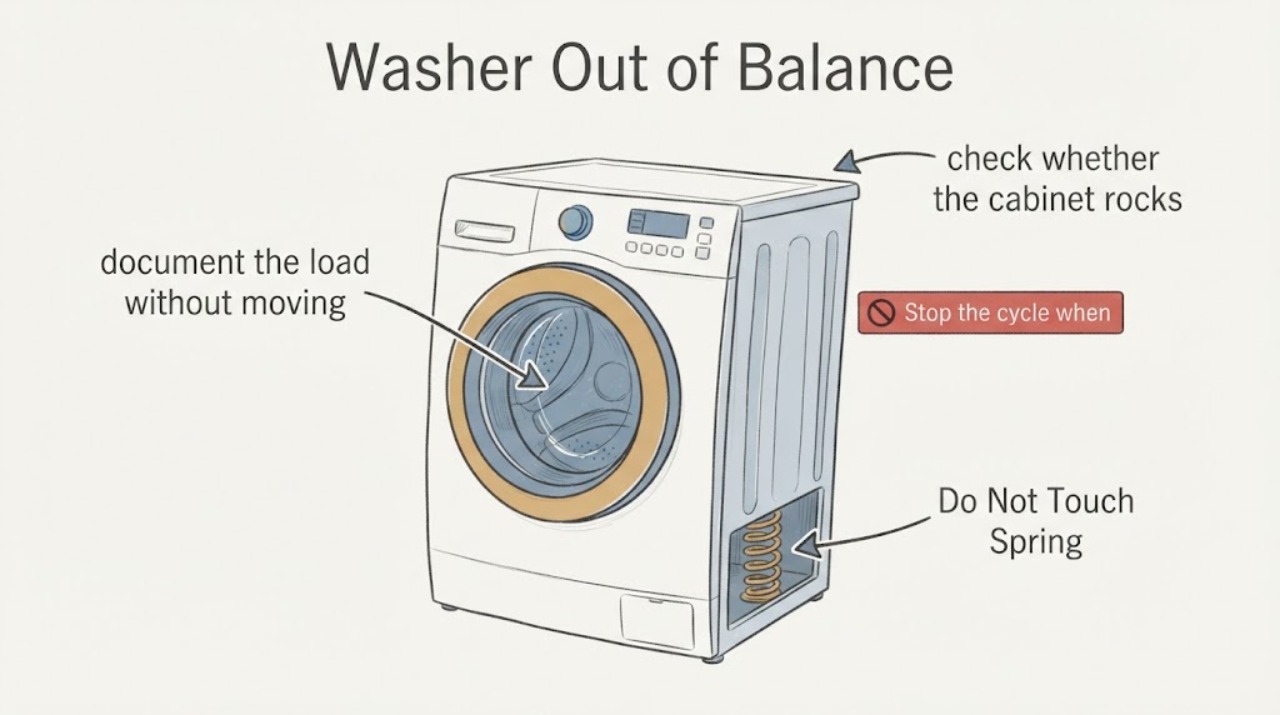
Stop the cycle when the washer walks, strikes the cabinet, or makes a severe out-of-balance noise. Keep hands away from the moving basket and wait for all motion to stop; disconnect power only from a dry, safely reachable position. Do not hold the cabinet down or start another high-speed test.
Expected result: The basket stops normally, the lid remains locked, the cabinet has contacted a wall, water is present near the outlet, or there is a damaged cord, smoke, sparking, or burning odor.
Next step: Keep the washer out of service, close the water supply if a hose or connection is wet, and arrange seller-installer or qualified appliance assessment. Never force the lid open.
Stop if: Do not reach into a moving basket, repeatedly reset power, press on the cabinet to restrain it, or operate with water near electrical parts.
Why this matters
Why: Violent movement or water near electrics is a safety escalation, not a reason to reproduce the sound. Contact with a wall can also disturb hoses or the installation, but it does not identify a failed part.
-
Check 2
After the basket is completely still, document the load without moving the appliance: note whether towels, one heavy item, or several garments had gathered on one side; whether the basket was overloaded; and whether the event began at the start of spin or after the basket accelerated. Do not run a new load to compare.
Expected result: The load was visibly one-sided or unusually heavy, the load was ordinary and distributed, or the original load cannot be reconstructed.
Next step: Photograph the settled load and record the cycle and spin setting. If movement returns with an ordinary load, stop using the washer and arrange service rather than escalating the load experiment.
Why this matters
Why: A one-sided or unusually heavy load can explain one event and is not equivalent to recurring movement with ordinary laundry. An ordinary load or an unknown history leaves installation and mechanical branches open.
-
Check 3
From the front and sides, check whether the cabinet rocks on the floor, whether all visible feet appear to bear evenly, and whether the floor is firm and dry. Use a level only from a safe accessible position; do not pull, tilt, or prop the washer while it contains water or laundry.
Expected result: The cabinet rocks, a foot is visibly not bearing, the floor is soft or uneven, or the washer appears stable and level.
Next step: Ask the seller-installer to correct leveling using the exact model instructions. Keep the washer unused if it rocks or the problem returns after a documented correction.
Why this matters
Why: An unstable floor or uneven feet can amplify a balanced load into walking and noise. A stable, level cabinet makes a repeated no-load or normal-load event more concerning, but still does not prove which internal part is involved.
-
Check 4
If installation was recent or the washer was moved, have the seller or installer verify from the matching manual that all shipping material was removed, the machine is upright and stable, and the installation did not leave the cabinet pressed against a wall. Do not tip the washer or remove rear covers yourself.
Expected result: The installer finds shipping material still present, a movement or clearance issue, an incorrect installation, or no installation discrepancy.
Next step: Have the installer correct and document the installation. If the machine still moves with a normal load, request Kenmore-compatible service and provide the before/after record.
Why this matters
Why: Shipping material or an installation constraint can produce excessive noise and movement from the first cycles. A clean installation makes load balance or a service diagnosis more likely, but an installer check is not a substitute for internal testing.
-
Check 5
Use prior observations to classify recurrence without creating a test: note whether the washer has banged or walked with no laundry, with an ordinary mixed load, or only with the original one-sided load. Also note whether the sound is a repeated tub impact, a loose-object rattle, or a continuous abnormal noise. Do not run an empty spin to find out.
Expected result: No-load or ordinary-load movement was already observed, only the one-sided load caused the event, or the sound pattern is uncertain.
Next step: Stop using the washer for no-load or ordinary-load recurrence and give service the exact event history. Do not order springs, pads, a balance ring, coupling, clutch, or transmission from shaking alone.
Why this matters
Why: Movement without the original load is a stronger reason for service than one isolated one-sided load. The matching report shows why recurring out-of-balance behavior deserves a separate branch, while its community suggestions do not prove a universal suspension or balance diagnosis.
-
Check 6
Record the full model number exactly as printed, including punctuation if shown, plus serial number, cycle and spin setting, load description, installation or relocation date, floor condition, whether the seller installed it, and any hose movement or water found after the event. Use Kenmore's official manual lookup for the matching document.
Expected result: The full model is readable and matches 110.29422801, the seller can review a recent installation, or the model/platform remains uncertain.
Next step: Send the record to the seller-installer first when appropriate; otherwise request qualified service and ask the provider to confirm the platform before naming a part.
Why this matters
Why: Kenmore uses the complete model number to route owners to the applicable manual and resources. A model match prevents a suspension or shipping procedure from another Kenmore platform being applied by appearance alone.
Use your observations
Decision map
Find the observation that best matches what you see, then follow the next safe action.
-
PATH 01Next step
What you see
The washer moved only during the original cycle and the load was visibly gathered on one side, with no damage, water, or recurrence already observed.
Do this next
Keep the record, use the matching manual's normal loading guidance, and stop for service if out-of-balance movement returns with ordinary laundry.
Why this path and its safety boundary
Why it matters: A one-sided load is the leading explanation for that event, but the event should not be recreated by adding another heavy or uneven load.
-
PATH 02Next step
What you see
The cabinet rocks, a foot is not firmly bearing, the floor is unstable, or shipping material or a clearance problem is found after a recent installation or move.
Do this next
Have the seller-installer correct the installation under the exact model instructions. Do not operate at high speed until the machine is stable and the leak or hose condition is clear.
Why this path and its safety boundary
Why it matters: Installation or floor stability is more likely than a proven suspension or drive failure. The movement can also stress hoses if the cabinet walks.
-
PATH 03Next step
What you see
The washer already bangs or walks with no laundry or with an ordinary load, or the same imbalance returns after the seller verifies loading and installation.
Do this next
Keep the washer out of service and arrange qualified Kenmore appliance service. Provide the exact model, the recurrence history, and any recording; do not remove the cabinet or buy parts by symptom.
Why this path and its safety boundary
Why it matters: A recurring no-load or normal-load pattern is not explained by the original one-sided load alone. Suspension, basket support, balance, drive, or another internal path may need inspection, but movement does not select a compatible part.
-
PATH 04Next step
What you see
The washer struck a wall or cabinet, a hose was pulled or damaged, water appeared, the floor is wet near the outlet, or there is smoke, sparking, burning odor, or a hot cord.
Do this next
Keep clear, close the water supply if safely reachable, isolate power only from a dry location, and obtain urgent qualified assessment. Do not move the washer or restore power to test it.
Why this path and its safety boundary
Why it matters: The event has become a water, electrical, or impact-safety issue. A balance diagnosis must wait until the appliance and installation are safe.
-
PATH 05Next step
What you see
The model label cannot be matched to 110.29422801, the platform is different from the reported top-loader, or the exact cycle and load history are unavailable.
Do this next
Use Kenmore's official manual lookup with the complete model number and provide the label photo to service. Until identity and installation are confirmed, limit the response to stopping, safe observation, and professional assessment.
Why this path and its safety boundary
Why it matters: A platform-specific suspension, shipping, or diagnostic procedure cannot be safely transferred from the matching community report or another Kenmore family.
Helpful context
Understand the symptom
Treat the two symptoms as two decisions
A single load can collect on one side and make a top loader stop, thump, or walk. That is different from the same movement with a normal load or no laundry. The matching 110.29422801 report is valuable because it records both the original one-sided-load event and a later recurrence; it does not prove that a particular spring, pad, balance ring, or drive part failed. Establish the load and installation pattern before pursuing a repair.
Recent installation changes the first contact
Kenmore's official manuals page says to enter the complete model number for the correct manual and appliance resources. If this washer was recently installed or moved, the seller or installer should verify the matching instructions, shipping material, level floor, and secure feet. Do not tilt or pull a heavy washer to inspect hidden hardware yourself.
What the owner can safely document
The useful owner evidence is the load description, when the movement began, whether the cabinet rocked on a solid floor, whether hoses were pulled or water appeared, and whether a no-load recurrence was already observed. Stop rather than creating a new high-speed test. A technician can use the exact model and the event record to assess suspension and drive parts without a part being guessed from cabinet movement.
When checks do not resolve it
Need a professional?
Refer the issue to the seller-installer when installation or relocation is recent, especially if shipping material, leveling, floor stability, or clearance has not been verified. Arrange qualified Kenmore appliance service when the washer moves with an ordinary or no-load condition, the problem persists after documented installation correction, it has struck the surroundings, or internal inspection would be required. Use plumbing or electrical service for an independent drain, supply, or outlet problem.
Safety scope: Do not hold the cabinet down, reach into a moving basket, run another high-speed or empty spin to reproduce the problem, tilt or pull the heavy washer, remove the cabinet, or select springs, pads, balance, coupling, clutch, pump, or transmission parts from shaking alone. Stop immediately for water near electrical parts, impact damage, a damaged or hot cord, smoke, sparking, burning odor, or violent movement.
Have this ready
- Provide the complete model and serial numbers, label photo, exact cycle and spin setting, load description and distribution, whether the event was unattended, any prior no-load or ordinary-load recurrence, floor and leveling observations, seller installation date, transport-material verification, hose or water evidence, and a safe recording made from outside the moving area if one already exists.
Common questions
FAQ
Is one load stuck on one side enough to explain the Kenmore 110.29422801 shaking?
It can explain one out-of-balance event, especially if the load was a single heavy item or visibly gathered on one side. Do not force another test load. Recurrence with ordinary laundry or no laundry needs an installation and service branch.
Should I hold the washer down while it spins?
No. Stop the cycle and wait until all motion has stopped. Holding the cabinet can hide the severity and expose you to moving parts or hose damage. If it walks, strikes a wall, or makes a severe noise, leave it out of service.
Could unlevel feet or shipping material cause this problem?
Yes. A matching report and general washer guidance both support checking installation, level, and shipping material before assuming an internal part. Have the seller or installer verify those items without you tilting or pulling the machine.
Do I need suspension springs or damper pads?
Not from cabinet movement alone. An exact-model community report described improvement after springs and damper pads were changed, but that is a reported outcome, not proof for every washer. Have service confirm the platform and failed condition before ordering a part.
Read the exact guide
Official sources
- Kenmore Washing Machine - out of balanceReddit r/appliancerepair · Exact Reddit post opened for the assigned model and symptom. It is a lived-experience case, not manufacturer confirmation or a universal repair procedure.
- Find Your Manual | Kenmore Appliance Manuals & GuidesKenmore / Transform SR Brands LLC · Official Kenmore manual-lookup page opened as the model-specific retrieval path for Kenmore 110 29422801; use the complete model number to retrieve its matching washer manual and resources. The page does not itself define a suspension fault.
Community feedback
Share a repair observation
Share a plain-text repair observation. Accepted observations are published automatically; this page may take a moment to update.