
On this page
Start here
Quick answer
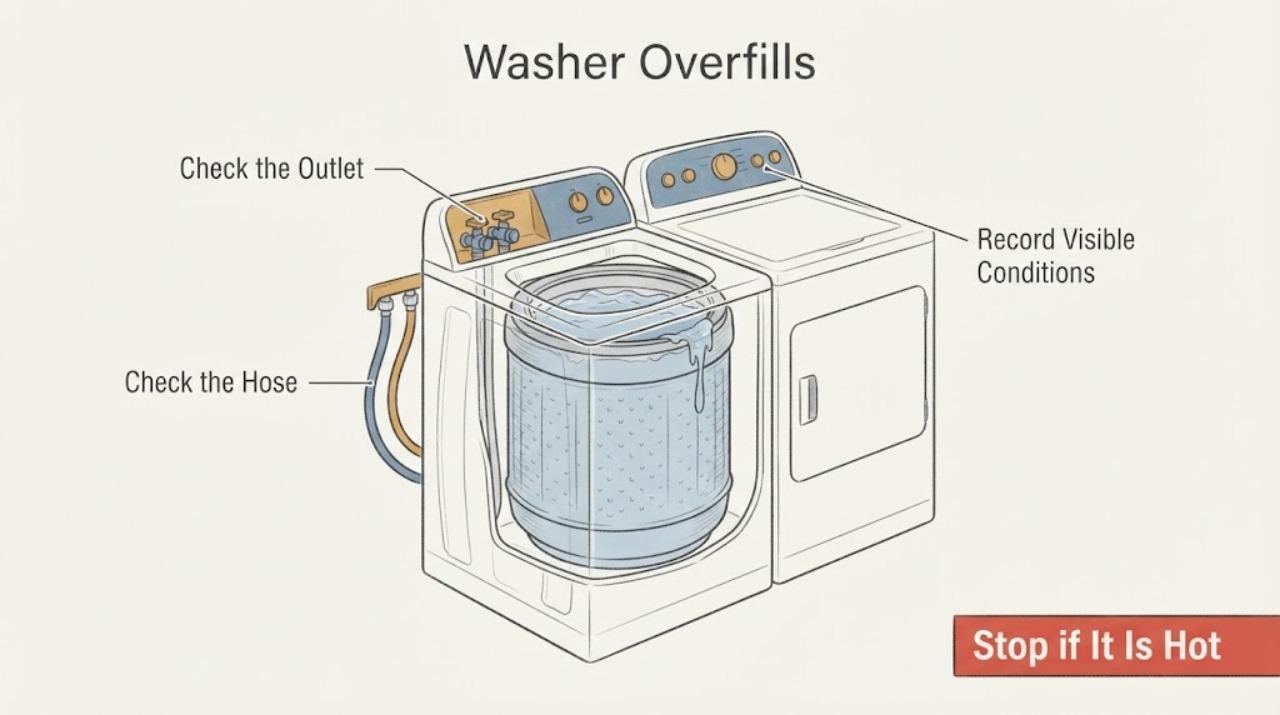
If a Kenmore 110.29422801 washer is filling above its normal level or water keeps entering after the cycle is stopped, close both household water supply valves immediately, contain the water and keep the washer out of unattended use. First distinguish a true high water level from a hose, tub or floor leak, then note whether the water enters only during the fill portion or continues with the controls off. Whirlpool's official washer guidance supports external checks of the supply faucets and kinked inlet hoses and says to turn the water supply off before removing a hose. Because the exact Kenmore manual and internal fill-control layout must be matched by model, do not diagnose or replace an inlet valve, pressure hose, switch or control board from this symptom alone.
Work through in order
Diagnostic checks
Use only checks that match the exact appliance or system and its official guide.
-
Check 1
Close both household water supply valves behind the washer, stop the cycle, and contain the water without reaching into a wet control area. Disconnect power only from a dry, safe location if the plug and outlet are dry and undamaged.
Expected result: Water stops when the supply valves are closed, or water continues entering despite the valves being closed; the floor, outlet or cord may also be wet or damaged.
Next step: Keep the valves closed and the washer out of use. If flow continues, the floor is flooded, or electrical equipment is wet or damaged, call qualified service or a plumber rather than restarting the machine.
Why this matters
Why: Closing the valves prevents additional supply water from worsening an overflow. Continued flow with closed valves suggests residual water or a plumbing issue that needs service; wet or damaged electrical equipment creates a separate shock hazard.
-
Check 2
After the water is contained, identify where the water first appeared: above the normal basket level, at an inlet-hose connection, under the tub/cabinet, from the drain hose, or only on the floor.
Expected result: The basket was genuinely overfilled, or the tub level stayed normal while water leaked from a hose, cabinet, drain connection or floor area.
Next step: Photograph the water path and keep the supply valves closed. Route an exterior hose or drain-connection leak to qualified service without removing the cabinet or pulling the washer through standing water.
Why this matters
Why: A true high water level points toward the fill and level-sensing process but does not identify a valve, pressure hose or control fault. A normal tub level with exterior water points toward a leak or drain-path problem instead.
-
Check 3
Record when the event begins: as soon as a fill starts, only at a selected water level, during agitation, after the machine is paused or stopped, or only on rare loads or cycles.
Expected result: Water enters during the fill period and stops at a normal level, rises beyond the expected level, continues after the controls are stopped, or the event is actually a one-time spill or hose leak.
Next step: Do not run an unattended reproduction cycle. Provide the timing, selected cycle, water level, load and photos to service after the exact manual is located.
Why this matters
Why: The timing separates a fill-level symptom from a leak or spill pattern, but it cannot prove an inlet valve, pressure system or timer failure. A rare event still deserves a controlled service record because an unattended recurrence can flood the room.
-
Check 4
With the water still shut off, inspect only the visible hot and cold inlet hoses and faucet connections for kinks, bulges, splits, loose fittings or signs of leakage. Do not remove a hose or valve screen unless the exact manual permits it and the water is off.
Expected result: An inlet hose is sharply kinked, visibly damaged, leaking at a connection or appears normal; the household faucets may also be partially closed.
Next step: Leave the water off for a damaged or leaking hose and arrange replacement or service. If the hoses are visibly sound, do not proceed to valve or pressure-hose testing; use the model manual and service path.
Why this matters
Why: Whirlpool identifies supply faucets and kinked inlet hoses as external washer checks. A kink or leak can disrupt filling, but it does not establish a failed internal water valve or level-control system.
-
Check 5
Find the complete model label and enter the model into Kenmore's official manual lookup. Record the exact cycle, selected fill level, water temperature selection, load, timing and whether the water entered with the washer stopped.
Expected result: The label confirms 110.29422801 or a different suffix/model, and the official lookup provides a matching manual or does not provide one.
Next step: Use only the matching manual for any documented user maintenance. If no matching manual is available or the overflow recurs after visible checks, arrange qualified Kenmore/appliance service with the full label and incident record.
Why this matters
Why: Kenmore states that its manuals are retrieved by model number and that model numbers are at least 11 characters long. A nearby 110-series washer may use different controls or service boundaries.
-
Check 6
Before any permitted single supervised test, verify that the supply valves, floor and electrical area are dry and that the exact manual does not require a different procedure. Stop immediately if the water level rises abnormally or the machine leaks.
Expected result: The washer completes a manual-approved test without abnormal water level or leak, or the tub begins overfilling, water enters after stop, or the floor/electrical area becomes wet.
Next step: Stop after one failed test, close both valves and arrange service. Do not remove the console, disconnect a pressure tube, electrically test an inlet valve, bypass a lid switch or replace a component based on a symptom ranking.
Why this matters
Why: A normal supervised cycle does not rule out an intermittent fault; a repeat overflow confirms that the washer must not be left unattended and still does not identify the failed internal part.
Use your observations
Decision map
Find the observation that best matches what you see, then follow the next safe action.
-
PATH 01Next step
What you see
Water is still entering, the supply valves do not stop it, the floor is flooded, or water has reached an outlet, plug or damaged cord.
Do this next
Keep the supply valves closed, stay clear of wet electrical equipment and arrange qualified appliance or plumbing service. Do not restart the washer.
Why this path and its safety boundary
Why it matters: The immediate risk is water and electrical damage, not identifying a washer part.
-
PATH 02Next step
What you see
The tub level is normal but water appears at an inlet hose, beneath the cabinet, at the drain hose or only on the floor.
Do this next
Leave the water off, photograph the first wet point and have the hose, connection or appliance inspected without pulling the washer through water.
Why this path and its safety boundary
Why it matters: This is more consistent with an external leak or drain-path problem than a confirmed overfill control failure.
-
PATH 03Next step
What you see
The basket genuinely rises above its normal level during filling or water continues entering after the washer is stopped.
Do this next
Keep both water valves closed and arrange service with the exact model, cycle, selected fill level and timing. Do not run an unattended repeat cycle or open the console.
Why this path and its safety boundary
Why it matters: The fill and level-sensing process needs professional diagnosis; the observation does not prove a water inlet valve, pressure hose, switch or timer failure.
-
PATH 04Next step
What you see
The visible hoses and faucets are sound, the exact manual is unavailable or does not resolve the symptom, and the rare overflow repeats.
Do this next
Stop further tests, keep the washer supervised or out of use with valves closed, and request qualified Kenmore appliance service.
Why this path and its safety boundary
Why it matters: A concealed fill, level-sensing or control issue remains possible, but the published evidence does not support selecting a specific part remotely.
Helpful context
Understand the symptom
Stop water before diagnosing the washer
Close the hot and cold supply valves behind the washer as soon as the tub rises abnormally or water reaches the floor. Keep towels and containers clear of electrical outlets and do not keep restarting the cycle to reproduce an intermittent overflow. If the valves do not stop the flow, leave them closed and arrange plumbing or appliance service.
Overfill, leak and siphoning are different observations
Record whether water is above the usual level inside the basket, appears only under the machine or along a hose, or enters during a fill but disappears through the drain. A floor leak or loose hose connection can look like an overflow, while a drain installation problem can change the water level without proving that the fill control has failed.
Do not guess the internal fill-control part
Kenmore's official manual lookup is model-based. The assigned model is retained exactly, but a model-matched manual or opened official Kenmore technical page was not available for the internal valve, pressure hose, switch or control behavior. Use the exact manual and service path after the safe observations rather than transferring a part or cabinet procedure from another 110-series washer.
When checks do not resolve it
Need a professional?
Arrange qualified Kenmore or appliance service after any true overflow, any water entering after the washer is stopped, any recurrence after visible hose checks, or any condition in which the model-matched manual does not resolve the symptom. Provide the full model, cycle, fill level, timing, photos and whether closing the supply valves stopped the flow.
Have this ready
- Provide Kenmore 110.29422801, the exact label suffix, cycle and fill selection, load, when the overflow began, whether water continued after stop, where water first appeared, supply-valve result, hose photographs and any prior repair history.
Common questions
FAQ
What should I do first if the Kenmore washer starts to overflow?
Close both hot and cold supply valves, stop the cycle and contain the water. Keep the washer out of unattended use. If water continues entering or electrical equipment is wet, leave it alone and arrange qualified service.
Does an intermittent overflow prove the water inlet valve is bad?
No. The symptom can involve the fill path, level-sensing process, a hose or leak, but an intermittent event does not identify a part. Record when it happens and use the exact model manual or qualified service.
Can I remove the water-level pressure hose or test the inlet valve myself?
Do not remove or electrically test those internal parts based on this symptom. The article's safe scope is shutoff, containment, visible hose checks and model-specific service routing; cabinet and live electrical work belong to qualified service.
Why do I need the full Kenmore model number?
Kenmore's official manuals page says to enter the model number to retrieve the applicable manual and notes that model numbers are at least 11 characters long. Similar 110-series washers can have different controls and instructions.
Read the exact guide
Official sources
- Find Your Manual | Kenmore Appliance Manuals & GuidesKenmore / Transform SR Brands LLC · Supports exact-model routing and service scope; it does not diagnose the 110.29422801 fill system.
- Checking the Fill Hoses if the Washer is not FillingWhirlpool Product Help · General Whirlpool-family external hose guidance used cautiously for a Kenmore washer; it does not establish a Kenmore-specific valve, pressure hose or control diagnosis.
Community feedback
Share a repair observation
Share a plain-text repair observation. Accepted observations are published automatically; this page may take a moment to update.