
On this page
Start here
Quick answer
A Kenmore washer that shakes violently during spin should be stopped safely and checked for a bunched or oversized load, an uneven floor, or feet that are not making firm contact. Kenmore's own laundry guidance says an unbalanced washer can make a lot of noise and recommends using a level and adjusting the feet; it also recommends a balanced load that lets clothes move freely rather than overloading or underloading. If the washer is new or was recently moved, use the exact model's installation manual to check any transport or installation requirements. Do not keep running a washer that walks, strikes the cabinet, leaks, smells burnt, damages the cord, or shows abnormal drum motion; persistent shaking after a balanced load and correct leveling needs qualified service.
Before you begin
Safety first
- Do not reach into a moving or locked washer, move a heavy appliance alone, remove the cabinet, access suspension or drive parts, perform live electrical tests, or order a spring, damper, bearing, motor, or control part from the symptom alone. Stop immediately for walking that risks impact, leaks, smoke, burning odor, abnormal heat, damaged power hardware, or repeated electrical trips.
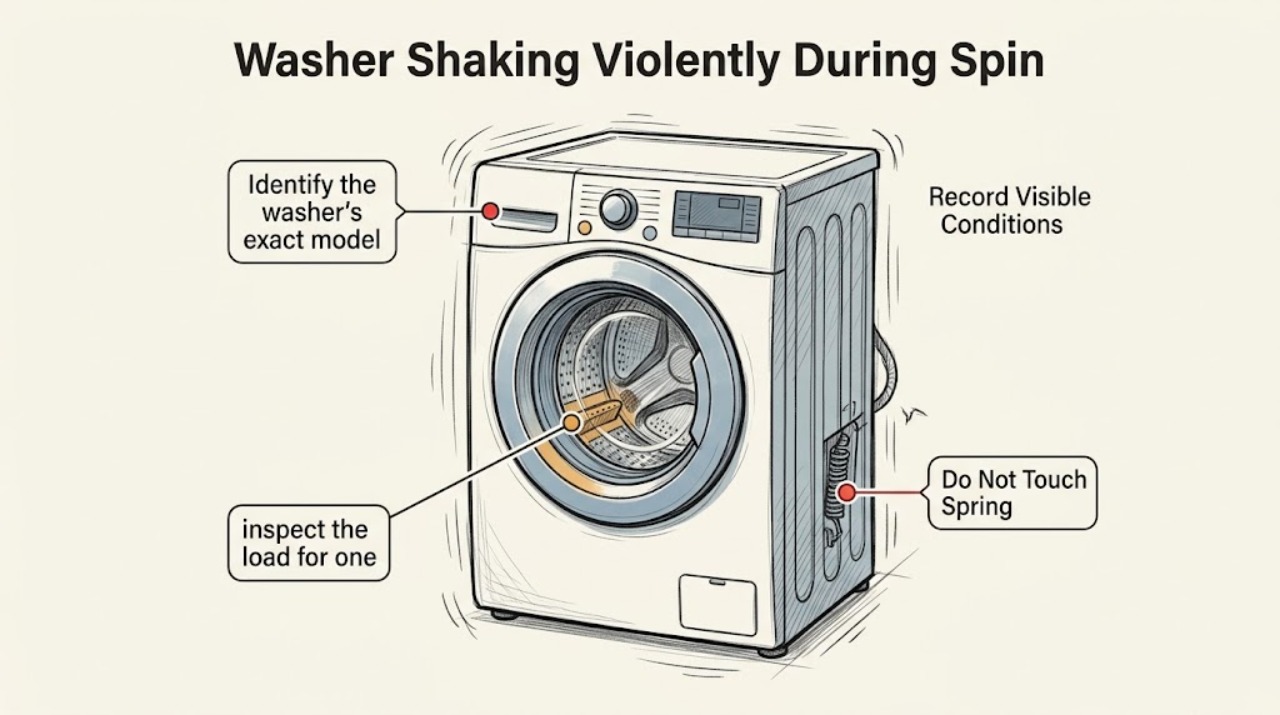
Work through in order
Diagnostic checks
Use only checks that match the exact appliance or system and its official guide.
-
Check 1
Stop or pause the cycle using the washer's normal control and stay clear until the basket or drum has completely stopped. Record whether the machine only rocks in place, walks across the floor, bangs the cabinet, or shows a leak, smoke, burning smell, or damaged power hardware; never reach into a moving or locked washer.
Expected result: The washer settles without a hazard, or it walks, strikes surrounding surfaces, leaks, smells burnt, smokes, or has abnormal motion or electrical damage.
Next step: For walking, impact, leak, smoke, odor, abnormal heat, or electrical damage, stop using the washer and isolate power or water only if safe, then arrange qualified service. Otherwise continue with the washer stopped and the load accessible only when the exact model says it is safe to open.
Why this matters
Why: A washer that only becomes unstable during spin may have a load or leveling condition, while violent movement or a safety symptom can damage the appliance or surroundings and is not safe to reproduce.
-
Check 2
Identify the washer's exact model, loading style, and whether the vibration began after installation, relocation, or a recent repair. Use Kenmore's model-specific manual lookup before checking any installation or transport item; do not move a full washer or remove a panel to inspect it.
Expected result: The washer is new or recently moved, the model manual is available, or the appliance has been in the same position for a long time and the model information is uncertain.
Next step: Retrieve the manual using the model number. Follow only its external installation checks; if the manual cannot be matched, keep the washer out of high-speed spin until the installation is assessed.
Why this matters
Why: Installation-related conditions are more plausible after a move, while a sudden change on an established installation is less likely to be solved by copying a new-installation procedure. The exact manual controls what an owner may inspect.
-
Check 3
When the washer is stopped and the model permits safe access, inspect the load for one heavy item, tangled bedding, a tightly packed tub, or too little material to distribute. Redistribute or reduce the load according to the exact manual; do not add random items or exceed the stated capacity.
Expected result: The load is bunched or oversized, the load is very small or made of one heavy item, or the clothes are already distributed and the washer still shakes.
Next step: Correct the load once and use a low-risk test only if the manual permits it. If the washer still shakes with an ordinary balanced load, move to the level and floor-contact check rather than repeating high-speed tests.
Why this matters
Why: Kenmore says unbalanced loading causes noise and recommends a balanced load that allows clothes to move freely; a normal, well-distributed load makes loading alone less likely as the explanation.
-
Check 4
With the washer empty or safely unloaded, place a level on the appliance as the exact manual directs and gently test for rocking from stable corners. Inspect whether all feet make firm contact and whether the floor is solid and free of an unstable mat; adjust feet only through the model's installation procedure and do not lift the appliance alone.
Expected result: The level shows an uneven cabinet, the washer rocks or a foot is not firmly planted, the floor flexes, or the washer is level and stable when empty.
Next step: Correct the permitted foot or floor condition, secure any model-specified lock hardware, and reassess only with a balanced load. If it remains level but shakes violently, stop spin testing and arrange service.
Why this matters
Why: Kenmore's guidance makes uneven floor contact an actionable vibration cause. A stable, level empty washer with correct foot contact makes a simple installation error less likely and raises the possibility of a model-specific mechanical or suspension issue.
-
Check 5
After one permitted load-and-level correction, record whether vibration occurs only at high spin, on every load, in one direction, with knocking, or together with leaking, scraping, or a drum that appears loose. Do not remove the cabinet, access suspension parts, or perform live electrical tests.
Expected result: The vibration stops after load or leveling correction, or it returns with ordinary loads despite correct floor contact and no visible loading issue.
Next step: Keep the washer out of high-speed spin and contact Kenmore or qualified appliance service. Provide the model, installation history, load type, level result, movement pattern, and any noise or leak observations.
Why this matters
Why: Recovery after a visible condition supports an external load or installation cause. Recurrence with ordinary loads means the symptom is not resolved by user checks and does not identify a safe replacement damper, spring, bearing, motor, or control part.
Use your observations
Decision map
Find the observation that best matches what you see, then follow the next safe action.
-
PATH 01Next step
What you see
The washer shakes only with a bunched, single-heavy, oversized, or very small load, and it is otherwise level and stable.
Do this next
Pause safely, redistribute or reduce the load as the exact manual permits, and use one normal cycle observation. Stop if the washer still walks or strikes the cabinet.
Why this path and its safety boundary
Why it matters: The pattern is consistent with load distribution rather than proof of an internal failure; Kenmore advises a balanced load that lets clothing move freely.
-
PATH 02Next step
What you see
The washer rocks when pushed gently, a foot is not firmly planted, the floor is uneven or flexible, or a recent installation/move preceded the vibration.
Do this next
Use the exact Kenmore manual to correct the permitted leveling or installation condition. Do not move a heavy appliance alone or copy transport-part instructions from another model.
Why this path and its safety boundary
Why it matters: An installation or floor-contact condition is more likely than a cycle-control fault. The model manual is needed for the exact foot, lock, and installation procedure.
-
PATH 03Next step
What you see
The washer is level and stable when empty, the load is ordinary and distributed, but violent shaking, walking, scraping, or repeated banging returns during spin.
Do this next
Stop using high-speed spin and arrange qualified Kenmore appliance service. Provide the exact model and the recorded movement/noise pattern rather than ordering a generic suspension or drive component.
Why this path and its safety boundary
Why it matters: The user-level load and installation checks have not explained the symptom. A model-specific tub, suspension, drive, or other mechanical problem is possible, but the visible symptom cannot identify a safe part.
-
PATH 04Next step
What you see
Shaking is accompanied by a leak, smoke, burning odor, abnormal heat, damaged cord or plug, exposed wiring, or repeated electrical trips.
Do this next
Stop the washer, isolate water or power only if safe, keep clear of smoke or damaged hardware, and arrange qualified appliance or electrical service. Seek emergency help for active smoke or fire.
Why this path and its safety boundary
Why it matters: The condition has crossed the routine balance check and may involve water damage, fire, or electrical risk. Reproducing the spin can worsen the hazard.
Helpful context
Understand the symptom
What violent spin vibration changes
Shaking during spin is a movement and installation decision, not merely a cycle-stage pause. Kenmore's published laundry guidance links an unbalanced washer with noise, lower efficiency, and premature wear, and separately recommends checking that the appliance sits evenly on the floor. The first safe branch is therefore to stop the motion, inspect the load and floor contact, and only then decide whether service is needed.
Model and installation conditions still matter
Kenmore sells different washer designs and directs owners to the exact model manual for operating and installation information. A recent installation or move can change the installation branch, while an established washer that suddenly begins walking after ordinary loads needs a different service assessment. Do not use a generic foot adjustment, transport-part instruction, or replacement part from another model.
When checks do not resolve it
Need a professional?
Arrange qualified Kenmore appliance service when violent shaking persists after one model-approved load correction and leveling check, when the washer is stable empty but repeatedly shakes with ordinary loads, or when the exact installation procedure cannot be matched. Use qualified electrical help for damaged supply hardware or repeated protective trips.
Safety scope: Do not reach into a moving or locked washer, move a heavy appliance alone, remove the cabinet, access suspension or drive parts, perform live electrical tests, or order a spring, damper, bearing, motor, or control part from the symptom alone. Stop immediately for walking that risks impact, leaks, smoke, burning odor, abnormal heat, damaged power hardware, or repeated electrical trips.
Have this ready
- Provide the full model number, loading style, installation or move history, load type and size, whether the washer rocks when empty, level and foot-contact results, direction and timing of movement, sounds, leaks, and any power or odor symptoms.
Common questions
FAQ
Why does my Kenmore washer shake violently during spin?
Start with the visible causes: a bunched or oversized load, a single heavy item, or an uneven washer. Kenmore says an unbalanced washer can make a lot of noise and recommends a level and properly adjusted feet, plus a balanced load that lets clothes move freely. If shaking persists with a normal load and a level washer, stop high-speed spin and arrange service.
Should I keep running the washer to see if it balances itself?
No. Stop or pause it safely and wait for all movement to stop. Correct the load or leveling only when the exact model permits access, then make one cautious observation. Do not continue if the washer walks, bangs the cabinet, leaks, smells burnt, or shows abnormal motion.
Do I need a new suspension part when my Kenmore washer shakes?
Not from the symptom alone. A load or floor-contact problem can produce severe vibration, while persistent shaking after those checks can require model-specific suspension or drive diagnosis. Use the exact model and service assessment before selecting a part.
Read the exact guide
Official sources
- Find Your Manual | Kenmore Appliance Manuals & GuidesKenmore · Supports the exact-identity next step: Kenmore directs owners to enter the model number to access the washer's owner manual and installation/use information.
- Appliance Maintenance Tips to Help Maximize EfficiencyKenmore Livemore · Directly supports the assigned Kenmore washer shaking topic: Kenmore states that an unbalanced washer can make a lot of noise and recommends checking level/feet, and it recommends a balanced load that lets clothes move freely.
- 3.9 cu. ft. Front-Load Washer - WhiteKenmore · Supports the product-line boundary: Kenmore describes this model as using Vibration Guard and provides a model-specific manual link, so a symptom article must not assume all Kenmore washer designs or procedures are identical.
- Customer Care & Support | Kenmore AppliancesKenmore · Supports escalation: Kenmore's customer-care page provides product manuals, safety/compliance information, and appliance repair routes when safe user checks do not resolve a performance issue.
Community feedback
Share a repair observation
Share a plain-text repair observation. Accepted observations are published automatically; this page may take a moment to update.