
On this page
Start here
Quick answer
Treat a Kenmore 27132 that squeaks only while washing and leaves an oil-like or greasy spray beneath the cabinet as a stop-use mechanical or fluid-contamination case, not as an ordinary load-balance noise. Kenmore's product page identifies model 26-27132 as a top-load washer with a Triple Action Impeller, but the short model number in the request is not enough to select an internal part or procedure. Turn the washer off, keep people away from the slippery area, and isolate power and water only from a safe, dry position. Without moving or opening the cabinet, photograph the spray, identify whether it is oily, soapy, or plain water, and record whether the sound occurs during wash, drain, or spin. Do not run another heavy load to reproduce it, touch moving parts, or guess that the drive, seal, pump, or transmission is the failed part; arrange qualified service if the residue is truly oily, the noise returns, or any leak, odor, heat, or electrical symptom appears.
Before you begin
Safety first
- Do not continue high-load operation, reach under the washer, touch moving parts, tilt or move the cabinet, remove panels, or choose a drive, pump, seal, motor, or transmission part from the sound or residue alone. Keep power and water isolated when a leak or electrical hazard is present.
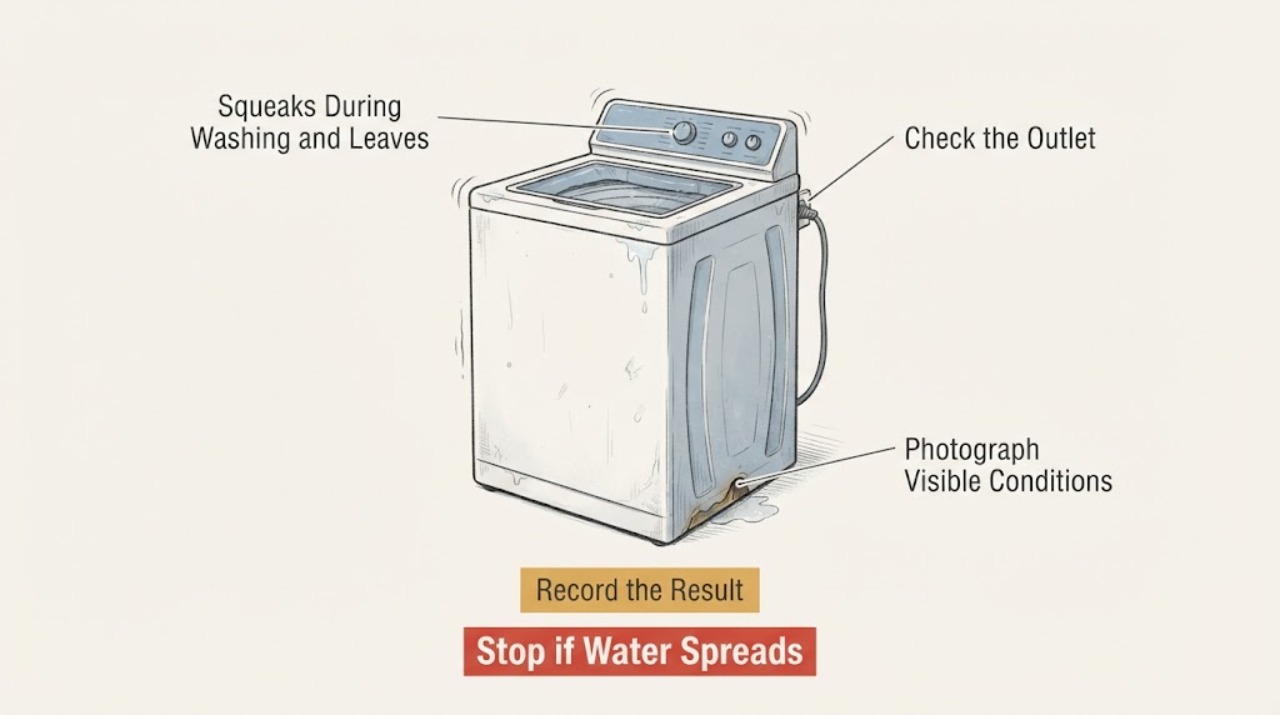
Work through in order
Diagnostic checks
Use only checks that match the exact appliance or system and its official guide.
-
Check 1
Stop the washer, keep people away from the wet or greasy floor, and do not start another load. From a safe, dry position, disconnect power and close the water supply only if the plug, outlet, and valves can be reached without stepping in liquid or moving the machine.
Expected result: The residue is near the outlet or cord, the floor is slippery, water is actively spreading, there is a burning smell or smoke, or the machine is safely isolated with no immediate hazard.
Next step: Keep the washer out of service and arrange qualified appliance help; use an electrician or urgent help when the outlet, cord, smoke, or electrical area is unsafe. Do not move the washer through standing liquid.
Stop if: Do not run a cycle, reach below the cabinet, touch moving parts, or reset power repeatedly to reproduce the sound.
Why this matters
Why: A wet electrical area, active leak, or odor/heat event is a safety stop rather than a noise diagnosis. Even without those signs, a new spray under the cabinet means continued high-load operation could spread contamination or damage.
-
Check 2
Read and photograph every character on the model and serial label, including any prefix or suffix, then compare it with Kenmore's official product and manual lookup. Do not treat the shorthand 27132 as permission to use a procedure for another Kenmore platform.
Expected result: The label matches Kenmore Model # 26-27132, provides a longer model identifier, or cannot be read or does not match the product page.
Next step: Include the label photograph with the service request. If the model cannot be matched, stop at external observations and do not order an internal part from the 27132 shorthand.
Why this matters
Why: A matching identity lets a technician retrieve the correct owner documentation and parts information. A partial or conflicting identity leaves platform, cabinet, and drive details uncertain.
-
Check 3
Without moving the washer or opening a panel, photograph the first place the material appears: front, rear, one corner, beneath a hose, or from the center of the cabinet. Blot only the accessible floor surface with disposable white material; do not probe underneath.
Expected result: The material is beside a supply or drain hose, appears only on the floor, tracks from the cabinet center, or cannot be localized without reaching under the machine.
Next step: Close the household water valves if a hose is wet and safe to reach, then arrange plumbing or appliance service according to the source. Leave a hidden or cabinet-origin residue for a technician to inspect.
Why this matters
Why: A hose or household spill remains an external possibility; a trail that starts under the cabinet raises the priority of an internal leak or expelled lubricant. Inability to see the origin is itself a reason not to dismantle the machine.
-
Check 4
Describe the material without touching machine parts: color, transparency, thickness, odor, whether it separates like detergent or water, and whether it leaves a slick film after drying. Compare it with any known detergent or floor-cleaning spill only on the floor, not by adding liquid to the washer.
Expected result: The residue is plainly soapy or watery, is a persistent slick black or amber film, has a burnt or solvent-like odor, or remains uncertain.
Next step: Document the sample and keep the washer off. Ask the technician to identify the material and its origin before approving any seal, pump, motor, drive, or transmission work.
Why this matters
Why: A confirmed household or detergent spill weakens the oil-leak hypothesis but does not explain a recurring wash-only squeak. A persistent slick or unusual odor supports a mechanical or electrical stop; uncertain material cannot safely justify a part selection.
-
Check 5
Use the last completed safe observation to map timing, not to recreate it: note whether the squeak occurred during impeller wash motion, filling, draining, or spin, whether the basket actually moved, the load size, and whether the washer rocked. Do not run a high-load cycle or reach through the lid.
Expected result: The noise was limited to wash motion, occurred in several stages, appeared with a single heavy load only, or is now present with no cycle running.
Next step: Give the timing and load history to the technician. If noise occurs while idle, worsens, or accompanies residue, leave the machine isolated rather than seeking another confirmation cycle.
Why this matters
Why: Wash-only timing makes the wash-drive path a useful area for professional diagnosis, while multi-stage or idle noise broadens the possibilities. A single heavy load can add strain but cannot explain a returning oil-like spray by itself.
-
Check 6
Check only the visible, user-accessible surroundings: hoses and faucets are dry, the washer is not rocking, no object is trapped at the lid edge, and no fluid is entering from a nearby appliance or drain. Do not pull the washer out, tilt it, remove the cabinet, or touch the underside.
Expected result: A hose, faucet, floor drain, nearby appliance, or unstable floor explains the visible wetness, or all visible surroundings are normal while the residue returns under the cabinet.
Next step: Correct only a plainly visible external source without operating the washer. If the source remains under the cabinet or the floor is unsafe, keep water and power isolated and schedule service.
Why this matters
Why: An external source can mimic a washer leak and should be corrected by the appropriate household or plumbing professional. A clean exterior with recurring cabinet-origin spray leaves an internal mechanical or fluid fault for appliance service.
Use your observations
Decision map
Find the observation that best matches what you see, then follow the next safe action.
-
PATH 01Next step
What you see
There is smoke, a burning smell, a hot or wet outlet/cord, exposed wiring, active spreading water, or a dangerously slippery floor.
Do this next
Keep clear, disconnect power only if it is safe, contain standing water without touching electrical equipment, and seek qualified appliance/electrical help or emergency help for active smoke or fire.
Why this path and its safety boundary
Why it matters: The case has crossed into an immediate electrical, fire, or slip hazard; the squeak and residue should not be investigated by restarting the washer.
-
PATH 02Next step
What you see
The material is a confirmed household spill, detergent residue, or plain water from a visible hose/faucet, and no residue returns from the cabinet.
Do this next
Clean the external spill safely, leave the washer off until the floor is dry, and use the complete model manual or a technician if the squeak returns or worsens.
Why this path and its safety boundary
Why it matters: The oil-leak hypothesis becomes less likely, but the wash-only squeak remains a separate symptom requiring timing and load evidence rather than a guessed drive part.
-
PATH 03Next step
What you see
A black or amber slick repeatedly appears from beneath the cabinet and the squeak is limited to wash motion or becomes more frequent.
Do this next
Keep the washer out of service and request qualified Kenmore appliance diagnosis. Provide photographs, the full model label, wash-stage timing, load history, and whether drain or spin behavior changed.
Why this path and its safety boundary
Why it matters: This pattern is compatible with an internal mechanical or sealing problem, but it does not distinguish a drive, shaft, pump, seal, or other component from external observation.
-
PATH 04Next step
What you see
The noise occurs in several stages, while the washer is idle, or with abnormal movement, heat, odor, or a changed drain/spin result.
Do this next
Stop using the washer and arrange service. Do not use the next load as a diagnostic test or authorize a component based only on the sound label.
Why this path and its safety boundary
Why it matters: The symptom is not a simple wash-motion squeak and may involve more than one system; continued operation could worsen a mechanical or electrical fault.
-
PATH 05Next step
What you see
The model label is incomplete or conflicts with 26-27132, or locating the residue would require moving the washer, tilting it, or opening a cabinet.
Do this next
Stop at photographs and external observations, obtain the complete identity from the rating label, and have a qualified technician perform the internal inspection.
Why this path and its safety boundary
Why it matters: The platform and safe access boundary are not established. A procedure or part from another Kenmore washer could create a fit or injury risk.
Helpful context
Understand the symptom
Why this symptom is different from an ordinary squeak
Kenmore's product page identifies 26-27132 as a top-load, 4.8 cu. ft. washer using a Triple Action Impeller. The request's 27132 shorthand does not establish the complete model label or the exact service documentation. A squeak that occurs only while the wash mechanism reverses or moves is useful timing evidence, but a greasy or oily-looking spray underneath adds a possible fluid or seal-related hazard. The visible material must be identified before anyone assumes a drive, pump, shaft, or other internal part is responsible.
Oil-like residue is not automatically confirmed oil
Laundry detergent, fabric softener, dirty wash water, floor cleaner, and lubricant can look different after they spread under a washer. Do not use a finger test or restart the machine to make the material move. Use a dry white paper towel or disposable card only on the already-wet floor, away from moving parts and disconnected from power, to document color and texture without reaching under the cabinet. A black or amber slick that returns from the machine is a service finding, not a reason to order a gearcase, seal, pump, or motor by symptom alone.
Heavy use raises the need for evidence, not a part diagnosis
Twelve loads a week is context for documenting when the sound began and whether it is worsening; it does not prove that normal wear has caused one particular failure. Because Kenmore requires a complete model number to route manuals, the technician should receive the full label, the wash-only timing, residue photographs, and whether the washer still drains and spins. Stop before any panel removal, underside inspection, or powered test unless a qualified technician takes responsibility for that work.
When checks do not resolve it
Need a professional?
Call qualified appliance service for recurring wash-stage squeaking with cabinet-origin residue, any hidden leak, or any need for internal inspection. Use a plumber for a confirmed house-side hose, faucet, drain, or floor-drain source; use electrical help for a damaged or wet outlet, cord, or circuit.
Safety scope: Do not continue high-load operation, reach under the washer, touch moving parts, tilt or move the cabinet, remove panels, or choose a drive, pump, seal, motor, or transmission part from the sound or residue alone. Keep power and water isolated when a leak or electrical hazard is present.
Have this ready
- Provide the complete model and serial label, photographs of the residue and its first visible location, color/texture/odor observations, the exact wash/fill/drain/spin timing, load size, rocking or heat, and whether any drain or spin performance changed.
Common questions
FAQ
Does an oil-like spray prove the gearcase or transmission is bad?
No. The material may be lubricant, detergent, dirty water, or an external spill, and a visible spray does not identify one internal component. Keep the washer off and have the material and source documented before approving a part.
Can I run an empty cycle to hear the squeak again?
Not when a new spray or possible leak is present. Repeating operation can spread fluid or worsen a mechanical fault. Give the technician the last known cycle stage, load, and sound pattern instead.
Is 27132 a complete Kenmore model number?
Kenmore's product page labels the related product Model # 26-27132, while its manual lookup asks for a longer model number. Photograph every character on the rating label; do not use 27132 alone to select a manual or internal part.
What if the residue turns out to be detergent or plain water?
That makes an internal lubricant leak less likely, but it does not explain away a recurring wash-only squeak. Clean and dry the external spill safely, keep the washer off until the area is dry, and arrange service if the noise returns or any cabinet-origin residue appears.
Read the exact guide
Official sources
- 4.8 cu. ft. Top Load Washer w/Steam Treat - White ENERGY STAR CertifiedKenmore · Exact Kenmore product page opened for the 27132 identity, top-load configuration, 4.8 cu. ft. capacity, and Triple Action Impeller; it does not establish an internal failure or part diagnosis.
- Find Your Manual | Kenmore Appliance Manuals & GuidesKenmore · Official Kenmore manual portal opened to establish the need for a complete model identifier and matching documentation before applying service or operating instructions.
Community feedback
Share a repair observation
Share a plain-text repair observation. Accepted observations are published automatically; this page may take a moment to update.