
On this page
Start here
Quick answer
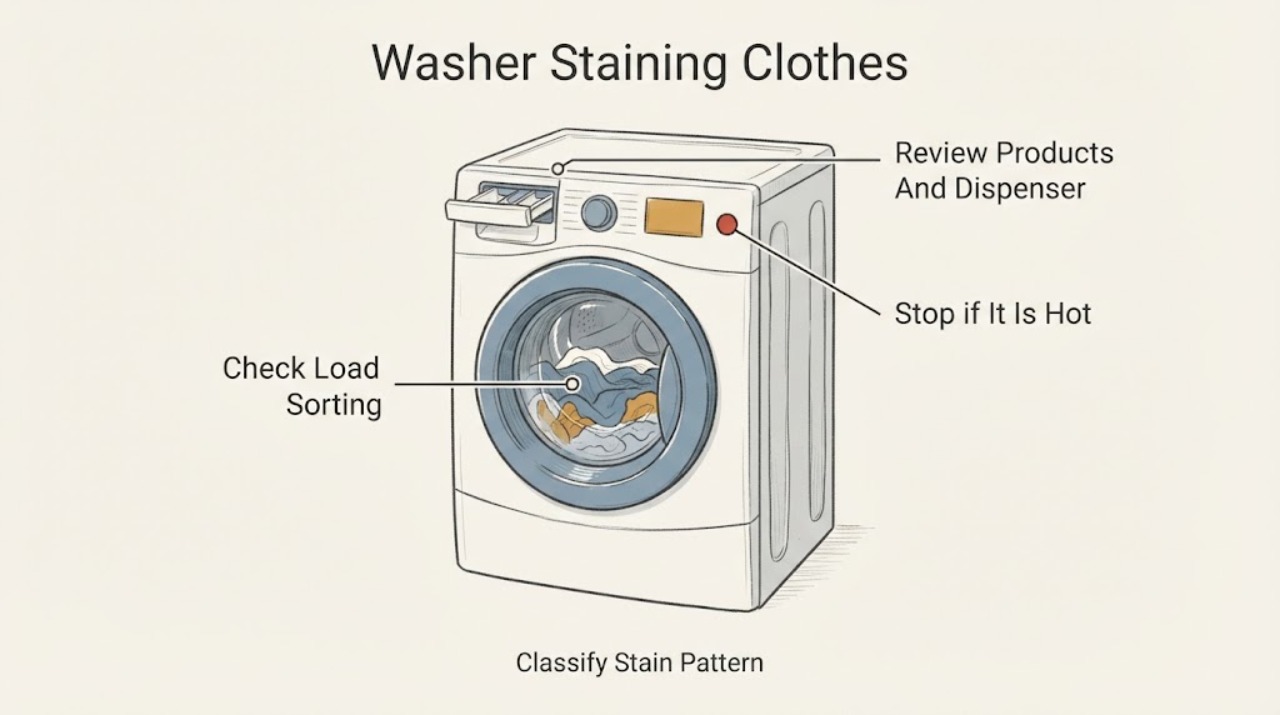
Do not order a washer part from the stain alone. First photograph the mark and check whether it matches dye from another item, appears as a film or residue across several garments, or repeats at the same location. Kenmore's laundry guidance says to separate lights and darks and fabric types, use a suitable water temperature, pre-treat promptly and use the manufacturer's recommended detergent amount; it warns that an oversized load can clean poorly or damage the machine. Check where detergent or softener was added and use the exact model manual before choosing a rinse, soak or washer-cleaning cycle. Some Kenmore models have model-specific stain and advanced-rinse features, but the 41122 product page is not a universal instruction for every washer. Keep marked clothes out of the dryer until the cause is understood, and stop for a repeated dark or oily mark, visible damage, leaking, smoke or a burning smell; those conditions need Kenmore or qualified appliance service.
Work through in order
Diagnostic checks
Use only checks that match the exact appliance or system and its official guide.
-
Check 1
Photograph the mark and record its color, texture, distribution, whether it affects one garment or the whole load, and whether it repeats at the same position on different items.
Expected result: The mark matches another garment, forms a film or residue across the load, or repeats as a streak/spot at a consistent location.
Next step: Use the corresponding sorting/product/source branch. Keep the item out of the dryer while the cause is uncertain and do not select a replacement part from the pattern alone.
Why this matters
Why: A matching color is first a load-transfer clue; broad film is a product or rinse clue; a repeatable location suggests an accessible surface or mechanical source that cannot be diagnosed from appearance alone.
-
Check 2
Review the marked load against its color groups, fabric types, care-label temperature and tub loading; separate lights and darks and reduce the load for the next comparison wash.
Expected result: The mark appeared after a mixed-color or overloaded load, or it returns even on a correctly sorted, appropriately sized load.
Next step: Run a controlled load using the model's documented cycle and keep a photo record. If the same mark returns, continue to the product/manual and service checks.
Why this matters
Why: Kenmore identifies sorting, fabric/temperature choices and very large loads as factors that affect cleaning and clothing condition; recurrence on a controlled load makes a simple transfer explanation less likely but does not prove an internal failure.
-
Check 3
Write down the detergent, softener and other additives, where each was placed and how much was used; compare those choices with the exact Kenmore manual and inspect only the user-accessible dispenser area.
Expected result: A product was over-measured, placed in the wrong location, added directly to clothing, or residue is visible in the accessible dispenser; alternatively the product amount and dispenser path match the manual.
Next step: Correct only the documented product/dispenser use and use a model-approved extra-rinse or cleaning option if available. If marks persist with correct use, preserve the evidence for service.
Why this matters
Why: Kenmore's laundry guidance connects film or residue with detergent amount and directs users to the manufacturer's recommendation; a clear dispenser or product issue is different from a confirmed washer-part failure.
-
Check 4
Locate the full Kenmore model number and consult Kenmore's manual page before using a soak, extra-rinse or washer-cleaning cycle; treat features shown on another model as examples only.
Expected result: The exact manual documents the proposed cycle/feature, or the model cannot be matched or does not document it.
Next step: Use only the documented control and cleaning procedure. If the manual cannot be matched, limit checks to sorting, product use and visible user-accessible areas, then arrange support for persistent marks.
Why this matters
Why: Kenmore's manual lookup is the authority for the washer in front of you. The 41122 page demonstrates that stain and advanced-rinse features can be model-specific and cannot be generalized to an unidentified washer.
-
Check 5
Record the model, stain photos, load contents, cycle, products, temperature, recurrence pattern and any visible leak, abrasion or odor before contacting Kenmore support.
Expected result: The same mark appears on a controlled load, a visible surface is damaged, the washer leaks, or there is smoke, burning smell, arcing or exposed wiring.
Next step: Stop using the washer for an unsafe condition and arrange Kenmore or qualified service. Do not open panels, bypass a door lock, scrape a drum or replace a part based only on the stain.
Why this matters
Why: The evidence now exceeds a safe generic laundry adjustment; a model-specific surface, seal, tub or control assessment is needed, and an electrical or water warning requires immediate stop-use handling.
Use your observations
Decision map
Find the observation that best matches what you see, then follow the next safe action.
-
PATH 01Next step
What you see
The mark matches the color of another item in the load and does not recur in a correctly sorted comparison load.
Do this next
Separate lights, darks and fabric types, follow care-label temperature guidance, and pre-treat the affected garment promptly as Kenmore recommends.
Why this path and its safety boundary
Why it matters: The observed pattern is more consistent with color transfer or load composition than with a confirmed washer component failure.
-
PATH 02Next step
What you see
Several garments have a film or residue and the detergent, softener or dispenser use differs from the exact manual.
Do this next
Correct the documented amount and dispenser location, then use only the model's documented extra-rinse or cleaning procedure and compare a controlled load.
Why this path and its safety boundary
Why it matters: Product amount or placement and incomplete rinsing are the first supported checks; the residue does not identify a pump or control fault.
-
PATH 03Next step
What you see
The same dark, oily-looking or sharply located mark returns on a correctly sorted load after documented product use.
Do this next
Stop repeated test loads, inspect only visible user-accessible areas without dismantling the washer, photograph the source if visible, and arrange model-specific service.
Why this path and its safety boundary
Why it matters: A washer-side source is possible, but the appearance still does not prove a seal, drum, bearing or other part.
-
PATH 04Next step
What you see
The exact model cannot be matched, or a proposed soak/rinse/cleaning feature appears only on another Kenmore model.
Do this next
Do not use the other model's button sequence. Limit the response to sorting, product and visible checks, then use Kenmore's manual lookup or support path.
Why this path and its safety boundary
Why it matters: The control sequence and feature applicability are unresolved; a neighboring model cannot supply the missing instruction.
-
PATH 05Next step
What you see
Staining is accompanied by a leak, smoke, burning smell, arcing, exposed wiring or visible sharp/damaged washer surfaces.
Do this next
Stop the washer, disconnect power only if it can be done without contact with water or damaged wiring, keep clear of smoke or fire, and arrange qualified service; do not open the cabinet or continue testing.
Why this path and its safety boundary
Why it matters: This is an unsafe appliance condition rather than a laundry-setting problem.
Helpful context
Understand the symptom
Describe the mark before changing the wash settings
Separate one marked item and photograph it in good light. Note the color, whether it is a film, a spot, a streak or an oily-looking patch, whether it appears on every item or only one garment, and whether it repeats in the same place. A mark that matches another garment is a load-sorting clue; a film on several items is a product or rinsing clue; a repeated mark in one location is a reason to stop guessing and check only user-accessible surfaces or arrange service. The appearance alone does not identify a failed pump, motor, bearing or control.
Separate the load and match the care conditions
For the next load, separate lights and darks and separate fabric types as Kenmore recommends. Follow the garment care label for water temperature, and avoid packing the tub beyond the model's load guidance. Kenmore notes that an oversized load can leave clothing poorly cleaned and can put the machine at risk. If the mark appeared only on one mixed load, correct sorting, load size or temperature before treating it as an appliance fault.
Check detergent, softener and the rinse route
Record what was added, where it was added and whether the product was measured. Use the detergent amount stated by the manufacturer and do not pour products directly onto clothing unless the exact manual says to do so. Kenmore's laundry guidance specifically calls out film or residue as a reason to review detergent amount. Some Kenmore models, such as the documented 41122, advertise an advanced rinse that bypasses the dispenser to rinse detergent and softener; use that feature only when the exact model's manual or controls confirm it. Do not infer that every Kenmore washer has the same dispenser or rinse program.
Use the exact model manual before a cleaning cycle
Find the full model number on the washer and search Kenmore's manual page before selecting a soak, extra-rinse or washer-cleaning cycle. Kenmore says its manual lookup covers washers and provides model-specific operating and parts information. If the manual identifies a user-accessible dispenser or cleaning procedure, follow only that procedure with the washer stopped and cool. Do not remove the tub, baffles, panels or wiring to search for a stain source, and do not assume a cycle named on another Kenmore model exists on yours.
Stop when the mark points to damage or an unsafe fault
Keep the affected clothes out of the dryer until the mark is identified. Arrange Kenmore or qualified appliance service if clean loads continue to develop the same mark, if there is a visible sharp edge, rust-colored damage, oily residue, leaking water or a door-seal/drum surface that looks damaged, or if the washer makes an electrical or burning smell. Do not buy a seal, drum, motor or control board from the stain description alone. The model number, a photo of the mark, the load contents, products used and the exact cycle will give service a useful starting point.
When checks do not resolve it
Need a professional?
Arrange Kenmore or qualified washer service when the exact-model load, product and manual checks do not stop the marks, when the mark repeats at one washer location, or when there is leakage, visible damage, smoke, burning smell, arcing or exposed wiring. Do not identify or order a seal, drum, bearing, motor or control from the stain alone.
Common questions
FAQ
Can a Kenmore washer itself stain clothes?
It can be a possibility when the same mark returns on controlled loads, but the stain's appearance does not prove a particular washer part. First separate color transfer, product residue and a repeatable washer-side mark; then use the exact model manual and service path.
Should I run a cleaning or extra-rinse cycle?
Only if the exact Kenmore model's manual documents that cycle or option. Kenmore's 41122 page describes an advanced-rinse feature for that model, but the feature and controls are not universal across unidentified Kenmore washers.
Should I replace the door seal or another part because of stains?
No. A seal, drum, bearing, motor or control should be considered only after the exact model and a service diagnosis support it. A photo of a stain alone is not enough to establish fit or failure.
Read the exact guide
Official sources
- Customer Care & SupportKenmore · Official Kenmore support hub for service and model-specific help when safe external checks do not resolve a symptom.
- 3.9 cu. ft. Front-Load Washer - White (Model 41122)Kenmore · Exact Kenmore model 41122 only; used to show that stain and advanced-rinse features are model-specific, not as a universal instruction for an unidentified Kenmore washer.
- Kenmore ManualsKenmore · Official Kenmore manual lookup; the exact model number is required before applying a control sequence, cycle or parts instruction.
- Tips for Washing Extra Large Loads of LaundryLivemore / Kenmore · Kenmore-branded laundry guidance for load handling and clothing-care decisions; it does not identify a specific internal washer fault.
Community feedback
Share a repair observation
Share a plain-text repair observation. Accepted observations are published automatically; this page may take a moment to update.