
On this page
Start here
Quick answer
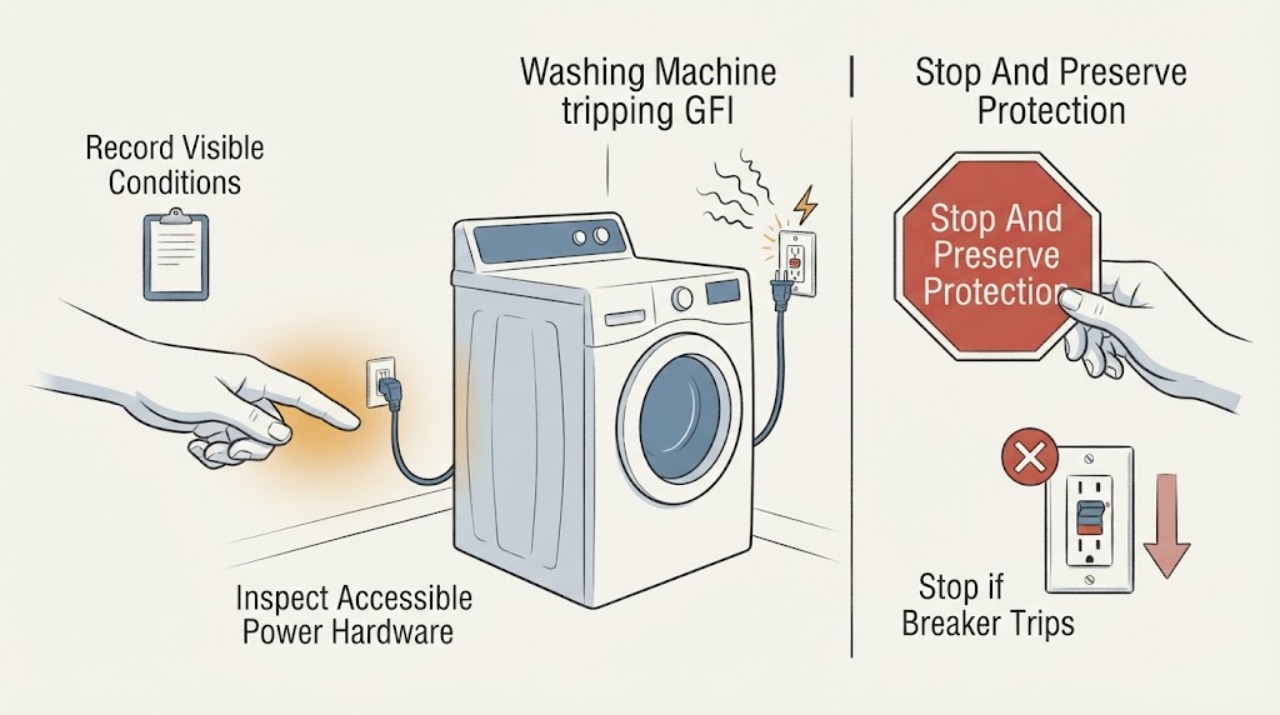
Treat a repeating GFI/GFCI trip as an electrical stop condition. The U.S. Consumer Product Safety Commission explains that a GFCI interrupts power when it detects a ground fault and advises unplugging an appliance that repeatedly trips a breaker and having it repaired or replaced. Leave the Kenmore washer unplugged, keep the protective device in service, and inspect only accessible signs such as a hot or damaged plug, cord or receptacle without opening anything. Record whether the trip occurs on connection, start, filling, draining or later, then use the exact Kenmore manual and qualified appliance/electrical service. Do not keep resetting the GFI, move the washer to an unprotected outlet, use an extension as a workaround or perform live tests.
Work through in order
Diagnostic checks
Use only checks that match the exact appliance or system and its official guide.
-
Check 1
Stop the washer when the GFI trips, leave the washer unplugged and do not repeatedly press RESET to continue a cycle. Do not substitute an unprotected outlet, defeat the protective circuit or use an extension cord as a workaround.
Expected result: The GFI stays tripped, resets but trips again when the washer is connected, or the washer/cord/receptacle has visible damage, heat or moisture.
Next step: Keep the washer off. If there is smoke, arcing, a burning smell or hot/damaged electrical hardware, keep clear and use qualified emergency/electrical support; otherwise continue only with safe observation and service preparation.
Why this matters
Why: CPSC says a GFCI interrupts power for ground-fault protection and advises unplugging an appliance that repeatedly trips a fuse or breaker. The trip is not evidence that the protection should be removed.
-
Check 2
Without reconnecting the washer to reproduce the trip, write down when it last occurred: immediately on plug-in, when Start was pressed, during filling, during drain/spin, or after the machine had been running. Record whether the GFI protects a receptacle or a breaker and whether other loads share the circuit.
Expected result: The trip timing is known, unknown, or the event involved water, a loud pop, smoke or visible electrical damage.
Next step: Give the timing and any hazard signs to both the appliance service provider and, where the receptacle/circuit is implicated, a qualified electrician. Keep the washer disconnected.
Why this matters
Why: Timing helps qualified service distinguish the reported symptom from a household protection event, but it does not identify a failed washer part and must not be recreated by repeated energizing.
-
Check 3
With the washer disconnected and dry, look only at the accessible plug, cord and receptacle face for fraying, cracks, discoloration, moisture or unusual warmth. Do not remove the receptacle cover, open the washer, perform electrical measurements or touch exposed conductors.
Expected result: The cord/plug/receptacle is damaged or warm, the area is wet, or the accessible hardware appears normal.
Next step: If damage, warmth or moisture is present, leave the circuit and washer alone and call a qualified electrician/appliance service. If normal, keep the washer unplugged and use the exact model manual/support path rather than testing live.
Why this matters
Why: CPSC identifies damaged cords and unusually warm outlets or switches as electrical hazards requiring the outlet not to be used and qualified evaluation. Normal appearance does not clear the washer or circuit after a repeated trip.
-
Check 4
Read the Kenmore model number from the accessible rating label without removing panels, then use Kenmore's Manuals page to locate the washer documentation. Do not apply another model's wiring, cord or diagnostic instructions.
Expected result: The exact model can be matched to a manual, or the label is missing/ambiguous.
Next step: Give the matched model and the GFI trip history to Kenmore support/service. If it cannot be matched, stop at the identity boundary and use Kenmore Customer Care or qualified service.
Why this matters
Why: Kenmore says its manual lookup requires the model number and provides washer manuals/resources. Model and electrical configuration are therefore unresolved when the label cannot be matched.
-
Check 5
Arrange qualified appliance service and, when the receptacle/circuit or GFI itself is implicated, a qualified electrician. Keep the washer off until evaluated; do not authorize a protective-device change merely to make the washer run.
Expected result: The washer trips the protected circuit again after a prior event, the GFI will not reset normally, or the circuit also trips with other loads.
Next step: Provide the model, circuit/GFI type, trip timing, visible condition and any water/heat/smoke history. Do not open the cabinet or alter the circuit while awaiting service.
Why this matters
Why: A repeated trip can involve the appliance, cord/plug, receptacle, branch circuit or protective device. The available evidence cannot distinguish these safely for a model-free consumer repair.
Use your observations
Decision map
Find the observation that best matches what you see, then follow the next safe action.
-
PATH 01Next step
What you see
The GFI trips immediately when the washer is connected or when power is requested.
Do this next
Keep the washer unplugged and arrange qualified appliance/electrical evaluation. Do not keep resetting or move it to an unprotected outlet.
Why this path and its safety boundary
Why it matters: The event is an electrical protection symptom; no appliance part or receptacle fault is established.
-
PATH 02Next step
What you see
The GFI trips only during filling, drain/spin or after the washer has run for a while.
Do this next
Do not recreate the event. Record the timing and leave the washer off for qualified diagnosis.
Why this path and its safety boundary
Why it matters: The timing is useful to service but does not prove a pump, motor, heater, wiring or moisture fault.
-
PATH 03Next step
What you see
The cord, plug or receptacle is hot, damaged, wet, discolored or smells burnt.
Do this next
Stop using the outlet and washer, keep clear of exposed hazards and have a qualified electrician/appliance technician evaluate them.
Why this path and its safety boundary
Why it matters: CPSC treats damaged cords and unusually warm outlets/switches as electrical hazards.
-
PATH 04Next step
What you see
The GFI does not trip with the washer disconnected, but the washer has repeated trips when connected.
Do this next
Keep the washer off and arrange qualified appliance service. Preserve the GFI protection and do not substitute an unprotected circuit.
Why this path and its safety boundary
Why it matters: The appliance/cord interaction remains unresolved; a normal GFI reset does not prove the washer is safe.
Helpful context
Understand the symptom
Treat repeated GFI trips as a stop condition
A GFI/GFCI interrupts power when it detects a ground-fault condition. CPSC advises unplugging an appliance that repeatedly trips a fuse or breaker and having it repaired or replaced. Leave the Kenmore washer disconnected and keep the protective circuit in service; do not repeatedly reset it or substitute an unprotected outlet.
Record timing without reproducing the fault
Write down whether the last trip happened on connection, Start, filling, draining/spinning or after operation, and whether other loads share the circuit. Timing helps service but does not diagnose a pump, motor, wiring, cord, receptacle or GFI. Do not reconnect the washer just to see when it trips again.
Inspect only accessible electrical conditions
With power disconnected and the area dry, look for a frayed cord, cracked plug, discoloration, moisture or unusual warmth. CPSC says damaged cords and unusually warm outlets or switches require the outlet not to be used and qualified evaluation. Do not remove covers, perform electrical measurements or open the washer.
Use the model and professional service path
Kenmore's manuals page requires the washer model number to locate the correct documentation, while Customer Care provides repair and safety routes. Give service the model, GFI type, trip timing and visible condition. A protective-device change or internal appliance diagnosis belongs to qualified professionals.
When checks do not resolve it
Need a professional?
Keep the Kenmore washer unplugged and arrange qualified appliance service for any repeated GFI trip. Include a qualified electrician when the receptacle, branch circuit or GFI will not reset, trips with other loads, or shows heat/damage. Smoke, arcing, burning odor, water near electrical parts or a shock requires immediate stop and appropriate emergency/electrical support.
Common questions
FAQ
Should I keep resetting the GFI so the Kenmore washer can run?
No. CPSC explains that GFCI protection interrupts power for a ground fault and advises unplugging an appliance that repeatedly trips protection and having it repaired or replaced. Keep the protection in service and arrange qualified evaluation.
Can I move the washer to a regular non-GFI outlet?
Do not use an unprotected outlet or an extension cord as a workaround for repeated trips. The GFI is a shock-protection device; a different circuit must be selected and evaluated by qualified professionals under the applicable installation requirements.
Does a GFI trip prove the Kenmore washer is defective?
No. The event can involve the appliance, cord, receptacle, branch circuit or protective device. Record timing and accessible conditions without re-energizing repeatedly, then provide the exact model and history to qualified service.
Read the exact guide
Official sources
- GFCI Fact SheetU.S. Consumer Product Safety Commission · Government safety fact sheet explaining GFCI function, ground faults, protected circuits and qualified electrician boundary.
- Find Your Manual | Kenmore Appliance Manuals & GuidesKenmore · Official model-based manual lookup and washer documentation path.
- Customer Care & Support | Kenmore AppliancesKenmore · Official support hub for warranty, safety/compliance, manuals and repairs/services.
- CPSC and NESF Urge Consumers to Plug Into Electrical SafetyU.S. Consumer Product Safety Commission · Government safety guidance for repeated appliance trips, damaged cords and warm outlets/switches.
Community feedback
Share a repair observation
Share a plain-text repair observation. Accepted observations are published automatically; this page may take a moment to update.