
On this page
Start here
Quick answer
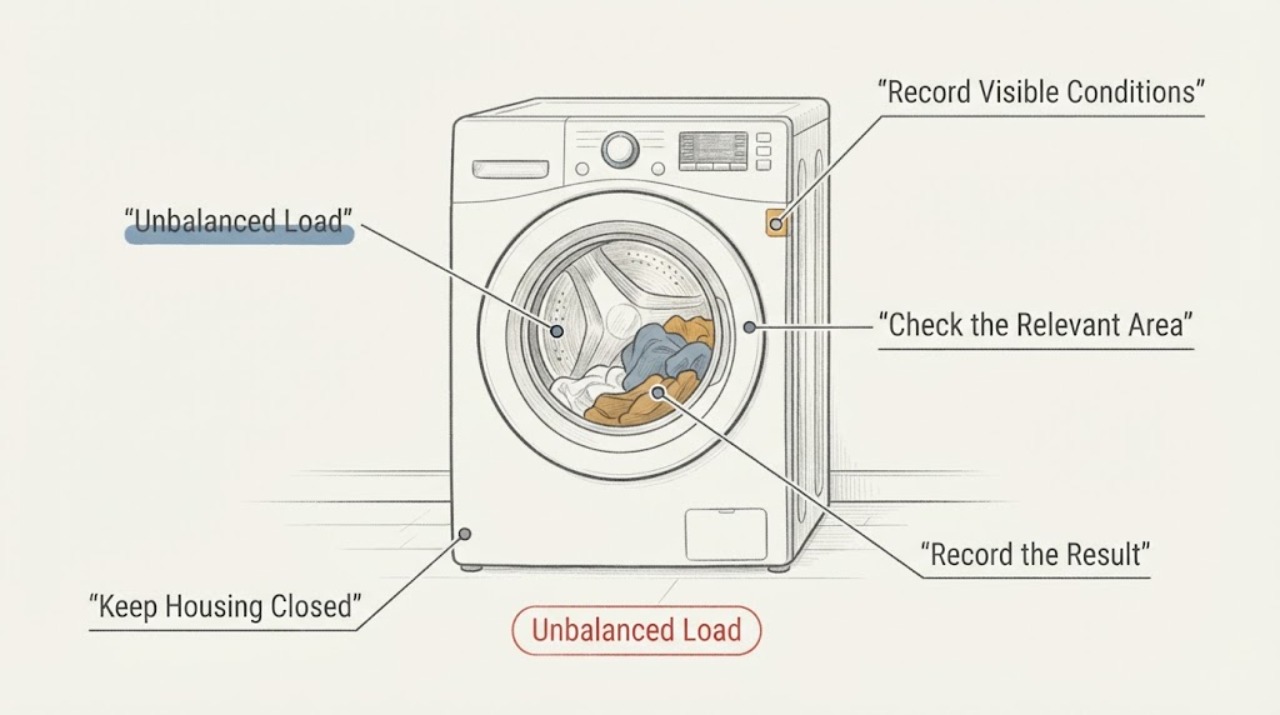
For the assigned Kenmore 110.4470290, treat an unbalanced-load complaint as a symptom to separate into load, installation, and persistent-machine branches before buying a part or deciding to replace a roughly 33-year-old washer. Stop the spin and wait until the basket is fully still. Record whether the problem followed one bulky, wet, or single item, whether the cabinet rocks, and whether the same violent movement or incomplete spin returns with a suitable, evenly distributed load. Whirlpool's opened balance guidance describes noise, vibration, reduced spin, longer cycles, wet clothes, and manual redistribution as typical out-of-balance clues, but that Whirlpool guidance does not prove the exact Kenmore controls or construction. Use Kenmore's official model-specific manual search with the model number entered without punctuation, and do not borrow a procedure or part from another 110 model. Repair is reasonable to investigate when the issue is load or leveling related, or when a technician can name one bounded, safe repair and confirm the required part. Replacement is a decision only after a written diagnosis, repair scope, part availability, and any other safety or structural problems are known; the stated age alone is not a diagnosis or a fixed replacement rule.
Before you begin
Safety first
- Owner-level work is limited to stopping the cycle, waiting for all motion to stop, recording the symptom, checking the model identity, inspecting visible load and floor conditions, and following an exact-model visible instruction. Do not reach into a moving basket, tip the washer, open the cabinet, test energized components, bypass a lid or door switch, or select a suspension, basket, motor, transmission, or control part from the symptom alone.
Work through in order
Diagnostic checks
Use only checks that match the exact appliance or system and its official guide.
-
Check 1
Stop the spin using the Kenmore control only if it responds normally, keep hands and clothing away from the basket, and wait until all motion has stopped. Record the cycle stage, whether the tub was full of water, whether the load contained one heavy or absorbent item, and whether the symptom was banging, cabinet movement, a reduced spin, an incomplete cycle, or wet clothes.
Expected result: The event occurs only with one blanket, towel, rug, small load, or other unevenly distributed load; or it also occurs with an ordinary mixed load and the basket never settles.
Next step: If the problem was clearly load-specific, wait for the basket to stop, redistribute or remove the offending item according to the Kenmore manual, and do not add items to a tightly packed tub. If the pattern is not load-specific, continue to the installation and recurrence checks.
Stop if: Do not reach into a moving tub, hold the cabinet during spin, force a lid or door, or keep running cycles while the washer walks violently, scrapes, leaks, smokes, smells burnt, or trips protection.
Why this matters
Why: Whirlpool's opened guidance associates an uneven load with spin noise, excessive shaking, reduced spin speed, longer cycles, wet clothing, and sometimes a stopped spin. A load-specific event is not evidence that a suspension or drive part has failed.
-
Check 2
With the washer off, the tub still, and the floor dry, check from outside whether the cabinet rocks diagonally and whether every visible foot remains firmly on the floor. Do not move the machine or reach behind it just to perform this check; record a soft, uneven, or damaged floor and any recent relocation or installation change.
Expected result: The cabinet rocks, a foot is not firmly seated, the floor flexes, or the installation is stable and the cabinet does not rock.
Next step: If the manual for this exact Kenmore model authorizes leveling, follow only that visible procedure with the appliance safely isolated. If the floor or installation needs building or plumbing work, use the appropriate professional. If the cabinet is stable, document that result and move to a controlled recurrence decision.
Stop if: Do not tip the washer, remove cabinet panels, place improvised shims under a moving appliance, or adjust hardware while the floor is wet or the power cannot be isolated safely.
Why this matters
Why: Whirlpool's manufacturer guidance says firm foot contact and leveling affect balance, noise, and vibration. A level problem can imitate a machine fault, while a stable installation makes a repeated load-independent symptom more significant; neither result identifies a specific part.
-
Check 3
After a safe redistribution and any exact-model, visible leveling correction, make one supervised attempt with a suitable, evenly distributed load only if the Kenmore manual permits normal operation and there is no safety symptom. Do not use an empty high-speed spin or repeatedly reproduce violent movement. Record whether the same issue returns during spin and whether it also leaves the load wet or the cycle incomplete.
Expected result: The washer completes normally after the load correction, or the same movement, noise, reduced spin, wet load, or stopped cycle returns with a suitable load and stable installation.
Next step: Use the exact Kenmore model manual and arrange qualified service for a persistent recurrence. Give the provider the model, load type, cycle stage, video or notes made from a safe distance, and the result of the load and level checks.
Stop if: Stop immediately for violent walking, metal-on-metal scraping, a tub that strikes the cabinet, a leak, burning odor, smoke, sparks, a hot plug, a damaged cord, or another breaker trip.
Why this matters
Why: A clean result after a load correction supports a load or installation explanation. Recurrence despite those conditions moves the question from 'which load?' to a model-specific service diagnosis; it does not prove suspension rods, bearings, a basket, motor, or transmission.
-
Check 4
Verify the model identity before any repair estimate or part search. Enter 1104470290 without punctuation in Kenmore's official manual finder, compare the result with the rating label and the physical washer, and record any mismatch, missing manual, or different suffix. Do not substitute a nearby 110-series model or a generic top-load procedure.
Expected result: Kenmore returns a matching manual/resource set, returns a different model or no result, or the label is incomplete or unreadable.
Next step: Use the matching manual as the authority for controls and visible maintenance. If identity cannot be confirmed, give the label photo and full model/serial information to a qualified service provider and do not order a part by appearance.
Stop if: Do not remove the console, cabinet, wiring, or serial label to find a hidden number, and do not install a part because another Kenmore 110 model looks similar.
Why this matters
Why: Kenmore states that its manual search uses the model number to retrieve the appliance's manuals and resources. An exact match can narrow the permitted owner checks; a mismatch means platform-specific controls and parts remain unverified.
-
Check 5
For the repair-versus-replace decision, ask for a written diagnosis that names the failed system or assembly, the evidence supporting it, the safe repair scope, whether the exact part is still obtainable, the labor and any follow-up work, and whether the washer has other leaks, corrosion, electrical damage, or structural problems. Treat the user's stated age as context, not as a repair verdict.
Expected result: The technician can identify one bounded repair with a confirmed path and no immediate safety or structural concern, or the diagnosis is uncertain, parts are unconfirmed, multiple systems are affected, or the quote leaves little margin for the household's budget and reliability needs.
Next step: Consider repair when the diagnosis is specific, the work is safe and bounded, and the cost and expected use fit the household. Consider replacement when the problem is not reliably diagnosed, the repair scope is broad or unsafe, key parts cannot be confirmed, or the total risk and cost no longer fit the household; obtain a second opinion for a major recommendation that lacks test evidence.
Stop if: Do not authorize repeated blind part swaps, live electrical testing, cabinet work, or a suspension/drive repair based only on the phrase 'unbalanced load.'
Why this matters
Why: A repair-or-replace decision depends on evidence, scope, safety, and the owner's tolerance for uncertainty. Age alone cannot establish remaining life, repair economics, or part availability, and an unbalanced-load symptom alone cannot establish a failed component.
Use your observations
Decision map
Find the observation that best matches what you see, then follow the next safe action.
-
PATH 01Next step
What you see
The washer completes after a single heavy or absorbent item is redistributed or removed, and it remains quiet and stable with a suitable load.
Do this next
Use the Kenmore manual's loading guidance and monitor ordinary loads. Do not purchase a suspension, basket, motor, or transmission part from this result alone.
Why this path and its safety boundary
Why it matters: The observed pattern is more consistent with load distribution than with a confirmed failed component. Whirlpool describes this as the normal out-of-balance pattern, but the exact Kenmore controls still govern the correction.
-
PATH 02Next step
What you see
The cabinet rocks or a foot is not firmly seated, and the symptom improves after an exact-model, visible leveling correction.
Do this next
Keep the cabinet stable and use the exact model instructions for any further installation work. Arrange service if movement returns or the floor cannot support the appliance safely.
Why this path and its safety boundary
Why it matters: Installation and floor contact are credible contributors to the imbalance. Improvement does not prove the washer has no other wear, so recurrence should still be monitored.
-
PATH 03Next step
What you see
The same violent movement, reduced spin, wet load, or stopped cycle returns with a suitable distributed load and a stable cabinet, or the symptom is accompanied by scraping, leaks, or unusual electrical behavior.
Do this next
Keep the washer out of service and arrange qualified Kenmore appliance service with the exact model and recorded pattern. Do not continue test cycles or order a component without a model-specific diagnosis.
Why this path and its safety boundary
Why it matters: The issue is no longer explained by the first load or leveling check. A platform-specific mechanical, control, or other fault is possible, but the symptom does not identify a part and the safety symptoms raise the urgency.
-
PATH 04Next step
What you see
A written diagnosis identifies one safe, bounded repair with a confirmed part path and no other major concern, or it identifies uncertain/multiple faults, unavailable parts, structural damage, or an unacceptable total repair risk.
Do this next
Choose the option that fits the documented safety, scope, cost, part certainty, and household reliability needs. Request a second written opinion when a major repair-or-replace recommendation is not tied to observable or measured evidence.
Why this path and its safety boundary
Why it matters: The first pattern supports investigating repair; the second supports a replacement discussion. Neither outcome can be determined from the 33-year age or 'unbalanced load' wording alone.
Helpful context
Understand the symptom
A 33-year-old Kenmore may still be worth diagnosing, but an out-of-balance report does not identify a suspension part, basket, motor, or transmission. First establish whether the event is tied to the load or installation. The exact model is important because Kenmore 110-series numbers do not guarantee identical controls or mechanical layouts; Kenmore's official manual finder directs the owner to enter the model number to obtain the applicable manual and resources.
The opened Whirlpool pages are manufacturer guidance for Whirlpool washer families, not an exact Kenmore 110.4470290 manual. They are useful for the observable pattern—noise, shaking, reduced spin, wet clothes, and load redistribution—but any control sequence, cycle name, component, or part decision must come from the Kenmore model documentation or a qualified technician.
When checks do not resolve it
Need a professional?
Request qualified Kenmore appliance service for persistent imbalance with a suitable load, a stable installation that does not explain the movement, scraping, leaks, electrical symptoms, a damaged cabinet or tub, or an unresolved repair-versus-replace diagnosis.
Safety scope: Owner-level work is limited to stopping the cycle, waiting for all motion to stop, recording the symptom, checking the model identity, inspecting visible load and floor conditions, and following an exact-model visible instruction. Do not reach into a moving basket, tip the washer, open the cabinet, test energized components, bypass a lid or door switch, or select a suspension, basket, motor, transmission, or control part from the symptom alone.
Have this ready
- Provide the exact model and serial label information, the model-finder result, the cycle and stage, load type and approximate distribution, whether the tub was full or drained, whether the cabinet rocks, the first location and sound of movement, photos or video taken from a safe distance, and any leaks, odors, sparks, or breaker activity.
Common questions
FAQ
Does being about 33 years old automatically mean this Kenmore should be replaced?
No. Age is useful context, but it does not establish the cause, safety, part availability, or repair economics. First determine whether the problem clears with a suitable load or exact-model leveling check, then compare a written diagnosis and scope with the household's budget and reliability needs.
Can one heavy towel, blanket, or other absorbent item cause an unbalanced load?
It can. The opened manufacturer balance guidance links uneven distribution with spin noise, shaking, reduced spin, and wet clothes. Stop the cycle, wait for the basket to stop, and follow the exact Kenmore manual for redistributing the load; do not use that result to diagnose a part.
Should I order suspension rods or a basket because the washer is out of balance?
Not from that phrase alone. A repeatable imbalance with a suitable load and stable installation needs a model-specific diagnosis. Kenmore's manual finder and the rating label should establish identity before any part is considered, and the service provider should name the failed system and confirm the part path.
When should I stop using the washer instead of trying another load?
Stop for violent walking, the tub striking the cabinet, metal-on-metal scraping, a leak, smoke, burning odor, sparks, a hot or damaged cord, repeated breaker trips, or any situation in which power and water cannot be isolated safely. Keep clear and arrange qualified appliance or electrical help as appropriate.
Read the exact guide
Official sources
- Vibration - Washing a Single ItemsWhirlpool Corporation · Used to cross-check the observable distinction between a single/uneven load, leveling, and recurring vibration; it is not proof of the Kenmore model's controls or mechanical layout.
- Top Load HE Washer is Unbalanced or Overloaded - Product HelpWhirlpool Corporation · Used for general observable balance patterns and the manufacturer-level load/leveling concepts only; it is not an exact Kenmore 110.4470290 manual and does not authorize transfer of controls, cycles, or parts.
- Find Your Manual | Kenmore Appliance Manuals & GuidesKenmore / Transform SR Brands LLC · Supports using the exact model number to retrieve the applicable Kenmore washer manual and resources; it does not establish the internal platform or parts for 110.4470290 by itself.
Community feedback
Share a repair observation
Share a plain-text repair observation. Accepted observations are published automatically; this page may take a moment to update.