
On this page
Start here
Quick answer
“Heavy Duty 70 Series” is a series name, not a complete Kenmore model number, so do not assume that a Cold selection has the same logic as a newer temperature-sensing washer. First read the full model from the rating label and its matching manual, then check from a dry, stopped washer that the hose marked HOT goes to the hot faucet and the hose marked COLD goes to the cold faucet. A short warm burst can be residual water or model-specific temperature control, but water that remains hot on Cold after correct hose routing and a model-appropriate cycle check needs qualified diagnosis; do not replace the inlet valve or open the console based on the symptom. Whirlpool's official guidance is useful for comparison because it documents both reversed-hose symptoms and platforms that may add warm water on a cold setting, but it is not proof of the behavior of an unidentified Kenmore 70 Series model.
Work through in order
Diagnostic checks
Use only checks that match the exact appliance or system and its official guide.
-
Check 1
With the washer off and cool enough to approach safely, photograph the rating label and transcribe the complete Kenmore model, stock or series number, serial number, and the wording around the temperature selector. Search that complete model in Kenmore's official manual library and open the matching owner's manual; do not rely on a manual for another 70 Series number.
Expected result: The label identifies one complete model with a matching manual, or only the words Heavy Duty 70 Series are available and the manual cannot be matched.
Next step: Use the matching manual's cycle and temperature definitions. If the model remains uncertain, record the label photo and arrange service rather than ordering a valve, timer, selector, or control.
Stop if: Do not move the washer, remove the cabinet, or open the control panel to find the model.
Why this matters
Why: The exact model determines whether Cold means tap-cold, a mixed target, or a selector position that operates a particular valve. A series name alone cannot distinguish an older mechanical selector from a later temperature-regulated platform.
-
Check 2
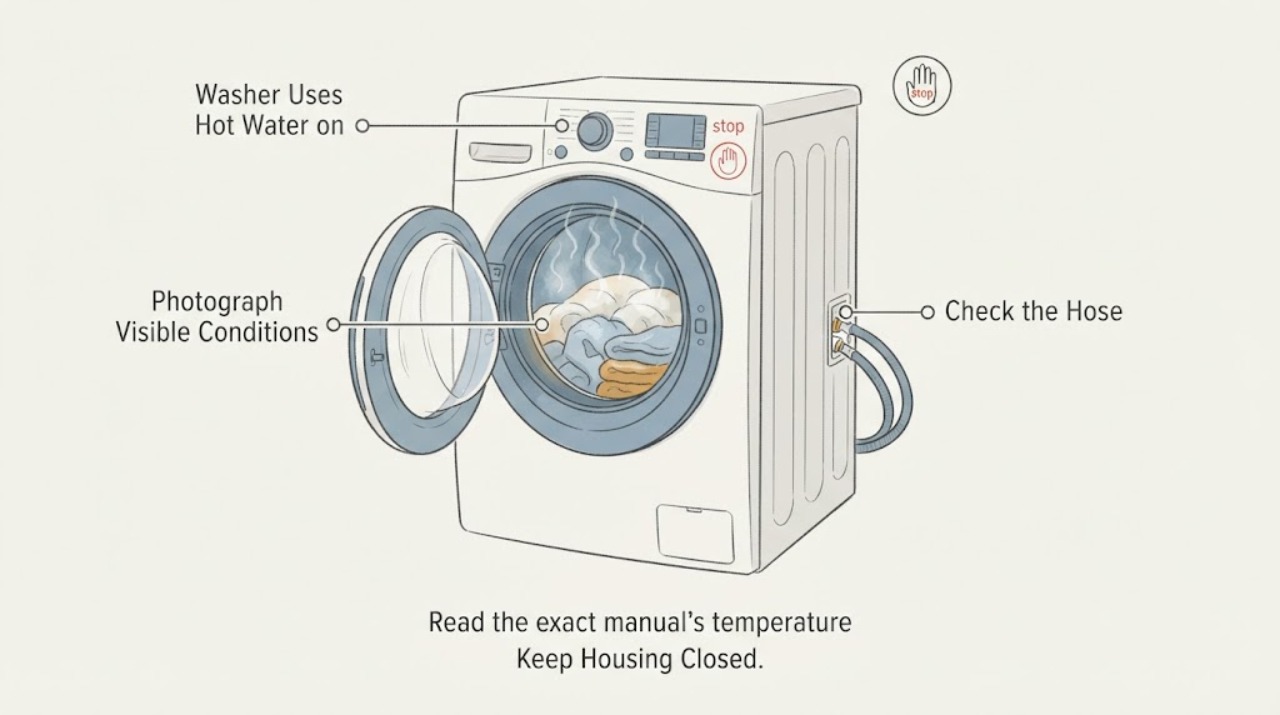
From the front or another dry, accessible position, compare the visible hose labels or color markers at the washer with the wall faucets. The washer's HOT hose should lead to the hot faucet and its COLD hose to the cold faucet. If a correction is required, close both supply valves first and follow the matching manual; do not loosen a pressurized connection or reach behind a moving washer.
Expected result: The hose labels and faucet temperatures agree, the hoses are reversed or unlabeled, or the connections cannot be inspected safely.
Next step: If reversed, correct the pairing only with water shut off, restore connections without leaks, and use the exact manual's check. If already correct or unsafe to access, keep the washer off and continue with model/cycle verification or service.
Stop if: Do not disconnect hoses on a wet floor, while the faucets are open, or while the washer is powered; stop for a cracked hose or active drip.
Why this matters
Why: Reversed inlet hoses can make a Cold selection deliver hot water even though the washer's selector is working. Unlabeled hoses or an unsafe access path leave the connection unverified; they do not prove an internal valve fault.
-
Check 3
Read the exact manual's temperature and cycle table for the program used for the comforter and towels. Confirm whether “Cold,” “Cold/Cold,” “Tap Cold,” or another label applies to the wash and rinse separately, and whether the program changes temperature for fabric, soil, or load size. Do not substitute a modern HE washer's temperature chart for this series.
Expected result: The manual defines the selected program as tap-cold, allows mixing or temperature regulation, or gives no reliable temperature definition for the unidentified series.
Next step: If the manual allows warm mixing, judge the result against that stated behavior and the fabric-care label. If the manual expects cold water and the hot result persists, proceed to the controlled comparison and service branch without opening the machine.
Why this matters
Why: A cold label can have different platform meanings. Whirlpool documents that some washers add warm water to maintain a minimum cold-wash temperature and that actual water temperature is sensed in the tub; that does not establish the same behavior for an older Kenmore Heavy Duty 70 Series.
-
Check 4
If the manual permits a brief user-level fill check, first run the nearby cold faucet into a sink until the tap is cold, then start the selected cold cycle with no hands near the tub. Observe only from a safe position whether the initial water is briefly warm and then cold, remains hot, or the cycle pauses or shows an indicator. Do not touch moving water or continue if the water could burn.
Expected result: The water changes from a brief warm start to cold, remains hot for the cold fill, or the fill cannot be observed safely.
Next step: For a brief transition, monitor one ordinary load only if the manual permits and the fabric label allows it. For sustained hot fill, stop using the affected setting and arrange qualified service with the model, cycle, hose-routing result, and timing; do not test the valve electrically.
Stop if: Do not place a hand in the tub, open a lid lock, bypass a lid switch, or run repeated cycles with hot water that may damage fabrics or burn someone.
Why this matters
Why: A brief warm start is consistent with residual line water or a documented platform temperature strategy; sustained hot fill after correct hose routing and a manual-defined cold program is a repeatable mismatch. An unsafe observation is not evidence of a valve or timer failure.
-
Check 5
Compare the symptom across one model-authorized small, stable load and the comforter/towel load only after the hose and program checks pass. Record the selected temperature, which fill or rinse is warm, whether water changes after the first fill, and whether the load completes normally. Follow fabric-care labels and do not overload the tub.
Expected result: Only one program or load reports warm water, every cold selection stays hot, or the washer also leaks, overfills, stops, or shows an electrical warning.
Next step: Save the comparison and stop using the affected cycle if the mismatch repeats. Arrange qualified appliance service and provide the complete model, program settings, hose mapping, fill stage, and companion symptoms.
Stop if: Stop immediately for a leak, water near electrical parts, smoke, burning odor, sparks, a hot plug, repeated breaker operation, uncontrolled filling, or a tub that will not stop.
Why this matters
Why: A cycle-specific result may reflect that program's temperature logic; an all-cold-selection result after correct routing is more consistent with a repeatable supply/selector/valve control symptom but still does not identify a part. Companion faults raise the service priority.
Use your observations
Decision map
Find the observation that best matches what you see, then follow the next safe action.
-
PATH 01Next step
What you see
The complete Kenmore manual explicitly allows warm-water mixing or defines Cold as a regulated target, and the observed water is within that documented behavior without fabric damage or another fault.
Do this next
Follow the matching manual and fabric-care labels, and monitor without opening the washer. Request service if the temperature becomes sustained hot beyond the manual's description or the behavior changes.
Why this path and its safety boundary
Why it matters: The warm water is a platform or cycle characteristic rather than proof that the inlet valve or selector has failed. A modern temperature-control explanation must not be generalized to other 70 Series models.
-
PATH 02Next step
What you see
The hose marked COLD is connected to the hot faucet, or the hose labels are reversed relative to the washer's inlet markings.
Do this next
Close both supply valves, correct the hose pairing only as the exact manual permits, restore water slowly, inspect for leaks from a dry position, and run no further load if a connection drips.
Why this path and its safety boundary
Why it matters: The external supply path explains a Cold selection producing hot water; this result does not establish an internal valve or selector failure.
-
PATH 03Next step
What you see
The full model manual defines the selected cycle as cold or tap-cold, hoses are correctly routed, and the water remains hot through the cold fill or repeats on more than one cold program.
Do this next
Stop using the affected cold setting and arrange qualified Kenmore appliance service with the model, cycle settings, hose mapping, fill stage, and water-temperature observations. Do not order a valve or timer from a generic 70 Series listing.
Why this path and its safety boundary
Why it matters: A repeatable temperature-selection mismatch remains. A supply, selector, inlet-valve actuation, or control issue is possible, but the symptom does not identify which component or authorize live testing.
-
PATH 04Next step
What you see
The water temperature cannot be checked safely, the model cannot be matched, or the symptom is accompanied by a leak, overfill, smoke, burning odor, sparks, water near electrical parts, a hot plug, repeated breaker operation, or a tub that will not stop.
Do this next
Keep the washer off, close both water valves if safely reachable, isolate power only from a dry safe position, and arrange qualified appliance service; use a plumber for a house supply or faucet problem. Follow local emergency guidance for smoke, fire, or electrical danger.
Why this path and its safety boundary
Why it matters: The evidence is insufficient for a user-level temperature diagnosis or has crossed a water/electrical/mechanical safety boundary.
Helpful context
Understand the symptom
Do not start with a replacement inlet valve. The phrase Heavy Duty 70 Series does not identify one exact Kenmore platform, and older Kenmore washers with similar names can have different controls and hose arrangements. The safe first split is external: confirm the complete model, read its temperature instructions, and verify the HOT/COLD hose-to-faucet pairing with the washer stopped.
There are two different meanings of “hot on Cold.” A brief warm start can be water that was already sitting in a warm supply hose, or a platform may intentionally regulate a selected cold temperature. A sustained hot fill after the hoses are correctly routed, on a cycle that the exact manual says should use cold, is a repeatable mismatch that needs service diagnosis. Whirlpool's temperature pages describe newer platform behavior; they are comparison evidence, not a Kenmore 70 Series manual.
Comforters and towels make load and fabric instructions important, but they do not make it safe to reach into a filling or agitating washer. If water is hot enough to risk a burn, a hose leaks, the floor is wet, the washer smells electrical, or a breaker trips, stop the cycle and isolate water or power only from a dry, safe position before arranging qualified help.
When checks do not resolve it
Need a professional?
Arrange qualified service when the complete model cannot be confirmed, hoses are correctly routed but a manual-defined cold cycle remains hot, more than one cold program repeats the mismatch, or the washer also leaks, overfills, stops, or fails to complete. Stop immediately for water near electrical parts, smoke, burning odor, sparks, a hot plug, repeated breaker operation, uncontrolled filling, a cracked hose, or a tub that will not stop; keep clear and seek urgent appliance, plumbing, electrical, or emergency help as appropriate. Do not open the console, remove the inlet valve, disconnect pressurized hoses, make live measurements, or bypass a lid or safety switch.
Common questions
FAQ
Does Cold always mean tap-cold water on a Kenmore Heavy Duty 70 Series washer?
Not safely answerable from the series name alone. Find the complete model and matching manual first. Some newer washer platforms can regulate or mix water on a cold setting, while an older or different platform may use a selector and separate hot/cold supply path.
What should I check if the Cold setting fills with hot water?
With the washer stopped, dry, and the water valves safely accessible, verify that the hose marked COLD goes to the cold faucet and HOT goes to the hot faucet. Then use the exact manual to determine whether a brief warm start or regulated temperature is expected. Do not disconnect pressurized hoses or open the washer.
Can washing a comforter or towels make the washer choose hot water?
The load can change which cycle or temperature options are available, but it does not justify assuming a failed valve. Check the exact cycle guide and fabric labels, then compare a model-authorized small load only if the water can be observed safely. Repeated hot water on a manual-defined cold program needs service.
Read the exact guide
Official sources
- Only Dispensing Hot WaterWhirlpool · Manufacturer comparison for safe external hose-routing logic only; not proof of a Kenmore 70 Series component or procedure.
- Selecting the Correct Cycle for the Clothes being WashedWhirlpool · General manufacturer comparison only; the Kenmore Heavy Duty 70 Series cycle guide controls the assigned topic.
- Checking the Fill Hoses if the Washer is not FillingWhirlpool · General washer comparison only; any Kenmore-specific hose procedure comes from the exact Kenmore manual.
- Find Your Manual | Kenmore Appliance Manuals & GuidesKenmore / Transform SR Brands LLC · Kenmore model-specific manuals and owner resources
- Cycles, Options, and Modifiers on a Top Load HE WasherWhirlpool · Modern top-load HE comparison only; do not assume this electronic temperature behavior exists on an older Kenmore Heavy Duty 70 Series.
- Getting Cold Water when Warm or Hot was SelectedWhirlpool · General Whirlpool platform comparison only; not an exact Kenmore Heavy Duty 70 Series manual.
Community feedback
Share a repair observation
Share a plain-text repair observation. Accepted observations are published automatically; this page may take a moment to update.