
On this page
Start here
Quick answer
A Kenmore washer door or lid normally stays locked while the basket is moving, while water remains in the tub, or while the water is too hot; a brief power interruption or a control-lock state can also leave the controls or lock indicator active. Record the complete model number and any code, press Start/Pause or Cancel only as the Kenmore manual describes, and use Drain or Drain and Spin if the controls respond and the floor is dry. Wait for motion and hot water to stop. Never force the door or lid, bypass the lock, or remove panels. If water will not drain or the lock remains after safe cooling and one documented reset, keep the washer out of service and arrange qualified repair.
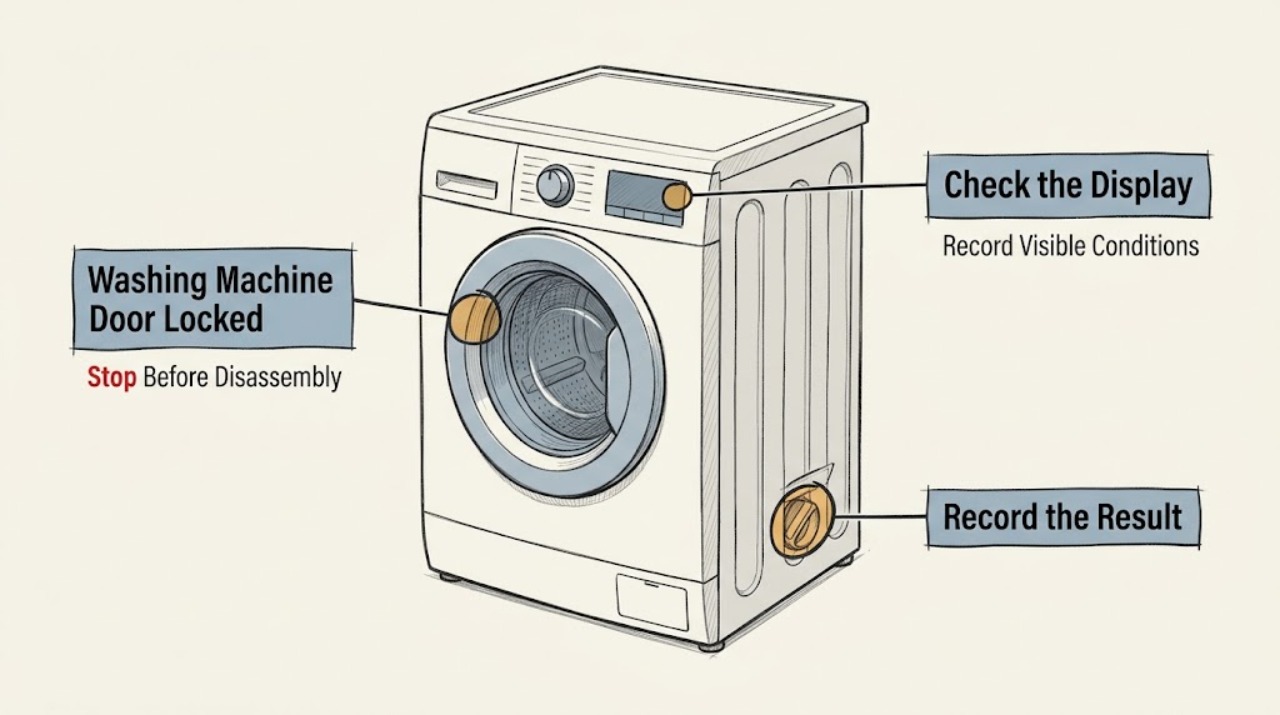
Work through in order
Diagnostic checks
Use only checks that match the exact appliance or system and its official guide.
-
Check 1
Record the complete Kenmore model number, the exact lock icon or code, whether the washer is top-load or front-load, where the cycle stopped, whether water is visible, and whether the basket or drum is still moving.
Expected result: The washer is moving, water is present, the water may be hot, the display is dark, a control-lock message is present, or only the door or lid indicator remains on.
Next step: Follow the matching branch below and keep the recorded details for service. Do not pull the door or lid while a lock indicator is active.
Stop if: Stop for water near electrical connections, a burning odor, smoke, sparking, a damaged cord, an active leak, or uncontrolled movement.
Why this matters
Why: Movement, water level, temperature, power state, and control-lock state lead to different safe next steps. Kenmore manuals are model-specific, so the observed code must be matched to the complete model number.
-
Check 2
Press Start/Pause or the model's documented Pause or Cancel control once, then wait without pulling the door or lid until the drum or basket stops and the lock indicator changes.
Expected result: The machine stops and unlocks, continues a drain or cool-down routine, or remains locked with no motion.
Next step: If it unlocks, remove laundry carefully. If it remains locked, determine whether water or heat remains and use the model-specific drain or cool-down instruction.
Stop if: Stop if the lock clicks repeatedly, the latch or glass is damaged, the machine moves violently, or the controls activate unpredictably.
Why this matters
Why: A lock during active operation protects against moving parts. A remaining lock after motion stops can reflect water, heat, a power event, a control lock, or a latch fault.
-
Check 3
Without opening the locked door or lid, look through the window if present and check whether the tub is visibly full, whether the last cycle used hot water, and whether the display shows a hot, cooling, or water-level condition.
Expected result: Water is above the door opening, the water or glass is hot, the tub appears empty, or the display gives no usable status.
Next step: If water or heat is present, keep the door or lid closed and follow the model's Drain or cool-down path. If the tub is empty and cool, continue to the controls and drain-path checks.
Stop if: Stop if water is leaking toward the outlet, the door glass is cracked, steam or unusual heat is present, or the water cannot be isolated safely.
Why this matters
Why: A high water level or hot water can intentionally prevent unlocking. An empty, cool tub with a persistent lock shifts attention to the latch, control, or power state.
-
Check 4
If the controls respond and the floor and plug are dry, select the exact Kenmore manual's Drain, Drain and Spin, or Spin Only operation once. Keep hands away from the door or lid and observe the drain outlet from a safe position.
Expected result: Water exits normally, water exits slowly, the pump hums without flow, the household drain backs up, or the washer will not accept the drain command.
Next step: If flow is poor, stop repeating cycles and inspect the visible hose and household drain. If the controls do not respond, keep the lock closed and arrange service rather than forcing it.
Stop if: Stop for an active leak, water near electricity, a pump burning smell, smoke, sparking, repeated breaker trips, or a locked door with rising water.
Why this matters
Why: Normal flow may release a front door after the safety conditions clear. Slow or absent flow points toward hose, standpipe, filter, pump, or control trouble; a blocked household drain can mimic a washer fault.
-
Check 5
With the washer off, inspect the visible drain hose behind the machine and its connection to the standpipe, tub, or sink. Look for a kink, crush point, blockage, frozen section, excessive insertion, sealed connection, or a household drain that overflows.
Expected result: The hose is restricted or incorrectly routed, the household drain backs up, or the visible drain path looks clear.
Next step: Correct only an obvious routing issue according to the Kenmore installation guide and clear a reachable household drain without mixing chemicals. If the path is clear, continue to the model-specific filter decision.
Stop if: Stop if moving the washer would strain hoses, the standpipe overflows, the hose is cracked, or clearing the problem requires cabinet removal.
Why this matters
Why: A restricted hose or household drain can leave water in the washer and prevent the lock from releasing. A clear visible path makes an internal filter, pump, latch, or control issue more likely but does not identify the failed component.
-
Check 6
Only if the exact Kenmore manual identifies a user-accessible pump filter or reset procedure, disconnect power from a dry location, let hot water cool, contain residual water, and follow that one documented procedure. Do not open an unlisted panel or use a manual latch release from a generic guide.
Expected result: The model has the documented filter or reset, debris is found, the filter is clear, or the manual provides no user-accessible procedure.
Next step: Reinstall every cap and hose as documented, restore a dry area, and make one supervised test. If the lock or water problem returns, leave the washer out of service for qualified diagnosis.
Stop if: Stop if water is hot, the cap will not turn normally, the lock is jammed, wiring or panels would be exposed, or the reset causes a breaker trip or abnormal noise.
Why this matters
Why: Some washer designs provide a serviceable filter while others do not. A one-time reset can clear a temporary control state but cannot repair a blocked drain, failed latch, pump, or control.
Use your observations
Decision map
Find the observation that best matches what you see, then follow the next safe action.
-
PATH 01Next step
What you see
The drum or basket is moving or coasting and the lock indicator is on.
Do this next
Pause once and wait for all motion to stop. Do not reach through the door or hold a lid switch closed.
-
PATH 02Next step
What you see
Water is visible in the tub or the water and door or lid are hot.
Do this next
Keep the door or lid closed and use the exact Kenmore manual's Drain or cool-down procedure if the controls respond.
-
PATH 03Next step
What you see
The drain hose is kinked, blocked, too deeply inserted, sealed, or the household drain backs up.
Do this next
Correct the visible routing or clear the reachable household drain according to the model instructions, keeping the floor and electrical area dry.
-
PATH 04Next step
What you see
The tub is empty and cool but buttons do not respond, a control-lock indicator is present, or the washer lost power during the cycle.
Do this next
Use the complete Kenmore manual's control-lock command or one model-approved power reset from a dry, safe location; do not guess at button combinations.
-
PATH 05Next step
What you see
The washer is still locked after motion stops, water drains, the machine cools, and the documented cancel or reset has been tried once.
Do this next
Keep the Kenmore washer out of service and arrange qualified appliance repair; do not force the door, bypass the lid lock, or remove panels.
-
PATH 06Next step
What you see
Water reaches electrical connections, a hose leaks, the door glass is damaged, smoke or burning odor appears, sparking occurs, or the breaker trips.
Do this next
Stop using the washer. From a dry, safe location isolate water and power if possible, keep people away, and contact a qualified service resource; do not continue testing.
Helpful context
Understand the symptom
Identify the lock state before touching anything
Kenmore makes both top-load and front-load washers, and a door or lid indicator can mean different things by model. Note whether the basket is moving, whether water is visible, whether the water may be hot, whether the display is lit, and whether the lock indicator is a door or lid state or a control-lock state. Enter the complete model number in Kenmore's manual finder and use that guide for the exact button sequence. Do not treat a code from another Kenmore model as equivalent.
Draining comes before opening a locked front door
If water is inside a front-load tub, the lock may be doing its job. A responsive washer may offer a model-specific Drain, Drain and Spin, or Spin Only command. A drain hose can also be kinked, crushed, obstructed, frozen, or connected to a backed-up standpipe. Inspect only visible routing first. Do not siphon through the door, tip a full machine, or dismantle the cabinet to reach a latch.
A locked lid is a moving-part safety boundary
On a top-load washer, the lid can stay locked until the basket has fully stopped, especially during spin. Pause once and wait for all motion to stop. A hot wash, standing water, a power interruption, or a failed lock can require additional time or service. Never hold a lid switch closed, insert a tool, pull the lid, or bypass the lock to reach laundry.
Only after diagnosis
Potential parts
- door or lid lock assembly
Consider this category only after the washer is still, cool, drained, and the exact model reset or control-lock checks do not clear a persistent lock; a qualified diagnosis must identify the latch fault.
Confirm the complete Kenmore model number and manufacturer fit information. Do not bypass or manually defeat the lock to test it. - drain pump or pump filter assembly
This category is conditional on a clear visible drain path and a qualified diagnosis showing a pump or documented filter fault rather than a door or control condition.
Verify the exact model and documented design before ordering; the symptom alone does not establish compatibility or a failed part.
When checks do not resolve it
Need a professional?
Stop and arrange qualified service for water near electrical connections, an active leak, a locked door or lid with standing water, a latch that will not clear after complete cooling and the model-approved reset, repeated codes, a damaged door or lid, a cracked glass window, burning odor, smoke, sparking, repeated breaker trips, violent movement, or any repair requiring lock bypass, cabinet removal, or live testing.
Common questions
FAQ
Why is my Kenmore washer door locked?
The door or lid may be locked because the washer is still moving, water remains inside, the water is hot, power was interrupted, or a model-specific control-lock state is active. Use the complete model guide and never force the lock.
How can I open a Kenmore washer door with water inside?
Do not force it. If the controls respond and the area is dry, use the exact model's Drain or Drain and Spin operation and wait for the lock to clear. If it will not drain or the lock remains, arrange service.
How long should I wait before opening a locked Kenmore washer?
Wait until the drum or basket has completely stopped and any hot water has cooled. There is no single safe time for every Kenmore model; use the model guide and the lock indicator rather than a timer.
Can I bypass the Kenmore lid or door lock?
No. Do not hold a lid switch closed, insert tools, pull the door, or remove panels to defeat the lock. The lock protects against moving parts, hot water, and access to an unsafe tub.
What if my Kenmore washer will not drain and the door stays locked?
Inspect the visible drain hose and household drain for kinks, blockage, incorrect routing, or backup. Use a model-accessible pump filter only if the Kenmore manual documents it. Persistent no-drain or a locked door needs qualified diagnosis.
When should I stop troubleshooting a locked Kenmore washer?
Stop for water near electricity, leaks, hot or rising water, damaged glass or latch, smoke, burning odor, sparking, repeated breaker trips, violent movement, or a lock that remains after the washer is still, cool, drained, and the documented reset has been tried once.
Read the exact guide
Official sources
- Washer Not Draining or Spinning? Troubleshooting GuideWhirlpool Product Help · General washer drain and spin distinctions, hose routing, unbalanced loads, suds, door state, and model-dependent pump-filter access
- LG washing machine - Whys is water not draining from my washer?LG USA Support · General washer drain hose, household drain, hose blockage, and professional diagnosis guidance
- [LG Front Load Washing Machine] [Signature] Door Won’t OpenLG USA Support · General front-load washer door lock behavior during operation, with water, after heat, or after power interruption
- LG Washer - Recovering From a Locked WasherLG USA Support · General washer lock safety, water-level and temperature conditions, drain-only behavior, power interruption, and service escalation
- Find Your Manual | Kenmore Appliance Manuals & GuidesKenmore · Kenmore model-specific washer manuals and owner documentation
Community feedback
Share a repair observation
Share a plain-text repair observation. Accepted observations are published automatically; this page may take a moment to update.