
On this page
Start here
Quick answer
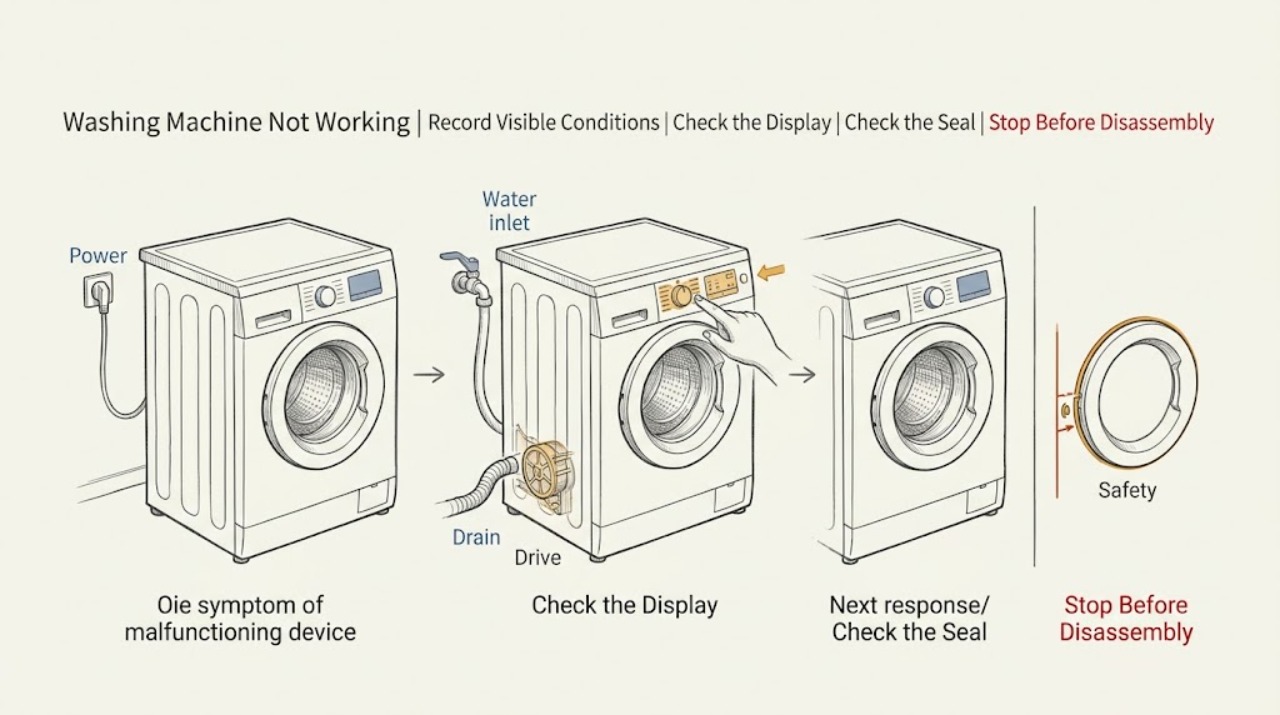
A Kenmore washing machine that is not working should be narrowed by the stage that fails: no display or no response, no start after a command, no fill, no drain, no rotation or spin, a leak, or an error message. Do not keep testing if water reaches the outlet, the cabinet moves violently, or there is a burning smell, smoke, arc, shock, abnormal heat or a repeated breaker trip. From a dry, stable position, check the outlet and visible cord, the selected cycle and door or lid closure, the visible water hoses and drain outlet, and the display message. Kenmore has multiple washer configurations, so use the exact model manual for control-lock, code, filter, reset and user-accessible service instructions. If a safe external check does not restore one complete cycle, arrange qualified appliance service rather than opening the cabinet or replacing a guessed part.
Work through in order
Diagnostic checks
Use only checks that match the exact appliance or system and its official guide.
-
Check 1
Stop the washer and classify the first failed stage without opening it: is the display blank, does it power up but ignore Start, does it fill, does it drain, does the drum rotate or spin, or does it stop with a message? Record the complete display text or code and whether the washer is wet, hot, leaking or unusually noisy. Do not reach into the tub or restart it for a hazard symptom.
Expected result: There is no display, the controls respond but the cycle does not start, water enters but remains, the drum does not rotate, or an error message appears.
Next step: Use the matching branch and the exact model manual. Keep the washer off for a leak, hot or contaminated water, violent movement, abnormal noise or any electrical warning.
Why this matters
Why: A blank panel points first to power or control, while a filled tub points toward drain, door or control sequencing and a non-rotating drum points toward a load, lid or drive branch. A code is model-specific and must not be interpreted from another Kenmore design.
-
Check 2
For a blank or unresponsive panel, inspect the accessible plug, cord and receptacle from a dry position. Confirm the plug is seated and the circuit has not tripped, but do not touch a hot or damaged plug, use an extension cord, repeatedly reset a breaker, or pull the washer through water. If the panel has power, check only whether a control-lock or delayed-start indication is shown in the exact model guide.
Expected result: The receptacle is dead, the breaker trips again, the cord or plug is damaged or hot, the panel is powered but locked, or the external power path appears normal.
Next step: Stop for any electrical warning and obtain qualified appliance or electrical help. If the panel is powered and the model guide identifies a control-lock or delay state, use only its single cancellation procedure; otherwise continue to the door or lid check.
Why this matters
Why: An external supply or control-lock condition can prevent starting, but heat, damage or a recurring trip can indicate a wiring or appliance fault. A normal-looking outlet does not clear a washer that has a burning smell, smoke, spark or shock.
-
Check 3
For a powered washer that will not start, verify the intended programme, the selected options and that the door or lid is fully closed without clothing trapped in the seal. Press Start or Pause once as the exact manual describes and watch from outside for a lock indication, fill sound or immediate drain. Do not force the lid or door, bypass an interlock or add water by hand.
Expected result: The washer starts after the door or lid is closed correctly, remains idle with a lock indication, shows a code, immediately drains, or still gives no response.
Next step: Record the stage and message, then follow only the model-authorized external step. If the washer remains idle or the lock will not release, keep it out of service and arrange technician evaluation.
Why this matters
Why: A corrected closure or option indicates a start-condition issue. A persistent lock, code or immediate drain requires the model's instructions; forcing or bypassing the interlock can create a safety hazard.
-
Check 4
For no-fill or no-drain symptoms, inspect the visible supply and drain paths without moving the machine alone. Look for closed supply valves, kinked inlet hoses, a kinked or displaced drain hose, water backing up in the laundry sink or standpipe, dripping connections or standing water near the base. Do not loosen a wet hose, reach into standing water or pour drain chemicals into the washer.
Expected result: A supply valve is closed, an inlet or drain hose is kinked, the outlet splashes or backs up, a connection leaks, or the visible paths look clear.
Next step: Correct only an accessible valve or hose position according to the exact Kenmore manual. Stop for leakage or backup and arrange plumbing or appliance service; if the paths are clear, continue only with a model-authorized filter or code check.
Why this matters
Why: A restricted supply or drain installation can stop the washer before an internal part is at fault. A leak or backup is a water-damage stop condition, while a clear visible path shifts attention to the cycle, lock, filter or internal pump and control.
-
Check 5
For a washer that fills but will not rotate or spin, wait for the drum to stop and check the load from the opening. Remove a single bulky item, redistribute a one-sided load and check for an obvious overloaded condition, then look for excessive cabinet rocking or a loose-looking foot from outside. Do not hold the cabinet, reach under it, or run another cycle if it walks, bangs, leaks or smells hot.
Expected result: The load is tightly packed or one-sided, the cabinet rocks or moves, the washer drains but still will not rotate, or the load and cabinet appear normal.
Next step: Use the exact manual's load and leveling guidance and perform no more than one safe supervised confirmation. If the drum still will not rotate or movement is severe, keep the washer off and request service.
Why this matters
Why: An unbalanced load or unstable installation can prevent or reduce spin, but a stable washer that will not rotate may have a model-specific lid or door, motor, drive or control fault. Severe movement is not a load experiment.
-
Check 6
After one safe, model-authorized external correction, make at most one supervised confirmation with no hands near moving or wet parts. Watch the display, fill, drain, rotation, visible hoses, floor and sound. Stop immediately for a leak, water near the outlet, violent vibration, scraping, smoke, sparks, burning odor, abnormal heat, shock or another breaker trip.
Expected result: The washer completes the stage, repeats the same failed stage or code, leaves water, does not rotate, or develops a new water, mechanical or electrical warning.
Next step: Return to normal use only if the exact manual permits it and the washer remains dry, stable and free of warning signs. Otherwise keep it out of service and provide the technician with the model and recorded stage details.
Why this matters
Why: A complete stage supports a corrected option, load or visible installation issue but does not prove that internal components are sound. A repeat failure after safe external checks needs model-specific diagnosis.
Use your observations
Decision map
Find the observation that best matches what you see, then follow the next safe action.
-
PATH 01Next step
What you see
The display is blank, the receptacle is dead, or the washer's breaker trips again.
Do this next
Do not keep resetting the breaker or use another outlet as a test. Stop for heat, smoke, sparks, damage or shock and arrange qualified electrical or appliance service.
Why this path and its safety boundary
Why it matters: The problem may be the household supply, cord, receptacle or appliance electrical system rather than a wash-cycle setting.
-
PATH 02Next step
What you see
The panel works but the washer does not start, shows a lock or delay indication, or reports a code.
Do this next
Use the exact Kenmore model manual for one cancellation or reset step, record the complete code and call for service if the condition returns.
Why this path and its safety boundary
Why it matters: A start condition, door or lid interlock, control lock or model-specific fault may be blocking the programme.
-
PATH 03Next step
What you see
The washer will not fill or drain and the visible hoses, valves and household drain are restricted, displaced or backing up.
Do this next
Correct only an accessible hose or valve position according to the model guide; stop for a leak or backup and arrange plumbing or appliance service.
Why this path and its safety boundary
Why it matters: A visible water path or plumbing problem may be preventing the cycle from progressing.
-
PATH 04Next step
What you see
The washer fills but will not rotate or spin, and the load is one-sided or the cabinet rocks.
Do this next
Redistribute the load and use the model's external leveling guidance once. Keep the washer off for repeated severe movement or a machine that still will not rotate.
Why this path and its safety boundary
Why it matters: An unbalanced load or unstable installation is plausible, but persistent failure after correction may indicate a drive, lock or control fault.
-
PATH 05Next step
What you see
The washer leaks, water reaches an outlet or cord, the cabinet moves violently, or there is smoke, a spark, burning odor, abnormal heat, shock or repeated breaker operation.
Do this next
Stop using the washer. Isolate water or power only from a safe, dry position and arrange qualified appliance, plumbing or electrical help; do not restart it to confirm the symptom.
Why this path and its safety boundary
Why it matters: This is a water, impact or electrical safety boundary, not a routine no-operation branch.
Helpful context
Understand the symptom
“Not working” is a set of different symptoms
A blank panel, a washer that accepts a command but does not fill, one that fills but will not drain, and one that drains but will not spin need different next checks. Write down what the display does, what sounds occur, whether water enters or leaves, and the point where the cycle stops. This is more useful than assuming that every Kenmore washer uses the same control or component.
Use the model number before using a code or reset
Kenmore's official manual page asks for the model number and includes washers among its resources. Control-lock behavior, door or lid interlock details, error-code meanings, drain-filter access and reset steps vary by design. A single model-authorized reset can be reasonable when no hazard is present, but a code that returns or a washer that remains dead needs service rather than repeated resets.
Water and electricity change the stop point
A visible leak or standing water near an outlet is not just a performance problem. Keep hands out of water, do not move a heavy washer alone, and isolate water or power only when it can be done from a safe dry position. Smoke, sparks, heat, a shock, a burning smell or a breaker that trips again requires the washer to remain out of service.
When checks do not resolve it
Need a professional?
Call a qualified appliance technician when the washer remains unresponsive after the exact model's safe external checks, a code or lock condition returns, it will not fill, drain or rotate, or any leak, violent movement, mechanical noise, heat, smoke, spark, shock or breaker warning occurs.
Common questions
FAQ
What should I check first when my Kenmore washer stops working?
Identify the first failed stage: no display, no start, no fill, no drain, no rotation, a leak or a code. Then use the exact model manual for the matching check. Do not keep testing when there is water near electricity, violent movement, smoke, a spark, burning odor, heat, shock or a repeated breaker trip.
Why does my Kenmore washer fill but not spin?
Wait for the drum to stop, then check for a one-sided or bulky load and observe whether the cabinet rocks or moves. A balanced load and stable cabinet that still will not rotate points toward a model-specific lock, drive or control problem and needs service rather than repeated cycles.
Can I use an error-code explanation from another Kenmore washer?
No. Kenmore has multiple washer configurations, and code meanings and reset steps can vary. Record the complete message and model number, then use the exact manual; arrange service if the code returns after one authorized reset.
When should I stop troubleshooting a Kenmore washer?
Stop for a leak, water near the cord or outlet, violent vibration, a new grinding sound, smoke, a spark, burning or hot-plastic odor, abnormal heat, a shock or another breaker trip. Isolate water or power only from a safe dry position and obtain qualified appliance, plumbing or electrical help.
Read the exact guide
Official sources
- Home Electrical Safety ChallengeElectrical Safety Foundation International · General appliance safety guidance; it does not identify a Kenmore model or internal component.
- Find Your Manual | Kenmore Appliance Manuals & GuidesKenmore · Use the exact washer model manual before selecting a start, lock, error-code, drain, filter, reset or user-service step.
- Guide to addressing moisture and mould indoorsHealth Canada · General laundry-room moisture and leak guidance; it is not a Kenmore internal repair manual.
- CPSC Guide to Home Wiring HazardsU.S. Consumer Product Safety Commission · General electrical safety guidance for stopping use of an appliance with warning signs; it is not a Kenmore washer diagnosis.
- Laundry Appliances | Washers & Dryers | KenmoreKenmore · Supports distinguishing Kenmore washer configurations and features; it is not a universal repair procedure.
Community feedback
Share a repair observation
Share a plain-text repair observation. Accepted observations are published automatically; this page may take a moment to update.