
On this page
Start here
Quick answer
Treat a visibly wobbling blower wheel or any rotating part that remains powered after the dryer door opens as unsafe to operate, not as a confirmed motor or wheel diagnosis. A KitchenAid owner manual covering multiple dryer models says opening the door or turning the control to OFF stops the dryer, and KitchenAid installation instructions state that an open door stops operation. Unplug the dryer or switch off its dedicated breaker before looking only at the lint screen, lint chute opening, cabinet clearance and door closure; do not reach into the drum, hold the blower, open the cabinet or bypass the door switch. The exact Reddit report found for this symptom names KitchenAid KEYS850LE2, but that community post is not proof of the model in this task and does not establish the cause. If the machine actually keeps running after the door opens, the wheel strikes the housing, or the wobble returns, keep it disconnected and arrange model-specific service.
Before you begin
Safety first
- Keep the dryer unplugged or isolated after abnormal door-open motion, wobble, contact, smoke, burning odor, gas odor or electrical damage. Do not open panels, touch the blower, test or bypass the door switch, defeat an interlock, or run another cycle to reproduce the condition.
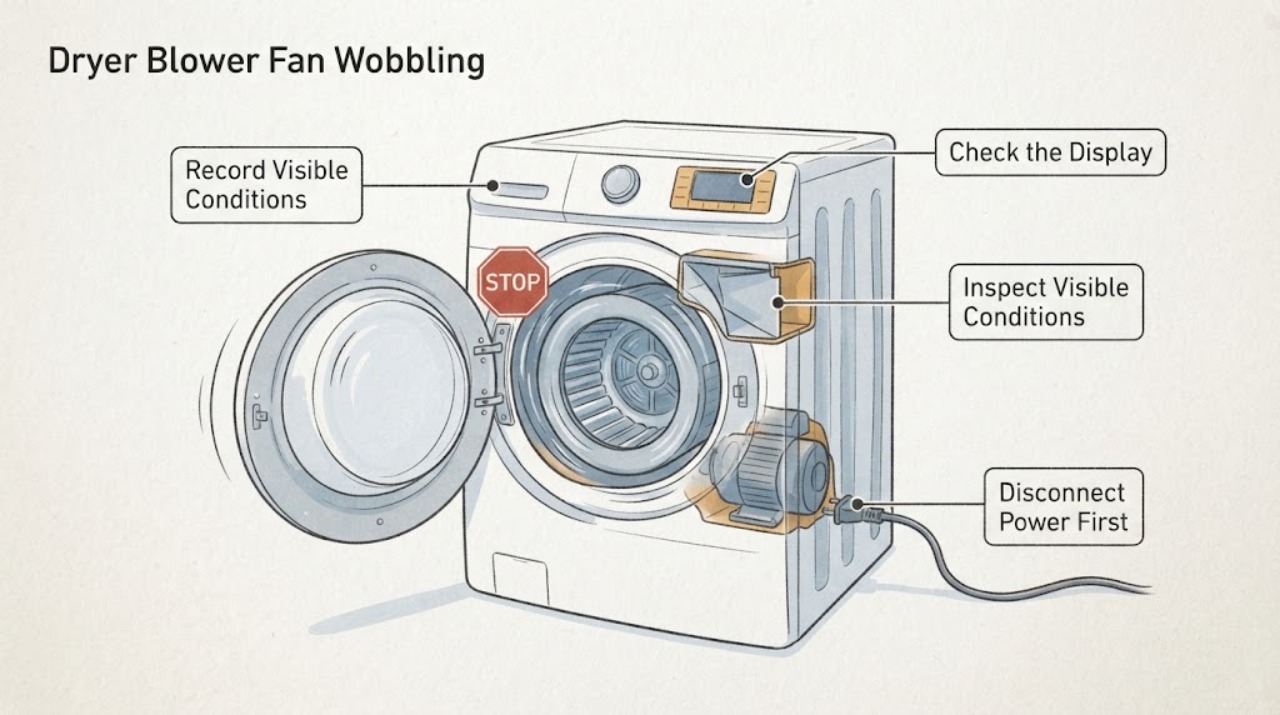
Work through in order
Diagnostic checks
Use only checks that match the exact appliance or system and its official guide.
-
Check 1
Record the complete model number from the dryer label and identify what is visibly moving: drum, blower sound, or a wheel seen through an opening; do this without opening the cabinet or reaching into the drum.
Expected result: The label confirms a KitchenAid dryer model and the motion can be described from a safe position, or the model/moving part remains unknown.
Next step: If the model is confirmed, retrieve that model's Owner's Manual and give the technician the model plus the exact timing of the motion. If either identity or moving part is unknown, keep the article at the external safety boundary and do not infer a blower diagnosis.
Stop if: If the label cannot be read without unsafe access, stop and arrange service rather than removing an access panel.
Why this matters
Why: KitchenAid directs owners to model-specific literature, and the exact Reddit report is for KEYS850LE2; a similar brand name or symptom is not enough to select an internal part or service procedure.
-
Check 2
From a safe position, turn the dryer OFF and open the door only if the dryer is otherwise stable and there is no smoke, burning odor or exposed damage; observe whether the motion stops immediately or only coasts briefly.
Expected result: The drum/fan stops when the door opens, coasts briefly with no power, or continues to be driven or makes contact after the door is open.
Next step: If motion stops and no wobble or contact is present, do not assume the original symptom is reproduced. If motion continues, contact occurs or the stop behavior is uncertain, do not run another test; unplug or isolate the dryer and use the service branch.
Stop if: If opening the door cannot be done without approaching a moving or damaged part, stop testing and isolate the dryer.
Why this matters
Why: KitchenAid documentation says opening the door stops operation. Continued powered motion or contact with the housing does not match that documented stop behavior; a brief coast-down does not identify a failed part by itself.
-
Check 3
Disconnect power at the plug or dedicated breaker before any external inspection; for a gas dryer, leave gas connections and controls untouched and use the model manual or qualified service for gas isolation.
Expected result: The dryer is fully disconnected and cool, or power cannot be isolated, the cord/outlet is damaged, or there is an electrical, burning or gas odor.
Next step: If it is safely disconnected and cool, continue only with the visible lint and clearance checks. If a cord, outlet, gas connection or odor is abnormal, leave the dryer out of service and arrange qualified appliance or gas service; do not re-energize it.
Stop if: If the dryer cannot be made safe to inspect, do not continue.
Why this matters
Why: KitchenAid installation instructions warn of electrical shock and fire hazards and require the correct grounded supply; an energized or hazardous dryer is outside a user cleaning check.
-
Check 4
With power disconnected, remove only the lint screen as the model manual allows and look into the visible lint-chute opening for a loose coin, sock, paper clip or other object; do not insert fingers or tools.
Expected result: A foreign object is visible at the opening, or the chute is clear but the wobble/impact report remains.
Next step: If an object can be removed without reaching into the housing, remove it using a dryer lint brush appropriate to the model and reinstall the lint screen. If it is stuck, damaged or beyond the opening, stop and call service.
Stop if: Do not open the cabinet or infer that the blower wheel, motor or bearing is defective from the sound alone; use the service branch.
Why this matters
Why: The official multiple-brand dryer-noise guide says objects can fall into the lint chute and hit the blower wheel, but a clear opening does not rule in a failed wheel, shaft or motor.
-
Check 5
Check the dryer's exterior stability and clearance: all four feet should be firm, nothing should lean against the cabinet, and a pedestal or nearby washer should not be transmitting contact vibration.
Expected result: The cabinet rocks, a foot is missing, an object touches the cabinet, or the installation is stable and clear.
Next step: If the issue is only an external object or clearly accessible leveling condition, correct that condition without opening the dryer and keep power disconnected until stable. If the blower still wobbles or contacts the housing, arrange service.
Stop if: If the exterior is stable and clear, do not attribute a rotating blower problem to leveling; keep the dryer isolated and arrange model-specific service.
Why this matters
Why: KitchenAid says leveling reduces excess noise and vibration; the official dryer-noise guide also lists cabinet contact, pedestal contents and nearby appliances as external vibration sources.
-
Check 6
Give the technician the model, whether the door-open stop failed, where the sound or contact was heard, whether the lint chute was clear, and any visible blade damage; do not remove the blower, motor, panels or door switch yourself.
Expected result: The technician can match the model literature and inspect the blower/door-interlock system, or the symptom cannot be reproduced safely.
Next step: Keep the dryer unplugged until the technician confirms the door-stop and rotating assembly are safe. If the issue cannot be reproduced, provide the timing and video only if it was recorded from a safe distance without restarting the dryer.
Stop if: Do not reopen or re-energize the dryer to create a demonstration; service must determine the cause.
Why this matters
Why: The available public evidence supports an external safety decision but not a component diagnosis or compatible replacement part for an unknown KitchenAid model.
Use your observations
Decision map
Find the observation that best matches what you see, then follow the next safe action.
-
PATH 01Next step
What you see
The door opens and the rotating motion stops without contact, with no wobble, odor or damage; the original symptom cannot be safely reproduced.
Do this next
Do not repeat the test. Record the model and arrange service if the reported wobble or abnormal noise returns during normal closed-door use.
Why this path and its safety boundary
Why it matters: This matches the general KitchenAid documentation that an open door stops the dryer, but it does not prove that the original report was harmless or identify the part.
-
PATH 02Next step
What you see
The dryer remains powered, the drum or blower continues to be driven after the door opens, or the rotating part strikes the housing.
Do this next
Do not reach in, bypass the door switch or run another cycle. Unplug or isolate the dryer, keep it out of service and arrange qualified KitchenAid appliance service.
Why this path and its safety boundary
Why it matters: That behavior does not match the documented door-stop behavior and creates an entanglement, impact or electrical hazard.
-
PATH 03Next step
What you see
A foreign object is visible at the lint-screen opening and can be removed without reaching into the housing.
Do this next
Remove only the accessible object with an appropriate lint brush, reinstall the lint screen and stop if the noise, wobble or door-open motion remains.
Why this path and its safety boundary
Why it matters: The official dryer-noise guide identifies lint-chute objects as a possible source of blower-wheel knocking, but it does not establish a motor or wheel failure.
-
PATH 04Next step
What you see
The dryer rocks, touches nearby equipment or has an external object on top, but there is no confirmed door-open powered motion.
Do this next
Correct the safe external clearance or leveling condition with power disconnected; if the blower still wobbles or the sound persists, use service rather than opening the cabinet.
Why this path and its safety boundary
Why it matters: External installation can transmit or amplify vibration, and KitchenAid says leveling reduces excess noise and vibration.
-
PATH 05Next step
What you see
The exact model, moving part or safety behavior cannot be confirmed, or the dryer has exposed damage, smoke, burning odor, gas odor, damaged power equipment or a stuck foreign object.
Do this next
Keep the dryer disconnected, do not reproduce the fault or bypass the door switch, and provide the model and observations to qualified appliance service; use emergency gas/fire procedures for an active hazard.
Why this path and its safety boundary
Why it matters: The available evidence cannot select a safe component repair or prove that the reported behavior belongs to a particular KitchenAid platform.
Helpful context
Understand the symptom
Separate the reported symptom from a diagnosis
The exact Reddit post located during research identifies its own appliance as a KitchenAid KEYS850LE2 and reports a blower wheel wobbling, contacting a rear metal panel, and possibly continuing to spin briefly when the door is opened. That is a useful lead for identity, but it is a user report rather than a service finding and it does not establish that the task's dryer has that model. It also does not prove whether the moving part was the blower wheel, drum or a brief coast-down. Keep the model and observation separate until the rating label and a technician confirm them.
What the door should do
The KitchenAid owner manual opened for this research covers several dryer models and says opening the dryer door or turning the cycle control to OFF stops the dryer; the installation instructions likewise say that an open door stops operation. A short, unpowered coast-down is different from a motor or blower that remains driven. Do not put a hand inside to distinguish them. If power remains on or the part keeps rotating beyond a brief stop, treat the door-stop behavior as failed until service confirms otherwise.
Safe external checks only
With the dryer disconnected, record the full model, inspect the lint screen and the visible lint-chute opening for a loose object, and check that nothing is leaning against the cabinet and that the dryer is stable on all four feet. The official multiple-brand dryer-noise guidance says an object in the lint chute can contact the blower wheel and that level or cabinet-clearance problems can amplify vibration. Do not remove panels, touch the wheel, test the door switch, or try to reproduce the fault with the door open.
When checks do not resolve it
Need a professional?
Arrange qualified KitchenAid appliance service immediately if the dryer keeps a rotating part powered after the door opens, the blower wheel wobbles or strikes the housing, the lint chute object cannot be removed externally, or the fault returns after safe external clearance and leveling checks. Stop and isolate the dryer for smoke, burning odor, damaged cord/outlet or gas odor. Do not open the cabinet, replace the blower or motor from a symptom, bypass the door switch, reach into a moving drum or repeat a dangerous test.
Safety scope: Keep the dryer unplugged or isolated after abnormal door-open motion, wobble, contact, smoke, burning odor, gas odor or electrical damage. Do not open panels, touch the blower, test or bypass the door switch, defeat an interlock, or run another cycle to reproduce the condition.
Common questions
FAQ
Does the Reddit post prove that my KitchenAid dryer is KEYS850LE2?
No. That post identifies its own dryer as KEYS850LE2, but the current task supplies no model. Read the rating label and use KitchenAid's model-specific literature before selecting any component or procedure.
Is a brief fan coast-down after opening the door the same as the dryer continuing to run?
No conclusion can be made from a sound or brief motion alone. KitchenAid documentation says opening the door stops operation. Do not reach in or repeat a test; if power remains applied, motion continues, or the wheel contacts the housing, isolate the dryer and call service.
Can I remove the blower wheel or bypass the door switch to check it?
No. The available evidence does not establish the exact model or a compatible part, and the dryer safety documentation supports keeping panels and safety controls intact. Disconnect the appliance and arrange qualified service.
Read the exact guide
Official sources
- Knocking or Rattling Sound - DryerWhirlpool Product Help · Official Whirlpool Product Help page marked for multiple brands; used only for external, non-diagnostic checks and service boundary, not to assert a KitchenAid-specific internal design.
- KitchenAid Dryer Installation Instructions W11595577 Rev AKitchenAid · Official KitchenAid dryer installation instructions; used for documented door-stop behavior, grounded-power warnings and leveling/noise boundary, not for internal repair steps.
- KitchenAid Dryer Owner's Manual 3405635KitchenAid · The manual states that it covers several dryer models; it is used for the general door-open stop rule and safety boundary, not as proof of the unknown task model.
- KitchenAid Owner's CenterKitchenAid · Official KitchenAid Owner's Center; used to identify dryer model-label locations and the need for model/serial information before support.
- Dryer blower wheel rotating freely on motor shaft?r/appliancerepair · The opened post states that the author's dryer is KitchenAid KEYS850LE2 and reports wobble, panel contact and suspected brief spinning after opening; it is not official diagnosis or proof of the current task's appliance.
- KitchenAid Manuals & LiteratureKitchenAid · Official KitchenAid manual portal; used only to require exact model lookup, not as evidence for an unseen manual rule.
Community feedback
Share a repair observation
Share a plain-text repair observation. Accepted observations are published automatically; this page may take a moment to update.