
On this page
Start here
Quick answer
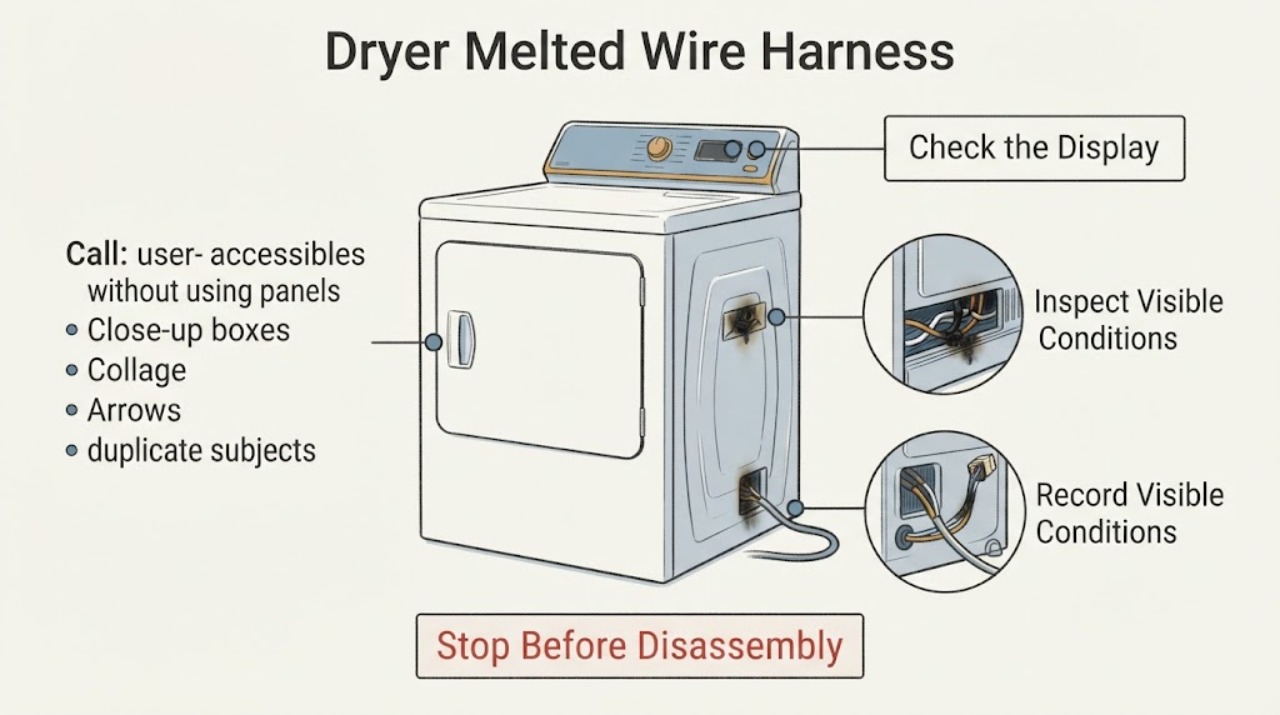
Do not run a KitchenAid KEYS850LE2 dryer after finding a melted or blackened wire harness. Stop the cycle if it is safe, disconnect power only through a safe accessible means, and do not touch the damaged wiring, move the cabinet, reset the breaker repeatedly, or test the dryer again. Smoke, flames, a burning odor, heat, sparking, or a hot electrical connection requires leaving the area and contacting emergency or qualified electrical help as appropriate. Record the exact model and serial information from the dryer label and arrange qualified appliance service; KitchenAid says model-specific tech sheets can contain wiring diagrams and component tests, but they are intended for trained appliance-repair personnel because repair attempts can cause injury or property damage.
Work through in order
Diagnostic checks
Use only checks that match the exact appliance or system and its official guide.
-
Check 1
Stop the dryer immediately. If it is running and stopping is safe, use the normal control; then disconnect power only by an accessible plug or clearly identified supply control that can be operated without touching damaged wiring, a hot cabinet, smoke, or water. Do not pull the cabinet out, remove a cover, or reach toward the harness.
Expected result: The dryer is fully de-energized without contact with the damaged area; power cannot be disconnected safely; or smoke, flame, sparking, heat, or a burning odor is present.
Next step: Keep clear and contact emergency help for fire or active smoke. Otherwise leave the dryer untouched and arrange qualified electrical or appliance service; do not re-energize it to see whether it still runs.
Why this matters
Why: A melted harness creates a service and electrical-safety boundary. Active smoke, flame, or dangerous heat is an immediate hazard, while inability to isolate power safely means the user should not improvise an electrical procedure.
-
Check 2
From outside the appliance only, note whether there is a burning smell, smoke residue, heat at the cabinet or connection, visible arcing, or a breaker that trips when the dryer is used. Do not open the rear, console, terminal block, motor area, or heater housing to look for the burned section.
Expected result: There is active smoke or flame; a persistent odor or heat remains after shutdown; the supply protection trips; or the dryer is cool and there are no further external signs.
Next step: For smoke or flame, leave the area and use emergency procedures. For any damage, heat, odor, or trip, keep power off and tell the service professional exactly what was observed; do not reset protection repeatedly.
Why this matters
Why: Smoke, flame, persistent heat, odor, or repeated trips increase the urgency and do not identify a part that a user can safely replace. A cool, quiet dryer with visible damage is still unsafe to operate because the conductor and its connection have been compromised.
-
Check 3
Read the complete model and serial label from the dryer lid or door area without removing a panel. Confirm that the label says KEYS850LE2 and record when the harness damage was found, whether the dryer was heating or tumbling, and whether a breaker or fuse operated.
Expected result: The label confirms KEYS850LE2; the model differs; or the label cannot be read without opening the cabinet.
Next step: Give the full label information and the observed symptom to KitchenAid support or a qualified technician. Do not substitute a neighboring model's wiring sheet, harness, fuse, or motor connection.
Why this matters
Why: KitchenAid's support and document lookup are model-based, and nearby KEYS850L variants are not proof that the same harness or wiring diagram applies. An unreadable or different label is a reason to preserve the uncertainty rather than select a part by appearance.
-
Check 4
Arrange qualified KitchenAid appliance or electrical service and tell the technician that a harness area is melted or blackened. Provide the exact model, any visible location of the damage, the last normal cycle, heating/tumbling status, and any odor, smoke, heat, or protection-trip event. Do not attempt a splice, crimp, wire-nut repair, harness replacement, bypass, or energized continuity/voltage test.
Expected result: The technician confirms the model-specific wiring documentation and can examine the de-energized dryer; or the available information does not identify the correct harness or initiating fault.
Next step: Let qualified service determine the wiring repair, related component checks, and whether the dryer is safe to return to service. Keep the dryer out of use until that assessment is complete.
Why this matters
Why: KitchenAid's tech-sheet guidance separates professional wiring and component testing from ordinary user troubleshooting. A harness replacement without checking the connected load and cause can leave a second fault energized or create another fire risk.
Use your observations
Decision map
Find the observation that best matches what you see, then follow the next safe action.
-
PATH 01Next step
What you see
Smoke, flame, active sparking, a strong burning odor, or dangerous heat is present around the dryer or its electrical connection.
Do this next
Leave the area and contact emergency help as appropriate. Do not touch the cabinet, use water on an electrical fire, or re-enter to reset the dryer.
Why this path and its safety boundary
Why it matters: This is an immediate fire or electrical hazard, not a component-identification problem.
-
PATH 02Next step
What you see
The dryer is de-energized, but a harness is visibly melted, blackened, scorched, or has damaged insulation.
Do this next
Keep the dryer disconnected and arrange qualified appliance/electrical service. Do not splice the wire, replace only the visibly damaged section, or test the dryer under load.
Why this path and its safety boundary
Why it matters: The electrical path has physical damage even if there is no active smoke and the dryer previously continued to run. The appearance alone cannot identify the initiating fault or a safe replacement part.
-
PATH 03Next step
What you see
A breaker or fuse trips when the dryer is used, or the supply cannot be isolated safely from outside the appliance.
Do this next
Do not reset protection again. Keep clear of the dryer and use qualified electrical or appliance service to isolate and diagnose it.
Why this path and its safety boundary
Why it matters: The supply or appliance may have an unresolved electrical fault, and repeated resetting can increase risk.
-
PATH 04Next step
What you see
No smoke or heat remains and the dryer appears quiet, but the model-specific harness damage has not been professionally assessed.
Do this next
Leave the dryer out of service, provide the exact model and event history, and wait for qualified service to inspect the wiring and related loads.
Why this path and its safety boundary
Why it matters: The absence of an active symptom does not make melted insulation safe; the circuit can still be compromised.
Helpful context
Understand the symptom
A melted harness is visible electrical damage, not a normal dryer adjustment. The blackened spot does not establish whether the initiating problem was a loose connection, overload, heat exposure, a failed component, or another wiring fault. Because this model is an electric dryer on a dedicated high-voltage circuit, continued operation can add fire, shock, or equipment damage risk; do not infer a repair from the appearance of one wire.
Keep the dryer closed and de-energized while arranging service. KitchenAid directs owners to use the complete model number for manuals and support, and its tech-sheet guidance explains that wiring diagrams, pin-outs, and component tests are professional service data. The safe handoff is the model, serial information, what was observed, and any trip, odor, heat, or smoke history—not a guessed harness or replacement component.
When checks do not resolve it
Need a professional?
Qualified appliance or electrical service is required for any melted, blackened, or scorched harness on the KitchenAid KEYS850LE2. Provide the complete model and serial information and the external event history. Do not order a wire harness, motor, heater, terminal, fuse, connector, or control from the appearance alone; the initiating fault and exact fit must be verified by the technician.
Common questions
FAQ
Can I keep using the KitchenAid KEYS850LE2 if the melted wire is no longer hot?
No. Melted or blackened insulation is physical electrical damage even when the dryer is cool and quiet. Keep the dryer de-energized and arrange qualified service before any further operation.
Can I replace only the visibly burned section of the dryer harness?
Do not choose or splice a repair from the appearance alone. KitchenAid says model-specific tech sheets can include wiring diagrams and component tests, but they are intended for people with electrical, electronic, and mechanical repair experience. Have qualified service identify the initiating fault and exact repair.
What information should I give the technician?
Give the complete KEYS850LE2 model and serial information, where the visible damage was noticed, whether the dryer was heating or tumbling, the last normal cycle, and any smoke, odor, heat, spark, breaker, or fuse event. KitchenAid identifies dryer model labels on the lid or door and uses the model number for manuals and service documentation.
Read the exact guide
Official sources
- Dryer Safety — Installation InstructionsKitchenAid / Whirlpool Corporation · KitchenAid dryer safety, electrical requirements, fire/electric-shock precautions, and service boundaries; used here for safety principles rather than as a model-specific wiring diagram.
- Where Can I Find the Tech Sheet for My Appliance?KitchenAid Product Help · KitchenAid model-specific tech-sheet scope and professional safety boundary for wiring diagrams and component testing.
- Customer Service | KitchenAidKitchenAid · KitchenAid major-appliance service, support, product-help, model-number, parts, and scheduling routes.
- Dimension Guide — KitchenAid Electric DryerKitchenAid / Whirlpool Corporation · KitchenAid KEYS850L-family installation electrical requirements, used to bound the assigned KEYS850LE2 model as an exact-label check rather than to transfer a wiring diagram.
- Kitchen Appliance Manuals | KitchenAidKitchenAid · KitchenAid manual and service-document lookup for the complete assigned model KEYS850LE2; the page requires the appliance model number to retrieve matching literature.
- How to Find Your Model NumberKitchenAid · KitchenAid model-label location guidance for confirming the assigned KEYS850LE2 dryer identity.
Community feedback
Share a repair observation
Share a plain-text repair observation. Accepted observations are published automatically; this page may take a moment to update.