
On this page
Start here
Quick answer
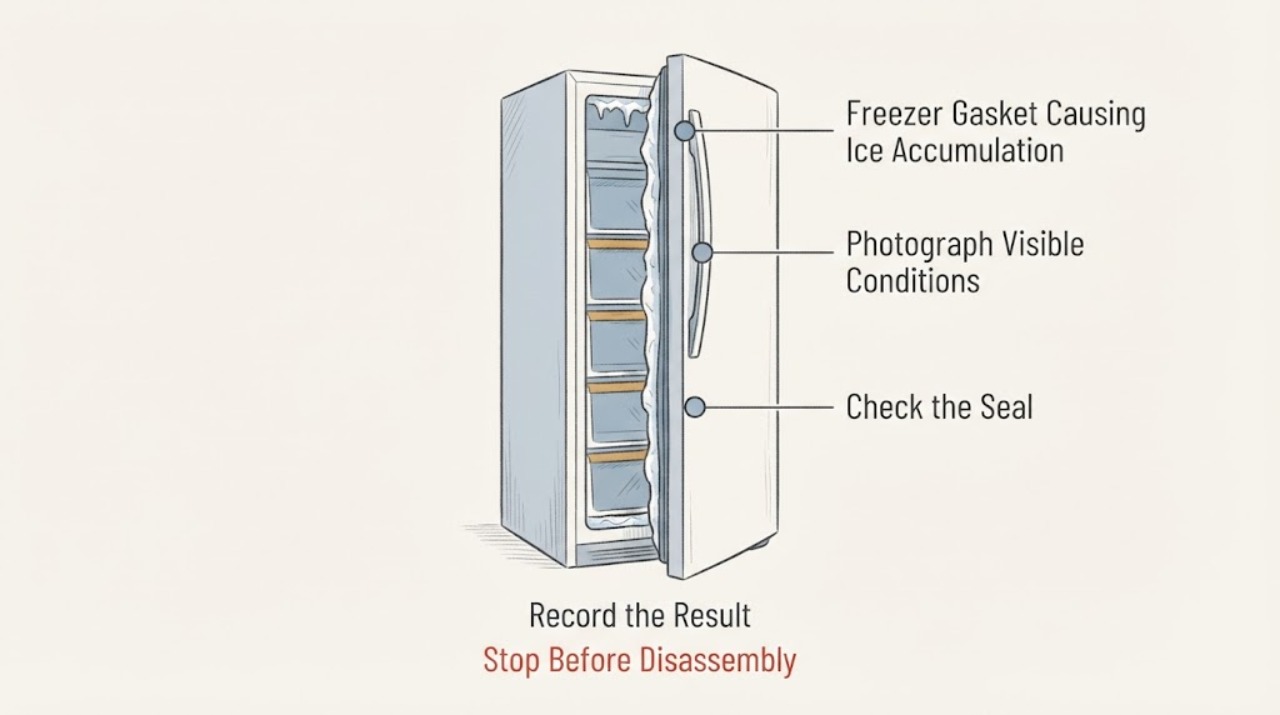
A KitchenAid freezer gasket can cause ice when warm, moist room air enters through a gap, but the gasket should be verified before accepting a repair quote. Record the exact model, inspect the seal and door alignment, clean the gasket and contact surface, and use a paper-resistance check around the closed door. If frost is thick, defrost safely according to the model manual; if the seal still has a gap or frost returns after the freezer is fully dry, ask for a written, model-specific diagnosis that separates a gasket, door/liner, alignment, or other cooling repair. The part price alone cannot establish whether a quoted labor total is appropriate.
Work through in order
Diagnostic checks
Use only checks that match the exact appliance or system and its official guide.
-
Check 1
Photograph the rating label and record the complete KitchenAid model number, freezer configuration, visible frost location, and the written scope of the repair quote.
Expected result: The model and quote identify a gasket-only repair, a door or liner assembly, alignment work, or an unspecified job.
Next step: Ask the service provider to state the diagnosed failed part, whether the door or liner is involved, the labor scope, and what warranty is included before approving work.
Why this matters
Why: The part price and labor effort depend on the exact appliance construction and repair scope; a generic gasket price cannot validate a total quote.
-
Check 2
With the freezer closed and unloaded only as needed, inspect the gasket around the entire perimeter for tears, flattened sections, dirt, gaps, or a corner that is pulled away from the cabinet; also check that food packages, shelves, or drawers are not blocking closure.
Expected result: The gasket is visibly damaged or dirty, the door cannot close fully, or the seal appears continuous and the door closes without obstruction.
Next step: Clean only an accessible dirty gasket with the care method in the owner manual and remove an obvious obstruction. Do not reshape, cut, glue, or force the seal.
Why this matters
Why: A damaged or obstructed seal can let warm air enter and promote frost, while a visually intact seal shifts attention to alignment, airflow, defrost, or another cause.
-
Check 3
Perform KitchenAid's paper check at several points around the closed freezer door: place a sheet across the gasket, close the door, and gently pull.
Expected result: The paper has consistent resistance around the perimeter, or it slides out freely at one or more corners or sections.
Next step: Photograph any repeatable gap and include it in the service request. Obtain the exact model procedure before ordering a replacement gasket or changing door hardware.
Why this matters
Why: Resistance supports contact at that location; paper that slides freely indicates a possible loose seal at that point, but it does not prove whether the gasket, door, liner, hinge, or alignment is responsible.
-
Check 4
If frost is thick enough to block the drawer, vents, or gasket contact, follow the KitchenAid defrost boundary: disconnect power, protect the food, catch meltwater, use warm water and a plastic scraper or wooden spoon, and dry the freezer completely before reconnecting it.
Expected result: The frost clears and the door seals normally after a full dry, or frost returns at the same seal area after normal operation resumes.
Next step: Never use a knife, ice pick, heat gun, or other sharp or high-heat tool. If frost returns, stop repeating defrosts and arrange model-specific service.
Why this matters
Why: A temporary improvement after defrost removes the immediate ice obstruction but does not prove the gasket is fixed. Recurrence points to continuing warm-air entry or another model-specific cooling/defrost issue.
-
Check 5
After the freezer is dry and the door closes without obstruction, monitor the same gasket section and frost pattern during normal use without repeatedly opening the door.
Expected result: The seal remains evenly contacted and frost does not return, or frost and a visible gap return at the same location.
Next step: For recurrence, request a written KitchenAid-authorized diagnosis tied to the exact model and ask the provider to explain why the proposed repair scope is needed. Do not rely on the quoted amount alone.
Why this matters
Why: A stable seal after correction makes an obstruction, dirt, or temporary frost interference more plausible; recurring localized frost makes a persistent sealing or door-assembly issue more likely but still does not establish a specific replacement part.
Use your observations
Decision map
Find the observation that best matches what you see, then follow the next safe action.
-
PATH 01Next step
What you see
The gasket is visibly damaged or the paper slides freely at the same corner while the door and liner appear aligned.
Do this next
Request an itemized, model-specific gasket quote and installation scope; do not infer a fair total from the part cost or from another KitchenAid model.
Why this path and its safety boundary
Why it matters: A gasket sealing problem is plausible, but the exact model still determines whether the seal is a separate part and how it is installed.
-
PATH 02Next step
What you see
The gasket is clean and continuous, the paper has resistance all around, and the door closes squarely but frost returns.
Do this next
Do not approve a gasket-only repair solely because frost is present. Ask for the observed failure and exact model-based diagnosis, or obtain another qualified service opinion.
Why this path and its safety boundary
Why it matters: The gasket alone is not established as the cause; alignment, airflow, defrost, or another cooling condition may need professional diagnosis.
-
PATH 03Next step
What you see
Frost blocks the door or vents, and the freezer has not yet been safely defrosted and dried.
Do this next
Use the model manual and KitchenAid's safe defrost method, then repeat the seal check only after the freezer is dry. Stop if the appliance cannot be safely disconnected or water reaches electrical parts.
Why this path and its safety boundary
Why it matters: The ice itself can prevent proper closure and airflow, so a gasket test made against the frost may be misleading.
-
PATH 04Next step
What you see
A service quote does not identify the model, diagnosed part, labor scope, or whether it includes a door/liner or alignment repair.
Do this next
Request a written itemization and model-specific explanation before approving the work. The source material does not support declaring any universal normal price.
Why this path and its safety boundary
Why it matters: The quote cannot be meaningfully compared with the reported gasket part price, and the repair identity remains incomplete.
Helpful context
Understand the symptom
The reported symptom and quote are related, but the amount cannot be judged from the gasket price alone. KitchenAid freezer designs differ, and a technician may be quoting a gasket-only job, door or liner work, alignment, or a different source of frost. Confirm the leak path and the exact model before comparing quotes.
Keep the freezer closed as much as possible while checking it. Do not cut the gasket, inject foam, pry the door, use a heat gun, or chip frost with a knife. If a full defrost is needed, use the model manual and KitchenAid's safe defrost guidance.
When checks do not resolve it
Need a professional?
A qualified refrigerator technician should inspect the exact KitchenAid model's gasket, door/liner alignment, hinge or support structure, airflow, and defrost/cooling system before selecting parts or accepting a repair scope. No generic price can be inferred from the gasket's retail cost.
Common questions
FAQ
Is $1,400 a normal price for a KitchenAid freezer gasket repair?
There is no universal price that can be verified from the gasket's part cost or from this symptom alone. Ask for the exact model, diagnosed failure, labor scope, whether a door or liner is involved, and the parts/labor warranty; compare itemized quotes rather than a headline total.
Can ice buildup prove that the gasket is bad?
No. A gasket gap can admit warm, moist air and create frost, but frost can also involve door obstruction, airflow, temperature, defrost, drain, or other cooling conditions. Verify the seal and repeat the check after a safe defrost if ice was blocking contact.
Can I use a heat gun or knife to reshape the seal or remove the ice?
No. KitchenAid's defrost guidance says to disconnect power, use controlled warm-water thawing and a plastic scraper or wooden spoon, and avoid knives or other sharp tools. Do not cut, glue, inject foam, or force the gasket.
Read the exact guide
Official sources
- Troubleshoot Your Refrigerator’s Possible ProblemsKitchenAid · Opened KitchenAid official refrigerator guidance. It supports cleaning the gasket, removing door obstructions, and regular freezer-seal inspection but does not establish exact-model repair pricing.
- 4 Signs Your Freezer Is Too Cold & Possible SolutionsKitchenAid · Opened KitchenAid official guidance for freezer frost causes and prevention. It connects warm/moist air and gasket gaps with frost, while preserving model-manual scope for settings and defrost.
- How to manually defrost a freezerKitchenAid · Opened KitchenAid official defrost guidance. The owner manual remains controlling for the exact freezer model; this source supports the general safety boundary and no-sharp-tool rule.
- 9 Possible Freezer Troubleshooting Fixes & TipsKitchenAid · Opened KitchenAid official freezer troubleshooting page. It supports checking gasket wear and external conditions and directs professional inspection for recurring leaks, frost, coils, drain, defrost, or cooling issues.
- Possible fixes for a freezer that’s not freezingKitchenAid · Opened KitchenAid official family-level freezer guidance. It supports an external gasket paper check and points to professional diagnosis for persistent frost or component issues; it does not establish a specific model's gasket fit or any repair price.
Community feedback
Share a repair observation
Share a plain-text repair observation. Accepted observations are published automatically; this page may take a moment to update.