
On this page
Start here
Quick answer
Do not use a KitchenAid gas oven whose door will not close fully: heat and combustion can escape, and the door may not engage its safety or latch position. Let the oven cool completely, then remove only an obvious rack, pan, packing material, food, or soil that is blocking the frame. Confirm that the racks are fully seated and that a self-clean latch is not still engaged. Do not force the door, bend the latch, adjust a gas connection, or remove the door unless the exact manual and a safe, cool appliance explicitly support that work. A door that remains crooked, springs back, has a damaged hinge, seal, latch, glass, or frame, or requires door removal needs qualified KitchenAid appliance service; any gas odor, smoke, flame, hot glass, or damaged hardware is an immediate stop condition.
Before you begin
Safety first
- This article supports cool-down, removal of obvious obstructions, rack and bakeware checks, normal model-approved latch steps, visual alignment checks, and documentation only. Do not run a gas oven with the door open or work on its gas, electrical, hinge, latch, glass, or safety parts.
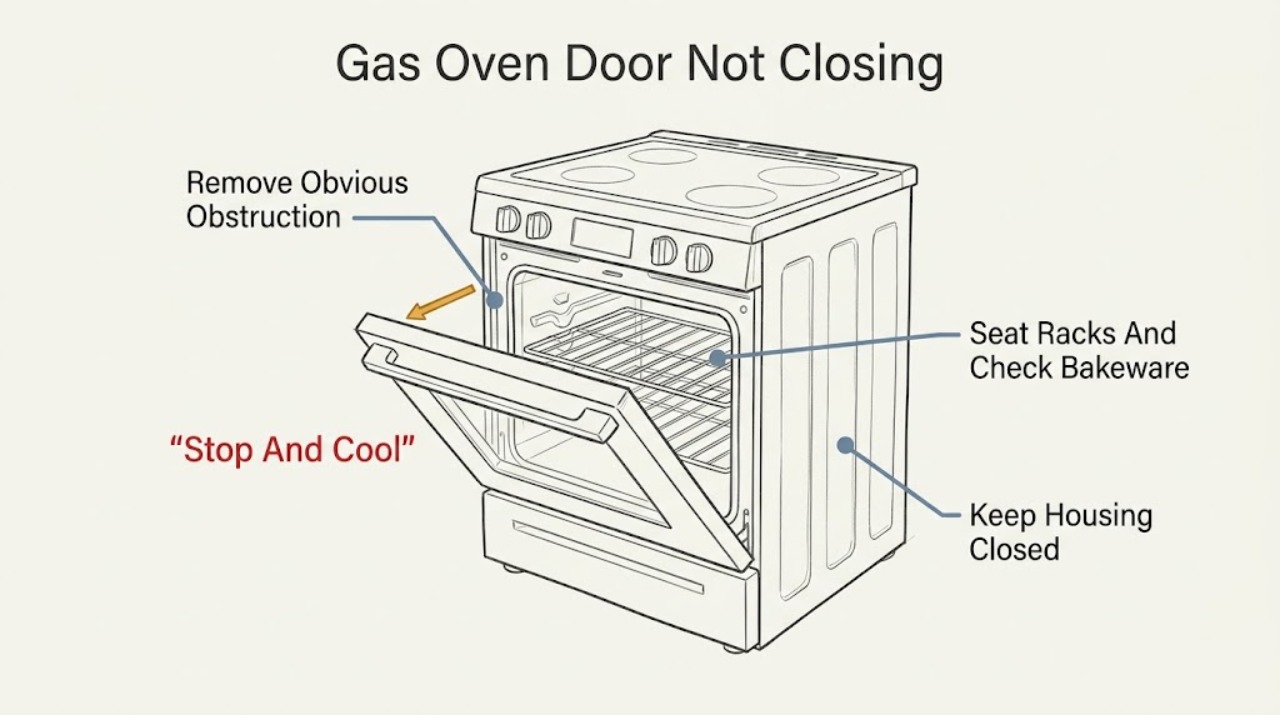
Work through in order
Diagnostic checks
Use only checks that match the exact appliance or system and its official guide.
-
Check 1
Turn the gas oven off using its normal control only if there is no gas odor, smoke, or electrical hazard, keep the oven unused, and allow the door and cavity to cool before inspecting them.
Expected result: Record whether the door is fully open, partly closed, springing back, rubbing, visibly skewed, or hot, and whether the oven had been baking, broiling, or self-cleaning.
Next step: Keep the gas oven off and use the emergency branch for gas odor, smoke, flame, or electrical warning; otherwise continue only when the appliance is cool.
Stop if: Do not force a hot door, run another cycle, hold it closed, or touch the glass, gasket, hinge, or latch while hot.
Why this matters
Why: A hot or self-cleaning oven can make the latch and glass unsafe to handle; an uneven or springing door suggests alignment or hinge trouble rather than a simple obstruction.
-
Check 2
With the oven cool, remove only obvious cookware, bakeware, food, packing material, or loose soil that is in the door path; do not pry against the glass, gasket, latch, or frame.
Expected result: Check whether the door closes evenly after the obstruction is removed, or whether it still stops at the same point, rubs, or leaves a gap.
Next step: If the door now closes normally without force, follow the model manual before any use; otherwise keep the oven off and continue with rack and latch checks.
Stop if: Do not scrape with a sharp tool, pull on the gasket, bend the latch, or force the door past resistance.
Why this matters
Why: A pan, food residue, shipping material, or other item can physically block the door. If the same gap remains with the cavity empty, the cause is more likely a rack, latch, hinge, seal, or frame issue.
-
Check 3
Verify that every oven rack is fully pushed into its guides and that no roasting pan, baking dish, or roll-out rack is oversized or projecting into the door path.
Expected result: Record whether a rack is out of position, a roll-out rack is not fully engaged, or the door closes when the racks and bakeware are removed.
Next step: Correct only the rack or cookware position allowed by the manual; if the empty door still will not close, do not operate the oven and inspect the latch and alignment visually.
Stop if: Do not push a rack against the door, use an oversized dish, or run the gas oven with the door partly open.
Why this matters
Why: An incompletely seated rack or oversized dish can hold the door open even when the hinges and latch are sound.
-
Check 4
If the door was locked during or after self-cleaning, confirm that the cycle has been canceled according to the exact KitchenAid manual and wait until the oven is cool before checking the latch position.
Expected result: Record whether a lock indicator or latch arm remains engaged, whether the oven is still warm, and whether the manual's normal cancel or unlock procedure returns the latch to its rest position.
Next step: Leave the oven off and arrange service if the latch does not release through the model-approved procedure or if the door still will not close.
Stop if: Do not pry the door open, defeat the latch, start self-clean again, or reach into a hot cavity.
Why this matters
Why: A self-clean cycle intentionally locks the door and may keep it locked while the cavity is hot; a latch that stays engaged after cooling or moves abnormally may be faulty.
-
Check 5
From a safe, cool position, visually compare the door gap on both sides and inspect the gasket, glass, handle, hinge areas, frame, and latch for displacement, cuts, cracks, looseness, or visible interference.
Expected result: Classify the door as evenly aligned and undamaged, low on one side, separated from a hinge slot, blocked by a deformed seal, cracked, or damaged at the glass, handle, frame, or latch.
Next step: Keep the gas oven off and provide photos and the model number to a qualified technician when alignment, seal, glass, hinge, latch, or frame damage is present.
Stop if: Do not move or stretch the gasket, bend hardware, remove the door, tighten hidden fasteners, or handle broken glass.
Why this matters
Why: An even gap with no damage supports a minor obstruction or latch-state branch. A skewed gap, damaged gasket, broken glass, loose hinge, or bent latch can prevent sealing and requires service.
-
Check 6
Without relighting or running the oven, record whether there was gas odor, delayed ignition, an abnormal flame, smoke, soot, a bang, a burning smell, or a carbon-monoxide alarm while the door problem occurred.
Expected result: Record no warning, gas odor or hissing, smoke or flame, soot or delayed ignition, or an alarm or compatible symptoms such as headache, dizziness, nausea, or shortness of breath.
Next step: Use the emergency branch for any gas, smoke, flame, alarm, or symptoms; after the area is safe, request qualified gas-appliance service before any reuse.
Stop if: Do not use a flame to test for gas, operate switches near a suspected leak, run the oven with the door open, or re-enter after an alarm until responders permit it.
Why this matters
Why: These signs may indicate a fuel leak, combustion problem, fire, or carbon-monoxide exposure and take priority over the mechanical door diagnosis.
-
Check 7
If the empty, cool door still will not close evenly or the cause requires a hinge, latch, seal, glass, frame, gas, or internal repair, leave the cooker off and arrange qualified KitchenAid appliance service.
Expected result: Give the technician the exact model, door position, self-clean history, obstruction result, visible damage, lock state, and any gas, smoke, heat, or alarm warning.
Next step: Keep the gas oven out of service until the repair is completed and the technician confirms that the door closes and the appliance is safe.
Stop if: Do not remove the door, disassemble a hinge or gas path, bypass a latch, or operate with a door that does not fully close.
Why this matters
Why: Persistent resistance or misalignment is not corrected safely by force; the technician must verify door retention, heat sealing, latch operation, and gas-oven safety.
Use your observations
Decision map
Find the observation that best matches what you see, then follow the next safe action.
-
PATH 01Safety boundary
What you see
There is gas odor, hissing, smoke, flame outside normal operation, a bang, soot, or a burning or electrical smell.
Do this next
Avoid flames, switches, plugs, phones, and the oven; leave the area and contact emergency or gas-leak help from a safe location.
Why this path and its safety boundary
Why it matters: This is a gas, fire, or combustion emergency rather than a door adjustment.
Safety stop: Do not relight the oven, operate the latch, reset power repeatedly, or re-enter until qualified responders say it is safe.
-
PATH 02Safety boundary
What you see
A carbon-monoxide alarm sounds or anyone has compatible symptoms while the gas oven is operating or has operated.
Do this next
Move outside to fresh air, seek emergency help, and do not re-enter or operate fuel-burning appliances until responders permit it and trained personnel inspect them.
Why this path and its safety boundary
Why it matters: Carbon monoxide is odorless and may be present even without a gas smell.
Safety stop: Do not silence the alarm, search indoors for the source, or run the oven to reproduce the condition.
-
PATH 03Safety boundary
What you see
The door closes normally after removing an obvious obstruction, fully seating racks, or removing an oversized dish.
Do this next
Follow the exact model manual, keep bakeware and racks clear of the door path, and use the oven only when the door closes and seals without force.
Why this path and its safety boundary
Why it matters: The original problem was likely physical interference rather than proven hinge or latch failure.
Safety stop: Stop if the door rubs, springs back, leaves a gap, or requires pressure again.
-
PATH 04Safety boundary
What you see
The oven recently ran self-cleaning and the lock or latch remains engaged while the oven is hot or cooling.
Do this next
Wait for the oven to cool and follow the model's normal cancel or unlock instructions; arrange service if the latch remains engaged after the permitted procedure.
Why this path and its safety boundary
Why it matters: The lock may be operating as designed during the cool-down period.
Safety stop: Do not pry the door, force the latch, or restart self-cleaning to clear the lock.
-
PATH 05Safety boundary
What you see
The door is crooked, has an uneven gap, a damaged hinge, latch, gasket, handle, glass, or frame, or still resists with the cavity empty and cool.
Do this next
Keep the gas oven off and arrange qualified KitchenAid appliance service; provide the model and safe photos of the damage.
Why this path and its safety boundary
Why it matters: The door cannot be trusted to contain heat or operate its latch and safety functions.
Safety stop: Do not remove the door, bend the hinge or latch, stretch the gasket, handle broken glass, or test the oven with the door partly open.
-
PATH 06Safety boundary
What you see
No obstruction or self-clean latch explains the problem, but the door still will not close fully.
Do this next
Keep the appliance out of service and request model-specific diagnosis rather than applying force or replacing a part by symptom alone.
Why this path and its safety boundary
Why it matters: A concealed hinge, latch, frame, seal, alignment, or control-related issue remains possible.
Safety stop: Do not operate the gas oven, defeat the latch, open panels, or work on gas or live electrical components.
Helpful context
Understand the symptom
Keep the gas oven off while the door is not sealed
A door that stops short, sits unevenly, or will not latch can let heat escape and can interfere with the oven's normal operation. Do not try to hold it shut with a towel, weight, tape, or force, and do not start a bake, broil, or self-clean cycle to test it. If the oven is hot, has recently self-cleaned, or the glass or handle may burn, wait for it to cool before any visual check.
Start with obstruction and latch position
With the oven cool, remove cookware and inspect the door opening, rack edges, gasket, latch area, and lower storage drawer for an obvious obstruction. KitchenAid's guidance specifically calls out racks that are not fully inserted and bakeware that is too large. A self-clean latch may remain engaged until the oven cools and the model's cancel or unlock procedure completes. Do not bend the latch or move the gasket to make the door close.
A damaged hinge, seal, or frame is a service boundary
If the door is low on one side, has a changing gap, will not stay in its hinge slots, rubs the frame, or has broken glass, a hinge, door frame, latch, or seal may be damaged or misaligned. These parts carry hot glass and affect the gas oven's heat containment. Do not remove the door, stretch a hinge spring, or open the control or gas area unless a qualified technician performs the model-specific repair.
Safety boundary
Stop conditions
- Do not operate the KitchenAid gas oven when the door does not close fully, latches unevenly, springs back, or must be held shut.
- Stop immediately for gas odor, hissing, delayed ignition, a bang, abnormal flame, smoke, soot, burning or electrical smell, or a carbon-monoxide alarm or compatible symptoms.
- Do not force the door, bend or defeat the latch, move or stretch the gasket, remove the door, handle broken glass, or disassemble a hinge or gas connection as a homeowner test.
- Do not pry open a self-cleaning door or reach into a hot oven; wait for cool-down and use only the exact model's normal cancel or unlock procedure.
- Do not use oversized bakeware, an incompletely seated rack, a damaged seal, or an improvised object to keep the door closed.
Only after diagnosis
Potential parts
- oven door hinge or hinge hardware
Consider this category only when a qualified diagnosis finds a bent, loose, worn, or mis-seated hinge after the empty cool door remains crooked or will not close.
Confirm the exact KitchenAid model and professional diagnosis; door springs and hinge hardware can carry stored force and should not be replaced as a casual test. - oven door gasket or seal
Consider this category only when the exact model's service instructions or technician diagnosis identify a damaged, displaced, or hardened seal that prevents proper closing or heat containment.
Confirm the exact model and approved seal orientation; do not stretch, trim, glue, or move a gasket to force the door closed. - oven door latch or lock assembly
Consider this category only when the latch remains engaged or fails to retain the cool, aligned door after obstructions and self-clean state are ruled out.
Confirm the exact model and technician diagnosis; do not defeat or bypass the latch or install an unverified substitute. - oven door glass or frame component
Consider this category only when inspection finds cracked glass, a distorted frame, or other documented door damage that prevents a safe seal.
Confirm the exact model and safe professional handling requirements; do not handle broken glass or operate with a damaged door.
When checks do not resolve it
Need a professional?
Use emergency or gas-leak help immediately for gas odor, hissing, smoke, fire, or a carbon-monoxide alarm or symptoms. After the area is safe, arrange qualified KitchenAid appliance service when the empty cool door remains misaligned or will not close, the latch stays engaged after the model-approved cool-down procedure, the hinge, seal, glass, handle, or frame is damaged, or any gas-oven ignition, combustion, or control concern is present.
Safety scope: This article supports cool-down, removal of obvious obstructions, rack and bakeware checks, normal model-approved latch steps, visual alignment checks, and documentation only. Do not run a gas oven with the door open or work on its gas, electrical, hinge, latch, glass, or safety parts.
Common questions
FAQ
Can I use a KitchenAid gas oven if the door does not close all the way?
No. Keep it off until the door closes evenly and safely without force. Remove only obvious obstructions when the oven is cool; a persistent gap, damaged hardware, or a door that needs pressure requires qualified service.
Could a rack or pan keep the oven door from closing?
Yes. KitchenAid identifies incompletely inserted racks, roll-out racks, and oversized bakeware as possible interference. Check those items only with a cool, unused oven, and do not force the door if the empty cavity still has a gap.
What if the door is locked after self-cleaning?
A self-clean cycle can keep the door locked while the oven cools. Follow the exact model's cancel and cool-down instructions. Do not pry the door or defeat the latch; arrange service if it remains locked or will not close after the permitted procedure.
What should I do if I smell gas while the door is stuck?
Do not troubleshoot the door. Avoid flames, switches, plugs, phones, and the oven, leave the area, and contact emergency or gas-leak help from a safe location. Do not re-enter until qualified responders say it is safe.
Read the exact guide
Official sources
- Using High Temperature Clean - Electric RangeKitchenAid · Official KitchenAid self-clean guidance; latch and temperature behavior vary by model and fuel type.
- Carbon Monoxide Fact SheetU.S. Consumer Product Safety Commission · U.S. government consumer-safety guidance for carbon monoxide from fuel-burning appliances, including gas cooking appliances.
- Oven is Locked - What to DoKitchenAid · Official KitchenAid oven lock guidance; exact model controls and lock mechanisms vary.
- Oven Door Won't Close - Wall OvenKitchenAid · Official KitchenAid product-help guidance for oven doors; freestanding gas-oven model instructions control where they differ.
- Pipeline Leak Recognition and What to DoU.S. Department of Transportation, Pipeline and Hazardous Materials Safety Administration · U.S. government emergency guidance for suspected gas leaks near a home or appliance; local emergency instructions also apply.
- Oven Not Working - Cooktop Working - ClickingKitchenAid · Official KitchenAid product-help guidance for gas ovens in ranges; exact model installation and owner instructions control.
Community feedback
Share a repair observation
Share a plain-text repair observation. Accepted observations are published automatically; this page may take a moment to update.