
On this page
Start here
Quick answer
Treat a KitchenAid gas-oven odor as a possible leak until you know it is only a brief preheat odor. If you smell gas while the appliance is off, hear hissing, notice a sulfur or rotten-egg smell, or anyone feels lightheaded or gets a headache, do not light anything, touch electrical switches, use a phone inside, or search for the leak. Leave the home and call your gas supplier or emergency services from a safe location. A slight odor during the first minutes of gas-oven preheating can occur, but it should dissipate; a persistent or delayed-ignition odor can indicate an igniter or gas-supply problem and needs professional diagnosis. Do not slide the range, tighten fittings, adjust the regulator, or repeat ignition attempts yourself.
Before you begin
Safety first
- The owner may observe when the odor occurs from a safe location and provide model information. Do not search for a leak, slide the range, tighten fittings, adjust gas pressure or conversion parts, manually light the oven, remove panels or the oven bottom, test live ignition, or replace a valve, regulator, igniter, or burner.
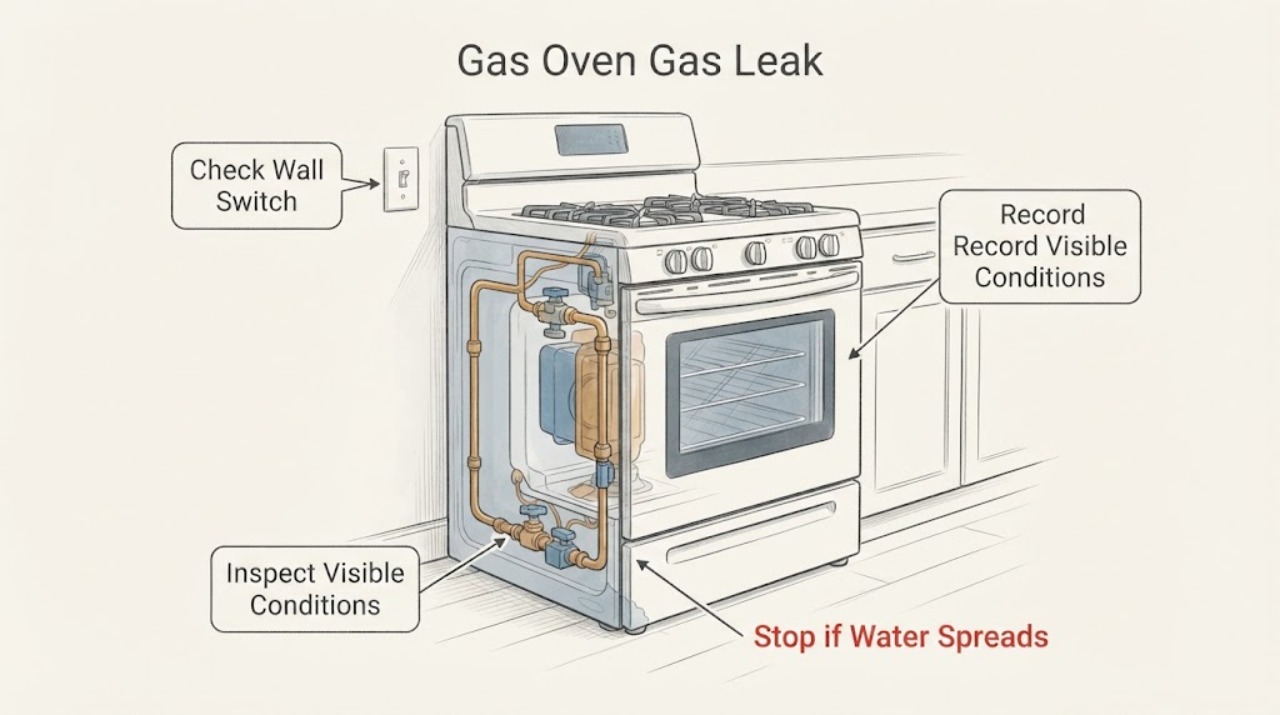
Work through in order
Diagnostic checks
Use only checks that match the exact appliance or system and its official guide.
-
Check 1
If you currently smell gas, hear hissing, notice a sulfur or rotten-egg odor, or feel headache or lightheadedness, stop using the oven and do not try to identify the source. Do not light an appliance, touch electrical switches, use a phone inside the building, or operate anything that could create a spark. Leave by a safe route; from outside or from a neighbor, contact the gas supplier and follow its instructions, or call the fire department/emergency services if the supplier cannot be reached.
Expected result: The odor is strong or present while the appliance is off, hissing is audible, symptoms are present, or the situation is uncertain; alternatively, there is no odor or hazard at the time of observation.
Next step: For any active or uncertain gas-leak sign, stay out and wait for the gas supplier, fire department, or qualified emergency responder to declare the area safe. Do not return to test the oven or reset controls.
Stop if: Do not operate switches, plugs, thermostats, fans, phones, or the oven while inside a suspected gas leak area, and do not search behind or under the range.
Why this matters
Why: An odor while the appliance is off or a sulfur smell/hiss can indicate an active gas-supply leak rather than normal burner ignition. KitchenAid treats this as an emergency and says not to find or fix the leak yourself.
-
Check 2
Only if there is no current gas odor or other hazard and you are already at a safe distance, note whether a surface burner knob appears visibly left on. Do not turn controls or approach the appliance if gas is present. Record whether the odor occurs with every burner and the oven off, only while the oven preheats, or after cooking stops.
Expected result: A surface burner may have been left on, the odor is absent with the appliance off, the odor appears briefly at preheat, or the odor remains with all visible controls off.
Next step: If an odor remains with controls off, leave and use the emergency gas-leak path. If the odor is absent and only occurs during operation, continue only with the limited timing observation below; never use this check to dismiss uncertainty.
Stop if: Do not turn a knob to test it, relight a burner, move the range, or inspect a rear connection when any gas odor is present.
Why this matters
Why: KitchenAid says a burner accidentally left on can create a slight gas odor, while gas odor with no burner operating needs escalation. The timing helps separate a possible ignition odor from a supply leak but cannot certify the system safe by itself.
-
Check 3
If the odor occurs only when a gas oven starts and there is no odor when it is off, do not repeat the start sequence. Record whether the smell fades after the first few minutes, whether the burner ignites promptly through the normal viewing path, and whether ignition is delayed, clicking continues, or the oven fails to heat. Observe only from outside and press Off if the model's normal control is safely reachable.
Expected result: The odor is brief and fades as the oven heats, or it persists, returns after each start, accompanies delayed ignition/clicking, or the oven stays cold.
Next step: A brief, fading first-use odor can be documented and discussed with the model manual. For persistent odor, delayed ignition, clicking without a normal flame, or no heat, turn the oven Off, keep it out of use, and arrange qualified appliance service.
Stop if: Do not keep restarting the oven, manually light the burner, remove the oven bottom, probe the igniter, or continue if smoke, abnormal flame, or gas odor persists.
Why this matters
Why: KitchenAid says a slight preheat odor can be normal because gas is ignited at the oven burner, but a faulty igniter can delay or fail ignition and cause a continuing odor or no heat. Persistence or delayed ignition is not proof of a leak location or a user-replaceable igniter.
-
Check 4
If the range was recently installed, moved, converted, or reconnected, stop trying to test it and record the installation timing, fuel type shown on the rating plate, and whether the smell is near the appliance or supply connection. Do not slide the range, tighten a connector, adjust the regulator, or perform a leak test yourself.
Expected result: The smell began after installation or reconnection, the fuel type or model is unclear, the odor seems near the rear/connection area, or there was no recent installation change.
Next step: Keep the appliance off and have the installer, gas supplier, or qualified appliance technician inspect the complete connection and pressure/regulator setup. If gas is currently smelled, leave first and use the emergency path.
Stop if: Do not pull a hard-piped range, kink the flexible line, apply a flame, brush solution on a suspected connection, or adjust gas pressure or conversion parts.
Why this matters
Why: KitchenAid's installation guidance requires qualified gas connection work and warns that incorrect tightening or pressure/regulator conditions can create a leak or unsafe combustion. A recent installation changes the likely source but cannot make a user inspection safe.
-
Check 5
Prepare a service report without reopening the gas situation: provide the complete model and serial information, fuel type, whether the oven is a range or wall oven, when the odor occurs, whether any surface burner was on, whether ignition was prompt, whether there was hissing or an abnormal flame, and whether the odor or symptom continued after the oven was turned Off.
Expected result: The report shows a brief preheat-only odor with normal ignition, a recurring odor or delayed ignition, an odor while off, or an unclear model/fuel setup.
Next step: Keep the oven off until the provider or gas supplier clears the concern. Ask the technician to verify the model-specific gas path, ignition, regulator and connections before any part is ordered.
Stop if: Do not order an igniter, valve, regulator, hose, or control from the odor alone and do not resume operation to create a service symptom.
Why this matters
Why: This record helps the provider distinguish normal initial combustion, an igniter/oven gas-path problem, and a possible supply leak without asking the owner to perform hazardous tests. KitchenAid directs owners to model-specific manuals and professional service when the condition is unresolved.
Use your observations
Decision map
Find the observation that best matches what you see, then follow the next safe action.
-
PATH 01Next step
What you see
Gas odor is present while the KitchenAid oven and burners are off, or there is hissing, a sulfur/rotten-egg smell, headache, lightheadedness, or uncertainty about whether gas is escaping.
Do this next
Leave without operating switches or appliances and contact the gas supplier or emergency services from a safe location. Do not return to inspect or test the range until responders say it is safe.
Why this path and its safety boundary
Why it matters: This pattern must be treated as a possible active gas leak, not as ordinary preheating or a failed oven part.
-
PATH 02Next step
What you see
The odor occurs only at the start of preheating, fades after the first few minutes, and ignition is prompt with no abnormal flame, hissing, or symptoms.
Do this next
Follow the exact model's first-use guidance and document the timing. Stop using the oven and arrange service if the odor lasts, becomes stronger, returns outside preheating, or ignition becomes delayed or abnormal.
Why this path and its safety boundary
Why it matters: KitchenAid documents that a slight preheat odor can occur as gas ignites at the oven burner; a new appliance may also have temporary first-use odors. This timing is reassuring but is not a permit to ignore a smell that changes or persists.
-
PATH 03Next step
What you see
The oven clicks or attempts ignition but the flame is delayed/absent, the oven stays cold, or gas odor continues while it runs or after it is turned Off.
Do this next
Press Off if safe, keep the appliance out of use, and arrange qualified appliance service. If gas odor remains with the oven off, leave immediately and use the emergency gas-leak route.
Why this path and its safety boundary
Why it matters: A faulty igniter or another oven gas-path fault is possible, but the observation cannot identify whether the issue is the igniter, valve, regulator, supply, or an actual leak.
-
PATH 04Next step
What you see
The odor began after installation, relocation, reconnection, or fuel conversion, or appears near a supply/regulator connection.
Do this next
Keep the range off and contact the installer, gas supplier, or qualified appliance technician. If gas is currently smelled, evacuate first and call from a safe location.
Why this path and its safety boundary
Why it matters: The installation and gas-connection path needs professional inspection; moving or tightening the range can worsen a leak or damage the regulator.
-
PATH 05Next step
What you see
There is smoke, an abnormal flame, scorching, a carbon-monoxide alarm, a burning/electrical odor, a hot or damaged line, or repeated electrical protection operation.
Do this next
Stop operation and leave if gas or combustion danger is possible. Contact emergency help from outside; for a non-emergency but damaged appliance, arrange qualified gas and appliance service before reuse.
Why this path and its safety boundary
Why it matters: The situation includes fire, combustion, carbon-monoxide, gas, or electrical risk and is beyond odor troubleshooting.
Helpful context
Understand the symptom
A gas smell around a KitchenAid oven is a safety decision before it is a repair decision. KitchenAid notes that a brief odor can occur as a gas oven preheats, especially during initial use, but the odor should dissipate after the first few minutes. If the smell is present while the appliance is not running, persists, is accompanied by hissing, or is associated with headache or lightheadedness, treat it as a possible supply leak and leave rather than inspecting the appliance.
A faulty igniter can delay or fail gas ignition and create an oven odor, but that distinction requires qualified appliance service. The owner-level boundary is to observe when the smell occurs, verify only obvious external conditions from a safe location, and provide the model and symptom history. Gas connections, pressure regulators, supply pressure, and leak testing are not DIY adjustments.
When checks do not resolve it
Need a professional?
Contact the gas supplier or emergency services immediately for an odor while off, hissing, sulfur/rotten-egg smell, symptoms, or uncertainty. Contact qualified KitchenAid appliance service for persistent preheat odor, delayed ignition, no heat, abnormal flame, or a post-installation/reconnection concern.
Safety scope: The owner may observe when the odor occurs from a safe location and provide model information. Do not search for a leak, slide the range, tighten fittings, adjust gas pressure or conversion parts, manually light the oven, remove panels or the oven bottom, test live ignition, or replace a valve, regulator, igniter, or burner.
Have this ready
- Provide the complete model and serial information, fuel type, range or wall-oven format, installation/reconnection history, exact timing of odor, whether any surface burner was on, ignition delay, flame behavior, hissing, smoke or alarm symptoms, and whether the odor remained after the oven was turned Off.
Common questions
FAQ
Is a brief gas smell during KitchenAid oven preheating normal?
KitchenAid says a slight odor can occur as a gas oven preheats and should dissipate after the first few minutes. Do not dismiss an odor that persists, occurs while the oven is off, becomes stronger, or comes with hissing, delayed ignition, an abnormal flame, headache, or lightheadedness.
What should I do if my KitchenAid oven smells like gas when it is off?
Treat it as a possible gas leak. Do not light an appliance, touch electrical switches, use a phone inside, or search for the source. Leave the home and contact your gas supplier or emergency services from a neighbor or other safe location.
Could a bad igniter cause a gas smell in a KitchenAid oven?
Yes. KitchenAid explains that a faulty igniter can delay or fail ignition, causing a temporary gas odor or preventing the oven from heating. The igniter is not proven to be the failed part from smell alone; persistent odor or failed ignition needs qualified diagnosis.
Can I tighten the KitchenAid oven gas connection or regulator myself?
No. KitchenAid's installation guidance requires qualified gas connection work and warns that incorrect tightening or regulator conditions can cause a leak or unsafe combustion. Keep the appliance off and have the gas supplier, installer, or qualified appliance technician inspect it.
Read the exact guide
Official sources
- Oven Not Working - Cooktop Working - Clicking - Product HelpKitchenAid · Supports model-dependent oven gas-path and ignition observations, including delayed/no ignition and regulator shutoff distinctions; it does not authorize gas leak repair.
- Odors or Smells - Commercial Range - Product HelpKitchenAid · Supports the gas-odor emergency instructions and burner-on distinction for the covered range family; exact model instructions remain controlling.
- 7 Reasons an Oven Smells Like GasKitchenAid · Supports the distinction between brief preheat odor, faulty-igniter odor, and possible gas leak; not a model-specific repair manual.
- Oven Not Working - Gas - Product HelpKitchenAid · Supports the distinction between oven ignition power, main gas supply, and qualified service; it is not a gas-leak detection procedure.
- Make Gas ConnectionKitchenAid · Supports the professional installation, gas pressure, connection-tightening, and leak-test boundary for the covered range installation; not a user repair guide.
Community feedback
Share a repair observation
Share a plain-text repair observation. Accepted observations are published automatically; this page may take a moment to update.