
On this page
Start here
Quick answer
A KitchenAid gas oven can make short clicking sounds while its igniter is trying to establish a flame, and KitchenAid says short clicking every 1–3 minutes during a cycle can be normal. The useful distinction is whether the flame is detected and the oven resumes heating without a warning. If clicking ends without heat, the oven repeatedly fails to ignite, or there is gas odor, a delayed pop or bang, an abnormal flame, smoke, soot, or a carbon-monoxide alarm, stop using the oven. Leave immediately for a suspected gas or combustion emergency; otherwise keep the oven off and arrange qualified gas-appliance service.
Work through in order
Diagnostic checks
Use only checks that match the exact appliance or system and its official guide.
-
Check 1
From a safe position during one normal oven start, listen for a short sequence of clicks and observe whether the sequence stops after the oven begins heating. Do not start repeated cycles to reproduce the symptom.
Expected result: The clicks may stop when heat is established, continue without visible or confirmed heating, or occur with a gas odor, delayed pop or bang, smoke, soot, or an abnormal flame.
Next step: For normal heating, monitor the pattern and follow the exact model manual. For clicking without heat, keep the oven off and arrange qualified service. For a warning, leave the area and use emergency or gas-leak help from a safe location.
Why this matters
Why: Clicks that stop when the flame is detected fit KitchenAid's described ignition sequence. Clicking without heat is an ignition failure pattern; any odor, delayed ignition, smoke, soot, or abnormal flame is a safety stop condition.
-
Check 2
If clicking returns while the oven is already running, note whether it is a brief sound and whether heating resumes, including whether it occurs about every 1–3 minutes.
Expected result: The oven may resume normal heating after a short click, click without restoring heat, or show a repeated no-heat interval or fault indication.
Next step: If heat remains normal and there are no warnings, record the pattern and check the exact manual for model-specific behavior. If heat does not return or the pattern is worsening, stop using the oven and arrange service.
Why this matters
Why: KitchenAid identifies short clicking every 1–3 minutes during a cycle as potentially normal. A repeated interval with no heat or a fault indication is different from normal igniter cycling and needs diagnosis.
-
Check 3
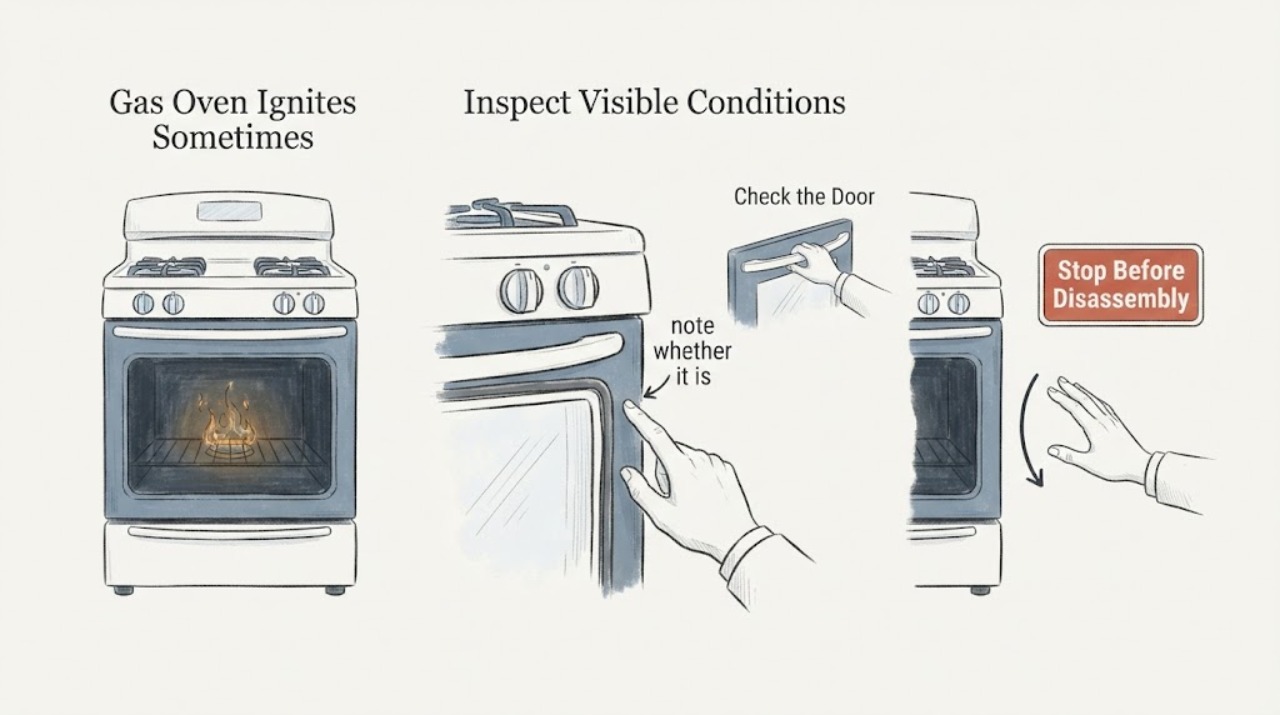
With the oven cool and no safety warning, check that the door closes fully, the storage drawer is not interfering with the igniter, and no foil or oven-bottom liner blocks the burner area.
Expected result: The door may remain open or misaligned, the drawer may contain an obstruction, the oven bottom may be covered, or all visible conditions may be clear.
Next step: Remove only an obvious cool obstruction permitted by the exact manual, then stop if ignition remains unreliable. Do not force the door, remove the burner cover, or reach into the ignition area.
Why this matters
Why: KitchenAid lists an open door, drawer interference, and a covered oven bottom as conditions that can prevent normal oven operation or gas flow. A clear cavity makes those explanations less likely but does not identify an internal part.
-
Check 4
If the exact installation instructions identify a user-visible main gas or regulator shutoff, confirm its visible position without moving the appliance; also verify the appliance has the grounded power connection required by the model.
Expected result: The approved shutoff may appear off, the range may have been recently installed or reconnected, the outlet may be unpowered or improperly grounded, or the visible supply may be normal.
Next step: Follow the exact installation instructions or contact a qualified gas-appliance technician or electrician when the supply or grounding is uncertain. If the visible supply is normal but ignition remains intermittent, keep the oven off and arrange service.
Why this matters
Why: KitchenAid notes that a closed oven regulator shutoff can leave cooktop burners supplied while the oven receives no gas, and that oven igniter operation depends on a good ground path. These checks do not authorize gas-line or live-wiring work.
-
Check 5
Prepare a service handoff if the oven alternates between successful and failed ignition. Record the exact model, Bake or Broil mode, whether clicking stopped, whether heat returned, the interval between failures, cooktop status, display state, and any warning signs.
Expected result: The record may show normal short cycling with restored heat, clicking without heat, no clicking, or a safety warning.
Next step: Keep the gas oven off when ignition is unreliable and arrange model-specific qualified service. Do not open panels, touch the igniter or burner, adjust gas pressure, or replace a part without diagnosis.
Why this matters
Why: These observations help a technician separate normal ignition cycling from a repeat ignition or supply fault. They do not confirm a failed igniter, burner, valve, sensor, or control.
Use your observations
Decision map
Find the observation that best matches what you see, then follow the next safe action.
-
PATH 01Next step
What you see
The oven makes short clicks, heat is established, and a brief click may recur during the cycle while the oven continues heating normally and no warning is present.
Do this next
Continue normal use according to the exact model manual and monitor for a change. Stop if heat is not restored or any gas, combustion, smoke, soot, or electrical warning appears.
Why this path and its safety boundary
Why it matters: This matches KitchenAid's documented normal igniter or cycle-clicking behavior more closely than a confirmed ignition failure.
-
PATH 02Next step
What you see
The oven clicks but does not establish or restore heat, fails on some starts, or repeatedly stops heating after clicking, with no visible obstruction or approved supply issue.
Do this next
Keep the oven off and arrange qualified KitchenAid gas-appliance service. Do not relight it, open panels, touch the burner or igniter, or adjust gas pressure.
Why this path and its safety boundary
Why it matters: The pattern is inconsistent with a simple normal clicking explanation. A gas-supply, ignition, burner, valve, sensor, wiring, interlock, or control problem remains possible, but the exact fault is unconfirmed.
-
PATH 03Next step
What you see
Gas odor, hissing, a delayed pop or bang, an abnormal flame, smoke, soot, a burning or electrical smell, or a carbon-monoxide alarm or symptoms occur.
Do this next
Avoid flames, switches, plugs, phones, and vehicles near the area; leave immediately and contact emergency or gas-leak help from a safe location. Do not re-enter or restart the oven until qualified responders say it is safe.
Why this path and its safety boundary
Why it matters: Treat the event as a possible gas leak, unsafe combustion, fire, electrical hazard, or carbon-monoxide emergency rather than as an intermittent igniter problem.
-
PATH 04Next step
What you see
The oven does not click at all, the display is blank, or the cooktop and oven lose power together.
Do this next
Check only the accessible power condition permitted by the manual. If the supply is uncertain or the oven still will not ignite, arrange qualified electrical or gas-appliance service without testing live wiring.
Why this path and its safety boundary
Why it matters: The observation shifts attention toward power, grounding, controls, or an interlock rather than proving a gas igniter failure.
Helpful context
Understand the symptom
First separate normal clicking from a failed ignition
KitchenAid says the gas-oven igniters can click several times until the flame is detected. It also describes short clicking every 1–3 minutes during a cycle as normal. A brief click sequence that stops when heat is established, or a brief click during an active cycle followed by normal heating, is different from clicking that ends with no heat or a repeated failure to light. The sound by itself does not identify a failed igniter.
Use one safe observation, not repeated ignition tests
If there is no gas odor, hissing, smoke, abnormal flame, delayed pop or bang, or carbon-monoxide warning, observe the next normal start from a safe position rather than repeatedly cycling the oven. Note whether the clicking is brief, whether it stops after the flame is detected, and whether the oven actually begins heating. Do not use a match or reach toward the burner or igniter.
Check only the visible conditions KitchenAid documents
With the oven cool, confirm that the door closes fully, the storage drawer is not overloaded near the igniter, and the oven bottom is not covered with foil or a liner. If the exact installation instructions identify a user-visible main gas or regulator shutoff, check its position without moving the range or adjusting an uncertain valve. Also confirm that the appliance has its required grounded power supply. Stop if the model instructions do not make a condition user-accessible.
What intermittent failure means
If the oven sometimes clicks and heats but at other times clicks without heat, or if it stops igniting after a normal cycle, record the mode, timing, sound, display state, and whether the cooktop works. This pattern can involve the gas supply, igniter, burner, valve, sensor, wiring, interlock, or control, but the observation does not prove which part has failed. Keep the oven off and give the record to a qualified gas-appliance technician.
When checks do not resolve it
Need a professional?
Arrange qualified gas-appliance service when the KitchenAid oven intermittently clicks without establishing or restoring heat, fails on some starts, has no ignition response, or remains unreliable after the documented external checks. Stop immediately and leave for emergency or gas-leak help for gas odor, hissing, a delayed pop or bang, smoke, fire, abnormal flame, or a carbon-monoxide alarm or symptoms.
Common questions
FAQ
Is clicking in a KitchenAid gas oven always a failure?
No. KitchenAid says the igniters may click several times until the flame is detected, and short clicking every 1–3 minutes during a cycle can be normal. Treat it as a fault when clicking does not establish or restore heat, or when a safety warning accompanies it.
Why does my KitchenAid gas oven ignite sometimes but not every time?
A successful start followed by an unsuccessful one is an intermittent ignition pattern, but it does not identify a particular part. Record whether clicks stop, whether heat returns, which mode was selected, and whether the cooktop works. Keep the oven off and arrange qualified service if the pattern repeats.
Should I keep trying to light a gas oven that did not ignite?
Do not use a match or repeatedly cycle the oven. Stop immediately for gas odor, a delayed pop or bang, abnormal flame, smoke, soot, or a carbon-monoxide warning. Without those warnings, make only the cool, external checks supported by the exact manual, then arrange qualified service if ignition remains unreliable.
Read the exact guide
Official sources
- Oven Not Working - Cooktop Working - ClickingKitchenAid Product Help · Official external checks for the oven door, main gas supply, regulator shutoff, storage drawer, and oven-bottom liner.
- Click or Clicking Noise in Oven - RangeKitchenAid Product Help · Official KitchenAid guidance distinguishing expected igniter clicking from a fault by timing and flame detection.
- Clicking Noise in a Gas OvenKitchenAid Product Help · Official KitchenAid guidance for short clicking while a gas-oven igniter detects the flame.
- Oven Not Working - Gas and Dual Fuel RangeKitchenAid Product Help · Official KitchenAid guidance on grounded power and the main gas shutoff for a non-working gas oven.
- Oven Not Working - Cooktop Working - Not ClickingKitchenAid Product Help · Official external checks for door position, storage drawer interference, gas shutoff, main gas valve, and grounded power.
Community feedback
Share a repair observation
Share a plain-text repair observation. Accepted observations are published automatically; this page may take a moment to update.