
On this page
Start here
Quick answer
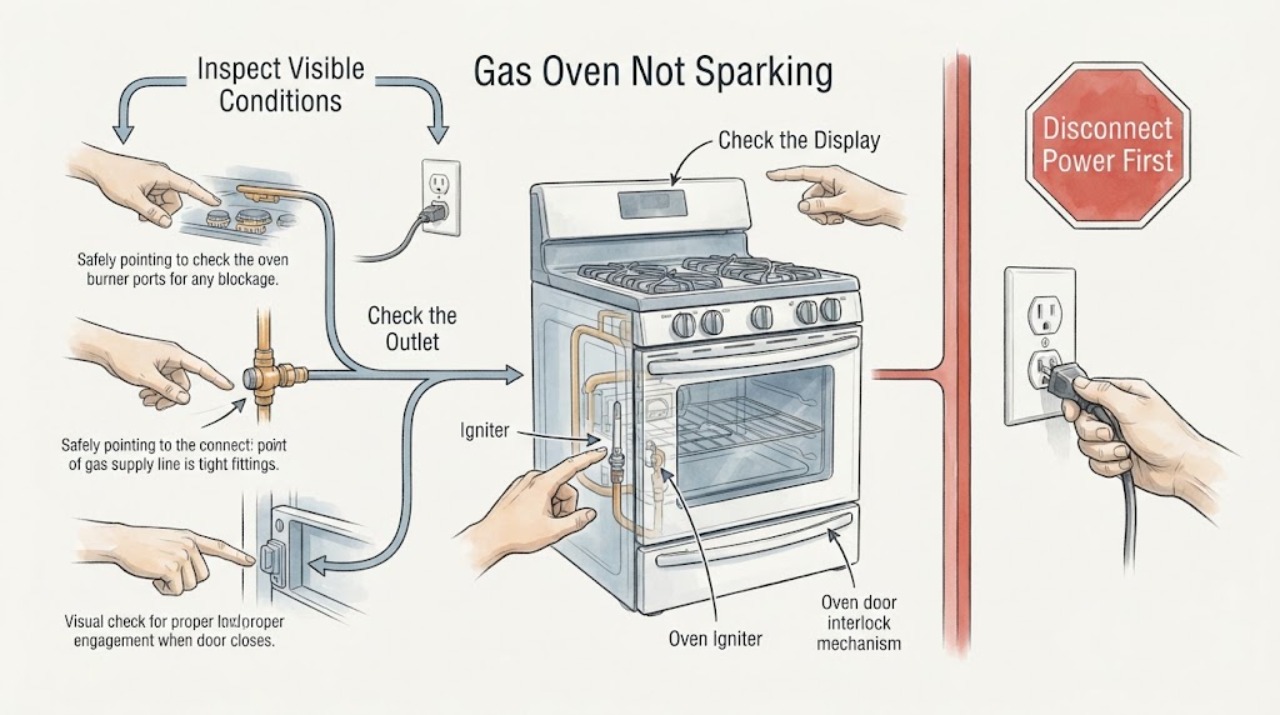
A KitchenAid gas oven may not show a visible spark because many gas ovens use a glow-bar igniter that heats until it lights the gas; the cooktop burners are the part that commonly produces an audible spark or click. First identify whether the complaint is a dark oven igniter, a clicking cooktop, or an oven burner that does not light. With no gas odor, smoke, burning smell, abnormal flame, sparks, or repeated breaker trip, confirm the oven door is closed, the display and grounded power are working, the main gas valve is on, and the model control sequence has been started. Perform at most one model-safe check. Press Off/Cancel if the burner does not light, and arrange qualified service rather than removing panels, adjusting gas pressure, or repeatedly attempting ignition.
Work through in order
Diagnostic checks
Use only checks that match the exact appliance or system and its official guide.
-
Check 1
Stop the attempted ignition and observe from outside whether the complaint is an oven with no visible glow, a surface burner that clicks without a flame, or a gas oven burner that remains unlit.
Expected result: The cooktop clicks, the oven igniter glows without a burner flame, nothing glows or clicks, or a flame appears abnormal.
Next step: Keep hands and tools out of the cavity. Use only the relevant model-safe checks below, and stop for any gas odor, smoke, abnormal flame, or other hazard.
Why this matters
Why: These are different ignition paths. KitchenAid owner material describes the oven igniter as a glow bar on covered gas-range models, while the surface burners use spark ignition; “no spark” alone does not identify the oven fault.
-
Check 2
With no gas odor or other hazard, confirm from outside that the display has power, the range is connected to a grounded operational outlet, and the accessible breaker or fuse is normal.
Expected result: The display is dark, the breaker is open or trips again, the outlet is not confirmed, or controls have stable power.
Next step: Correct only an obvious accessible supply issue once and only when safe. Do not use an adapter or extension cord. If power remains abnormal or damage is visible, leave the range off and call a qualified electrician or appliance technician.
Why this matters
Why: KitchenAid states that oven and surface igniter operation depends on a good electrical ground path. A power fault is a prerequisite problem, not evidence that the gas valve or igniter has failed.
-
Check 3
Close the oven door fully, cancel any active or locked control state, select Bake or Broil as directed by the exact KitchenAid manual, and press Start once.
Expected result: The control accepts the command, the door was obstructed or open, a lockout or delay was active, or the oven remains idle.
Next step: Do not bypass the door or control lock. If the command is accepted, make at most one supervised observation; if the control remains unresponsive, record the display and arrange service.
Why this matters
Why: A door or control condition can prevent the heating request. If the display starts but the oven remains cold, the remaining possibilities include the gas supply, glow-bar ignition path, burner, sensor, or control and require model-specific diagnosis.
-
Check 4
If the cooktop works while the oven does not, verify only the accessible main gas shutoff and, when the exact installation instructions permit safe access, the oven pressure-regulator shutoff.
Expected result: The main valve is off, the range was recently connected, the regulator shutoff is off, or all accessible supply conditions are normal.
Next step: Open only an intentionally closed accessible shutoff if the model instructions and local safety conditions allow. Do not move a hard-piped range, kink the flexible line, adjust pressure, or dismantle the regulator. Persistent failure needs qualified service.
Why this matters
Why: KitchenAid explains that a regulator shutoff can leave cooktop burners supplied while cutting gas to the oven; air can also be present after reconnection. A normal supply observation shifts attention to ignition or control, but does not identify a part.
-
Check 5
After the safe external checks and full cooldown, perform at most one Bake or Broil start using the exact model sequence and observe the normal viewing area without disassembly.
Expected result: The oven igniter glows and the burner lights, the igniter glows but the burner does not light, there is no glow, ignition is delayed, the flame is abnormal, or the cavity stays cold.
Next step: Press Off or Cancel if ignition fails or a hazard appears. Keep the range off and arrange KitchenAid or licensed appliance service. Do not repeat attempts, test live parts, remove the oven bottom, or adjust the air-gas mixture.
Why this matters
Why: Normal ignition after a corrected prerequisite supports a control, supply, or installation condition. A glow without flame, no glow, delayed ignition, abnormal flame, or no heat leaves an igniter, valve, burner, sensor, control, or gas-supply fault open; the observation does not select a replacement part.
Use your observations
Decision map
Find the observation that best matches what you see, then follow the next safe action.
-
PATH 01Next step
What you see
The cooktop clicks or fails to light, but the complaint is not an oven burner symptom.
Do this next
Turn the surface control off if it does not ignite and use the exact cooktop instructions. Do not keep clicking a burner that has not lit.
Why this path and its safety boundary
Why it matters: This is a surface-burner spark problem and follows different checks for wet burners, caps, control knobs, power, and surface gas supply.
-
PATH 02Next step
What you see
The oven has a glow-bar igniter or other normal ignition indication, but the burner does not light or the cavity remains cold.
Do this next
Press Off or Cancel, keep the range out of service, and arrange qualified KitchenAid or licensed appliance service. Do not open the oven or test live gas components.
Why this path and its safety boundary
Why it matters: The oven ignition or gas-heating path is not completing. The symptom alone cannot distinguish an igniter, valve, burner, regulator, sensor, control, or supply fault.
-
PATH 03Next step
What you see
The cooktop works, the oven does not, and the accessible main supply is normal.
Do this next
Have a qualified technician check the regulator and oven gas path if the model instructions do not provide a safe accessible check. Do not move a hard-piped range or adjust pressure.
Why this path and its safety boundary
Why it matters: A separate oven supply condition remains possible; KitchenAid specifically describes a regulator shutoff that can supply the cooktop while withholding gas from the oven.
-
PATH 04Next step
What you see
There is gas odor, smoke, burning odor, abnormal flame, scorching, a carbon-monoxide alarm, sparks outside normal ignition, or a repeated breaker trip.
Do this next
Do not operate switches or appliances during suspected gas leakage; leave the area and contact emergency help from a safe location. For other hazards, isolate power only when safe and obtain qualified service.
Why this path and its safety boundary
Why it matters: This is a gas, combustion, fire, or electrical safety event rather than a routine no-spark diagnosis.
Helpful context
Understand the symptom
“Not sparking” can describe two different symptoms
A cooktop burner normally makes a click as its spark igniter operates. An oven burner may instead use a glow-bar igniter, so the useful observation is whether the igniter glows and whether the burner lights, not whether you can see a spark through the oven opening. Do not remove the oven bottom or expose the burner to watch it ignite. If you mean a surface burner, use the cooktop-specific path and turn that control off if it clicks without lighting.
Start with gas and electrical safety
Stop immediately for a gas odor, smoke, burning smell, scorching, abnormal flame, sparks outside the normal ignition path, or a carbon-monoxide alarm. Do not operate switches or appliances during a suspected gas leak; leave the area and contact emergency help from a safe location. For a normal no-hazard complaint, confirm the range is connected to the grounded outlet required by its model and that the main gas valve is on. Never use a two-prong adapter or extension cord for the range.
Check the control and door conditions
Close the oven door fully, select the intended Bake or Broil cavity, and follow the exact KitchenAid controls for setting the temperature and pressing Start. A door, lockout, delay, or incomplete start command can prevent the heating request. If the display is dark, a breaker trips again, or the control does not accept a valid command, stop rather than repeatedly cycling the controls.
Separate cooktop gas from oven gas
If the cooktop works but the oven remains cold, that does not prove the oven gas path is available. KitchenAid explains that a pressure-regulator shutoff can be off while gas still reaches the cooktop. Check only an accessible main shutoff or model-approved condition. Do not slide a hard-piped range, stretch or kink a flexible gas line, remove the regulator, or adjust gas pressure; use a certified technician if access or identification is uncertain.
Stop after one model-safe ignition check
After the oven is cool and the controls, power, gas supply, and door are normal, perform no more than one supervised Bake or Broil start using the exact model manual. Observe whether the oven igniter glows, whether the burner lights normally, and whether the cavity begins warming. If the burner does not light, ignition is delayed, the flame is abnormal, or the oven stays cold, press Off or Cancel and arrange qualified appliance service. The symptom cannot identify a safe replacement part by itself.
Only after diagnosis
Potential parts
- oven igniter or glow-bar igniter
Only after a technician confirms that the exact model uses this part and testing identifies it as failed.
- oven gas valve, regulator, sensor, or control
Only after model-specific diagnosis; no one of these parts is established by “not sparking” alone.
When checks do not resolve it
Need a professional?
Arrange qualified KitchenAid or licensed appliance service when the oven will not ignite after one model-specific check, the igniter glows without flame, the oven remains cold, the cooktop works but the oven gas path is uncertain, or any panel or live gas component would need access. Stop immediately for gas odor, smoke, burning odor, abnormal flame, scorching, a carbon-monoxide alarm, sparks outside normal ignition, or repeated breaker trips.
Common questions
FAQ
Should a KitchenAid gas oven visibly spark?
Not necessarily. Covered KitchenAid gas-range instructions describe an oven glow-bar igniter that heats to ignite the gas, while the surface burners use spark ignition. Identify whether the oven igniter glows and whether the burner lights; do not remove panels to look for a spark.
Why does the cooktop work but the KitchenAid gas oven will not ignite?
The two paths are not identical. KitchenAid says a pressure-regulator shutoff can allow gas to reach the cooktop while preventing gas from reaching the oven. Check only the accessible conditions allowed by the exact installation instructions and use a qualified technician if the regulator or gas line would need moving.
What can I check when the oven is not sparking or lighting?
With no hazard present, confirm grounded power, a closed oven door, the correct control sequence, and the main gas valve. If the range was recently connected, air may be present in the gas line. Perform at most one model-safe start and press Off or Cancel if the burner does not light.
Can I replace the igniter based on this symptom?
No. “Not sparking” does not establish the failed part, and an oven may use a glow bar rather than a visible spark electrode. A technician should identify the exact model and confirm the ignition or gas fault before selecting a part.
Read the exact guide
Official sources
- Oven Not Working - GasKitchenAid Product Help · Official KitchenAid troubleshooting guidance for gas ranges; used for the grounded power, main gas valve, recent reconnection, and qualified-service checks. It does not identify a failed part for an unspecified model.
- Owner’s ManualKitchenAid · Official KitchenAid owner manual opened for a covered gas-range model family, used to distinguish cooktop spark ignition from an oven glow-bar igniter and to document the one-check/service boundary. The assigned topic has no model, so exact control timing and compatibility must be confirmed in the reader’s manual.
- How to Check the Gas Regulator Shut-Off Valve on an OvenKitchenAid Product Help · Official KitchenAid installation support; used to explain why cooktop gas does not prove oven gas supply and why hard-piped or strained lines require a certified technician.
- Oven Not Working - Cooktop Working - Not ClickingKitchenAid Product Help · Official KitchenAid guidance for the specific symptom that the cooktop works while the oven does not; used for the oven regulator shutoff, door, foil, storage-drawer, power, and main-valve branches.
Community feedback
Share a repair observation
Share a plain-text repair observation. Accepted observations are published automatically; this page may take a moment to update.