
On this page
Start here
Quick answer
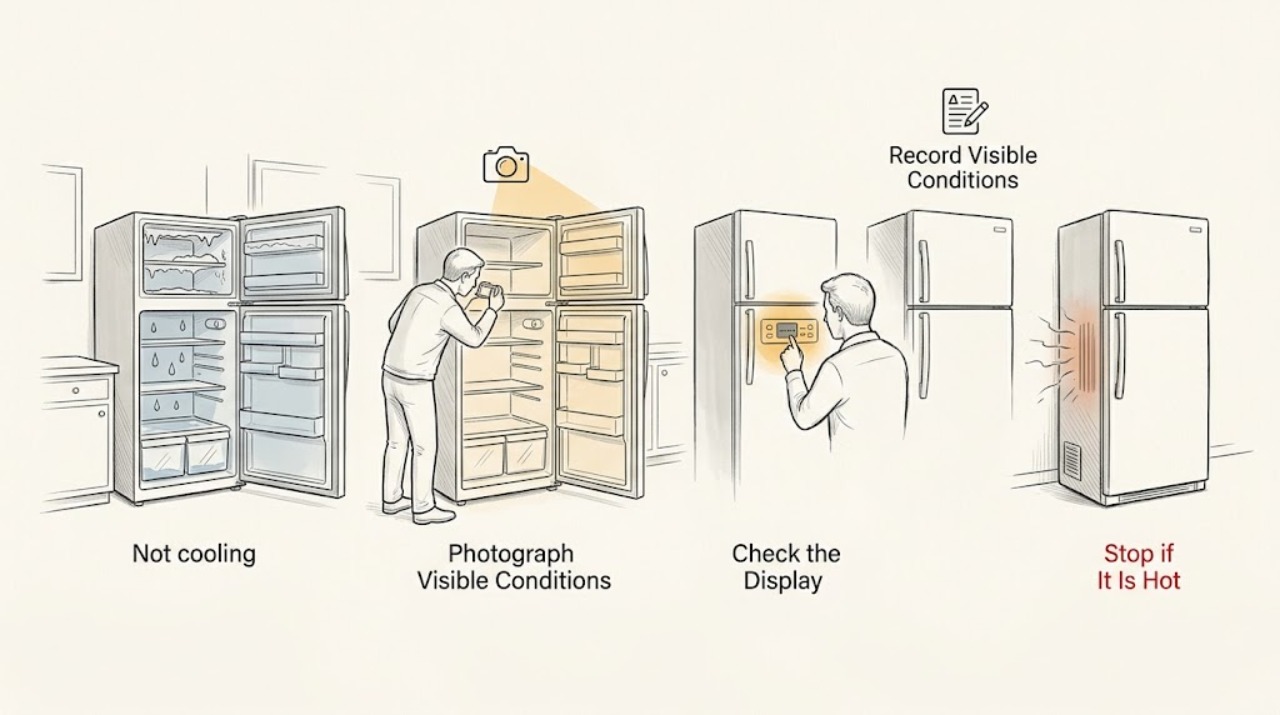
For a KitchenAid KRMF706EBS01 that is not cooling and shows or reports 6-39-56, do not assume those three values form one universal fault code. The official KitchenAid pages I could open identify the exact model family and provide cooling checks, but they do not define 6-39-56 as a single public code or show that it is one diagnosis rather than a service-test sequence. Photograph the display exactly, including whether the values appear one after another, and record refrigerator/freezer temperatures before resetting anything. Check only the external power, cooling-on state, door seals, visible airflow, and safe food-temperature situation. If both compartments are warm, the sequence returns, the display is abnormal, or any internal fan, sensor, control, defrost, or sealed-system test would be needed, keep the doors closed and arrange qualified KitchenAid service. Do not run live electrical tests, open panels, or buy a part from the three numbers alone.
Work through in order
Diagnostic checks
Use only checks that match the exact appliance or system and its official guide.
-
Check 1
Photograph the display before pressing buttons or disconnecting power. Write each value exactly as shown, including spaces, dashes, decimal points, flashing or solid state, the order in which 6, 39, and 56 appear, any letter beside a number, and whether the panel returns to a normal temperature screen.
Expected result: The record should show whether 6-39-56 is one simultaneous display, three sequential service-test results, or a partial/misread pattern, and whether the refrigerator or freezer temperature is also visible.
Next step: Keep the photo and do not clear the display until the exact model documentation or a qualified technician has reviewed it.
Stop if: Do not press random key combinations, enter a service test to reproduce the values, or repeatedly reset the refrigerator before recording the sequence.
Why this matters
Why: The official material opened for this exact model does not establish that 6-39-56 is one combined code. The display format and timing are needed before a service provider can match it to the model's tech sheet; a partial sequence cannot safely be translated from another KitchenAid platform.
-
Check 2
Confirm the complete model and serial label from the inside refrigerator compartment, then match the control layout and documentation to KRMF706EBS01. Use only an exact-model instruction to determine whether the display is a user alarm, diagnostic-test result, or service code.
Expected result: Note whether the exact KRMF706EBS01 tech sheet or owner's manual explicitly defines the values and gives a user-level acknowledgement or exit; do not substitute the KRMF706EBS00 page or a different multi-door platform as proof.
Next step: If the exact documentation provides a safe user acknowledgement, follow it once and record the result. If it does not, leave the controls alone and provide the display photo and full identity to KitchenAid service.
Stop if: Do not splice button sequences across KRMF706EBS suffixes, other KitchenAid refrigerators, or Whirlpool platforms, and do not treat a parts-list entry as a code definition.
Why this matters
Why: KitchenAid's owner page identifies KRMF706EBS as a 25.8-cu.-ft. multi-door refrigerator and exposes troubleshooting and service routing, while the exact EBS01 parts document lists a separate tech sheet. That separation means the family page alone cannot classify 6-39-56 or authorize a diagnostic sequence.
-
Check 3
Without removing panels, measure or record the refrigerator and freezer temperatures with a suitable appliance thermometer, check whether cooling is turned on, and inspect only visible door seals, blocked air vents, heavy frost, and whether a recent outage, cleaning, large warm load, or frequent door opening preceded the problem.
Expected result: Separate a warm fresh-food section with a cold freezer from both compartments warm, a display showing cooling off or showroom mode, blocked vents, a poor seal, or a heavy frost pattern visible without disassembly.
Next step: Restore only a clearly documented user setting, remove an accessible obstruction, and allow the model's stated stabilization time. If both compartments remain warm, the sequence returns, or frost requires panel removal, schedule service and protect food from unsafe temperatures.
Stop if: Do not remove evaporator or rear panels, scrape frost with a tool, touch a moving fan, probe wiring, or open the sealed refrigeration system.
Why this matters
Why: KitchenAid says cold air is commonly generated in the freezer and moved to the refrigerator section through vents; blocked airflow, door openings, warm loads, a hot environment, or a cooling/showroom setting can affect temperature. These observations do not identify a fan, thermistor, control, defrost component, compressor, or sealed-system failure.
-
Check 4
Inspect the external power path only when it is cool, dry, intact, and accessible: confirm the plug is seated in a grounded outlet and note any breaker/GFCI event, heat, odor, scorch, or visible cord damage. Do not remove an outlet cover or perform a live voltage check.
Expected result: A normal external supply with lights/display present differs from a blank display, repeated trip, hot or damaged cord/outlet, arcing, or a refrigerator that loses power again.
Next step: If the supply is visibly sound and the exact manual permits a user power acknowledgement, perform it once; otherwise leave the unit alone. For heat, arcing, damage, repeated trips, or a blank display, arrange qualified electrical/appliance service.
Stop if: Do not bypass grounding, use an adapter or extension cord, repeatedly reset a breaker/GFCI, or restore power just to reproduce the sequence.
Why this matters
Why: A power interruption can leave cooling off or produce a separate power indication, but it does not convert 6-39-56 into a component diagnosis. A repeated electrical event is an electrical-service issue and can make further operation unsafe.
-
Check 5
Prepare a service handoff with the full KRMF706EBS01 model and serial, the original display photo, the exact order/timing of 6, 39, and 56, refrigerator and freezer temperatures, cooling-on/showroom observations, door/airflow/frost findings, power history, and food-safety impact.
Expected result: A recurring sequence, both compartments warm, no cooling after the model-specific setting is restored, or a need to access an internal fan, sensor, control, defrost circuit, compressor, or sealed system is a persistent service symptom.
Next step: Keep the doors closed and move perishable food to a safe cold-storage location if temperatures are rising. Arrange KitchenAid or qualified refrigerator service and ask the provider to interpret each value against the exact tech sheet before replacing parts.
Stop if: Do not order a control, fan, thermistor, defrost part, compressor, or sealed-system component from 6-39-56 alone, and do not perform internal electrical or refrigeration tests.
Why this matters
Why: The official sources support external cooling checks and exact-model service routing but do not support naming one failed part from the three values. A technician needs the uncombined sequence to decide whether it came from diagnostics or a user-facing alarm.
Use your observations
Decision map
Find the observation that best matches what you see, then follow the next safe action.
-
PATH 01Next step
What you see
The exact model documentation identifies 6, 39, and 56 as a service-test sequence, the refrigerator exits that test using the documented procedure, and both compartments return to normal temperature.
Do this next
Save the sequence and monitor temperatures without entering diagnostics again. Call service if the values recur or cooling drifts warm.
Why this path and its safety boundary
Why it matters: The values were diagnostic observations rather than one combined user fault code; normal cooling after the documented exit reduces the immediate concern but does not justify repeating the test.
-
PATH 02Next step
What you see
The display returns 6-39-56 or another abnormal sequence after normal operation, the exact manual does not define it, or one or both compartments remain warm.
Do this next
Keep the refrigerator closed, protect perishable food, preserve the display photo and temperatures, and arrange qualified KitchenAid service.
Why this path and its safety boundary
Why it matters: This is an unresolved model-specific display/cooling symptom. The opened official sources do not establish whether the sequence represents a fan, sensor, control, defrost, compressor, or sealed-system fault.
-
PATH 03Next step
What you see
The refrigerator has a blank display, hot or damaged cord/outlet, arcing, smoke, repeated breaker/GFCI trip, water near electrical parts, or a burning odor.
Do this next
Do not touch the appliance or operate the electrical supply if unsafe. Leave it in a safe state and obtain qualified electrical/appliance service; move food to safe cold storage if possible.
Why this path and its safety boundary
Why it matters: This is an immediate electrical or water-damage stop condition, not a code-interpretation problem.
Helpful context
Understand the symptom
Treat 6, 39, and 56 as an unverified display sequence
The assigned identity is the KitchenAid KRMF706EBS01 multi-door refrigerator. KitchenAid's official repair-parts document names that exact black-stainless model and lists a separate English tech sheet and owner's manual, but it does not define a combined 6-39-56 fault. The public owner page identifies the KRMF706EBS family and links troubleshooting, while Product Help warns that controls and procedures vary by refrigerator type and model. Until the exact tech sheet confirms the display, preserve the values in the order and format shown. A service-test number, an individual result, and a user-facing error can require different actions; joining them into one code would create an unsupported diagnosis.
When checks do not resolve it
Need a professional?
Call when 6-39-56 recurs or cannot be classified from the exact model documentation, either compartment remains warm, cooling does not resume after a documented user setting, or any internal component or diagnostic test would be needed. Stop immediately for arcing, smoke, burning odor, hot/damaged power, repeated trips, water near electrics, or a blank display.
Have this ready
- Provide KRMF706EBS01, serial number, country, display photo, exact sequence/timing and whether values were simultaneous, refrigerator/freezer temperatures, cooling-on/showroom state, door/airflow/frost observations, recent outage or cleaning, and food-safety impact.
Common questions
FAQ
Is 6-39-56 one KitchenAid refrigerator fault code?
The opened official KitchenAid sources do not establish that. Preserve the values exactly and determine from the KRMF706EBS01 tech sheet whether they are separate diagnostic results, a sequence, or a user-facing display. Do not combine them or borrow a code meaning from another model.
What can I check if the KRMF706EBS01 is not cooling?
Record refrigerator and freezer temperatures, verify cooling is turned on, check visible door seals and blocked vents, note frost and recent power or warm-load events, and inspect the external power path only when safe. If cooling remains abnormal, arrange service rather than opening panels.
Can I enter the service test to see what 6, 39, and 56 mean?
Do not enter or repeat a diagnostic test without the exact KRMF706EBS01 documentation. A service-test value is not automatically a consumer repair instruction, and repeated resets or live testing can erase the useful sequence or create an electrical hazard.
Read the exact guide
Official sources
- Customer Service | KitchenAidKitchenAid · Opened KitchenAid's official service-and-support page as the escalation route when exact diagnostic interpretation or internal testing is required. It does not define the 6 39 56 sequence or imply a replacement part.
- KRMF706EBS | KitchenAid Owner's CenterKitchenAid · Opened KitchenAid's official Owner's Center page for the KRMF706EBS family. It identifies the 25.8-cu.-ft. 36-inch multi-door refrigerator and links troubleshooting and service. The assigned KRMF706EBS01 suffix is documented separately in the official repair-parts list; this family page does not define 6 39 56.
- Repair Parts List - W10853389 - Rev HKitchenAid · Opened the official KitchenAid repair-parts PDF. It explicitly lists KRMF706EBS01 (Black Stainless) and identifies the English tech sheet W10844356 and owner's manual W10730912, but it does not define 6 39 56 or authorize a consumer diagnostic test. The exact display sequence remains an unresolved service-documentation question.
- Not Cooling - Refrigerator Section - RefrigeratorKitchenAid Product Help · Opened the official KitchenAid Product Help article for French-door bottom-freezer refrigerators. It supports external checks for airflow, cooling-on state, power outage, temperature setting, environment, door use, and showroom mode; it does not define 6 39 56 or identify an internal part for KRMF706EBS01.
Community feedback
Share a repair observation
Share a plain-text repair observation. Accepted observations are published automatically; this page may take a moment to update.