
On this page
Start here
Quick answer
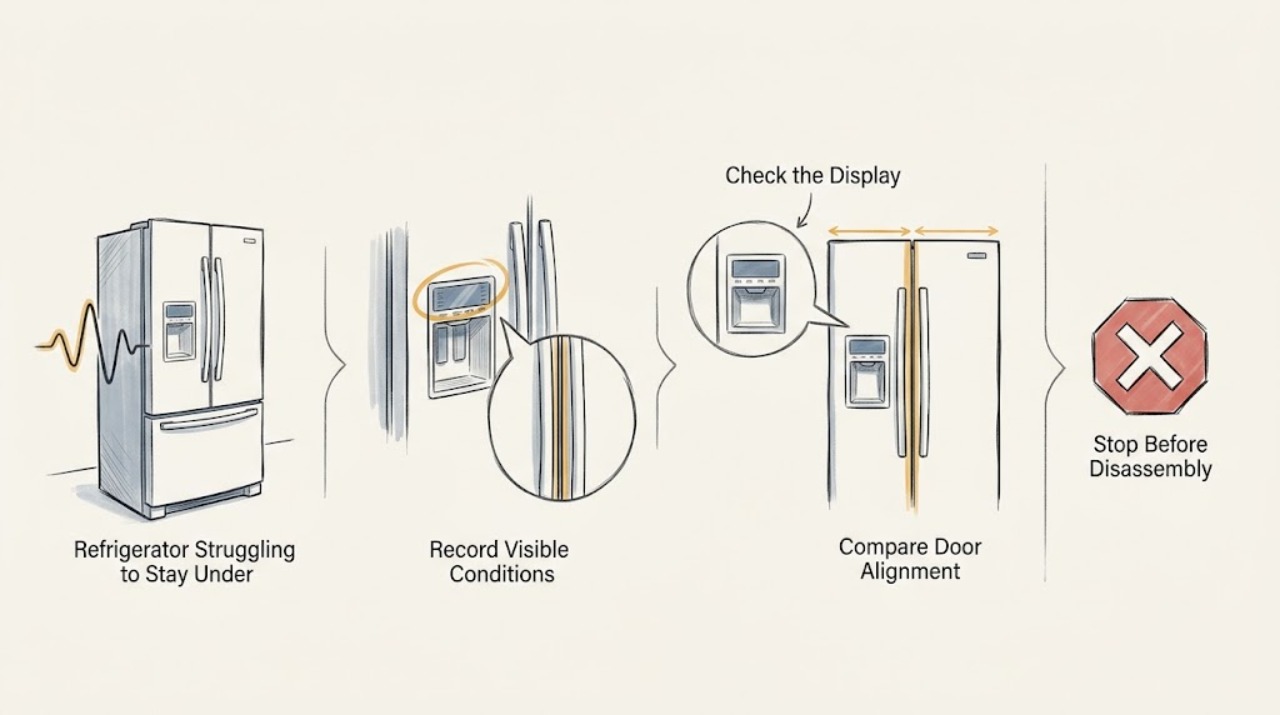
Treat a refrigerator that cannot stay at or below 40°F as a food-safety and service issue, not just a setting complaint. For the Beko BFBD30216SS, first put an accurate appliance thermometer in a cup of water on a middle shelf and record the temperature after it has been undisturbed; the control setting is not the same as the measured compartment temperature. Check the setting, door gasket, blocked interior vents, recent hot food or heavy loading, room heat, visible frost, and whether the rear ventilation clearance is obstructed. Beko's published BFBD30216SS specifications identify a 33–46°F fresh-food range and a 32–110°F operating environment, so a stable reading above 40°F needs escalation even if the display looks normal. As a tenant, do not pull out the appliance, open covers, clean hidden coils, or handle refrigerant; send the model, readings, photos, and symptom history to the landlord or property manager for an authorized service call. Move perishable food to a known-cold refrigerator. If food has been above 40°F for more than two hours or the duration is uncertain, follow FDA food-safety guidance and discard it rather than judging by smell.
Work through in order
Diagnostic checks
Use only checks that match the exact appliance or system and its official guide.
-
Check 1
Place an accurate appliance thermometer in a cup of water on a middle shelf, close the door, and leave it undisturbed for several hours or overnight. Record the reading, the control setting, and the time of each check; do not rely on a quick hand test or the displayed setting alone.
Expected result: The measured fresh-food compartment is at or below 40°F, intermittently above 40°F, or stably above 40°F while the setting appears normal.
Next step: Keep the record and continue with the visible setting, seal, loading, and environment checks only if the compartment is warm. If food has been above 40°F for more than two hours or the duration is unknown, move or discard perishables according to FDA guidance.
Why this matters
Why: Beko says an accurate thermometer in a cup of water is the best way to check the actual temperature, and recommends 40°F or below. A normal reading weakens the case for a cooling failure; a stable warm reading confirms a condition needing further checks or service.
-
Check 2
Check the temperature control and modes against the BFBD30216SS documentation without entering a diagnostic mode. Confirm the refrigerator compartment is enabled, the set point has not been raised, and Vacation or another intentional mode is not active; make one documented adjustment only if the control is clearly set incorrectly.
Expected result: The refrigerator setting or mode is warmer than intended, the control looks correct, or the display changes but the thermometer remains warm.
Next step: Leave the corrected setting in place and remeasure after stabilization. If the reading remains above 40°F, stop changing controls and report the measured result to the landlord or authorized Beko service.
Why this matters
Why: Beko lists the temperature setting as a first check, but the control value does not prove the actual compartment temperature. A corrected setting followed by a cooler stable reading makes a setting issue more likely; no improvement makes a persistent cooling or airflow condition more concerning.
-
Check 3
Inspect the full door gasket and door closure from the outside. Look for a visible gap, tear, raised section, food residue, or a container preventing the right-hinged door from closing; clean only the accessible gasket with a soft cloth and warm water, without reshaping or gluing it.
Expected result: The gasket has a gap, tear, or dirty section, the door is obstructed, or the gasket closes evenly against the cabinet.
Next step: Remove only the visible obstruction and clean the accessible seal. Recheck temperature after stabilization; if the gasket remains loose or damaged, do not order a part yourself—ask the landlord or service agent for a model-matched repair.
Why this matters
Why: Beko says gaps, cracks, tears, and obstruction can let warm air enter and keep the refrigerator running longer. A sound seal and unobstructed closure make the gasket less likely to explain a stable warm thermometer reading.
-
Check 4
Check the interior load without removing shelves or panels: make sure food is not pressed against visible air outlets, shelves are not packed solid, and recently added hot food or a long-open door is recorded. Restore modest space around the vents and close the door.
Expected result: A vent is blocked, the cabinet was recently heavily loaded or left open, hot food was added, or there is clear airflow and no recent heat load.
Next step: Keep the door closed and allow the refrigerator to stabilize before taking another thermometer reading. Do not keep adding food or repeatedly changing settings to force a result.
Why this matters
Why: Beko says overloading, blocked airflow, frequent or prolonged door opening, hot food, and a recently loaded or installed appliance can temporarily raise temperature. Improvement after one external correction supports that explanation; no recovery keeps a technical problem in consideration.
-
Check 5
Observe the room and installation from a standing position without moving the refrigerator. Note whether it is next to an oven, range, radiator, direct sun, or unusually hot or cold room; check visually that the rear area is not covered by boxes or furniture and that the published rear clearance is not obviously blocked.
Expected result: The room is outside the model's stated environment range, a heat source is nearby, the rear area is obstructed, or the location appears suitable with clear visible space.
Next step: Remove only loose objects that visibly obstruct ventilation and report any relocation or clearance problem to the landlord; do not pull out or re-level the appliance yourself. If the location is suitable and the thermometer remains warm, arrange authorized service.
Why this matters
Why: The BFBD30216SS specification lists operation between 32°F and 110°F and at least 13/16 inch of rear clearance for air circulation. Beko also warns that heat sources and unsuitable ambient conditions can make a refrigerator run longer. This is an installation contributor, not proof of a sealed-system or compressor fault.
-
Check 6
Look and listen without removing covers: record whether the interior light works, whether the refrigerator is silent, whether an operating sound is unusually loud or cyclical, and whether thick frost is visible on freezer walls or around an air path. Do not touch refrigerant tubing or electrical parts.
Expected result: The compartment is warm while the light works and the unit is silent, abnormal noise is increasing, thick frost is present, or ordinary operating sounds and no unusual frost are observed.
Next step: Stop at observation, keep the doors closed, and send the readings and photos to the landlord or authorized service agent. Do not manually defrost, remove panels, or run live tests unless the exact owner-approved procedure and technician authorize it.
Why this matters
Why: Beko treats a refrigerator that does not work despite power, persistent frost, and technical problems as service matters; it also notes that frost can make the appliance run longer. These clues can help the technician but cannot identify a fan, compressor, control, or sealed-system part from outside.
Use your observations
Decision map
Find the observation that best matches what you see, then follow the next safe action.
-
PATH 01Next step
What you see
The thermometer is at or below 40°F after stabilization and the temperature stays there with the door closed.
Do this next
Keep monitoring occasionally, avoid blocking vents, and record any later warm reading. Do not request a part based only on the earlier impression.
Why this path and its safety boundary
Why it matters: The refrigerator is meeting the basic food-safety target at the time measured; a warm hand test or display impression is not enough to diagnose a fault.
-
PATH 02Next step
What you see
The reading is warm but improves after correcting one visible setting, clearing a vent, closing the door, or allowing recovery from a heavy or hot load.
Do this next
Leave the correction in place and keep a short temperature log. If the reading rises again under ordinary use or cannot stay at or below 40°F, report it to the landlord or authorized Beko service.
Why this path and its safety boundary
Why it matters: The corrected external condition likely contributed to the temperature rise, although it is not proof that the refrigerator has no underlying fault.
-
PATH 03Next step
What you see
The thermometer remains above 40°F after the setting, door seal, visible airflow, recent-load, ambient, and visible-clearance checks, especially if the light works but the refrigerator is silent, noisy, or heavily frosted.
Do this next
Move perishables to a known-cold appliance and arrange an authorized service visit through the landlord or property manager. Provide the model, temperature log, room conditions, frost/noise observations, and photos; do not open the cooling system.
Why this path and its safety boundary
Why it matters: A continuing cooling or control problem is more likely than a simple user setting or loading issue, but the observations do not identify a single replaceable part.
-
PATH 04Next step
What you see
The refrigerator has been above 40°F for more than two hours, or nobody can establish how long the food has been warm.
Do this next
Discard affected perishables in accordance with FDA guidance, keep the refrigerator closed, and arrange service. Preserve the temperature reading and duration for the landlord or technician.
Why this path and its safety boundary
Why it matters: The temperature history creates a food-safety risk independent of whether the appliance can later recover. Smell, appearance, or taste cannot reliably clear food for safety.
Helpful context
Understand the symptom
The BFBD30216SS is a specific U.S. Beko 30-inch counter-depth bottom-freezer refrigerator with electronic controls, No-Frost cooling, and an AeroFlow system. Its published fresh-food range is 33–46°F, so the useful question is the measured temperature and whether it stays above 40°F—not whether the setting number looks cold or the cabinet feels cool by hand.
Because this is a tenant's appliance, limit the inspection to safe, visible checks and preserve the installation. Do not move the refrigerator, remove rear or lower panels, access the sealed system, test live wiring, or change a landlord-owned part. Report a persistent warm reading promptly so the property manager can arrange an authorized technician.
Keep the doors closed while assessing the problem. If a thermometer confirms the refrigerator is warm, transfer meat, dairy, eggs, leftovers, and other perishables to a refrigerator that is known to be at or below 40°F. Food can look and smell normal while being unsafe after excessive time warm.
When checks do not resolve it
Need a professional?
As a tenant, notify the landlord or property manager promptly when a stabilized thermometer reading remains above 40°F, when the door gasket is damaged, when the installation or rear clearance is obstructed, or when abnormal noise, silence with the light on, or persistent frost accompanies poor cooling. Move perishable food to a known-cold refrigerator. Seek urgent help for smoke, burning odor, a hot plug, damaged cord, sparking, or water near electrical connections. Do not pull out this 30-inch appliance, remove covers, clean hidden coils, handle R600a refrigerant, test live circuits, or order a compressor, fan, sensor, control board, or gasket without landlord/authorized-service approval and exact parts verification.
Common questions
FAQ
What temperature should the Beko BFBD30216SS refrigerator maintain?
Beko recommends keeping the refrigerator at or below 40°F. The BFBD30216SS specification lists a fresh-food temperature range of 33–46°F, so use an appliance thermometer to determine whether the compartment is actually staying below the food-safety target.
Why is the setting at 40°F but the food is still warm?
The control setting is not a direct measurement of the compartment. Beko recommends putting an accurate thermometer in a cup of water inside the refrigerator. Then check the door seal, blocked vents, recent hot food or heavy loading, room conditions, frost, and visible rear clearance; if the measured temperature remains high, request authorized service.
What should a tenant do if the refrigerator stays above 40°F?
Move perishable food to a known-cold refrigerator, keep the door closed, record the temperature and duration, and report the issue to the landlord or property manager for authorized service. Do not move the appliance, open panels, handle refrigerant, or choose parts yourself.
Read the exact guide
Official sources
- Beko Refrigerator Help CenterBeko · Official Beko U.S. help-center page opened for recommended temperature, accurate thermometer method, ambient limits, and model-manual lookup.
- How to Fix a Beko Refrigerator That Won't Stop RunningBeko · Official Beko article opened for heat-source, door-opening, recent-load, hot-food, seal, setting, frost, and service-related observations.
- Beko Guidance on Checking Refrigerator Food TemperatureBeko · Official Beko article opened for the cup-of-water thermometer method and 40°F refrigerator target; it is not model-specific repair evidence.
- Beko BFBD30216SS 30-inch Bottom Freezer Refrigerator with HarvestFreshBeko U.S. · Exact model and U.S. market product page opened to confirm the assigned refrigerator identity, product type, electronic controls, No-Frost, AeroFlow, and model-specific support links.
- Beko BFBD30216SS Product SpecificationBeko U.S. · Exact model and U.S. specification sheet opened for temperature, environment, electrical, cooling, and rear-clearance details.
- How to Fix a Beko Refrigerator That Won't WorkBeko · Official Beko troubleshooting article opened for visible checks: power, setting, ambient, door seal, loading/airflow, condenser-cleaning boundary, and service escalation.
- Refrigerator Thermometers: Cold Facts About Food SafetyU.S. Food and Drug Administration · Official FDA page opened for the food-safety threshold and handling of food after a warm or uncertain temperature history.
Community feedback
Share a repair observation
Share a plain-text repair observation. Accepted observations are published automatically; this page may take a moment to update.