
On this page
Start here
Quick answer
Check that the ice maker is on, the water shutoff valve is open, the supply line is not kinked, the filter is flowing, and the freezer is around 0°F. New or recently serviced refrigerators need time to stabilize. If the model-specific reset or test fails, arrange service instead of forcing the ice maker.
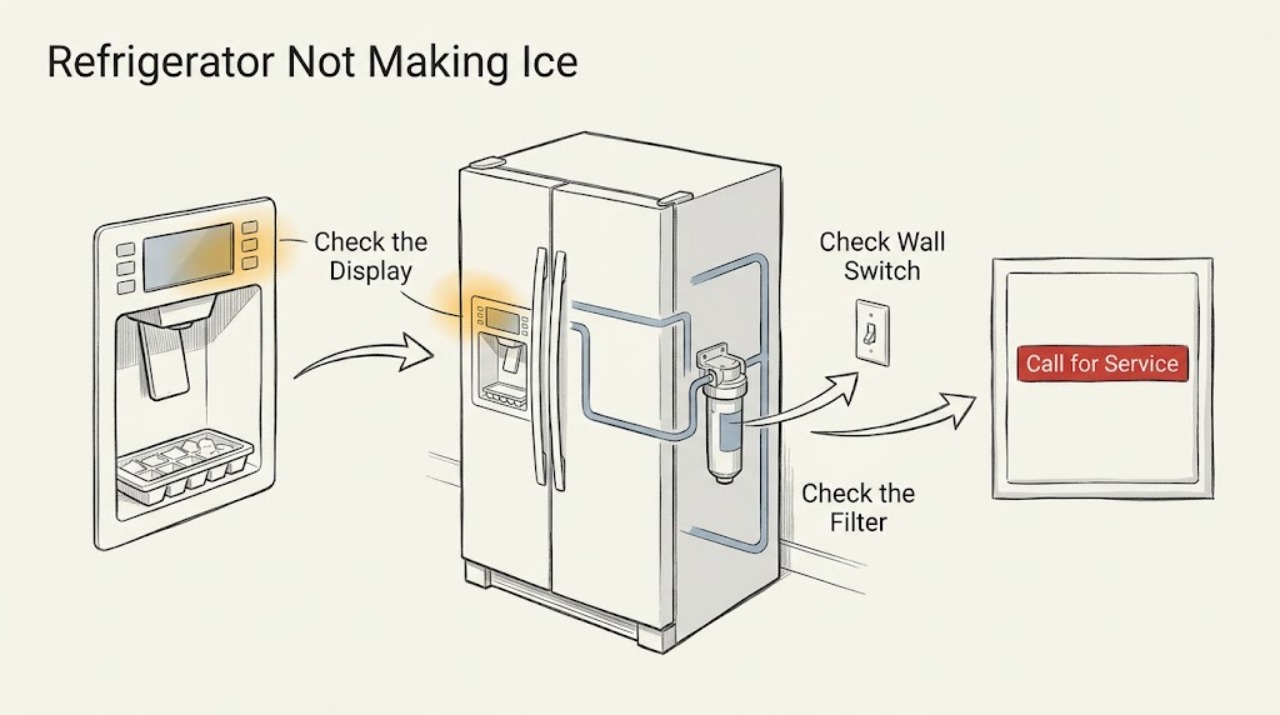
Work through in order
Diagnostic checks
Use only checks that match the exact appliance or system and its official guide.
-
Check 1
Confirm the ice maker is on, its arm or control is in the operating position, the bin is seated, and the freezer door closes fully.
Expected result: The control is off, arm raised, bin misseated, or door does not seal.
Next step: Correct the accessible position using the owner's manual, then allow the refrigerator to operate.
Stop if: Continue to water supply.
Why this matters
Why: The appliance may be paused or too warm for normal ice production.
-
Check 2
Inspect the rear water line for kinks, confirm the shutoff valve is open, and note whether the filter is old, clogged, or not fully seated.
Expected result: The line is kinked, the valve is closed, or the filter restricts flow.
Next step: Restore the accessible supply or replace the filter using the model procedure, then retest.
Stop if: Continue to temperature and reset checks.
Why this matters
Why: The ice maker cannot fill normally without adequate water flow.
-
Check 3
Check freezer temperature near 0°F (-18°C), then use the model manual's reset switch or documented one-minute power cycle.
Expected result: The freezer is warm or the ice maker does not cycle after the documented reset.
Next step: Restore cooling or record the failed reset and arrange service.
Stop if: Allow the documented production interval and monitor the bin.
Why this matters
Why: Warm conditions delay freezing; a failed reset after supply and temperature checks points to a service-level fault.
Use your observations
Decision map
Find the observation that best matches what you see, then follow the next safe action.
-
PATH 01Next step
What you see
The ice maker is off or the freezer is not yet cold
Do this next
Correct the setting or temperature and wait the documented period.
-
PATH 02Next step
What you see
Water flow is restricted but the ice maker otherwise cycles
Do this next
Correct only accessible supply conditions and arrange service if filling does not resume.
-
PATH 03Next step
What you see
The model reset/test does not move the ice maker
Do this next
Stop forcing the mechanism and arrange model-specific service.
Helpful context
Understand the symptom
No ice is a chain of conditions
KitchenAid separates the ice-maker operating state, water supply, filter, temperature, level, and reset behavior. Test those conditions in order so a water-flow problem is not mistaken for a motor failure.
When checks do not resolve it
Need a professional?
Use KitchenAid model-specific service when controls, supply, filter, temperature, and reset checks do not restore ice.
Common questions
FAQ
How long can a new KitchenAid refrigerator take to make ice?
KitchenAid notes that a new installation can take up to three days to fill the ice bin, depending on model and conditions.
Should I replace the ice-maker motor immediately?
No. Confirm the control, water supply, filter, temperature, and model test first; parts are conditional on a supported diagnosis and model fit.
Read the exact guide
Official sources
- Not Making Ice - Side by Side RefrigeratorKitchenAid · KitchenAid refrigerator water pressure, line, filter, and ice-maker checks
- Refrigerator Ice Maker TroubleshootingKitchenAid · KitchenAid refrigerator ice-maker operation, temperature, reset, and service guidance
Community feedback
Share a repair observation
Share a plain-text repair observation. Accepted observations are published automatically; this page may take a moment to update.