
On this page
Start here
Quick answer
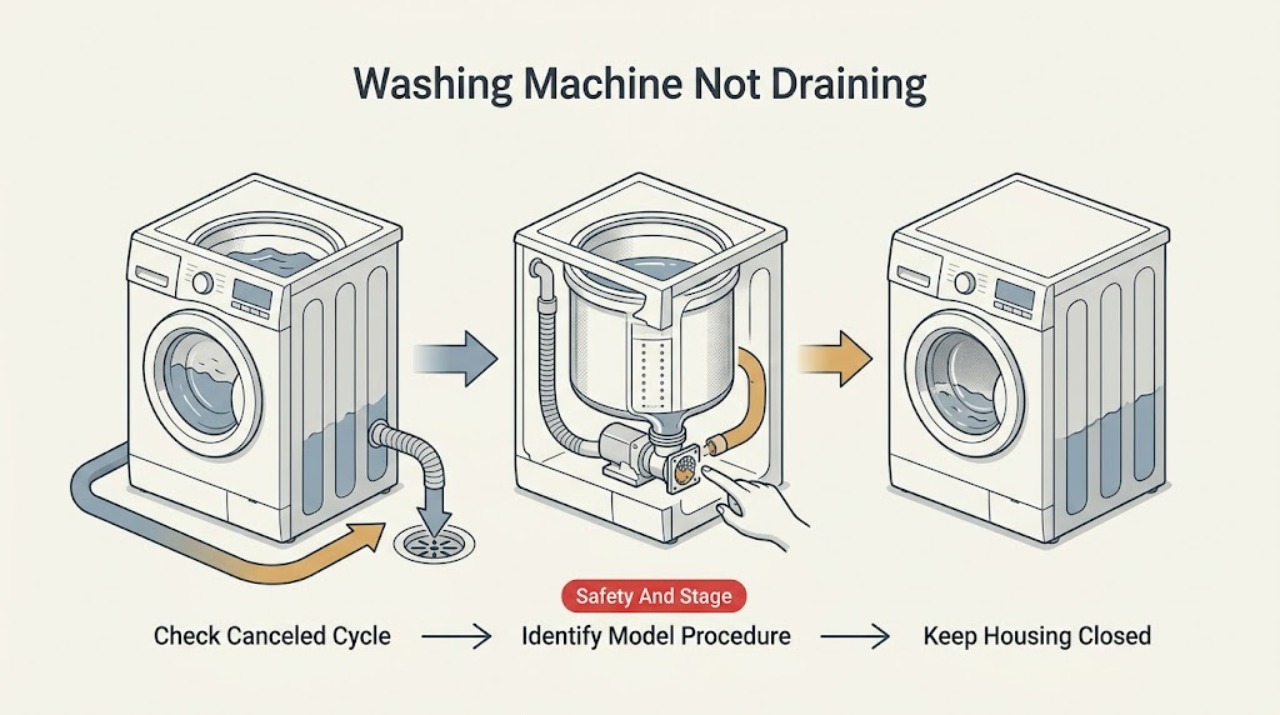
If a KitchenAid washer leaves water behind, first note when the water remains: after canceling, at the end of a wash, after a failed spin, or immediately after the pump starts. Stop and isolate power and water before handling residual water, and wait for recently heated water to cool. Check the accessible drain hose for kinks, crushing, incorrect placement, or a blocked household standpipe; reduce a tightly packed or unbalanced load and use only the detergent and amount specified for the exact model. Small items can obstruct a pump, and excess suds can slow or stop draining. A drain-pump filter is present on some models only, so use the model manual before opening a filter or draining residual water. Do not force a locked door, reach into a wet pump, or keep running the washer if there is a leak, water near electricity, a hot connection, a burning smell, abnormal pump noise, smoke, sparks, or repeated breaker trips.
Before you begin
Safety first
- This article supports ordinary-access observations and the exact manual's user-accessible drain procedure only. Do not open the cabinet, test live parts, bypass a door/lid lock, force a filter, handle hot or contaminated water, or operate after an electrical, fire, flood, or severe mechanical warning.
Work through in order
Diagnostic checks
Use only checks that match the exact appliance or system and its official guide.
-
Check 1
Stop the washer normally if it responds, keep the floor and hands dry, and record the water level and cycle stage before moving hoses or opening anything. If water is near the cord, plug, outlet, control, or a wet floor, isolate power only from a dry safe position.
Expected result: Classify the situation as no water, a small amount after cancellation, water remaining after a completed wash, a full tub after a drain attempt, leaking water, or water near electricity; note whether the water is still hot.
Next step: Leave a wet or electrically unsafe washer isolated and obtain service. If the area is dry and safe, continue with the model-appropriate external observations; wait for hot water to cool before residual-water handling.
Stop if: Do not touch a wet plug or outlet, unplug through standing water, reach into the tub or pump while energized, or restart after smoke, sparks, burning odor, a hot connection, or repeated breaker trips.
Why this matters
Why: A canceled cycle, wet load after low spin, and full tub after a failed pump are different decisions. Hot water, a leak, or water near power raises scald, flood, and shock risk and must be addressed before drain diagnosis.
-
Check 2
Record the full KitchenAid model number and identify whether the washer is top-load or front-load; read the exact manual for its drain, residual-water, door/lid, filter, and Drain & Spin instructions before opening a cover.
Expected result: Confirm whether the model documents an accessible drain-pump filter or residual-water hose, a dedicated Drain & Spin option, a drain indicator, or no user-accessible pump path.
Next step: Follow only the procedure for the exact model. If the manual does not describe safe access, leave the washer isolated and arrange service for the pump, hose, filter, or trapped object.
Stop if: Do not substitute a procedure from another KitchenAid design, remove the cabinet, bypass a lid or door lock, or pull a locked door open against resistance.
Why this matters
Why: A documented filter procedure may apply to some front-load or other models, while other machines require service access. A door that remains locked can be responding to water still in the tub; it is not permission to force the lock.
-
Check 3
Review whether the cycle was canceled or the door/lid was opened before the drain phase finished, and check the control panel for a Drain & Spin or equivalent cycle documented for the exact model.
Expected result: Record whether the washer was interrupted before draining, whether the door stayed locked because water remained, and whether the manual directs a normal Drain & Spin selection.
Next step: If the floor is dry, the water is cool, and the manual directs it, select the documented Drain & Spin once with the door/lid closed. If it will not drain, the pump only hums, or a safety warning appears, stop and continue to the external checks or service path.
Stop if: Do not run Drain & Spin with a leak, standing water at electrical parts, severe vibration, hot water, smoke, odor, sparks, or a jammed mechanism; do not bypass the lock.
Why this matters
Why: A canceled cycle can leave water even when the pump and hose are healthy. A locked door with water remaining is a safety state, not proof of a failed lock or a reason to force it.
-
Check 4
With power isolated and the water supply closed if the model's instructions require it, inspect the visible drain hose from the washer to the standpipe or laundry tub for kinks, crushing, sharp bends, loose attachment, a clogged end, or an unusually low or high route.
Expected result: Classify the hose as clear and correctly secured, kinked or crushed, clogged at the end, loose or leaking, inserted too far, or impossible to assess without moving or opening the appliance.
Next step: Correct only an obvious external kink, loose attachment, or documented routing issue with the machine off and dry; then check for leakage without running a cycle if the manual permits. Arrange service for a hidden blockage, damaged hose, or recurring backflow.
Stop if: Do not pull the washer while full, disconnect a hose containing hot or pressurized water, seal a drain opening with tape, or operate with water leaking toward power.
Why this matters
Why: A restriction or incorrect hose installation can prevent pumping or allow water to flow back. A loose connection or leak can create a flood and electrical hazard, and an inaccessible hose requires the manual or a technician rather than force.
-
Check 5
Observe the standpipe, laundry tub, or other household drain at the hose outlet and nearby plumbing without placing hands in the water; look for backup, slow flow, an obstructed opening, or water returning to the washer after pumping.
Expected result: Record whether water exits freely, backs up at the standpipe or tub, returns after the pump stops, or cannot be observed because the drain connection is concealed.
Next step: Stop using the washer if the household drain backs up or leaks, protect the floor from water, and arrange plumbing service. Do not pour drain chemicals into the washer or disconnect a full hose to force water into an unprepared container.
Stop if: Do not reach into contaminated or hot backup water, use chemical drain cleaner in the washer path, or continue cycles when water can overflow or reach electrical parts.
Why this matters
Why: Backup at the household drain or return flow points to a plumbing restriction or drain-hose setup rather than necessarily a failed washer pump. Concealed plumbing or recurring backflow needs qualified plumbing assessment.
-
Check 6
Only if the exact manual documents a user-accessible drain-pump filter or residual-water hose, switch off and unplug the washer, wait for a recent hot wash to cool, place a broad container and cloth, and follow that model's drain-and-filter procedure.
Expected result: Record whether the residual hose drains, the filter contains lint or a small object, the filter is clean, the filter will not turn, or water leaks after the filter is reseated.
Next step: Remove only debris the manual says is user-accessible, rinse and reinstall the filter fully, secure any stopper and hose, and verify dryness. If draining remains poor or the filter cannot be safely accessed or reseated, arrange service.
Stop if: Do not open a filter with hot or pressurized water, use tools to force it, reach into a wet pump, run the washer with the filter or stopper loose, or apply this step to a model whose manual does not describe it.
Why this matters
Why: A blocked filter or small object can restrict the pump on models that have this component. A filter that will not turn, a seized pump, an ongoing leak, or a model without documented access is not a reason to pry or open the cabinet.
-
Check 7
After the washer is off and safe, inspect the visible drum or basket holes, door seal, and clothing pockets for a small item such as a coin, wire, or fastener; do not reach into a pump or remove concealed components.
Expected result: Record a visible trapped item, a clear drum with no accessible obstruction, a rubbing or damaged seal, or an object that appears to have fallen between the drum and outer tub.
Next step: Remove only a loose, plainly accessible item with the washer isolated; otherwise keep the machine out of service and provide the item description and cycle stage to a technician.
Stop if: Do not insert tools through drum holes, cut a seal, turn the drum against resistance, or reach into a concealed pump or gap.
Why this matters
Why: KitchenAid washer guidance notes that small items can enter the pump or lodge between the drum and tub and slow draining. An object beyond ordinary access may require service to remove it without damaging the tub, pump, or seal.
-
Check 8
Review the detergent type and measured amount, the load size, and whether the load was tightly packed or badly unbalanced; inspect for excessive suds without adding more detergent or water.
Expected result: Record HE detergent used as directed, too much or non-HE detergent, visible excess suds, an overloaded basket, a single heavy item, or a normal load with no suds.
Next step: Follow the exact manual's suds-removal or no-detergent cycle only if the washer is dry and has no safety warning; reduce and redistribute a safe load for a future cycle. If the tub remains full or the symptom repeats, stop and request service.
Stop if: Do not add detergent to a suds-removal cycle, add water manually, run repeated cycles to clear foam, or continue operating with a leak, electrical heat, smoke, odor, or severe vibration.
Why this matters
Why: Excess suds can slow or stop draining and spinning, while a tight or unbalanced load can leave clothes wet even when water has drained. Neither explains smoke, a hot plug, a burning smell, a leak near power, or an abnormal pump noise.
-
Check 9
If the manual permits one safe Drain & Spin observation and there is no leak, hot water, electrical warning, or severe vibration, listen from outside the closed washer and observe the drain outlet without touching moving or wet parts.
Expected result: Record normal water flow, weak intermittent flow, a hum with no water movement, grinding or clicking, silence with a drain command, water returning, or a breaker trip.
Next step: Stop the test at the first abnormal noise, odor, vibration, electrical event, or leak. Keep the washer isolated and give the technician the sound, flow, cycle stage, and prior hose/filter observations.
Stop if: Do not run repeated drain commands, remove a panel while energized, probe the pump, or continue after a breaker trip, smoke, burning smell, sparks, hot connection, or severe movement.
Why this matters
Why: Normal flow shifts attention to cancellation, load, suds, or a cycle expectation. Weak flow suggests restriction; hum without flow can indicate an obstruction or pump problem; grinding, silence, backflow, or a trip requires service and should not be repeatedly reproduced.
-
Check 10
Prepare the model number, washer design, cycle and stage, water level, drain-hose route, household-drain behavior, filter result if applicable, detergent/load details, pump sound, displayed code, and safe photographs for KitchenAid or a qualified technician.
Expected result: Confirm whether the evidence points to cancellation or a cycle expectation, hose or household plumbing, filter or small-item obstruction, suds/load balance, pump failure, door/lid control, or an unresolved safety fault.
Next step: Use KitchenAid's model-specific manual and service resources to request diagnosis. Tell the technician if the tub is full, the door is locked, water was hot, a leak occurred, the outlet or plug was warm, or any odor, smoke, sparks, noise, vibration, or trip occurred.
Stop if: Do not return the washer to service while water remains for an unexplained reason, a filter leaks, the pump is noisy or seized, a lock is abnormal, or any electrical, flood, heat, or fire warning remains.
Why this matters
Why: A precise sequence prevents replacing a pump when the household drain or suds caused the symptom and helps service identify a concealed object or failed component without unsafe owner disassembly.
Use your observations
Decision map
Find the observation that best matches what you see, then follow the next safe action.
-
PATH 01Safety boundary
What you see
Water remains after a cycle was canceled or the door/lid was opened before the documented drain phase finished, with a dry floor and no safety warning.
Do this next
Use the exact model's documented Drain & Spin or restart procedure once, then reassess outlet flow; stop if the pump does not move water or any warning appears.
Why this path and its safety boundary
Why it matters: The interruption may explain the residual water and does not by itself establish a failed pump.
Safety stop: Do not force the lock, run a drain cycle with water near electricity, or repeat cycles after abnormal noise, odor, heat, vibration, or a breaker trip.
-
PATH 02Safety boundary
What you see
The drain hose is kinked, crushed, too low/high or loose, or the standpipe/laundry tub backs up or returns water.
Do this next
Correct only an obvious safe external routing issue according to the manual; stop using the washer and arrange plumbing service for backup, concealed blockage, recurring backflow, or leaks.
Why this path and its safety boundary
Why it matters: The external drain path or household plumbing can prevent or reverse draining even when the washer pump is operating.
Safety stop: Do not use chemical drain cleaner in the washer path, disconnect a full or hot hose without preparation, seal the drain opening, or operate while water can reach electrical parts.
-
PATH 03Safety boundary
What you see
The washer used too much or non-HE detergent, has visible excess suds, or was tightly packed/unbalanced and leaves wet clothes or drains slowly.
Do this next
Follow the exact manual's no-detergent suds-removal guidance only when the washer is otherwise safe; measure the specified detergent and load loosely in future cycles.
Why this path and its safety boundary
Why it matters: Suds can slow or stop draining/spinning, and load distribution can leave clothes wet without a blocked pump.
Safety stop: Do not add more detergent or water, repeatedly cycle a foaming or overloaded washer, or use this explanation to dismiss a leak, hot connection, burning odor, smoke, sparks, or persistent full tub.
-
PATH 04Safety boundary
What you see
The model has an accessible drain-pump filter and it contains debris, or a visible small item is caught in an ordinary-access drum area.
Do this next
Isolate power, cool hot water, and follow only the model's documented filter procedure; remove only plainly accessible debris and fully reseat the filter.
Why this path and its safety boundary
Why it matters: A filter or small object can restrict flow; a concealed item between the drum and tub or inside the pump requires service access.
Safety stop: Do not pry a filter, force a seized pump, probe drum holes, reach into a wet pump, run with a loose filter/stopper, or open the cabinet.
-
PATH 05Safety boundary
What you see
The drain hose and household drain are clear, suds/load issues are absent, but the washer hums without flow, grinds, stays silent during a drain command, or leaves a full tub.
Do this next
Keep the washer isolated and arrange model-specific appliance service, giving the technician the stage, sound, water level, and completed external checks.
Why this path and its safety boundary
Why it matters: A pump obstruction, failed pump, control issue, or concealed object is possible and cannot be safely narrowed by repeated owner testing.
Safety stop: Do not run repeated drain tests, bridge a pump or lock, reach into a wet mechanism, or open the cabinet for live testing.
-
PATH 06Safety boundary
What you see
Water leaks toward power, the floor is wet, the plug/outlet is hot or damaged, a breaker trips, or there is smoke, burning odor, melting, or sparking.
Do this next
Keep clear and isolate power and water only from a dry safe position, then obtain qualified electrical/appliance help and follow local emergency procedures for smoke or fire.
Why this path and its safety boundary
Why it matters: Shock and fire risk take priority over restoring the drain; do not treat the event as a simple hose or filter clog.
Safety stop: Do not touch wet electrical parts, unplug through standing water, reset a tripping breaker repeatedly, or restart to see whether the leak or heat clears.
Helpful context
Understand the symptom
Read the remaining water as a timing clue
A small amount of water can remain because a cycle was canceled before its drain phase, while a full tub after the pump runs points more toward a restricted hose, pump, filter, or household drain. Wet clothes after a low-spin or unbalanced cycle are not necessarily evidence that the pump failed. Note the exact stage, whether the pump hums or gurgles, whether water moves at all, and whether the washer shows a drain or spin indication before changing anything.
Use the correct KitchenAid procedure for the washer design
KitchenAid front-load and top-load washers do not all expose the same drain components. Some models have a user-accessible drain-pump filter and residual-water hose; others do not. The product guide and owner's manual identify whether that filter exists and how to drain it. Do not remove a panel, loosen a hose, or assume a front-load filter procedure applies to a top-load model.
Suds and backflow can look like a pump failure
KitchenAid manuals link too much or non-HE detergent to suds that slow or stop draining and spinning. A drain hose that is kinked, pushed too far into a standpipe, or connected to a blocked household drain can also leave water or allow backflow. Correct only an obvious, safe external setup issue; persistent residual water, leakage, or a pump that hums without moving water is a service boundary.
Safety boundary
Stop conditions
- Stop for water near the cord, plug, outlet, control, or wet floor; isolate power only from a dry safe position and do not touch wet electrical parts.
- Stop for smoke, flame, burning or melting odor, sparks, a hot or discolored plug/outlet, damaged cord, repeated breaker trips, or severe pump noise or vibration.
- Do not force a locked door or lid, bypass its safety, reach into a wet pump or drum gap, probe drum holes, or open the cabinet for live testing.
- Do not open a filter or hose with hot or pressurized water, use chemical drain cleaner, run with a loose filter or stopper, or add water manually to clear a blockage.
- Do not run repeated Drain & Spin tests after the pump hums without flow, grinds, stays silent, leaves a full tub, or produces any leak, odor, heat, or electrical warning.
Only after diagnosis
Potential parts
- drain pump or pump filter assembly
Consider this category only if the exact model has the component and diagnosis confirms a blocked, damaged, or failed pump/filter after safe external checks.
Confirm the full model number and exact pump/filter design; do not infer fit or open a wet pump from a symptom alone. - washer drain hose assembly
Consider this category only if the exact model's hose is cracked, crushed, leaking, incorrectly sized, or cannot be restored to the documented routing.
Confirm model-specific length, ends, routing, clamps, and household drain requirements before replacement; isolate water and power first. - door or lid lock assembly
Consider this category only if the exact model's diagnosis links a persistent lock state or canceled-cycle behavior to a failed lock after water has safely drained.
Confirm the exact model and technician diagnosis; never bypass or defeat the lock as a drain workaround.
When checks do not resolve it
Need a professional?
Arrange KitchenAid or qualified appliance/plumbing service when the hose and household drain are clear but water remains, a pump hums without flow, the filter is absent or inaccessible, a small item is concealed, the door/lid stays locked with water, the problem repeats after safe load or suds checks, or there is any leak, hot connection, odor, smoke, sparking, severe vibration, or breaker trip.
Safety scope: This article supports ordinary-access observations and the exact manual's user-accessible drain procedure only. Do not open the cabinet, test live parts, bypass a door/lid lock, force a filter, handle hot or contaminated water, or operate after an electrical, fire, flood, or severe mechanical warning.
Common questions
FAQ
Why is my KitchenAid washer leaving water in the tub?
Common decision points are a canceled cycle, kinked or incorrectly routed hose, household drain backup, excess suds, an overloaded or unbalanced load, a blocked pump/filter on applicable models, or a pump obstruction/failure. Note the stage and water level, isolate power before handling residual water, and use the exact model manual.
Can I run Drain & Spin if water remains?
Only when the floor and electrical area are dry, the water is cool, there is no leak or abnormal sound, and the exact manual documents Drain & Spin. A single safe observation may distinguish a canceled cycle from a drain fault. Do not run it after smoke, odor, heat, sparks, a breaker trip, severe vibration, or water near power.
Does every KitchenAid washer have a drain-pump filter?
No. Some models document an accessible pump filter or residual-water hose and others do not. Confirm the full model and follow only its manual; never remove a cabinet panel or force a filter because another washer has one.
Can too much detergent stop a KitchenAid washer from draining?
Yes. KitchenAid manuals explain that excess or non-HE detergent can create suds that slow or stop draining and spinning. Use only the detergent type and measured amount specified for the load and exact model, but do not blame suds for a leak, hot connection, burning smell, smoke, or a full tub that persists.
What if the drain hose looks clear but the washer still will not drain?
Check whether the household standpipe or laundry tub backs up, whether the model has a documented accessible filter, and whether the pump hums without flow or makes an abnormal sound. If those checks do not resolve it, keep the washer isolated and arrange service for a pump, concealed obstruction, control, or lock issue.
Can I force open the KitchenAid washer door when water remains?
No. A locked door may be protecting you from residual water or movement. Do not pry or bypass it. Use only the exact manual's safe drain and unlock procedure; obtain service if water remains or the lock does not release after a safe documented drain.
When is a washer drain problem an electrical emergency?
Treat water near a plug or outlet, a hot or discolored connection, smoke, sparks, burning or melting odor, a damaged cord, or repeated breaker trips as an immediate stop condition. Keep clear, isolate power only from a dry safe position, and obtain qualified help rather than restarting the washer.
Read the exact guide
Official sources
- Appliance and Electrical Fire SafetyU.S. Fire Administration · Government fire-safety guidance for major household appliances including washers; it does not diagnose a KitchenAid model.
- Owner's ManualKitchenAid · KitchenAid front-load washer manual; the drain-pump filter procedure applies only to models that document this access.
- TROUBLESHOOTING – WASHER (CONT.)KitchenAid · KitchenAid owner's manual for a top-load washer family; exact model documentation controls the user's machine.
Community feedback
Share a repair observation
Share a plain-text repair observation. Accepted observations are published automatically; this page may take a moment to update.