
On this page
Start here
Quick answer
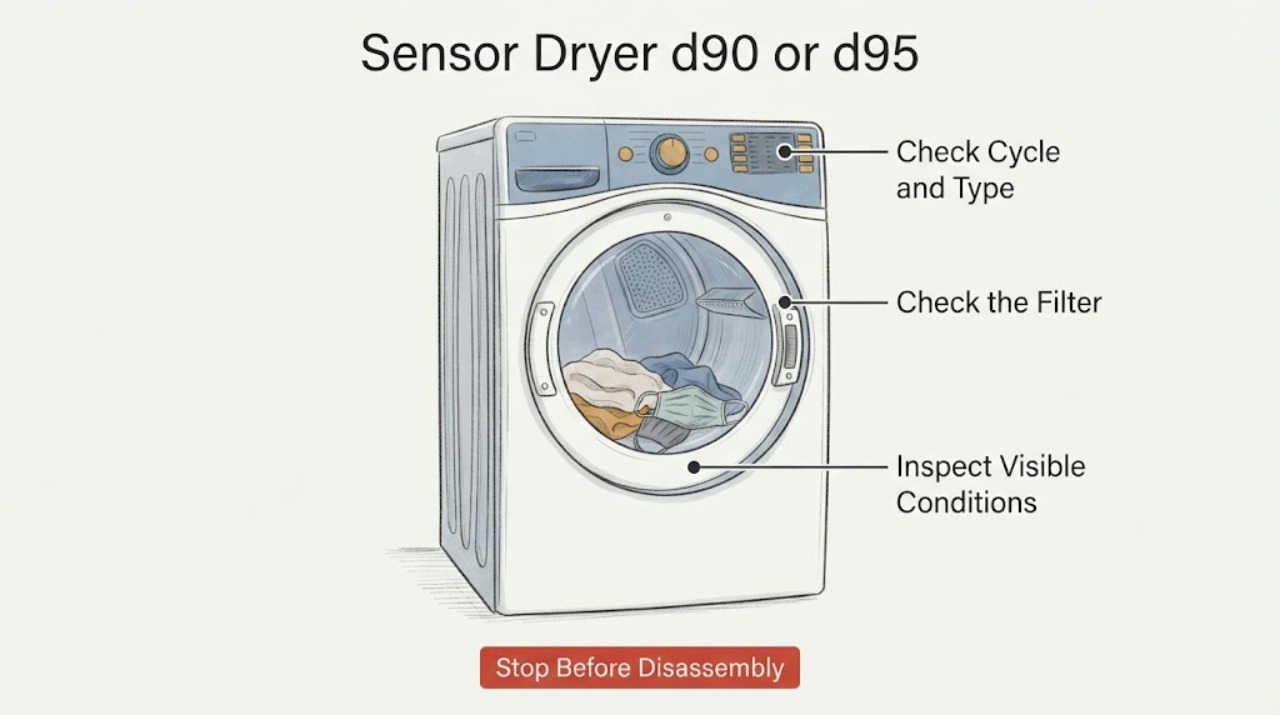
LG's official dryer guidance says d90 and d95 indicate that the exhaust duct is about 90% or 95% blocked, respectively; two or four Flow Sense bars also indicate severe restriction. The model is missing here, so do not assume a model-specific button sequence or internal sensor fault. Stop using the dryer until the exhaust system is cleaned or repaired. When the dryer is cool and disconnected from power, clean and fully dry the lint filter and inspect only the visible hose and outside vent hood for crushing, kinks, holes, lint, or a stuck flap. Towels can make a restricted system obvious through long drying, while a small mixed load such as face masks is useful only as a repeatable observation—not proof that the load caused the code. If airflow remains weak or d90/d95 returns, arrange professional vent inspection; stop immediately for smoke, burning smell, unusual heat, gas odor, or a repeated breaker trip.
Work through in order
Diagnostic checks
Use only checks that match the exact appliance or system and its official guide.
-
Check 1
Before pressing buttons, photograph the complete display and record whether it says d90, d95, D90, or another message, how many Flow Sense bars are lit, the dryer type if known (gas or electric), and whether the warning appeared while drying towels, face masks, or another load. Also record drying time and whether the cycle stopped.
Expected result: The complete display is d90 or d95 with two or four bars, the display is incomplete or different, or the code appears only as a transient after a power event.
Next step: If the code is incomplete or the model is unknown, keep the dryer off until the display and rating-label model are recorded. For confirmed d90/d95 or severe Flow Sense bars, proceed only with cool, power-off accessible checks and do not keep drying to see if it clears.
Why this matters
Why: LG assigns the 90% and 95% labels to different severities of exhaust restriction, while another display may need the exact model guide. A load-specific observation is a timing clue, not evidence that the load itself damaged an internal part.
-
Check 2
With the dryer off, cool, and disconnected from power, remove the accessible lint filter. Brush away lint, and if the model's instructions allow washing it, clean it with warm water and a soft brush and let it dry completely before reinstalling. Do not scrape sensors, bypass a filter switch, or open the cabinet.
Expected result: The filter is visibly packed with lint or damp residue, or it is clean, dry, correctly seated, and the warning remains.
Next step: If the filter was restricted, reinstall it only when fully dry and record whether d90/d95 returns on a later safe observation. If it is clean or the warning returns, inspect the visible exhaust route and stop using the dryer until the severe restriction is resolved.
Why this matters
Why: LG lists a blocked lint filter as an airflow restriction. A clean and seated filter rules out only that accessible point; it does not clear a wall duct, exterior hood, crushed hose, or internal dryer fault.
-
Check 3
From outside the appliance, inspect the hose between the dryer and wall for crushing, kinks, holes, loose joints, or a coil pressed behind the dryer. At the exterior outlet, look for lint, debris, snow or ice where applicable, and a flap that cannot open freely. Do not reach into the duct or move a stacked or gas dryer by force.
Expected result: The hose is crushed or kinked, the connection is loose, the exterior hood is blocked or its flap does not open, or the visible route is clear.
Next step: Correct only a visible, accessible obstruction without dismantling the dryer. If the hood or in-wall route is blocked, arrange a qualified vent-cleaning professional. Do not operate through d90/d95 while waiting for cleaning or repair.
Why this matters
Why: LG identifies crushed/damaged ducting, blocked hoods, lint, long runs, and multiple bends as causes of restricted airflow. A clear visible section can still conceal a restriction inside the wall.
-
Check 4
If a dry, safe exterior observation is needed, note whether the outside vent produces strong airflow during one permitted test only after the accessible filter and hose are clear and the dryer has no gas, smoke, heat, or electrical warning. Compare the result with the towel or face-mask load history, but do not run repeated cycles.
Expected result: Airflow at the outlet is weak or absent, airflow is strong but d90/d95 returns, or the dryer becomes unusually hot, stops, smokes, smells of burning or gas, or trips a breaker.
Next step: For weak airflow, stop use and arrange vent inspection. For strong airflow with recurring d90/d95, provide the model and recorded conditions to LG or qualified dryer service. For smoke, burning smell, gas odor, severe heat, or repeated breaker trips, stop immediately and obtain urgent qualified help.
Why this matters
Why: Weak outlet airflow supports a restriction between the dryer and outside exit. Strong outlet airflow with a returning warning may indicate hidden routing, sensor, or model-specific behavior and needs service; a hazard overrides all airflow interpretation.
-
Check 5
Record the full model number from the rating label before considering any reset or service instruction. Use only the matching LG guide; do not enter an undocumented installation or diagnostic test and do not replace a thermistor, fan, or control module from d90/d95 alone.
Expected result: The model remains unknown, the exact guide provides a documented owner action, or the warning persists after the visible exhaust issue is corrected.
Next step: Supply LG or a qualified technician with the model, code, Flow Sense bars, load, drying-time history, filter state, hose/hood observations, and any gas or electrical symptoms. Keep the dryer off until severe restriction is cleaned or repaired.
Why this matters
Why: LG's general guidance establishes the airflow safety boundary, but model details can change controls and sensor behavior. A persistent warning after visible checks needs professional vent or appliance diagnosis rather than a guessed internal part.
Use your observations
Decision map
Find the observation that best matches what you see, then follow the next safe action.
-
PATH 01Next step
What you see
Confirmed d90/d95 or severe Flow Sense bars are accompanied by a packed filter, crushed hose, blocked hood, or weak outside airflow.
Do this next
Stop using the dryer and have the visible obstruction corrected or the exhaust system professionally cleaned/repaired. Do not keep drying towels or masks through the warning.
Why this path and its safety boundary
Why it matters: This matches LG's restricted-exhaust branch, and the visible finding is more actionable than a theory about a dryer component.
-
PATH 02Next step
What you see
The filter, visible hose, and outside hood appear clear, but d90/d95 returns or airflow remains weak.
Do this next
Arrange professional vent inspection/cleaning and give the technician the exact model and airflow observations. Do not bypass the warning or replace a thermistor, fan, or control module from the code alone.
Why this path and its safety boundary
Why it matters: A hidden wall-duct restriction, long or sharply bent route, damaged duct, or another model-specific condition remains possible; a clear filter does not prove the dryer is at fault.
-
PATH 03Next step
What you see
The code appears only with one mixed towel/face-mask load, clears with no visible restriction, and drying performance is otherwise normal.
Do this next
Use the exact model guide and observe recurrence only after the exhaust path is confirmed safe. If d90/d95 returns, stop use and arrange vent or appliance service.
Why this path and its safety boundary
Why it matters: Load composition is a correlation worth recording, but it does not cancel LG's airflow warning or establish that the load caused it.
-
PATH 04Next step
What you see
Smoke, burning smell, gas odor, severe heat, sparks, a hot outlet, or a repeated breaker trip occurs.
Do this next
Stop the dryer immediately. For gas odor, avoid switches and leave the area using the local emergency route; otherwise isolate power only from a dry safe position if possible and arrange qualified appliance/electrical service.
Why this path and its safety boundary
Why it matters: This is an immediate fire, gas, or electrical safety boundary rather than an airflow troubleshooting branch.
Helpful context
Understand the symptom
d90 and d95 are airflow warnings, not a diagnosis of a thermistor, fan, or control board. LG's opened guidance describes d90 as approximately 90% blockage and d95 as approximately 95% blockage in the duct work. Because no full model number was supplied, use the shared LG airflow boundary only and do not borrow a model-specific test or reset sequence.
Towels and face masks do not change the meaning of d90/d95. A towel load may reveal restricted exhaust through extended drying, while a small mixed load can dry differently because of fabric and load arrangement. Record which load was present and whether the code repeats; do not use one successful small load to clear a severe airflow warning.
The safe owner boundary is the accessible lint filter, visible hose, and exterior outlet. LG says some restrictions are hidden in the wall or caused by long runs and multiple bends, so a clear hose at the dryer does not prove the whole exhaust system is clear.
When checks do not resolve it
Need a professional?
Arrange professional vent cleaning or qualified LG dryer service when d90/d95 returns, the exterior airflow is weak, the visible path is clear but the warning persists, the full model is needed for a safe instruction, or any internal access would be required. Stop immediately for smoke, burning smell, gas odor, severe heat, sparks, a hot outlet, water near electrical parts, or a repeated breaker trip. Do not bypass Flow Sense, run repeated cycles, open the cabinet, or perform live electrical tests.
Common questions
FAQ
Is d95 worse than d90 on an LG dryer?
LG describes d90 as about 90% duct blockage and d95 as about 95% blockage. Both are severe airflow warnings; the dryer should not be used until the exhaust system is cleaned or repaired.
What do two or four Flow Sense bars mean?
LG's official error list says two or four Flow Sense bars indicate that the exhaust system is severely restricted. Inspect the accessible filter, hose, and outside hood, then arrange professional vent inspection if the path is not clearly restored.
Could towels or face masks cause the d90/d95 code?
The load can change drying time and make an airflow problem more noticeable, but it does not prove the load caused the code. Record the load and recurrence; treat confirmed d90/d95 as an exhaust restriction until the vent path is checked.
Should I replace the dryer thermistor or fan?
Not from d90/d95 alone. LG's guidance points first to the lint filter and exhaust path, including the wall duct and outside hood. A returning warning after professional vent checks needs model-specific service diagnosis.
Read the exact guide
Official sources
- LG Dryer - Error Code ListLG USA Support · The opened LG error-code list states that d80/d90/d95 represent 80%, 90%, and 95% exhaust-duct restriction and that two or four Flow Sense bars mean severe restriction; it also notes long runs, bends, crushed ducts, and exterior airflow checks.
- LG Dryer - Understanding d90 and d95 Error CodesLG USA Support · The opened LG support article defines d90 and d95 as approximately 90% and 95% duct blockage, directs inspection of the lint filter, visible hose, exterior vent hood, and hidden/long duct runs, and says not to use the dryer until severe exhaust restriction is cleaned and repaired.
Community feedback
Share a repair observation
Share a plain-text repair observation. Accepted observations are published automatically; this page may take a moment to update.