
On this page
Start here
Quick answer
A sharp metallic scraping sound from an LG dryer can come from a foreign object such as a coin or zipper, but a scrape that continues through the cycle can indicate a worn roller, belt, loose drum shaft, hardened lubricant, or another internal part. Empty the pockets, remove the load, and inspect the drum opening for an accessible object or damage. Do not keep running the dryer if the sound is metallic, worsening, accompanied by a burning smell, or paired with a drum that is hard to move. With the dryer unplugged and cool, gently rotate the empty drum by hand and note whether it turns smoothly, rubs at one point, or feels loose. A brief squeak at startup or when the drum reverses can be normal on some LG models, but persistent scraping or any operational problem needs qualified service; do not open the cabinet or bypass a safety switch to locate it.
Before you begin
Safety first
- Homeowner-safe checks are stopping the cycle, emptying pockets, inspecting the visible drum opening, and gently rotating an empty drum only when the dryer is unplugged and cool. Cabinet removal, internal drive or support diagnosis, electrical measurements, gas work, safety-switch bypass, and damaged-component replacement belong to qualified professionals.
Work through in order
Diagnostic checks
Use only checks that match the exact appliance or system and its official guide.
-
Check 1
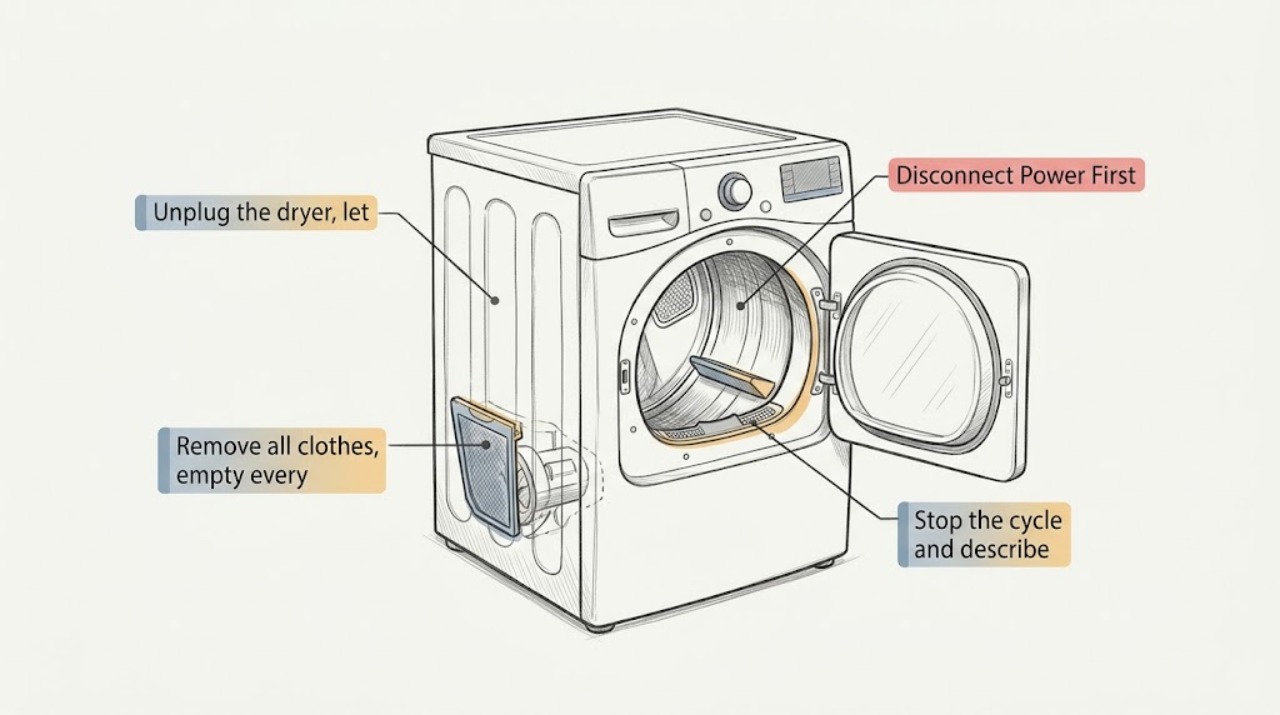
Stop the cycle and describe when the scraping occurs: only at startup or reversal, only with a particular load, at one drum position, or continuously throughout rotation; note any scraping, squealing, thumping, rattling, heat, smell, or drum-movement problem.
Expected result: The sound is brief at startup or reversal, follows a zipper or metal item, is a persistent sharp scrape, occurs with loud rumbling, or comes with a drum that stops or turns poorly.
Next step: Do not continue a cycle to make a persistent scrape louder. Record the sound timing and move to the no-power inspection; stop entirely for burning odor, smoke, sparks, or severe mechanical resistance.
Why this matters
Why: LG distinguishes brief belt-friction or roller sounds and clothing fasteners from persistent scraping that may indicate worn or damaged internal parts. The timing and accompanying symptom determine whether a safe load check is reasonable or service should be immediate.
-
Check 2
Remove all clothes, empty every pocket, and inspect the visible drum surface, front lip, rear area that can be seen through the opening, and clothing fasteners for coins, keys, hairpins, zippers, buttons, or a loose object; do not reach into a gap or remove a panel.
Expected result: A metal object or fastener is present, the drum has a visible scratch or dent, the opening is clear, or the suspected object cannot be safely reached.
Next step: Remove only a loose object that is plainly accessible with the dryer off and cool. Do not pry against the drum, pull at seals, or operate with visible damage; arrange service when the object is lodged or damage is present.
Why this matters
Why: LG identifies foreign objects and clothing hardware as common causes of contact noise and possible drum damage. A clear opening with persistent scraping makes an internal support or drive issue more likely.
-
Check 3
Unplug the LG dryer, let it cool, remove the load, and gently rotate the empty drum by hand from the opening; feel for smooth movement, a repeating rub at one point, grinding, wobble, or unusual resistance without using tools.
Expected result: The drum turns smoothly, rubs once per revolution, feels rough or tight, wobbles, or will not move normally.
Next step: Leave the dryer unplugged for rough, tight, wobbling, or grinding movement and arrange service. Do not force the drum, add lubricant, or restore power to overcome resistance.
Why this matters
Why: Smooth movement makes a seized support less likely but does not clear the belt or internal parts. A repeating rub, roughness, wobble, or resistance can involve a roller, slide, shaft, bearing, idler, obstruction, or seized drum.
-
Check 4
With the dryer still disconnected, inspect only the accessible door seal and drum edge for a displaced seal, trapped fabric, loose trim, or a shiny rub mark; keep hands away from concealed rollers, belt, motor, wiring, and hot or sharp edges.
Expected result: Fabric or trim is trapped, the seal is displaced or damaged, a rub mark repeats around the drum, or no visible contact point is found.
Next step: Remove only loose fabric or a clearly accessible obstruction and follow the exact model manual for a seal check. Stop for a damaged seal, loose drum edge, or any need to remove the cabinet and arrange qualified service.
Why this matters
Why: An accessible obstruction or seal problem can create contact noise, while a repeating rub mark without an accessible cause supports an internal alignment or support issue. No visible mark does not rule out a belt or bearing problem.
-
Check 5
If the drum turns freely by hand and there is no visible object or damage, compare the sound pattern with LG’s distinctions: brief startup/reversal squeak, roller thump, clothing clack, or persistent metallic scrape; do not perform an empty powered test when the scrape is sharp, continuous, or worsening.
Expected result: The sound is brief and disappears, is a clothing clack, is a short thump after sitting, or remains a high-pitched or metallic scrape during operation.
Next step: For a brief sound with normal operation, secure zippers and empty pockets on the next load while monitoring. For persistent scraping or any operational issue, leave the dryer off and arrange service.
Why this matters
Why: Brief belt friction, temporary roller shape recovery, or clothing contact may be normal under the conditions LG describes. A persistent metallic scrape is more consistent with worn or damaged internal parts and cannot be safely narrowed to one component by sound alone.
-
Check 6
Check whether the scraping coincides with a load that is overfilled, tangled, or improperly placed, and whether the door was opened or the cycle paused; do not use an overloaded or damaged drum to test the noise.
Expected result: The sound occurs only with a bulky or tangled load, the drum stops after the door opens, the load is empty but the scrape remains, or the dryer has an operational error.
Next step: Redistribute or reduce a safe load only after the empty-drum inspection, and stop if the sound returns. Do not bypass the door switch or continue using a dryer with a persistent scrape.
Why this matters
Why: LG notes that load size and door state can affect tumbling or make a pause look like a drum fault, but an empty drum that still scrapes points away from load contact. An operational error plus scraping needs service rather than a heavier test load.
-
Check 7
Document the LG model number, noise description and timing, empty-drum hand movement, visible object or rub mark, load conditions, and any heat, odor, or control symptom; do not remove the cabinet or make electrical measurements as a homeowner diagnosis.
Expected result: The drum is smooth but the scrape persists, the drum binds or wobbles, a motor or belt sound is present, the noise is worsening, or internal access is required.
Next step: Keep the dryer unplugged and arrange qualified LG appliance service. Provide the model, sound timing, hand-rotation result, load and object checks, and all safety symptoms.
Why this matters
Why: These patterns can involve a worn belt, roller, idler, shaft, bearing, motor, seal, or another internal part. Similar sounds overlap, so a part cannot be selected reliably from the symptom alone.
Use your observations
Decision map
Find the observation that best matches what you see, then follow the next safe action.
-
PATH 01Next step
What you see
The sound is a brief squeak at startup or drum reversal, or a short thump after the dryer has been idle, and the dryer operates normally afterward.
Do this next
Secure zippers and buttons, empty pockets, and monitor the next cycle. Escalate if the sound becomes metallic, continuous, louder, or is paired with an operational problem.
Why this path and its safety boundary
Why it matters: LG describes belt friction and temporary roller-shape recovery as possible normal sounds in these conditions.
-
PATH 02Next step
What you see
The scraping follows a coin, key, zipper, button, or other metal item, and the object is loose and accessible with the dryer off.
Do this next
Remove the accessible object, check the drum for damage, and use the dryer only if the drum remains intact and the sound is gone. Service any lodged object or damaged surface.
Why this path and its safety boundary
Why it matters: Foreign-object or clothing-hardware contact is more likely than an internal bearing or roller failure.
-
PATH 03Next step
What you see
The empty, unplugged drum turns with a repeating rub, roughness, wobble, or strong resistance, or the sound continues without a visible object.
Do this next
Keep power disconnected and arrange qualified appliance service. Do not force, lubricate, or disassemble the drum drive as a homeowner check.
Why this path and its safety boundary
Why it matters: An internal drum support, shaft, roller, bearing, seal, belt path, or obstruction is more likely.
-
PATH 04Next step
What you see
The sound appears only with a tangled or oversized load but disappears when the load is removed, and the empty drum moves smoothly.
Do this next
Use a smaller, evenly arranged load with pockets emptied and fasteners secured. Stop using the dryer if scraping returns with an ordinary load or any damage is visible.
Why this path and its safety boundary
Why it matters: Load contact or clothing hardware is more likely than a persistent internal scrape, although repeated rubbing can still damage the drum or seal.
-
PATH 05Next step
What you see
Scraping is continuous or worsening, the drum stops or binds, a burning smell or smoke appears, the cord or cabinet is hot, or electrical or internal access is required.
Do this next
Stop use and leave for smoke, fire, or immediate danger. Disconnect power only when safe, keep the dryer unplugged, and arrange qualified appliance or electrical service.
Why this path and its safety boundary
Why it matters: A mechanical, electrical, or fire hazard may be present beyond safe user checks.
Helpful context
Understand the symptom
First separate a foreign object from an internal scrape
A coin, key, zipper, button, or other metal item can strike the drum and make a sharp sound. Remove the load and check pockets and the drum opening before assuming a failed bearing or roller. If the sound continues with an empty drum, is metallic throughout the cycle, or comes with rough hand movement, treat it as an internal mechanical symptom.
Some startup sounds are brief, but persistent scraping is not
LG notes that a short squeak as the drum starts or reverses can result from belt friction, and rollers may thump briefly after sitting. Those sounds should not be confused with a sharp scraping sound that continues, causes discomfort, or accompanies poor operation. A persistent or worsening scrape is a reason to stop use and arrange inspection.
A hand check can reveal resistance without opening the dryer
With the dryer unplugged and cool, gently turning the empty drum can show whether the support system feels smooth or binds at one point. This is only a clue. Belt, roller, idler, shaft, bearing, motor, and cabinet work is model-specific and can expose moving, electrical, or hot components, so leave internal repair to a qualified technician.
Safety boundary
Stop conditions
- Do not keep running an LG dryer when a sharp metallic scrape continues, worsens, or is accompanied by poor operation. A stationary, binding, or damaged drum should remain out of service.
- Do not reach into a narrow gap, pry against the drum, pull at a seal, force the drum, or add lubricant to an unknown internal part. Stop for lodged metal, sharp edges, or visible drum damage.
- Do not remove the cabinet, bypass the door switch or another safety device, make electrical measurements, or work near concealed moving, hot, gas, or energized components unless qualified and following the exact model procedure.
- Stop for smoke, burning odor, sparking, a hot or damaged cord or outlet, exposed wiring, repeated breaker trips, or any scraping that begins with an electrical or gas-related symptom. Isolate power only when safe.
- For smoke, fire, gas odor, or immediate danger, leave the area and use emergency assistance from a safe location.
Only after diagnosis
Potential parts
- dryer drum roller or support
Consider this only when a qualified inspection confirms rough movement, rumbling, a repeating rub, or worn support components; scraping alone does not identify a roller.
Roller size, shaft, support arrangement, and model fit vary. Confirm the complete LG model number and manufacturer fit information before ordering or installing. - dryer drive belt or idler pulley
Consider this only when model-specific diagnosis links the sound to belt wear, slipping, loss of tension, or an idler problem after foreign-object and drum-support checks.
Belt routing, rib pattern, pulley design, and mounting vary by model. Confirm exact fitment from the manufacturer information before ordering or installing. - dryer drum shaft, bearing, or seal
Consider this only when a qualified inspection finds a loose shaft, rough bearing, damaged seal, or confirmed drum-support wear that matches the hand-movement and noise pattern.
Shaft, bearing, seal profile, and repair method are model-specific. Confirm the exact model and have a qualified technician verify the part before installation.
When checks do not resolve it
Need a professional?
Safety scope: Homeowner-safe checks are stopping the cycle, emptying pockets, inspecting the visible drum opening, and gently rotating an empty drum only when the dryer is unplugged and cool. Cabinet removal, internal drive or support diagnosis, electrical measurements, gas work, safety-switch bypass, and damaged-component replacement belong to qualified professionals.
Common questions
FAQ
Why does my LG dryer drum make a scraping sound?
A coin, key, zipper, or button may be contacting the drum, but persistent metallic scraping can also involve a worn roller, belt, loose drum shaft, hardened lubricant, bearing, or another internal part. Empty pockets and inspect the opening first, then stop use if the sound continues.
Is a brief squeak when an LG dryer starts normal?
LG says a brief high-pitched sound at startup or when the drum reverses can come from belt friction, and a short thump can come from rollers after the dryer has been idle. A sharp scrape that continues, worsens, or affects operation is not the same pattern and needs service.
Can a coin or zipper damage an LG dryer drum?
Yes. LG says coins, keys, hairpins, zippers, and buttons can strike the drum, make loud noise, and damage clothing or the drum. Empty pockets and secure fasteners before drying, and stop if an object is lodged or the drum is visibly damaged.
What does it mean if the LG dryer drum feels rough by hand?
With the dryer unplugged and cool, rough, tight, loose, or wobbling movement can indicate a support, shaft, bearing, roller, seal, belt-path, or obstruction problem. Do not force or lubricate it; keep the dryer off and arrange qualified service.
Could the load make an LG dryer sound like it is scraping?
A bulky, tangled load or clothing hardware can contact the drum and create noise. Remove the load and check the empty drum. If the scrape returns with an ordinary load or continues when empty, treat it as a possible internal issue rather than adding more clothes.
When should an LG dryer with a scraping drum be serviced?
Arrange service when a metallic scrape persists with an empty drum, the drum is rough or difficult to turn, the sound is worsening, or a roller, belt, shaft, bearing, motor, seal, or other internal part may be involved. Stop immediately for smoke, burning odor, sparks, hot electrical parts, or exposed wiring.
Read the exact guide
Official sources
- [LG Dryer] Clothes are damaged (torn or holes)LG USA Support · LG dryer foreign-object guidance; drum openings and model details vary.
- [LG Dryer] Noise From the DryerLG USA Support · LG dryer noise guidance for standard models; settings, sound behavior, and internal parts vary by model and region.
- [LG Dryer] Dryer Drum Not TurningLG USA Support · LG dryer drum-operation guidance; exact load behavior, controls, and error indications vary by model.
Community feedback
Share a repair observation
Share a plain-text repair observation. Accepted observations are published automatically; this page may take a moment to update.