
On this page
Start here
Quick answer
On an LG dryer, D80 is a Flow Sense indication of roughly 80% exhaust restriction somewhere between the dryer and the outside outlet; it is not proof that a thermistor, fan, or control board has failed. Let the unit cool, clean and reseat the accessible lint filter, and inspect the short visible transition duct and exterior outlet without moving or opening the WashTower. If those parts are clear but D80 returns, the restriction may be in an in-wall, roof, or shared apartment vent. Document the result and have the property manager or a qualified vent-cleaning professional arrange access; do not bypass the warning or alter a common duct. LG also notes that a gas dryer can show D80 when it is not receiving gas, so confirm the exact WashTower model and fuel before interpreting a recurring indication. Stop immediately for burning smell, smoke, sparks, abnormal heat, a hot outlet, or a repeated breaker trip.
Work through in order
Diagnostic checks
Use only checks that match the exact appliance or system and its official guide.
-
Check 1
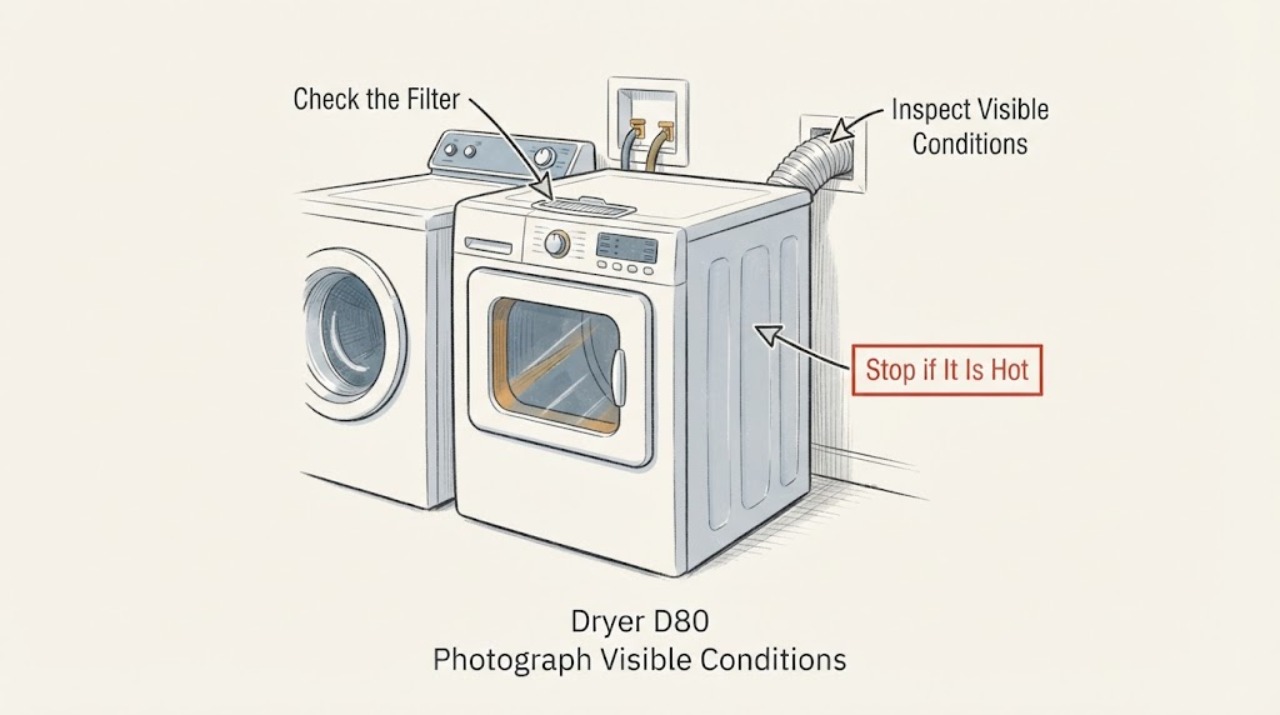
From a cool, dry, safe position, photograph the complete display and record whether it says d80, d90, d95, or shows Flow Sense bars. Record the full model suffix and whether the dryer is gas or electric before pressing Clear or Reset.
Expected result: The complete indication is D80/Flow Sense, another restriction level, a different code, or an incomplete/alternating display; the rating label identifies gas or electric operation.
Next step: Keep the photo and exact model for LG or service. If the display is accompanied by smoke, gas odor, burning smell, sparks, abnormal heat, a hot outlet, water near electrical parts, or a repeated breaker trip, stop immediately and seek qualified help.
Stop if: Do not keep restarting the dryer to make the display recur or to compare heat when a hazard is present.
Why this matters
Why: LG groups d80/d90/d95 with exhaust restriction, but a different code is a different diagnostic path. On a gas dryer, LG also says D80 may indicate that gas is not being received, so fuel type changes the interpretation.
-
Check 2
After the dryer is off and cool, remove the accessible lint filter, clean it as LG directs with warm water and a soft brush if residue is present, let it dry fully, and reseat it. Do not reach into the duct opening or run the machine with the filter removed.
Expected result: The filter is packed with lint or coated with residue, is damaged or not seating correctly, or is clean, intact, and seated normally.
Next step: If the filter is damaged or still does not seat, leave the dryer off and use the exact model's parts/service route. If it is sound, continue only with the external transition-path check.
Stop if: Do not force the filter, remove internal panels, or use compressed air or sharp tools inside the tower.
Why this matters
Why: A dirty or poorly seated filter can add resistance on the machine side; a clean, correctly seated filter makes a hidden or downstream restriction more important, but does not prove a particular internal component is bad.
-
Check 3
Without moving the stacked unit, inspect only the visible short transition duct and its connections from the room side. Look for a sharp kink, crushing, a hole, a loose joint, or the duct pressing against the cabinet; do not reach behind the tower if access is not safe.
Expected result: The visible hose is crushed, kinked, disconnected, damaged, or appears open and reasonably straight; the tower would have to be moved to see more.
Next step: Photograph the visible condition. Have the installer, property manager, or qualified appliance/vent professional correct a machine-side connection; do not alter a wall or shared duct yourself.
Stop if: Stop if the unit could tip, the floor or hose connection is wet, or inspection would require moving the tower or exposing wiring/gas piping.
Why this matters
Why: LG identifies crushed/damaged ducting and long or bent runs as airflow restrictions. An inaccessible path is an installation/service boundary, not permission to drag a roughly 326–329 lb WashTower or disassemble it.
-
Check 4
If there is no hazard and the exterior termination is safely accessible without entering a roof, shaft, or restricted building area, ask building maintenance whether the vent serves only this apartment or is a shared/in-wall run. From a safe distance, record whether the flap or outlet is visibly blocked and whether the building has a scheduled vent-cleaning process.
Expected result: The outside flap is blocked or has weak/no discharge, the duct disappears into the wall or roof, several units share the route, or building personnel cannot confirm the route.
Next step: Give the property manager or building maintenance the model, D80 photo, filter/hose observations, outlet location, and whether other units are affected. Request qualified vent inspection/cleaning before normal continued drying.
Stop if: Do not enter shared ducts, remove grilles, disconnect building plumbing/vent parts, or install an unapproved booster, cap, or bypass.
Why this matters
Why: A clear filter and short hose can coexist with restriction in a concealed or common exhaust. That result routes the work to the building/vent path; it does not identify a dryer fan, thermistor, or control-board failure.
-
Check 5
For a gas WashTower, compare the exact model's owner information and visible installation status with the D80 report, but do not adjust gas controls or open the burner area. For an electric model, keep the same airflow boundary and do not assume the electrical supply caused D80.
Expected result: The exact unit is gas and there is a gas odor or suspected supply interruption, or it is gas/electric with no fuel or supply warning and D80 persists after the accessible airflow checks.
Next step: For gas odor, leave the area and follow local emergency guidance; otherwise provide the fuel type, exact model, display photo, and airflow observations to qualified appliance service. For recurring D80 with clear accessible parts, request vent inspection as well.
Stop if: Never relight, adjust, bypass, or test gas components, and do not continue a cycle when heat is abnormal or a fuel odor is present.
Why this matters
Why: LG lists lack of gas as a possible D80 condition on gas dryers, while the ordinary D80 path remains an exhaust restriction. The displayed code alone cannot distinguish a gas-supply issue from a restricted vent in every model.
Use your observations
Decision map
Find the observation that best matches what you see, then follow the next safe action.
-
PATH 01Next step
What you see
The filter is dirty or damaged, and the visible short transition duct is crushed, kinked, loose, or visibly blocked.
Do this next
Clean and fully dry an intact filter. Leave the dryer off and have the damaged connection corrected by the installer or a qualified professional; do not move the tower unless the responsible professional can do so safely.
Why this path and its safety boundary
Why it matters: The observed restriction is on the accessible machine-side path; the result does not justify replacing an internal sensor or board.
-
PATH 02Next step
What you see
The filter is clean and seated, the visible transition duct is intact, but D80 returns or the outside termination has weak/no airflow.
Do this next
Stop normal dryer use and give the property manager/building maintenance the evidence. Arrange qualified vent inspection/cleaning for the concealed or shared path before resuming routine loads.
Why this path and its safety boundary
Why it matters: Restriction downstream of the accessible section—including inside a wall, roof run, or common building duct—is more likely than a confirmed dryer control or thermistor fault.
-
PATH 03Next step
What you see
The apartment-side path is clear and a qualified vent professional confirms the building path is clear, but the exact WashTower still reports D80.
Do this next
Provide LG service with the exact model suffix, fuel type, D80 history, filter/hose/outlet findings, and the building vent inspection result. Do not bypass Flow Sense or open the unit.
Why this path and its safety boundary
Why it matters: The restriction warning has not been explained by the verified exhaust route; model-specific service is needed rather than a guessed replacement part.
-
PATH 04Next step
What you see
The dryer produces burning smell, smoke, sparks, abnormal heat, a hot outlet, repeated breaker trips, or gas odor while D80 is displayed.
Do this next
Stop the dryer. From a dry, safe position only, isolate power if it can be done without touching water or exposed wiring; for gas odor, avoid switches and leave the area. Arrange urgent qualified service or local emergency help as appropriate.
Why this path and its safety boundary
Why it matters: This is a safety stop, not a routine airflow-cleaning branch; continued operation can add fire, electrical, or gas risk.
Helpful context
Understand the symptom
D80 narrows the first decision to airflow, not to a confirmed internal part. LG's error guide places D80, D90, and D95 in the exhaust-restriction family and warns that crushed or damaged ducts, long runs, multiple bends, lint, and a blocked outside flap can all contribute. A WashTower combines the washer and front-load dryer in one vertical unit; the exact model and fuel still matter because installation features vary.
In an apartment, a clean lint screen and unobstructed short hose do not establish that the wall or building exhaust is clear. Do not pull the heavy stacked unit out, enter a roof or shaft, disconnect a shared duct, or install a booster or bypass device to defeat Flow Sense. The tenant can record accessible observations; the property manager/building maintenance and a qualified vent-cleaning professional should control concealed or common-duct work.
The useful result is the boundary between machine-side restriction and building-side restriction. If the D80 clears after the filter and visible transition path are corrected, monitor the next normal load. If it returns with weak outside airflow, a long concealed run, or a common outlet, stop using the dryer until the building vent path is inspected. A gas WashTower needs an additional fuel-specific check because LG lists lack of gas as another possible D80 condition; do not troubleshoot gas components yourself.
When checks do not resolve it
Need a professional?
Request qualified vent or appliance service when D80 returns after the accessible filter and transition checks, airflow at the exterior termination is weak, the route is inside a wall/roof or shared by the building, the installation cannot be inspected without moving the WashTower, or the building path has been cleared but the code persists. The tenant should document and report a concealed/common-duct problem; the property manager or building maintenance should coordinate access and any building vent work. Stop immediately for smoke, burning smell, sparks, abnormal heat, a hot outlet, water near electrical parts, gas odor, or a repeated breaker trip. Do not bypass Flow Sense, use a booster or extension workaround, run without the lint filter, open the tower, or perform gas/electrical live tests.
Common questions
FAQ
Does LG D80 prove that the WashTower dryer fan or control board is bad?
No. LG uses D80 as a severe exhaust-restriction indication. A dirty filter, crushed transition duct, blocked outside flap, long/bent run, or concealed building duct can all be involved. If the verified vent route is clear and D80 persists, give the exact model and evidence to qualified service rather than guessing a part.
Who should handle a D80 when my dryer is in an apartment?
You can safely document the full display, filter, visible short hose, and accessible outlet. The property manager or building maintenance should coordinate concealed or shared duct access, with a qualified vent-cleaning professional doing the work. Do not disconnect or modify a common building duct yourself.
Is D80 different on a gas LG WashTower?
The ordinary meaning is still an exhaust-restriction indication, but LG notes that on gas dryers D80 may also indicate that the dryer is not receiving gas. Confirm the exact model and fuel type; never adjust or test gas components yourself, and stop for any gas odor.
Read the exact guide
Official sources
- LG Dryer - Error Code ListLG USA · Official LG dryer guidance opened for the d80/d90/d95 exhaust restriction family; the page's gas caveat is retained as a scoped condition and does not replace the exact WashTower manual.
- LG WashTower Installation GuideLG Philippines · Used only for generic WashTower installation boundaries; LG explicitly notes that features and installation vary by model, so it is not an exact vent-layout approval for an unknown apartment unit.
- LG WashTower Specification SheetLG USA · Used to scope what WashTower means and to avoid assuming one fuel/vent configuration for every unit; exact model and market still control.
Community feedback
Share a repair observation
Share a plain-text repair observation. Accepted observations are published automatically; this page may take a moment to update.