
On this page
Start here
Quick answer
White particles after an LG Steam Fresh cycle do not, by themselves, identify a failed steam generator or another failed part. Stop using Steam Fresh with clothes until you can observe where the material is coming from. LG documents a dust-removal phase before steam, recommends cleaning the lint filter and door/gasket, drying the drum after steam, and using a load no larger than half capacity; its support page also describes the steam feeder and water-supply checks when an Add Water message appears. Inspect the particles on the clothes, drum, door/gasket, and accessible steam area, then arrange LG or qualified service if residue returns after the external cleaning and loading checks. Do not open the dryer or add an unapproved cleaner.
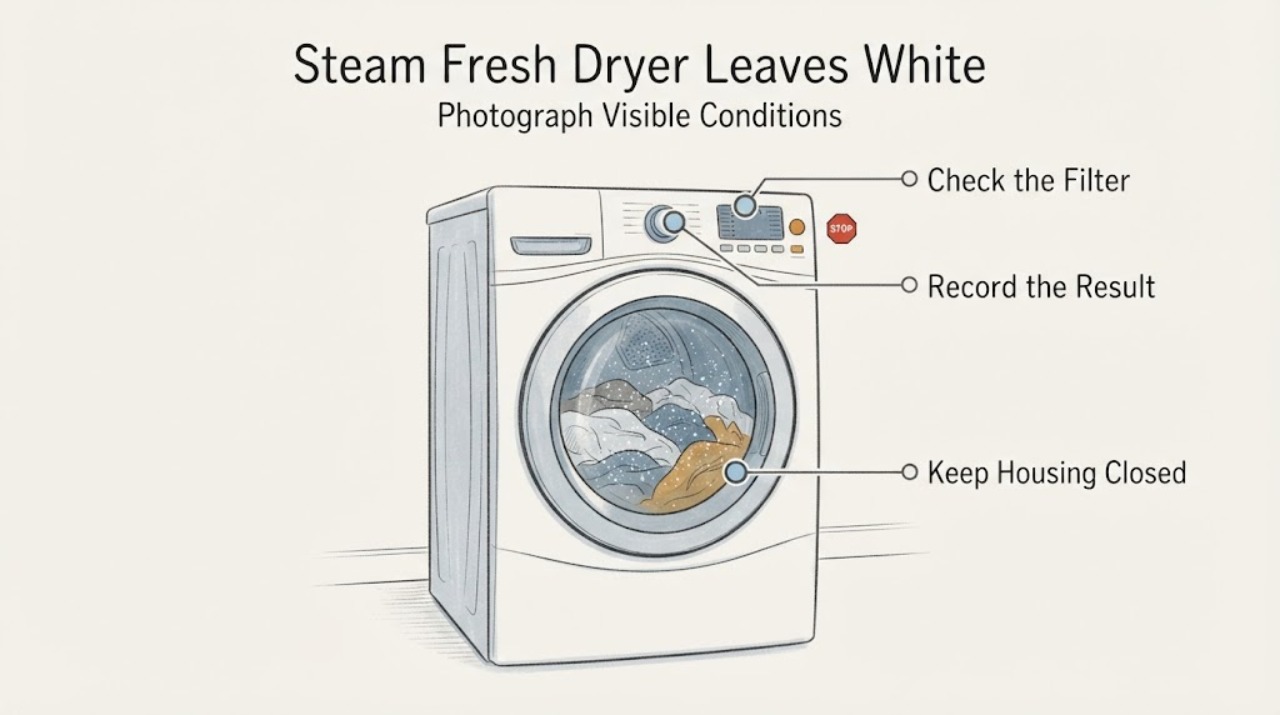
Work through in order
Diagnostic checks
Use only checks that match the exact appliance or system and its official guide.
-
Check 1
Stop using Steam Fresh for the affected garments, turn the dryer off, and let the drum and clothing cool before handling the residue. Photograph the particles on a contrasting surface and record whether they are powder-like, damp, clumped, or attached to the fabric.
Expected result: The particles are visible on the clothes only, or the same material is also visible inside the drum, on the door, or around the gasket.
Next step: Keep the affected clothes out of another Steam Fresh cycle. Continue with a cool, external inspection and follow the clothing care label for any cleaning or rewash decision; do not add chemicals to the dryer or clothing to test a theory.
Why this matters
Why: This separates a load-specific observation from residue that is also present inside the appliance. Neither observation identifies a failed steam component by itself, and the opened LG pages do not establish a safe user test for a steam generator or valve.
-
Check 2
With the dryer off and cool, inspect the drum surface, door glass, door gasket, lint-filter area, and the accessible rear steam outlet area. Use a clean white, soft cloth to collect a sample without scraping or opening panels.
Expected result: The white material transfers to the cloth or is visible on the drum, door, gasket, or lint area, or those surfaces are clean while only the garment shows particles.
Next step: Photograph the location and keep the sample. If material is on the drum, door, or gasket, perform the soft-cloth cleaning in the next step. If the appliance surfaces remain clean, suspend Steam Fresh and use the model label and photos when contacting LG.
Why this matters
Why: Residue on an accessible dryer surface gives a concrete place to clean and recheck. A clean drum with particles only on clothing leaves the source unresolved; it does not justify assuming a blocked nozzle, mineral deposit, or failed water component.
-
Check 3
Clean the lint filter before the next non-steam inspection, wipe accessible dust from the filter and door/gasket, and wipe the cool drum with a soft towel. After any steam use already performed, dry the drum cavity thoroughly with a soft towel as LG recommends.
Expected result: The cloth removes visible residue and the drum, gasket, and filter are clean after drying, or fresh particles remain or reappear on an accessible surface.
Next step: Do not use an abrasive, bleach, descaler, vinegar, or other cleaner unless the exact model's instructions explicitly permit it. If residue remains or returns, stop the Steam Fresh cycle and request model-specific LG or qualified service.
Why this matters
Why: LG treats filter and gasket cleaning and a dry drum as routine maintenance around steam operation. A cleanable surface residue can be removed externally; recurrence after that maintenance is a service clue, not proof of a particular internal part failure.
-
Check 4
Check the load and airflow conditions before any controlled comparison: LG's Steam Fresh guidance calls for a half-load for airflow, warns that overfilling can make dust stick, and its maintenance guidance recommends at least three clothing articles during a Steam Cycle. Confirm that the lint filter is clean and that the load was not packed tightly.
Expected result: The affected cycle was overloaded or used with too few items, or the load size and filter were within the published guidance.
Next step: If the prior load was outside the guidance, follow the exact model instructions for a smaller, appropriately sized load only after the residue has been removed and the drum is clean. If particles recur under the documented conditions, stop using Steam Fresh and escalate.
Why this matters
Why: An overloaded or poorly ventilated load is a documented cycle condition that can leave dust adhering to clothing. A correctly sized load with a clean filter makes recurrence more significant, but it still does not identify a failed steam generator or other part.
-
Check 5
If the dryer shows Add Water or Steam Water Refill, inspect the user-accessible steam feeder and water connection only as described for the exact model. Confirm that the feeder has the specified water and that a hose or feeder is not visibly frozen or disconnected; do not open the cabinet or infer a component failure from the message.
Expected result: There is an Add Water/Steam Water Refill message or an obvious feeder or hose issue, or there is no water warning and the supply appears normal.
Next step: Follow the exact model's user instructions for the feeder or tap and contact LG service if the warning persists. Do not pour cleaner, descaler, or an unapproved additive into the feeder, and do not remove panels to test a valve, pump, nozzle, or generator.
Why this matters
Why: LG says the message indicates a steam-water supply issue and may involve the hose or feeder. An absent message does not rule in or rule out the source of white particles, and a visible supply issue does not identify which internal component would require service.
Use your observations
Decision map
Find the observation that best matches what you see, then follow the next safe action.
-
PATH 01Next step
What you see
Particles are on the clothes but the cool drum, door, gasket, filter area, and accessible steam area are clean.
Do this next
Suspend Steam Fresh, keep the photos and garment-care information, and ask LG or qualified service to review the full model number and cycle history before using that cycle again.
Why this path and its safety boundary
Why it matters: The residue source has not been localized to an appliance surface. The opened LG guidance does not support declaring a steam-generator or water-mineral fault from this observation.
-
PATH 02Next step
What you see
Particles are visible on the drum, door, gasket, or lint area and are removed by a cool soft-cloth wipe.
Do this next
Dry the cavity, clean the filter, correct the load size, and monitor without using affected clothing. If the material returns, stop Steam Fresh and request model-specific service.
Why this path and its safety boundary
Why it matters: The material is present on an accessible surface that LG tells owners to keep clean around steam operation; this is an external maintenance finding, not a confirmed internal failure.
-
PATH 03Next step
What you see
The previous Steam Fresh load was over half capacity, tightly packed, or used with a dirty filter, and no Add Water warning is present.
Do this next
After the drum is clean and dry, follow the exact model's documented load and filter guidance only for a cautious comparison. If white particles recur, discontinue Steam Fresh and escalate rather than increasing the load or adding a cleaner.
Why this path and its safety boundary
Why it matters: The cycle conditions differ from LG's published airflow and maintenance guidance, which includes a warning that overfilling may make dust stick.
-
PATH 04Next step
What you see
Add Water or Steam Water Refill appears, or the feeder/hose has a visible issue that remains after the model's user-level instructions.
Do this next
Stop the Steam Fresh cycle and contact LG or qualified service with the full model number and the message. Do not access internal water or electrical components.
Why this path and its safety boundary
Why it matters: LG associates that message with the steam water supply and says the hose or feeder may be involved, but the source does not establish which internal part is defective.
Helpful context
Understand the symptom
Treat the particles as an observed residue, not a part diagnosis
The accessible LG support material explains what the cycle does: the dryer first runs a dust-removal phase, then injects steam, followed by warm and cool air. It does not say that white particles prove a failed steam generator, valve, nozzle, or water-quality problem. The useful first distinction is where the material is visible: on the clothes only, on the drum or door seal, or around the accessible steam and lint areas. Keep the checks below external and model-neutral.
When checks do not resolve it
Need a professional?
Contact LG or qualified service when white particles return after the cool external cleaning, clean filter, dry drum, and correct load checks; when particles are visible from an inaccessible steam or water path; or when an Add Water/Steam Water Refill condition persists. Stop using Steam Fresh and do not open the dryer, test energized parts, or add an unapproved cleaner.
Common questions
FAQ
Do white particles prove that the LG dryer's steam generator is bad?
No. The opened LG pages document the Steam Fresh dust-removal and steam sequence, routine filter/gasket and drum maintenance, and water-supply checks for an Add Water message, but they do not say that white particles identify a failed steam generator or another particular part. Localize the residue externally and escalate if it recurs.
Should I add vinegar, bleach, or descaler to remove the particles?
Do not add a cleaner or additive to the dryer, clothes, or steam feeder unless the exact LG model instructions explicitly authorize it. Start with the cool soft-cloth, filter, gasket, and dry-drum maintenance LG describes; use the garment care label for the affected clothing.
Can an overloaded Steam Fresh load make dust stick to clothes?
LG's Steam Dryer support page says to use half a load for airflow and warns that overfilling may cause dust to stick to clothes. That is a documented loading condition to correct, not proof that it explains every white-particle report.
What if the dryer displays Add Water after the residue appears?
LG says Add Water or Steam Water Refill indicates a steam water supply issue and may involve the hose or feeder. Follow the exact model's user-level feeder or tap instructions and request service if the message persists; do not open the cabinet or infer a failed valve, pump, nozzle, or generator.
Read the exact guide
Official sources
- LG Dryer - How to perform dryer maintenanceLG USA Support · LG's opened maintenance guidance is used for cleaning the filter, door gasket, and accessible sensor area, drying the drum after steam, and its load recommendation. It does not identify a residue cause or internal part failure for this unmodeled dryer.
- LG Steam Dryer - When and how is steam injected?LG USA Support · LG states that the guide applies to Steam Dryers and uses it for the Steam Fresh sequence, dust-removal phase, steam volume, airflow/load guidance, and accessible filter/door/gasket cleaning. It is not used to diagnose a failed steam component or to authorize a chemical additive.
- LG Steam Dryer - Error Code AddLG USA Support · LG's opened page is used only when an Add Water or Steam Water Refill condition is observed. It supports checking the user-accessible feeder, tap, hose, or freezing condition under model instructions and escalation if unresolved; it is not evidence that white particles come from a particular water component.
Community feedback
Share a repair observation
Share a plain-text repair observation. Accepted observations are published automatically; this page may take a moment to update.