
On this page
Start here
Quick answer
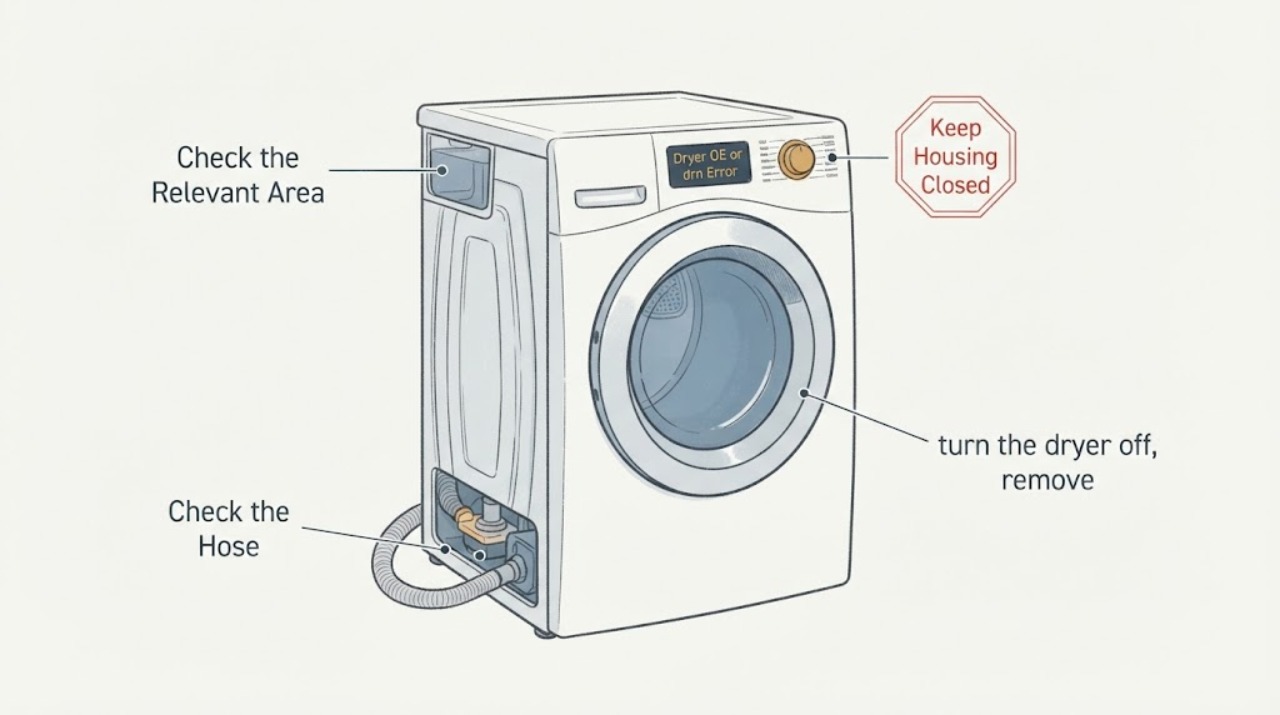
If an LG condenser, hybrid condensing, or heat-pump-style dryer starts showing OE, Drain, Empty Water Tank, or drn after freezing weather, treat the water path as potentially frozen before assuming the tank is simply full or the pump has failed. With power off, check the accessible drain hose for ice and thaw its frozen section with warm water or a warm towel for about 10 minutes; if the dryer uses a drain tank, thaw and empty the tank in warm water. If the exact model supports an internal defrost routine, follow that model's instructions. Reconnect any hose before testing. If the error returns within the permitted supervised test, water leaks, or the frozen area cannot be reached safely, leave the dryer off and request qualified LG service.
Work through in order
Diagnostic checks
Use only checks that match the exact appliance or system and its official guide.
-
Check 1
Turn the LG dryer off, remove the laundry, and record the exact display message and where condensed water is supposed to go. From ordinary access, identify whether this model has a removable drain tank, an external drain hose, a Hybrid Condensing designation, or a Steam water-supply connection.
Expected result: The message is OE, Drain, Empty Water Tank, or drn and the unit has a condensate tank or drain hose; alternatively, the message is Add or Refill Steam Water, or the unit has only a Steam supply connection.
Next step: Continue with the matching tank or hose check only for an OE, Drain, Empty Water Tank, or drn message. For a Steam supply message, use the exact model's Steam water guidance and stop if the supply connection leaks.
Stop if: Do not open panels or operate a wet dryer to determine its architecture.
Why this matters
Why: The first group points to the condensate path that can freeze in winter. Add or Refill Steam Water points to the separate Steam supply path, so thawing or replacing a condensate pump would not address that message.
-
Check 2
With the dryer powered off, inspect the accessible drain hose and its connection for a frozen section, a low spot holding water, a kink, crush point, or an end that is submerged. If ice is visible, thaw that section by soaking it in warm water or wrapping it and the connection with a warm towel for about 10 minutes; reconnect the hose securely if it was detached.
Expected result: The hose thaws and is open, supported, and routed within the exact model's limits, or it remains frozen, damaged, inaccessible, disconnected, or leaking.
Next step: Dry the connection and use one supervised test only if the model guide permits it. If the hose is damaged or cannot be safely reached, leave the dryer off and arrange service.
Stop if: Do not extend the hose, force a frozen fitting, move a stacked unit to reach it, or run the dryer with a leak.
Why this matters
Why: A winter freeze or restricted hose can prevent the drain pump from moving water and can trigger the listed messages. Reconnecting matters because leaving a detached hose can cause a leak; a clear hose with a continuing code points beyond this accessible correction.
-
Check 3
If the dryer collects condensate in a removable water tank, turn the dryer off, remove the tank without forcing it, and check for ice. Thaw a frozen tank by soaking it in warm water, then empty it completely and reseat it according to the model guide.
Expected result: The tank was frozen or could not be emptied and reseated, or it is thawed, empty, correctly seated, and the drain message remains.
Next step: Inspect only the remaining accessible water path and prepare for the model-specific defrost or service branch. Empty the tank after winter use to reduce repeat freezing.
Stop if: Do not force a stuck tank, operate without it, spill water into the cabinet, or continue testing near wet electrical parts.
Why this matters
Why: A frozen tank can block the same winter water path as a frozen hose. If the tank is thawed and correctly seated but the error remains, the tank alone has not explained the fault; an internal path or another model-specific condition is possible.
-
Check 4
When the accessible hose and tank are not the cause and the exact LG guide provides an internal defrost routine, use only that routine with the dryer off and empty. If the guide permits warm water through the specified filter or tank opening, use less than 1 liter at about 60°C/140°F, reinstall the filters, and wait the stated time; use a stable step stool for a stacked unit and do not improvise if the opening or procedure differs.
Expected result: The model's defrost mode completes or the documented warm-water procedure is followed without a leak, or access is unsafe, the procedure is unavailable, or water runs out of the appliance.
Next step: Wait for the documented thaw interval, dry accessible surfaces, and proceed to one permitted supervised test. Request service if the exact procedure cannot be followed safely.
Stop if: Do not use boiling water, pour into an unapproved opening, tilt the dryer, remove panels, or climb an unstable chair.
Why this matters
Why: LG documents internal ice as a possible reason the pump cannot operate, but the procedure and access vary by model. Too much or excessively hot water can damage the dryer or leak, so a generic defrost method is not a safe substitute for the model guide.
-
Check 5
After the documented hose, tank, or internal defrost step, run only the exact model's permitted supervised test and watch the display and floor. On LG's general frozen-dryer guidance, the listed OE, Empty Water Tank, or drn message should not return within 10 minutes of operation; a WashTower may require the model's specified repeat cycle.
Expected result: The dryer drains without the message returning and no water escapes, or the message returns, water remains, the unit stops again, or a leak reaches the floor or cabinet base.
Next step: Leave the dryer off and request qualified LG service for a recurring message, standing water, or leak. Give the technician the model, architecture, exact message, water location, hose or tank findings, and freezing-weather history.
Stop if: Do not repeat cycles to force drainage or disassemble the dryer to test the pump.
Why this matters
Why: A successful supervised test supports a temporary freeze as the cause. A returning error or leak means the accessible thaw did not establish a safe repair; an internal pump, sump, hose, sensor, installation, or control issue remains possible.
Use your observations
Decision map
Find the observation that best matches what you see, then follow the next safe action.
-
PATH 01Next step
What you see
OE, Drain, Empty Water Tank, or drn appeared after an overnight freeze and the accessible drain hose has ice or a low water-holding section.
Do this next
Thaw the hose with the documented warm-water or warm-towel method, restore the model's routing, reconnect it if detached, and perform only the permitted supervised test.
Why this path and its safety boundary
Why it matters: The timing and visible ice make a frozen external condensate path more likely than a proven pump failure.
-
PATH 02Next step
What you see
The dryer uses a removable condensate tank, the tank is frozen, and there is no leak or cabinet damage.
Do this next
Thaw the tank in warm water, empty it fully, reseat it according to the model guide, and keep it empty after winter use.
Why this path and its safety boundary
Why it matters: Ice in the tank can block collection and produce the same winter drain message even when the external hose is not the active path.
-
PATH 03Next step
What you see
The hose and tank are thawed and correctly positioned, but the exact model identifies an internal freeze and provides a defrost mode or documented internal thaw procedure.
Do this next
Follow that exact LG procedure, observe its wait and test limits, and stop if water leaks or the procedure cannot be reached safely.
Why this path and its safety boundary
Why it matters: The remaining evidence supports ice inside the appliance as a possibility, but the correct access and steps are model-dependent.
-
PATH 04Next step
What you see
The drain message returns after the documented thaw, the dryer still holds water, or any water reaches the floor, cabinet base, or electrical area.
Do this next
Leave the dryer off and request qualified LG service with the exact model, message, water path, photos, and weather history. Do not choose a pump or hose replacement from the symptom alone.
Why this path and its safety boundary
Why it matters: A temporary freeze has not been established as the complete cause; an internal pump, sump, hose, sensor, installation, or control fault is possible.
Helpful context
Understand the symptom
Why winter changes the first check
During drying, condensed water leaves through a drain hose or collects in a water tank, and some residual water can remain inside the dryer. LG says that residual water can freeze in cold winter weather and stop the drain pump, producing OE or drn. The useful distinction is where the ice is: an exposed hose or tank can be checked from ordinary access, while ice inside the appliance calls for the exact model's defrost procedure or service. A Steam water-supply hose belongs to a separate supply path; a Refill Steam Water or Add message should not be treated as a condensate drain fault.
Keep the test narrow
A thawed hose or tank can clear a winter fault without proving that an internal pump, sump, sensor, or hose is healthy. Use one supervised test only after the accessible area is dry and the model guide permits it. Do not extend a drain hose, force frozen fittings, open panels, or keep running the dryer to make it drain.
Only after diagnosis
Potential parts
- LG dryer drain hose
Consider a replacement only if the visible hose is cracked or damaged and the model-specific fit is confirmed; a frozen or kinked hose alone does not prove that a new hose is needed.
Confirm the exact dryer model and the manufacturer's installation guidance before ordering. - LG dryer drain pump
Consider this only after the drain hose and tank are thawed and correctly routed and a qualified diagnosis finds that the pump does not operate; OE or drn after freezing does not prove pump failure.
Confirm the exact dryer model and qualified service diagnosis before ordering.
When checks do not resolve it
Need a professional?
Request qualified LG service when the error returns after the exact model's thaw procedure, the tank or hose cannot be accessed without moving a stacked unit, the dryer leaks or retains standing water, the cabinet or connection is damaged, or diagnosis would require opening panels or testing the pump, sump, internal hose, sensor, wiring, or control.
Common questions
FAQ
Why does an LG dryer show OE or drn only when it gets very cold?
Residual water in the drain hose, tank, or an internal water path can freeze and keep the drain pump from moving water. The timing makes a frozen path worth checking first, but it does not prove that the pump is undamaged.
Should I thaw the frozen LG dryer hose with a hair dryer or flame?
Use the LG guidance for warm water or a warm towel on the accessible hose section. Do not use a flame, force frozen fittings, or improvise heat inside the cabinet.
Does OE mean the LG dryer water tank is full?
It can mean the condensate tank needs attention, but after freezing weather the tank or drain hose may be frozen. Check the water path and tank safely before assuming the tank is simply full.
What if OE or drn returns after the LG dryer thaws?
Stop using the dryer and request qualified LG service, especially if water remains or leaks. A recurring message after the documented thaw can involve the pump, sump, internal hose, sensor, installation, or control, and the symptom alone does not identify a replacement part.
Read the exact guide
Official sources
- [LG Dryer Error Code][Wash Tower] OE error appears.LG USA Support · Manufacturer troubleshooting for cold-weather OE/drn behavior on LG WashTower dryers
- LG Dryer machine - freezing washer - How to prevent freezing/How to prevent freezing in the winter.LG USA Support · Manufacturer winter-prevention guidance for removing residual water and avoiding hose bends
- LG Dryer - Error Code ListLG USA Support · Manufacturer error-code reference for LG Hybrid Condensing Dryer drain faults
- [LG Dryer] Troubleshooting Frozen DryersLG USA Support · Manufacturer troubleshooting for winter-frozen LG dryer condensate paths
Community feedback
Share a repair observation
Share a plain-text repair observation. Accepted observations are published automatically; this page may take a moment to update.