
On this page
Start here
Quick answer
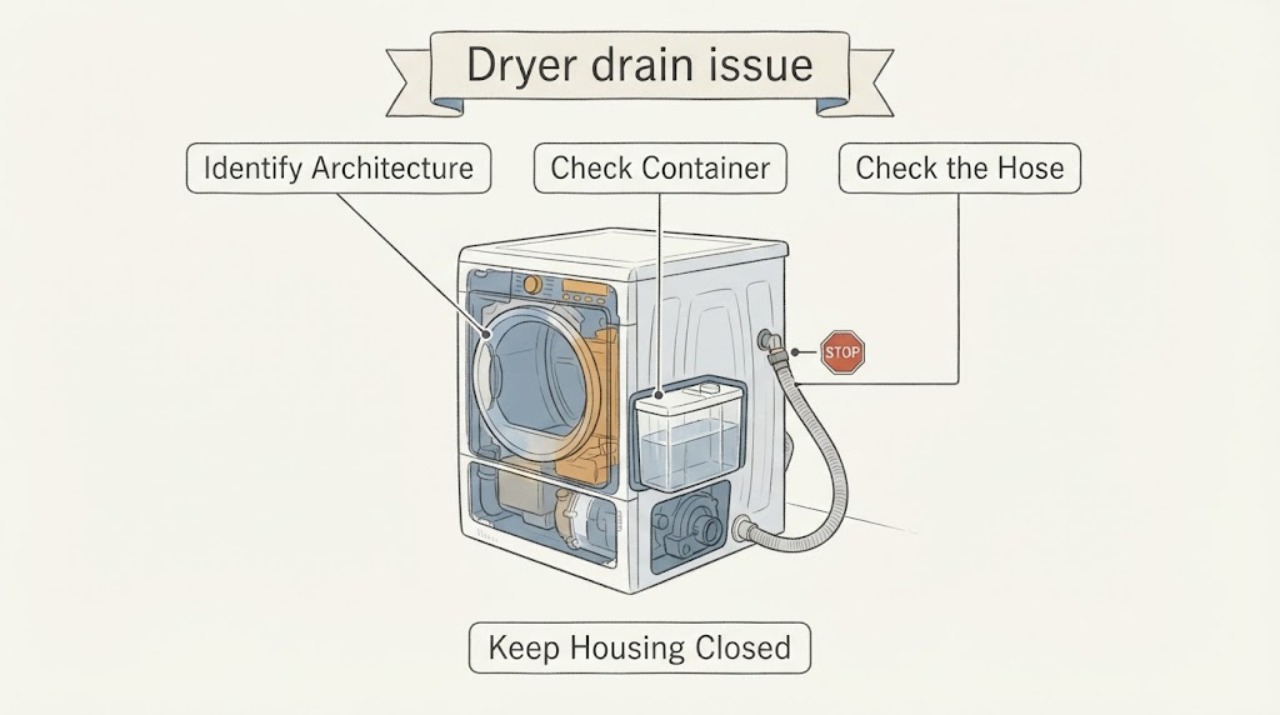
First identify the LG dryer’s drainage architecture from the model label and manual. LG’s opened drainage guidance applies to dryers that collect condensed water in a container or route it through a drain hose; the connection method varies by model and capacity. If a container is used, empty it and check that it is seated. If a drain hose is installed, inspect only the accessible hose and connector for a bend, twist, crush, blockage, submersion or excessive height, following the exact manual. If the appliance instead has an exhaust duct and no confirmed condensate system, use the model manual rather than applying these hose steps; LG’s separate venting guidance calls for an unobstructed, non-crushed exhaust path. Persistent drain errors, leaks, inaccessible rear connections or suspected pump/internal faults require LG service.
Work through in order
Diagnostic checks
Use only checks that match the exact appliance or system and its official guide.
-
Check 1
Read the complete model number and determine from the matching LG manual whether the dryer collects condensed water in a container, uses a direct drain hose, has a condenser/heat-pump water path, or is an exhaust-duct model.
Expected result: The manual identifies a container/direct-drain system, an exhaust duct, or an architecture that cannot be confirmed.
Next step: Follow only the matching branch below. If the manual or model cannot be identified, stop at visible checks and arrange model-qualified support rather than opening the dryer.
Why this matters
Why: LG’s water-drain connection method varies by model and capacity, while its venting page addresses a separate exhaust path. A generic drain-hose procedure is unsafe when the architecture is unknown.
-
Check 2
For a container-based dryer, turn the dryer off, let it cool, empty the water container as LG describes and reseat it fully. Do not spill water onto the controls or continue if the container or housing is cracked.
Expected result: The container was full/mis-seated, or it was empty and correctly seated but the indicator or drain issue remains.
Next step: Run only the model-approved external check. If the message returns, the container leaks or the housing is damaged, leave the dryer off and request service.
Why this matters
Why: LG says a full container can stop a cycle and that continuously displayed “Empty Water” after emptying needs further checking; this does not prove a pump failure.
-
Check 3
For a direct-drain model, inspect the accessible hose and connector from outside for a kink, twist, crush, blockage, submerged end, loose routing or excessive lift. Do not disconnect the connector unless the exact manual authorizes that user step.
Expected result: The hose is visibly restricted or damaged, or it is routed freely and the issue persists.
Next step: Correct only simple external routing allowed by the model manual. Do not add an unapproved extension or move a stacked unit; persistent failure requires service.
Why this matters
Why: LG links bends, twists, crushing, blockage, submersion and excessive resistance/height with poor drainage; an apparently clear hose does not identify a pump or internal fault.
-
Check 4
If the model is an exhaust-duct dryer and no condensate drain is documented, inspect the accessible exhaust transition and outside termination for crushing, sharp kinks, dents or visible obstruction. Do not confuse exhaust airflow with a condensate drain path.
Expected result: The exhaust path is visibly restricted, or the exhaust path is clear and the reported “drain” symptom still lacks an architecture match.
Next step: Correct only the external duct routing allowed by the manual and arrange support if the symptom remains. If the model is not confirmed, do not open the cabinet.
Why this matters
Why: LG’s venting guidance treats duct restriction as an installation/performance issue; it does not diagnose a drain pump or water container.
-
Check 5
Stop troubleshooting if water leaks from the cabinet, power or controls are wet, a drain error repeatedly returns, the hose/container is damaged, the rear connector is inaccessible, or an internal pump is suspected.
Expected result: A safety hazard or unresolved model-specific drainage problem is present.
Next step: Keep the dryer off, isolate power only from a dry safe position, avoid moving a stacked unit, and contact LG or a qualified appliance technician with the complete model and observations.
Why this matters
Why: The public LG pages support external container/hose/duct checks but do not establish an internal pump, sensor, valve or control failure for an unidentified model.
Use your observations
Decision map
Find the observation that best matches what you see, then follow the next safe action.
-
PATH 01Next step
What you see
The dryer uses a water container and shows an Empty Water indication or stops while drying; the container is full or was not seated after emptying.
Do this next
Empty and reseat the container as the model manual permits. If the indication persists, leaks or returns immediately, stop and request service.
Why this path and its safety boundary
Why it matters: LG says the product may stop because it cannot keep draining, and a full container can pause a second load.
-
PATH 02Next step
What you see
The manual confirms direct drainage and the accessible hose is kinked, twisted, crushed, blocked, submerged or routed too high.
Do this next
Restore only the routing specified by the exact manual, then monitor for a return of the drain message or leak. Do not add an unapproved extension or disconnect hidden tubing.
Why this path and its safety boundary
Why it matters: LG identifies restricted routing and flow resistance as causes of poor drainage; this is an external installation finding, not a confirmed pump failure.
-
PATH 03Next step
What you see
The manual identifies an exhaust-duct dryer and no condensate container/direct-drain path, while the reported “drain issue” is not supported by a matching water-system symptom.
Do this next
Use LG’s venting guidance and the exact manual. If the original problem is actually water collection, obtain the model-specific diagnosis before further operation.
Why this path and its safety boundary
Why it matters: Condensate drainage instructions cannot be transferred to this architecture; the relevant external path is the exhaust duct and its airflow.
-
PATH 04Next step
What you see
Water leaks from the cabinet, the rear connection cannot be safely reached, an error returns after the allowed checks, or water is near electrical parts.
Do this next
Stop the dryer, avoid repeated restarts and unsafe movement, and arrange LG/qualified service with the model, architecture, message and photos of the external routing.
Why this path and its safety boundary
Why it matters: The issue exceeds a no-model external check and may involve an internal pump, sensor, connector or other model-specific condition that the public guidance does not identify.
Helpful context
Understand the symptom
Identify the dryer type before touching a drain connection
LG’s drainage instructions describe condensed water from drying being collected in a water container or routed through a drain hose, and they warn that the connection method varies by model and capacity. A dryer with a rear exhaust duct may need a different troubleshooting path. Find the complete model number and check the matching manual before disconnecting any hose, moving a stacked unit or treating a “drain” message as a failed pump.
Container, direct-drain and exhaust symptoms are different
For a dryer using a water container, an “Empty Water” indication can mean the machine cannot keep draining; LG says to empty the container and check that a drain hose is not twisted, bent or submerged if direct drainage is used. For condenser dryers, LG also says a small amount of residual water can remain at the bottom after a cycle. Those statements do not establish a fault in every dryer or justify applying a condensate procedure to an exhaust-only model.
Use only external checks without a model-specific procedure
With power off and the machine cool, inspect the accessible container, hose and connector for a full container, kink, crush, twist, visible blockage, loose routing or a hose end sitting in water. LG’s hose guidance says location varies by model and warns that small or stacked installations need technician help. Do not open covers, reach the pump, pour water into hidden passages or disconnect a rear connection that the manual does not identify.
If it is an exhaust dryer, check the exhaust path instead
If the matching manual identifies a vented dryer with an exhaust duct rather than a condensate container/drain connector, do not use the condensed-water hose branches as a diagnosis. LG says the exhaust duct should be short, straight or in a smooth S curve, and free of kinks, crushing, dents and obstructions. This is an airflow/venting check, not proof of a drain-pump problem.
Stop at leaks, repeated errors or inaccessible internal causes
A recurring drain error after the model-appropriate external checks, a leak from the cabinet or connector, a damaged hose, or an internal/pump-origin suspicion is a service boundary. Keep the dryer off if water is near power, do not repeatedly restart it to reproduce a leak, and provide LG service with the model, architecture, message and hose/container observations.
When checks do not resolve it
Need a professional?
Have this ready
- complete LG model and region
- whether the unit is condenser/heat-pump, container-based direct-drain or exhaust-duct
- exact display message and when it appears
- container level and seating result
- visible hose/connector routing and any leak
- whether the unit is stacked or rear access is restricted
Common questions
FAQ
Does every LG dryer have a drain hose?
No universal procedure is supported by this no-model topic. LG describes dryers that collect condensed water in a container or use a direct drain hose, while separate LG guidance covers exhaust ducting. Confirm the exact model architecture before changing a connection.
What should I check when “Empty Water” appears?
For an LG dryer using a water container, empty and reseat the container. If using a drain hose, check the accessible hose for bends, twists, submersion and excessive resistance. A recurring message needs model-qualified service.
Is a little water at the bottom always a fault?
LG says a condenser dryer can retain a small amount of residual water after drying because condensed water is pumped from the bottom. The statement is model-family guidance, so a large amount, a leak or a recurring error still needs the exact manual and service assessment.
Can I replace or reroute the drain hose myself?
Only use the exact LG model instructions. LG says connector location varies by model and that small or stacked installations may need a technician; do not disconnect a rear connector or add an extension without model-specific authorization.
Read the exact guide
Official sources
- LG Dryer: Proper Venting and Installation TipsLG USA Support · LG dryers with an exhaust duct; external vent routing and obstruction checks
- LG Dryer Water Drainage: switch from water container to direct drainageLG USA Support · LG dryer condensed-water drainage method and model/capacity-specific direct-drain connection guidance
- LG Dryer: Is there a lot of water left after drying?LG USA Support · LG condenser dryers and expected small residual condensed water
- “Empty Water” Container IndicatorLG USA Support · LG dryers using a water container or drain hose; container-emptying and external hose routing checks
- LG dryer drainage: replace the drain hoseLG USA Support · LG dryer drain-hose location, routing and model-specific replacement boundary
Community feedback
Share a repair observation
Share a plain-text repair observation. Accepted observations are published automatically; this page may take a moment to update.