
On this page
Start here
Quick answer
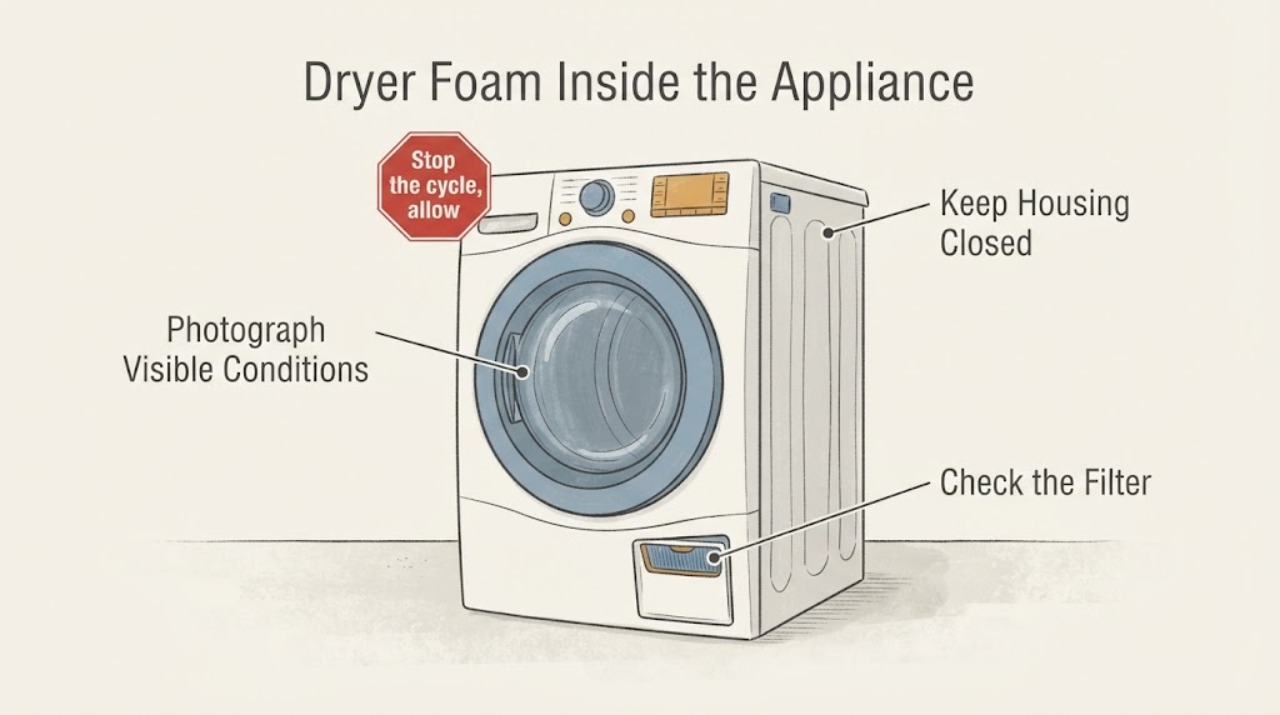
Stop the LG dryer and let it cool before deciding what the foam is. LG dryer guidance warns that foam, rubber and plastic items should be line-dried or run only on an appropriate Air Cycle because of fire risk. If the material is white fur or powder-like pieces rather than loose foam, LG says it is likely worn felt from the seal between the drum and its support; do not pull the seal or open the cabinet. Clean only accessible lint and arrange service if material continues, the seal is damaged, or there is heat or burning odor.
Before you begin
Safety first
- Do not run heated tests with foam, rubber or plastic items, pull the door gasket, reach into the drum gap, open the cabinet, bypass a safety device or order an internal seal from a guessed model.
Work through in order
Diagnostic checks
Use only checks that match the exact appliance or system and its official guide.
-
Check 1
Stop the cycle, allow the dryer to cool completely, and keep it off if there is smoke, a burning/electrical smell, visible damage or material near a hot surface.
Expected result: The dryer cools normally with no smoke, hot odor or visible damage, or a hazardous sign is present.
Next step: Do not repeat a heated test. Isolate power from a safe position and arrange qualified service when a hazardous sign is present.
Why this matters
Why: A cool, intact appliance permits a limited visual inspection; smoke, heat or odor is a stop-and-service condition.
-
Check 2
With the drum cool, inspect the load and drum opening for a foam-backed, rubber-backed or plastic item, and photograph any loose material before removing only what is plainly accessible.
Expected result: The material matches a load item, or it is white fur/powder-like debris with no obvious source in the load.
Next step: Keep foam, rubber and plastic items out of heated drying and use the item’s care instructions. If white debris recurs, stop using the dryer and use LG model-specific service.
Why this matters
Why: A load item points to an unsuitable drying load; white fur or powder-like debris is consistent with LG’s documented felt-seal symptom, but does not prove the exact part or model fit.
-
Check 3
Clean the accessible lint filter and gently wipe visible lint from the door gasket; if the filter was washed, let it dry fully before reinstalling it.
Expected result: The debris is only loose lint at the filter/gasket, or material continues to appear from the drum gap or seal area.
Next step: Do not pull the gasket or open the cabinet. Keep the dryer out of service and provide photos and model information to LG or a qualified technician if material recurs.
Why this matters
Why: Accessible lint can be maintained by the owner. Recurring material from a seal or drum-support area needs inspection rather than repeated cleaning.
-
Check 4
Find the model and serial label and compare the dryer’s support page or manual before selecting a cycle or part.
Expected result: The model is readable, or the label is missing or unclear.
Next step: Use LG’s model-based support route or qualified service; do not transfer a seal procedure, cycle setting or part number from a similar-looking dryer.
Why this matters
Why: A readable model permits the correct manual and seal design to be checked. An unclear label leaves model-specific construction and cycle rules unresolved.
Use your observations
Decision map
Find the observation that best matches what you see, then follow the next safe action.
-
PATH 01Next step
What you see
The material is a recognizable foam, rubber or plastic item from the load.
Do this next
Remove it only after cooling and follow its care label; do not put it back in a heated dryer cycle.
Why this path and its safety boundary
Why it matters: The load contains a material LG warns may be unsafe for heated tumble drying.
-
PATH 02Next step
What you see
The material is white fur or powder-like pieces and keeps returning from the drum or seal area.
Do this next
Stop using the dryer and arrange model-specific inspection; do not pull the seal or open the cabinet to confirm it.
Why this path and its safety boundary
Why it matters: LG identifies this appearance as likely felt-seal remnants, which can affect friction and drying performance.
-
PATH 03Next step
What you see
Only lint is visible at the filter or gasket, with no recurring material, smoke, heat or burning odor.
Do this next
Clean the accessible area as LG describes, dry any washed filter fully, and monitor without running unsuitable foam/rubber loads.
Why this path and its safety boundary
Why it matters: The observation is consistent with accessible maintenance rather than a confirmed internal foam failure.
-
PATH 04Next step
What you see
Foam is accompanied by smoke, persistent burning odor, scorching, a scraping sound or visible seal damage.
Do this next
Keep it disconnected from service and arrange qualified LG appliance service; do not run another test or remove internal panels.
Why this path and its safety boundary
Why it matters: The dryer may have a safety or mechanical condition that cannot be identified safely from the symptom alone.
Helpful context
Understand the symptom
Stop heat before identifying the material
Cancel the cycle and wait for the drum and contents to cool. If there is smoke, a burning or electrical smell, visible damage, or material caught near a hot area, keep the dryer out of service and isolate power only from a dry, safe position. LG’s dryer manual warns that items containing foam, rubber or plastic can create a fire hazard when dried with heat; do not run another heated cycle to test the material.
Separate a foam item from dryer-generated white material
Once the dryer is cool, photograph the material and check the load for a foam-backed garment, rubber-backed item, cushion, toy or other coated article. If what you see is white fur or powder-like debris rather than a recognizable item, LG identifies remnants of the dryer’s felt seal as a likely source. That is an observation-based clue, not permission to remove the seal or infer the exact replacement part without the model.
Clean only accessible filters and gaskets
Remove lint from the lint filter and gently wipe visible debris from the door gasket as LG instructs. Do not pull the gasket, reach into the drum gap, remove a seal, or open panels. LG’s maintenance guidance also says to dry a filter completely before reinstalling it and to wipe the moisture sensor with a dry rag; these are maintenance steps, not a way to repair a damaged seal.
Use model support before any part decision
Record the full model and serial numbers, the material’s color and texture, where it appeared, the load item that was drying, and whether the drum made noise or the dryer smelled hot. LG’s support portal asks for a model or product category, and the general white-material guide says images and content can differ by product. Use that route or qualified service instead of ordering a felt seal, gasket or other internal part from a symptom description.
When checks do not resolve it
Need a professional?
Safety scope: Do not run heated tests with foam, rubber or plastic items, pull the door gasket, reach into the drum gap, open the cabinet, bypass a safety device or order an internal seal from a guessed model.
Have this ready
- Provide the model and serial numbers, photos of the foam and its location, the load item involved, whether the material is white fur/powder or a recognizable object, and any odor, smoke, noise or heat observations.
Common questions
FAQ
Can foam rubber go in an LG dryer?
LG dryer safety guidance says items containing foam, rubber or plastic should be dried on a clothesline or with an appropriate Air Cycle, not a heated cycle. Follow the item’s care label and the exact dryer manual.
What if the material is white fuzz or powder rather than foam?
LG says white fur or powder-like pieces in a dryer are likely remnants of the felt seal between the drum and its support. Do not pull the seal; stop and arrange model-specific inspection if the material returns.
Can I remove the LG dryer door gasket to clean it?
LG’s gasket guidance says to gently wipe visible lint and warns against removing the gasket by force. Leave seal removal and inspection to service when debris is recurring or the gasket is damaged.
Could steam-cycle moisture look like foam?
LG says some steam-cycle models can have moisture or condensation in the drum and recommends drying the cavity with a soft towel. That does not explain recurring solid foam or white seal-like debris, which should be photographed and evaluated separately.
Read the exact guide
Official sources
- LG Dryer - Troubleshooting White Lint in the DryerLG Electronics USA · Opened the official LG dryer help article. It says white fur or powder-like pieces are likely felt-seal remnants, explains the seal’s friction and airflow role, and warns that content can differ by model.
- [LG Dryer] A burning smell comes from the dryer during dryingLG Electronics USA · Opened the official LG dryer help article. It discusses dust, lint or foreign substances in the dryer and says persistent burning smell in a non-new dryer needs LG assistance; it does not diagnose a foam source.
- Product Solutions Search | LG USA SupportLG Electronics USA · Opened the official LG support portal. It requests a model number or product category and distinguishes dryers from washers and washer-dryer combos; it is used for identity recovery, not as technical evidence of a component fault.
- LG Dryer: Bits of lint are stuck to the rubber seal of the doorLG Electronics USA · Opened the official LG dryer help article. It says to gently wipe lint from the gasket and warns not to remove the gasket by force; recurring or pulled-out gasket issues should go to service.
- LG Dryer – How to Perform Dryer MaintenanceLG Electronics USA · Opened the official LG maintenance article. It supports cleaning the lint filter, drying a washed filter fully, wiping the moisture sensor and gasket, and drying steam-cycle condensation; it does not authorize seal removal or cabinet repair.
- LG Dryer Use and Care GuideLG Electronics USA · Opened the official LG-hosted dryer manual. Its safety guidance says items containing foam, rubber or plastic must be line-dried or run using an Air Cycle; it is a general safety boundary and not proof of an exact model because the task has no model.
Community feedback
Share a repair observation
Share a plain-text repair observation. Accepted observations are published automatically; this page may take a moment to update.