
On this page
Start here
Quick answer
First separate normal heat cycling from a dryer that stays cold or takes much longer to dry. LG says a restricted lint filter or exhaust path can cause no heat or long drying, and its Installation Test can distinguish an airflow result from a heating-system result when the exact model supports that test. With the dryer cool and off, clean the lint filter, check that the rear hose is not crushed or kinked, and check the outside exhaust flap for visible blockage. Use only the exact owner's manual for any button sequence or code interpretation. If the dryer remains cold, repeatedly loses heat after airflow checks, trips a breaker, smells of burning, or smells of gas, stop using it and arrange qualified service; do not open the cabinet or live-test heating parts.
Before you begin
Safety first
- Keep the dryer out of service for persistent no-heat or hazard symptoms. Do not open panels, touch wiring or heating parts, live-test circuits, bypass thermal protection, repeatedly reset a breaker, relight a gas appliance, or run the dryer with gas odor, smoke or burning odor.
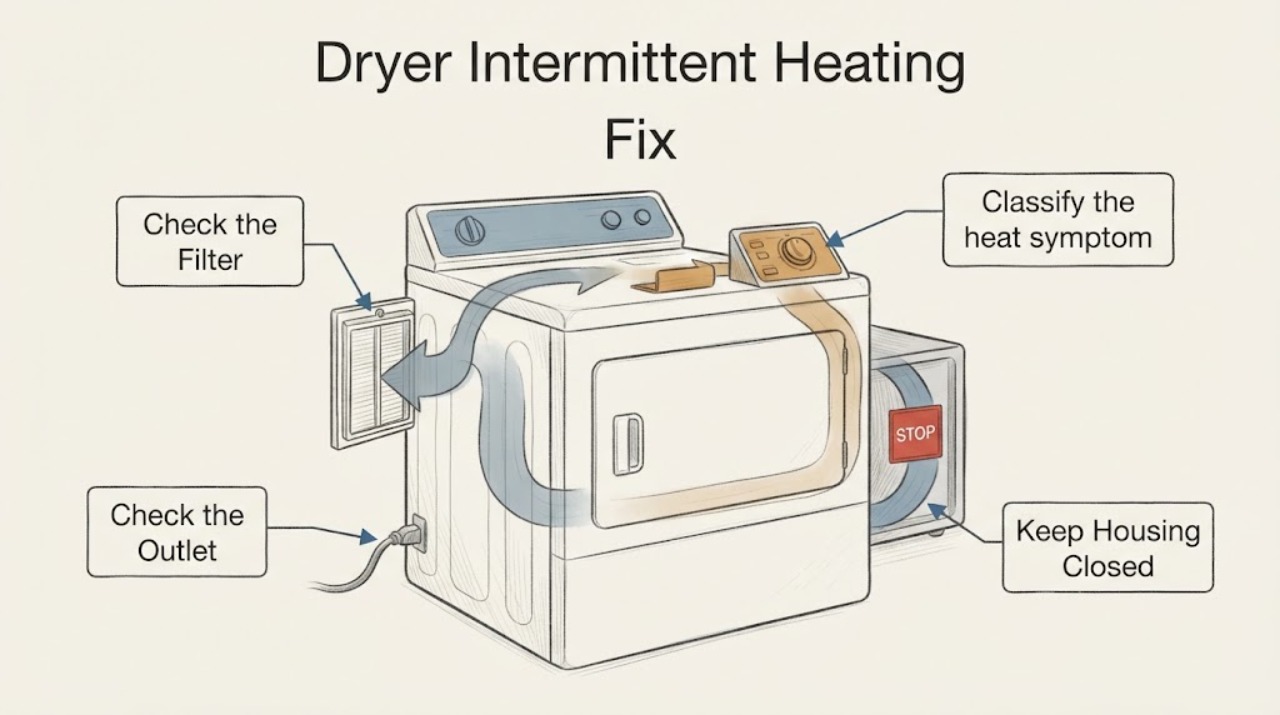
Work through in order
Diagnostic checks
Use only checks that match the exact appliance or system and its official guide.
-
Check 1
Classify the heat symptom from outside the closed dryer: note whether the drum turns, whether air is warm at any point, whether heat returns later in the cycle, and whether the load is merely taking longer or remains damp.
Expected result: The dryer produces warm air at some point and the load dries normally; it produces no warm air; or it stays cold and drying time increases.
Next step: If heat is present and drying is normal, continue with the model's normal cycle. If the dryer remains cold or the symptom repeats with poor drying, stop treating it as normal cycling and continue with the cool, powered-off airflow checks.
Stop if: If the drum does not turn, the controls do not respond, or the heat source cannot be observed safely, stop the test and use the exact manual or service path rather than repeatedly restarting it.
Why this matters
Why: Warm air that returns can be consistent with heat cycling, while a cold drum with long or failed drying needs the no-heat and airflow path checked. The observation alone does not identify an internal part.
-
Check 2
With the dryer cool and switched off, remove lint from the accessible lint filter and reinstall it correctly; inspect the rear exhaust hose without disconnecting pressurized or gas connections.
Expected result: The filter is heavily loaded, incorrectly seated, or the hose is crushed, kinked, compressed, holed or loosely connected; or the filter and visible hose are clear.
Next step: Correct only the accessible filter seating or hose routing described by the owner manual, then monitor one normal cycle. If the hose enters a wall or the restriction is not reachable, arrange professional vent cleaning instead of pushing objects into the duct.
Stop if: Continue to the outside exhaust check and model-specific test; do not infer a failed heater or fuse merely because the visible section looks clear.
Why this matters
Why: Lint or a restricted/damaged exhaust path can reduce airflow and cause long drying or a no-heat indication. A clear visible section does not prove that a concealed wall duct is clear.
-
Check 3
From outside the building, check the dryer exhaust outlet while the appliance is operating only if there is no gas odor, smoke, burning smell or electrical hazard and the owner manual permits normal operation.
Expected result: The exterior flap opens and airflow is present; the flap is blocked or barely moving; or the test cannot be performed safely.
Next step: Remove only visible lint or debris at the outlet without inserting tools. If airflow remains weak, stop and arrange professional duct service. If airflow is normal but heating still drops out, use the service branch rather than opening the cabinet.
Stop if: Do not run the dryer just to create a test if there is any gas odor, smoke, burning smell, repeated breaker trip or visible damage; isolate the appliance from a safe accessible point and call the appropriate professional.
Why this matters
Why: LG uses the outside outlet and Flow Sense/Installation Test results to identify possible exhaust restriction; a weak outlet does not prove which internal section is blocked.
-
Check 4
Use the exact LG owner's manual to run an Installation Test or interpret a displayed code, recording the model, fuel type, code and result instead of copying a sequence from another dryer.
Expected result: The model manual supports the test and reports an airflow restriction such as d80/d90/d95; it reports a heating-system issue or another code; or no applicable test/code is available.
Next step: For an airflow result, correct only accessible restrictions and arrange professional cleaning for concealed ductwork. For a heating-system or other persistent fault, stop use and provide the recorded result to qualified service.
Stop if: Do not invent a button combination, reset a code repeatedly or transfer a code definition from another model; document the symptom and request model-specific support.
Why this matters
Why: LG says airflow indications direct attention to the exhaust path, while a heating-system result or model-specific fault needs service. A generic reset cannot establish the meaning of an unidentified code.
-
Check 5
Check the safety boundary before any further cycle: identify whether the dryer is gas-fired, and stop immediately for gas odor, smoke, burning odor, visible damage, abnormal electrical noise or a breaker that trips again.
Expected result: There is no hazard sign and the symptom is limited to intermittent heat; or a gas/electrical/fire warning is present.
Next step: If there is no hazard, avoid repeated test cycles and arrange service if the condition persists after the external checks. If there is gas odor, leave the area, avoid flames, switches and phones in the area, and contact the gas utility or emergency service from a safe location; for smoke or burning, use the safe accessible shutoff and emergency response as appropriate.
Stop if: Do not relight a gas appliance, open the cabinet, touch wiring, test a heater or bypass a safety device. Keep the dryer out of service until qualified service clears it.
Why this matters
Why: Intermittent heating without a hazard can be documented for model-specific service, but gas odor or fire/electrical signs change the task to immediate safety response.
Use your observations
Decision map
Find the observation that best matches what you see, then follow the next safe action.
-
PATH 01Next step
What you see
The dryer produces warm air during the cycle, the heat returns after a cool interval, and the load dries normally.
Do this next
Use the normal cycle and monitor it without opening the dryer. If drying time increases or heat stops returning, repeat the external airflow checks and move to service.
Why this path and its safety boundary
Why it matters: This pattern can fit normal heat cycling; the observation does not prove a failed heater or control.
-
PATH 02Next step
What you see
The load is taking much longer, the dryer stays cold, or the display reports d80, d90 or d95.
Do this next
Clean the accessible lint filter, correct an accessible crushed or kinked hose, check the outside flap and arrange professional cleaning for concealed ductwork; do not replace an internal part from the code alone.
Why this path and its safety boundary
Why it matters: LG treats those symptoms or indications as consistent with restricted exhaust airflow until the path is checked.
-
PATH 03Next step
What you see
The exact model's Installation Test reports a heating-system issue, or heat remains absent after accessible airflow checks.
Do this next
Stop using the dryer and arrange qualified LG or appliance service. Give the technician the full model, fuel type, test result, cycle, load and observations.
Why this path and its safety boundary
Why it matters: LG routes a heating-system result or unresolved no-heat condition to repair; the public guidance does not justify identifying a heater, fuse, sensor or board from this symptom alone.
-
PATH 04Next step
What you see
There is gas odor, smoke, a burning smell, visible damage, or a breaker trips again.
Do this next
Stop the appliance from a safe accessible point, leave the area for gas odor, avoid flames and electrical switches, and contact the gas utility/emergency service or qualified appliance service as appropriate. Do not retry the dryer or open its cabinet.
Why this path and its safety boundary
Why it matters: This is a safety condition rather than a routine intermittent-heating diagnosis.
Helpful context
Understand the symptom
Intermittent heat is not automatically a failed heater
A dryer may alternate between warm and cooler air as its heating system cycles. The useful distinction is whether clothes dry normally, whether heat returns during the same cycle, whether the dryer remains cold, and whether drying time has increased. A single cool observation does not identify a heater, fuse, thermistor, relay or control-board fault. Observe from outside the dryer and do not remove panels.
Start with airflow while the dryer is cool
LG's dryer guidance puts the lint filter and exhaust path first because restricted airflow can cause long drying or a no-heat symptom. Clean the accessible lint filter. With the appliance off and cool, look behind it for a crushed, kinked, compressed or visibly damaged hose, and check from outside that the exhaust flap can open and is not visibly blocked. Do not push tools deep into the duct or attempt to clean inside a wall; arrange professional vent cleaning when that part of the path may be restricted.
Treat codes and fuel type as model-specific
LG uses different indications for different conditions. d80, d90 and d95 point to airflow restriction, while tE, nP/PS, gAS and other indications have separate meanings and steps. This task has no displayed code or model, so do not copy a button sequence or convert a code from another LG dryer. A gas dryer also has a different safety boundary from an electric dryer; only use gas-specific guidance when the appliance is confirmed to be gas-fired.
When checks do not resolve it
Need a professional?
Arrange qualified LG or appliance service when the dryer remains cold, intermittent heating persists after the accessible lint and exhaust checks, an exact-model test reports a heating issue, or the appliance shows smoke, burning odor, visible damage or repeated breaker trips. For a gas odor, leave the area and contact the gas utility or emergency service from a safe location. Do not open the dryer cabinet, live-test the heater or controls, bypass a safety device, or guess a replacement part.
Safety scope: Keep the dryer out of service for persistent no-heat or hazard symptoms. Do not open panels, touch wiring or heating parts, live-test circuits, bypass thermal protection, repeatedly reset a breaker, relight a gas appliance, or run the dryer with gas odor, smoke or burning odor.
Common questions
FAQ
Can an LG dryer heat intermittently and still be normal?
A dryer can cycle its heat source, so one cool interval does not prove a failed part. If heat returns and the load dries normally, monitor it. If it stays cold, takes much longer, or develops a code or hazard sign, check the accessible exhaust path and arrange model-specific service.
Why does my LG dryer heat sometimes but take a long time to dry?
LG identifies restricted lint or exhaust airflow as a common reason for no heat or long drying. Clean the accessible lint filter, inspect the rear hose for crushing or kinks, check the outside flap and use the exact model's Installation Test. A concealed wall-duct restriction needs professional cleaning.
What should I do if my LG dryer displays d80, d90 or d95?
LG lists those indications as airflow restrictions. Check the lint filter, accessible hose and outside exhaust flap as described by the manual, then arrange professional vent cleaning if the restriction is concealed. Do not use the code to identify an internal heater or control failure.
Can I keep running an LG gas dryer when I smell gas?
No. LG says to turn off the gas supply if safe, avoid flames, appliance lighting, electrical switches and phones in the area, leave the area and contact the gas company or emergency service from a safe location. Do not relight or test the dryer yourself.
Can I replace the heater or thermal fuse based on intermittent heating?
Intermittent heat does not identify a particular component. LG's public guidance supports airflow checks and service for a heating-system result; use the exact model manual and qualified service rather than opening the cabinet or live-testing parts.
Read the exact guide
Official sources
- LG Dryer - Error Code List(New)LG · LG dryer code list page; exact model and region may change which codes and controls apply, so only a displayed code confirmed on the user's model should be used.
- LG Dryer – Why Does My Dryer Turn Off Abnormally?LG · LG dryers covered by the LG USA support page; included only to distinguish an interrupted cycle or sensor/load condition from a heating complaint.
- LG Dryer – Why is My Dryer Not Heating, Not Drying or Taking a Long Time Drying?LG · LG dryers covered by the LG USA support page; exact model and fuel type are not supplied, so model-specific controls are not assumed.
- LG Dryer - What to Do If You Smell Gas Around Your LG DryerLG · LG gas dryers and suspected gas odor; it is not used to classify an unidentified dryer as gas-fired.
- Power On, Wont Run - Laundry DryerLG · LG dryers covered by the LG USA support page; used only for safe external observation and the warning that model controls vary.
Community feedback
Share a repair observation
Share a plain-text repair observation. Accepted observations are published automatically; this page may take a moment to update.