
On this page
Start here
Quick answer
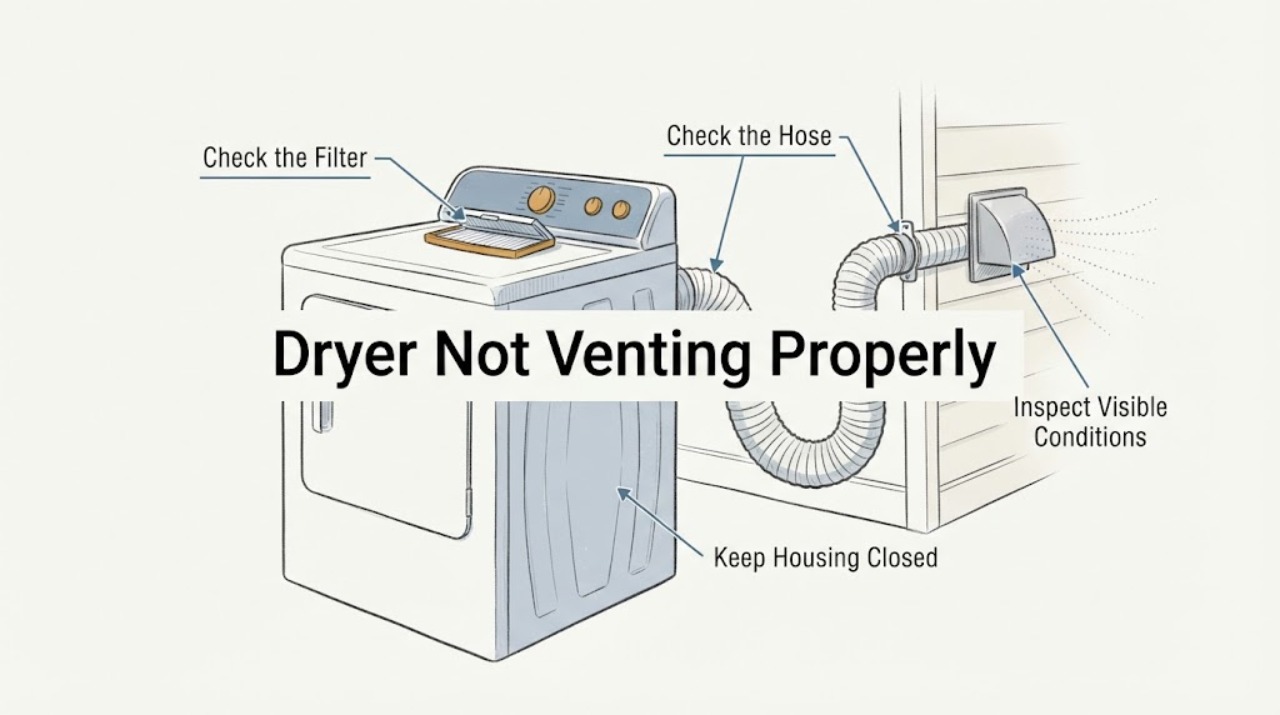
Start with the lint filter, then inspect the visible hose behind the dryer and the outside exhaust hood. LG says a clogged filter, crushed or kinked hose, blocked hood, lint in the home duct or an overlong/multi-elbow run can restrict airflow. With the dryer cool and off, clean the lint filter, check the hose for crushing or loose connections, and confirm the outside flap opens and can discharge air. If the restriction is severe, a d90/d95 or Flow Sense warning remains, or you see burning, discoloration, smoke or unusual heat, stop using the dryer. Visible exterior lint can be cleared safely, but ductwork inside walls should be inspected and cleaned by a professional vent specialist; do not open the dryer or guess at a fan, heater or sensor part.
Work through in order
Diagnostic checks
Use only checks that match the exact appliance or system and its official guide.
-
Check 1
Let the dryer cool, turn it off, remove the lint filter and clear the lint from the filter surface and tray. If the filter needs washing, clean it as the model manual allows and let it dry completely before reinstalling.
Expected result: The filter is packed with lint or the filter is clean but drying remains slow and airflow remains weak.
Next step: Reinstall only a dry, correctly seated filter and continue to the rear-hose and outside-hood checks. Do not run with the filter removed.
Why this matters
Why: A clogged filter can keep warm air from escaping and lengthen drying; a clean filter does not rule out restriction farther along the exhaust path.
-
Check 2
With the dryer off and cool, inspect the visible exhaust hose behind it without opening the cabinet. Check for crushing, kinks, dents, a circular coil, holes or loose connections; confirm the route is the rigid or semi-rigid type specified by LG rather than plastic or vinyl.
Expected result: The hose is visibly compressed, kinked, damaged or loose, or it is intact and open.
Next step: Correct only a clearly accessible, manual- or installation-approved hose position without disturbing gas or electrical connections. If the hose or connection is damaged, arrange service; otherwise inspect the outside outlet.
Why this matters
Why: A damaged or poorly routed visible hose can restrict airflow; an intact hose shifts attention to the outside hood or in-wall duct rather than proving an internal dryer failure.
-
Check 3
Run only the model-approved Air Dry or other no-heat airflow check if the dryer is otherwise safe, and observe the outside exhaust hood from a safe position. Look for a flap that opens fully and visible lint around the outlet; do not reach into the hood or climb to an unsafe location.
Expected result: The flap opens and airflow is strong, or the flap stays closed, airflow is weak, or lint/debris blocks the outlet.
Next step: Remove only visible lint that can be reached safely from the outside and keep the outlet clear. If the flap cannot open or the warning persists, stop using the dryer and arrange a vent inspection.
Why this matters
Why: A weak outlet flow or blocked hood supports an exhaust restriction; strong flow at the hood makes a severe external blockage less likely but does not prove the dryer is fault-free.
-
Check 4
If the dryer displays d90, d95, a Flow Sense restriction or a comparable blockage warning, note the exact display and whether it remains after the filter, visible hose and exterior hood checks.
Expected result: The warning clears after the accessible path is cleaned, or it remains/returns despite those checks.
Next step: Do not keep running a severely restricted dryer. Have a professional vent specialist inspect the in-wall run, lint accumulation, length, elbows and any required modifications; use LG service if the appliance still needs diagnosis.
Why this matters
Why: LG uses d90/d95 to indicate severe detected duct blockage; a persistent warning points to a restriction or design issue that may be hidden inside the household duct.
-
Check 5
Stop and check for an overheating warning sign before any further cycle: scorched clothing, discoloration at the rear grill or duct, smoke, a burning smell or unusually high heat.
Expected result: Any burning, smoke, discoloration or unusual heat is present, or the dryer only has a performance complaint with no heat/fire sign.
Next step: For any heat/fire sign, stop using the dryer and arrange qualified service after it is safe to do so. Do not bypass sensors, open the cabinet or repeatedly test cycles.
Why this matters
Why: LG links restricted airflow with higher temperature and says continued burning or discoloration requires service; a performance-only complaint can remain in the airflow branch if no hazard is present.
Use your observations
Decision map
Find the observation that best matches what you see, then follow the next safe action.
-
PATH 01Next step
What you see
The filter was clogged or the rear hose/exterior hood had a visible obstruction, and airflow and drying return to normal after a safe cleanup.
Do this next
Keep the filter clean before each load, keep the outside outlet clear and arrange regular duct cleaning as LG recommends.
Why this path and its safety boundary
Why it matters: The accessible exhaust path was restricting airflow; this does not establish a failed heater, motor or sensor.
-
PATH 02Next step
What you see
The filter, visible hose and outside hood are clear but airflow is weak, drying remains long, or a Flow Sense/d90/d95 warning returns.
Do this next
Stop using the dryer if the restriction is severe and have a professional vent specialist inspect and clean the household duct; request LG appliance service if the problem remains after the duct is verified.
Why this path and its safety boundary
Why it matters: A hidden in-wall restriction, excessive run, too many elbows or a needed ventilation modification is more likely than a simple filter issue.
-
PATH 03Next step
What you see
The dryer produces smoke, a burning smell, scorching/discoloration or unusual heat, with or without a vent warning.
Do this next
Stop the dryer, keep it out of use and arrange qualified service. Do not run another cycle to confirm the symptom or open the cabinet to inspect internal components.
Why this path and its safety boundary
Why it matters: This is a fire/overheating boundary rather than a routine airflow experiment.
Helpful context
Understand the symptom
What a venting problem means
The dryer must move warm, humid air through the lint filter, rear hose, household duct and exterior outlet. LG distinguishes a filter or visible hose problem from a restriction inside the home's ventilation system. A blockage can lengthen drying, trigger Flow Sense or d90/d95 on supported models, and raise temperature; it does not by itself prove that the dryer's heater, motor or sensor has failed.
Clean and inspect the accessible airflow path
Let the dryer cool and turn it off before handling the filter or rear hose. Clean the lint filter after each load and dry it fully before reinstalling. Check that the hose is not crushed, kinked, dented or loosely connected, and inspect the outside hood for lint and a flap that can open fully. Do not pull apart gas or electrical connections or open the dryer cabinet.
When the restriction is inside the wall
If the filter, visible hose and exterior hood are clear but airflow remains weak or the warning returns, the remaining restriction may be in the household duct. LG recommends a professional vent cleaning specialist for in-wall lint, excessive length, too many elbows or needed ventilation modifications. Do not treat a generic brush or a guessed internal part as a substitute for that inspection.
Burning or overheating changes the decision
Stop the dryer if clothing is scorched, the rear grill or duct is discolored, the dryer becomes unusually hot, or smoke or a burning smell appears. LG links restricted ductwork with increased temperature and says persistent burning or discoloration needs service. Do not run repeated cycles to test it or open the cabinet to find the heater or fan.
When checks do not resolve it
Need a professional?
Use a professional vent cleaning specialist when the restriction remains after the filter, visible hose and exterior hood checks, especially when the duct is inside walls, unusually long or has many elbows., Stop using the dryer for d90/d95 or severe Flow Sense restriction until the exhaust system is cleaned and repaired., Arrange qualified appliance service for smoke, burning, scorching/discoloration, unusual heat or a problem that persists after the household duct is verified.
Have this ready
- complete LG model and serial information
- any displayed Flow Sense, d90, d95 or other message
- whether the filter, rear hose and outside flap were checked
- drying time, load size and whether airflow was weak at the outside outlet
- any smoke, burning smell, scorching, discoloration or unusual heat
Common questions
FAQ
What should I check first when an LG dryer is not venting properly?
Start with a cool, powered-off lint filter check, then inspect the visible rear hose for crushing or kinks and the outside hood for lint or a flap that cannot open. LG treats these as the first accessible airflow checks before professional in-wall duct inspection.
What do d90 and d95 mean on an LG dryer?
LG says d90 and d95 indicate that the dryer detected about 90% or 95% duct blockage. Check the filter, visible hose and outside hood, but do not keep using the dryer while the exhaust remains severely restricted; hidden duct cleaning may require a professional.
Can I clean the dryer vent inside the wall myself?
LG directs owners to a professional vent cleaning specialist when the restriction is inside the home's ventilation system or when the accessible checks do not resolve it. Do not open the dryer or treat a guessed internal part as a vent repair.
Is a burning smell from an LG dryer just a venting issue?
A restricted duct can raise temperature, but burning, smoke, scorching or discoloration is a stop-use condition. LG recommends service for persistent burning or discoloration; do not run repeated cycles or open the cabinet.
Read the exact guide
Official sources
- LG Dryer – How to Perform Dryer MaintenanceLG USA · Opened LG USA's official maintenance article directly. It supports cleaning the filter after every load, drying it before reinsertion, annual duct cleaning and accessible lint/sensor/gasket maintenance; model-specific internal maintenance is not inferred.
- LG Dryer - Understanding d90 and d95 Error CodesLG USA · Opened LG USA's official support article directly. It supports d90/d95 as detected severe duct blockage and the filter, visible hose, exterior hood and professional duct-cleaning path; it is not generalized to other codes.
- LG Dryer – Why is My Dryer Not Heating, Not Drying or Taking a Long Time Drying?LG USA · Opened LG USA's official dryer support article directly. It applies to LG dryers generally and supports cool/powered-off filter preparation, rear hose checks, outside outlet checks and professional inspection inside walls; it does not identify an internal part failure.
- LG Dryer – Proper Venting and Installation TipsLG USA · Opened LG USA's official installation guidance directly. It supports checking for crushed/kinked/dented ducting and recognizing duct length and elbow count as ventilation-system factors; it does not authorize internal appliance disassembly.
- LG Dryer - Troubleshooting Burning or DiscolorationLG USA · Opened LG USA's official troubleshooting article directly. It supports the link between clogged ductwork and increased temperature and directs persistent burning/discoloration to service; it does not diagnose a specific heater or motor.
Community feedback
Share a repair observation
Share a plain-text repair observation. Accepted observations are published automatically; this page may take a moment to update.