
On this page
Start here
Quick answer
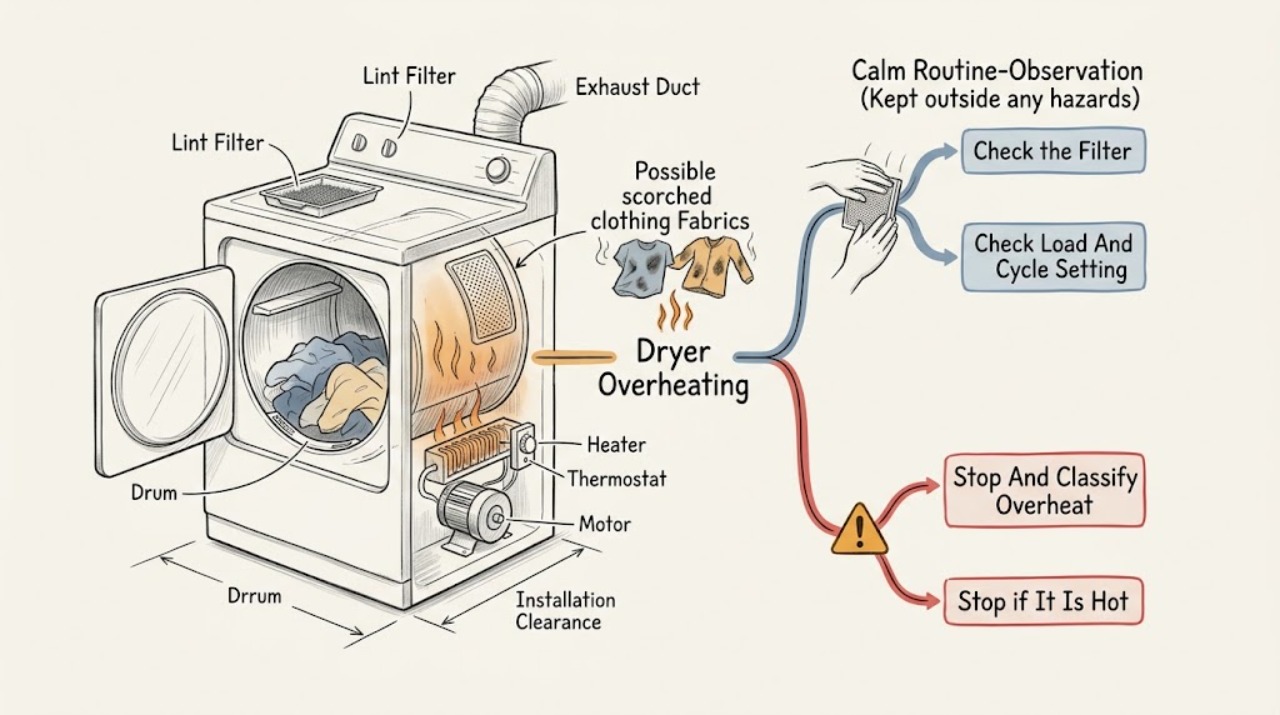
Stop the dryer and let it cool if the cabinet is unusually hot, clothing is scorched or too hot, drying times change sharply, or a burning smell, smoke, sparks, or a breaker trip occurs. Once there is no hazard, clean the accessible lint filter, check the drum for foreign objects, review the load and fabric-care setting, and inspect the accessible exhaust outlet for weak airflow or a blockage. LG says a full lint filter or restricted duct can raise dryer temperature, an oversized load can press clothing against the rear of the drum, and the installation space and duct path must follow the model's requirements. Do not open the cabinet, heater, or motor; persistent overheating, smoke, electrical odor, repeated trips, or gas odor needs qualified service or emergency action.
Before you begin
Safety first
- This article supports cool, ordinary-access inspection of the lint filter, drum, load, visible outlet, and installation space only. Do not open panels, heater, motor, thermal controls, wiring, or gas components; disconnect hot ducting; move a stacked unit alone; or re-energize a dryer with a hazard.
Work through in order
Diagnostic checks
Use only checks that match the exact appliance or system and its official guide.
-
Check 1
Stop the cycle, remove power only from a safe accessible position if there is no gas or smoke hazard, and let the dryer cool. From outside the appliance, record the cabinet temperature impression, clothing condition, odor, sound, display warnings, and whether the breaker tripped; do not open the cabinet or touch the heater.
Expected result: Classify the event as warm but cooling normally, clothing too hot or scorched, persistent burning or electrical odor, visible smoke or sparks, gas odor, abnormal fan or motor noise, or a repeated breaker trip.
Next step: For any immediate hazard, keep the dryer off and follow the emergency branch. If the dryer has cooled with no hazard, continue only with the accessible lint, load, duct, and installation checks.
Stop if: Do not restart to reproduce the overheat, touch hot surfaces, use a flame, reach into the heater, or approach smoke, arcing, or a gas odor.
Why this matters
Why: Clothing damage or weak cooling supports an airflow, load, or thermal-control branch. Burning, smoke, sparks, gas, severe heat, or repeated electrical trips are stop-now conditions and cannot be cleared by lint cleaning or another cycle.
-
Check 2
When the dryer is cool and unpowered, remove and inspect the accessible lint filter for a full, bonded, torn, loose, or missing screen. Look inside the drum for visible paper, plastic, rubber, or other foreign material and remove only loose items reachable without tools; reinstall the clean filter firmly according to the model manual.
Expected result: Record a clean and secure filter, lint or detergent residue blocking the mesh, a torn or missing filter, a foreign object or stain in the drum, or a clean drum and filter with the dryer still overheating.
Next step: Clean or replace the filter only as the exact model instructions permit, wipe visible drum residue safely, and continue to the load and exhaust checks. Keep the dryer out of service for a damaged or missing filter or continued overheat.
Stop if: Do not run with the filter loose, damaged, blocked, or missing; do not remove the drum, heater, fan, or cabinet panels.
Why this matters
Why: LG says a full or clogged filter can raise temperature, and a filter problem or foreign object can damage clothing or affect airflow. A clean filter does not clear a blocked duct, overloaded load, fan, heater, or control fault.
-
Check 3
Review the dried load and its care labels after cooling. Separate heavy or heat-sensitive fabrics, remove items that were exposed to oil, solvent, cleaning product, or other volatile material, and compare the selected heat and cycle with the load without starting another hazardous test.
Expected result: Record a small or suitable load with correct settings, a tightly packed or oversized load that cannot tumble, a fabric or setting mismatch, clothing with scorch marks, or clothing contaminated by a chemical or oil residue.
Next step: Discard or safely handle damaged items as appropriate, follow garment and model instructions, and use a smaller correctly sorted load only after the dryer has passed the filter and airflow safety checks. Do not dry chemically contaminated clothing until it is safe to do so.
Stop if: Do not dry gasoline-, solvent-, oil-, or cleaning-product-contaminated clothing, continue a cycle with scorch marks, or use a higher heat setting to compensate for poor drying.
Why this matters
Why: LG says an oversized load can restrict tumbling and airflow and press clothes against the rear of the drum where they can burn; a care-label mismatch or contaminated load can also create heat or ignition risk. A suitable load with repeated overheating points toward airflow or an internal fault.
-
Check 4
With the dryer cool and off, inspect the accessible exhaust outlet, duct connection, and clearance around the unit for lint, a kink, crushing, an obstruction, or a blocked outside outlet. Compare the installation with the exact LG manual or installation checklist without pulling a stacked or built-in dryer out of place.
Expected result: Record normal airflow and clear space, weak or absent exhaust air, a lint or blockage warning, a duct that is kinked or crushed, an outlet blocked by lint or debris, or clearance that cannot be confirmed without moving the appliance.
Next step: Clean only the accessible filter or outlet area and correct no installation detail unless the model instructions explicitly describe it. Arrange qualified vent or LG service for duct inspection, restricted airflow, internal lint, uncertain clearance, or a warning that remains after cleaning.
Stop if: Do not disconnect ducting on a hot or gas appliance, run with the exhaust disconnected or blocked, move a stacked unit alone, or open the chassis to clean internal lint.
Why this matters
Why: LG states that a clogged or incorrectly installed duct restricts airflow and raises temperature, and its installation guidance requires model-specific space and duct arrangements. An inaccessible duct or internal lint path is a qualified service boundary.
-
Check 5
After the dryer is cool, the filter and visible airflow path are addressed, and no hazard is present, note whether the dryer can remain unpowered safely and whether the breaker stays reset without operating the unit. Do not restore power merely to prove a diagnosis when a safety warning remains.
Expected result: Record normal cooling with no repeat symptom, overheating that returns on a suitable load, a repeated breaker trip, a persistent burning or electrical smell, smoke or sparks, gas odor, or a damaged cord or outlet.
Next step: Leave the dryer off and provide the model, load, filter and airflow findings, warning codes, and safety observations to LG service or a qualified vent/electrical professional. For gas odor or smoke, leave the area and contact emergency services or the gas supplier from a safe location.
Stop if: Do not reset a breaker repeatedly, test live voltage, bypass a thermal fuse or interlock, open the heater or motor area, or re-energize after smoke, sparks, gas odor, persistent burning smell, or abnormal heat.
Why this matters
Why: A recurrence after accessible airflow and load checks suggests a heater, thermostat, motor, sensor, control, or concealed duct problem. Electrical, gas, smoke, spark, severe heat, or repeated-trip observations require immediate stop and qualified or emergency help.
Use your observations
Decision map
Find the observation that best matches what you see, then follow the next safe action.
-
PATH 01Safety boundary
What you see
The lint filter is full, bonded with residue, loose, damaged, or missing, or a visible foreign object is in the cool accessible drum.
Do this next
Clean or replace the filter and remove only loose visible debris as the exact manual permits; keep the dryer off if the filter cannot be secured or overheating persists.
Why this path and its safety boundary
Why it matters: The filter or object can restrict airflow, raise temperature, or damage clothing.
Safety stop: Do not run with a loose, damaged, blocked, or missing filter and do not open the cabinet to chase lint.
-
PATH 02Safety boundary
What you see
The filter is serviceable but the load is tightly packed, cannot tumble, contains heat-sensitive fabric, or is being dried on an unsuitable setting.
Do this next
Follow clothing care labels and the exact LG cycle guidance, use a suitable sorted load only after safety checks, and stop for any repeat scorching or excess heat.
Why this path and its safety boundary
Why it matters: Load size, fabric care, and heat selection can prevent airflow and scorch clothing without proving an internal dryer failure.
Safety stop: Do not dry chemically contaminated items, increase heat to compensate, or continue after scorch marks or burning odor.
-
PATH 03Safety boundary
What you see
Airflow at the accessible outlet is weak, an exhaust warning appears, the duct is kinked or blocked, or the unit is installed without the model-required space.
Do this next
Keep the dryer off if airflow is severely restricted or the cabinet overheats; clean only accessible areas allowed by the manual and arrange qualified vent or LG service.
Why this path and its safety boundary
Why it matters: Restricted airflow or installation can trap heat and lengthen drying, and the internal path may need qualified inspection.
Safety stop: Do not run with the duct disconnected or blocked, move a stacked appliance alone, or alter ducting or clearances by guesswork.
-
PATH 04Safety boundary
What you see
The filter, suitable load, and visible exhaust path are clear, but overheating, scorching, abnormal noise, or a warning returns.
Do this next
Leave the dryer off and request LG or qualified appliance service with the test history; do not open the cabinet or replace a thermal component yourself.
Why this path and its safety boundary
Why it matters: A heater, thermostat, thermal sensor, fan, motor, control, or concealed lint or duct fault is possible.
Safety stop: Do not continue cycles, test live components, bypass thermal protection, or use the dryer while the fault recurs.
-
PATH 05Safety boundary
What you see
There is smoke, flame, sparks, persistent burning or electrical odor, severe abnormal heat, a hot or damaged cord or outlet, or a breaker that trips again.
Do this next
Stop use and keep clear. Isolate power only if it can be done safely without approaching smoke, flame, gas, or damaged equipment; request emergency, electrical, or LG service as appropriate.
Why this path and its safety boundary
Why it matters: The dryer or its supply may present an immediate fire, shock, or equipment hazard.
Safety stop: Do not reset the breaker as a test, touch hot or damaged equipment, open the dryer, or re-energize it.
-
PATH 06Safety boundary
What you see
A gas odor is present around a gas LG dryer, with or without overheating.
Do this next
Do not light anything or operate electrical switches; clear the area and contact the gas supplier, fire department, or emergency services from a safe location. A qualified installer or service agency must inspect the appliance.
Why this path and its safety boundary
Why it matters: A gas leak or combustion problem may create an immediate fire or explosion hazard.
Safety stop: Do not use the dryer, operate a switch, use a flame to locate the leak, or attempt gas-line or burner repair.
Helpful context
Understand the symptom
Treat excess heat as an airflow and fire-safety question
A warm cabinet after a cycle is not enough to identify the cause. The useful clues are clothing that is scorching or unusually hot, a longer or changing dry time, a lint or exhaust warning, weak air at the outside outlet, a burning smell, smoke, sparks, or a breaker event. Stop first and let the dryer cool; only then inspect ordinary-access parts. A normal cool-down or a short-lived new-appliance smell does not make smoke or persistent overheating safe.
Start with the lint filter, drum, load, and cycle
LG advises cleaning the lint filter and checking the drum for foreign objects, sorting loads by fabric-care needs, and avoiding a load so large that clothes cannot tumble and receive airflow. A filter that is loose, damaged, or blocked should not be treated as usable. Remove lint or a visible object only from a cool, accessible area and follow the exact model manual for filter care.
The duct and installation space can keep heat trapped
A restricted, kinked, crushed, too-long, or incorrectly installed exhaust path reduces airflow and can raise dryer temperature. Check the accessible outlet and the space around the dryer without moving a hot or stacked unit. LG's installation guidance specifies model-dependent side, top, rear, and duct requirements; use the manual rather than guessing a clearance or disconnecting the duct.
Safety boundary
Stop conditions
- Stop immediately for smoke, flame, sparks, persistent burning or electrical odor, severe abnormal heat, scorch marks, a hot or damaged cord or outlet, or a breaker that trips again.
- For gas odor, do not light anything or operate electrical switches; clear the area and contact the gas supplier, fire department, or emergency services from a safe location.
- Do not run with a loose, damaged, blocked, or missing lint filter; do not operate with a disconnected, crushed, blocked, or inaccessible exhaust problem.
- Do not open the cabinet, heater, motor, thermal controls, wiring, or gas components; do not test live voltage or bypass thermal protection.
- Do not dry clothing contaminated with gasoline, solvents, cleaning agents, cooking oils, or other volatile materials until it is safely handled according to its care and safety instructions.
Only after diagnosis
Potential parts
- dryer lint filter or screen
Consider this category only when the exact model's filter is torn, warped, missing, or cannot be secured after cleaning and the filter condition is contributing to restricted airflow.
Confirm the exact LG model and filter design before ordering; do not operate with a missing or loose screen. - dryer exhaust duct or vent component
Consider this category only after a qualified inspection confirms that the duct, exterior outlet, or related vent component is kinked, blocked, damaged, or incorrectly installed.
Confirm the model's duct material, routing, outlet, and installation requirements; do not substitute a restrictive duct or run the dryer with exhaust disconnected. - dryer thermal sensor, thermostat, or fuse
Consider this category only when qualified diagnosis confirms an internal thermal-control fault after the filter, load, and visible airflow path are clear.
Confirm exact model and electrical specification through LG or qualified service; never bypass thermal protection or replace it from symptoms alone. - dryer fan, motor, heater, or control assembly
Consider this category only after qualified testing identifies a failed fan, motor, heater, relay, or control that causes recurring overheating or clothing damage.
Confirm the exact model, fuel type, assembly revision, and safe fit through qualified service; these are not ordinary-access troubleshooting parts.
When checks do not resolve it
Need a professional?
Request LG or qualified appliance and vent service when overheating or scorching returns after the filter, load, and accessible exhaust checks; a duct warning remains; airflow is weak; installation clearance cannot be confirmed; internal lint, heater, fan, motor, sensor, thermostat, or control access is needed; or a breaker trips again. Obtain qualified electrical help for a hot or damaged cord or outlet. For gas odor, smoke, flame, or an immediate fire or explosion hazard, leave the area and contact emergency services or the gas supplier from a safe location.
Safety scope: This article supports cool, ordinary-access inspection of the lint filter, drum, load, visible outlet, and installation space only. Do not open panels, heater, motor, thermal controls, wiring, or gas components; disconnect hot ducting; move a stacked unit alone; or re-energize a dryer with a hazard.
Common questions
FAQ
Why is my LG dryer overheating?
Common branches include a clogged or loose lint filter, restricted exhaust duct, unsuitable or oversized load, wrong fabric-care setting, installation restriction, or an internal heater, sensor, fan, motor, or control fault. Stop for scorch marks, smoke, burning odor, sparks, abnormal heat, or a repeated breaker trip.
Can a clogged lint filter make an LG dryer too hot?
Yes. LG says a full or clogged lint filter can raise dryer temperature and affect drying. Let the dryer cool, clean or replace the filter as the exact model allows, and keep the dryer off if the screen is loose, torn, missing, or overheating returns.
Can an oversized load cause clothes to burn in the dryer?
Yes. LG explains that too many clothes may not tumble or receive airflow properly and can press against the rear of the drum where they can burn. Follow fabric-care instructions, use a suitable sorted load, and stop if scorching or excess heat returns.
How do I know if the LG dryer vent is blocked?
Weak or absent exhaust air, longer drying, lint warnings, a kinked or crushed duct, or lint at the outlet support a restricted-airflow branch. Check only accessible areas when cool and off; arrange qualified vent service when the duct is inaccessible or the warning remains.
What should I do if my LG dryer smells like burning or gas?
Stop immediately for burning or electrical odor, smoke, sparks, abnormal heat, or a breaker trip and keep the dryer off for qualified service. For gas odor, do not light anything or operate switches; clear the area and contact the gas supplier, fire department, or emergency services from a safe location.
Read the exact guide
Official sources
- Dryer - Clothing Too HotLG USA Support · LG USA support guidance covering dryers and washer-dryer combos; model-specific cycle behavior and installation requirements still control.
- Power Issues - Laundry DryerLG USA Support · LG USA laundry-dryer support guidance; reset and breaker arrangements vary by model and fuel type.
- [LG Dryer] A burning smell comes from the dryer during dryingLG USA Support · LG USA all-model guidance for dryer odor during drying; a persistent odor or an older appliance requires service assessment.
- LG Dryer - Troubleshooting Burning or DiscolorationLG USA Support · LG USA dryer support guidance for burning or discoloration; exact model settings and access procedures vary.
- TROUBLESHOOTINGLG USA · LG dryer manual for an identified product family; other models may use different components and controls.
- LG Dryer - What to Do If You Smell Gas Around Your LG DryerLG USA Support · LG USA gas-dryer safety guidance; local emergency and gas-supplier rules also apply.
- [LG Dryer power] The circuit breaker suddenly trippedLG USA Support · LG USA troubleshooting guidance for dryer breaker events; local electrical requirements and the model rating control.
- [LG Dryer] [Gas type] A display saying that the exhaust pipe is clogged appearsLG USA Support · LG gas-dryer exhaust warning guidance; the airflow principles apply to other vented models while exact displays vary.
- [LG Dryer lint] There is a lot of lint left on fabric after drying.LG USA Support · LG USA support guidance for dryers and washer-dryer combos; exact filter design varies by model.
- [LG Dryer] Pre-Purchase & Installation ChecklistLG USA Support · LG USA general installation checklist; exact model documentation and local requirements control a specific installation.
Community feedback
Share a repair observation
Share a plain-text repair observation. Accepted observations are published automatically; this page may take a moment to update.