
On this page
Start here
Quick answer
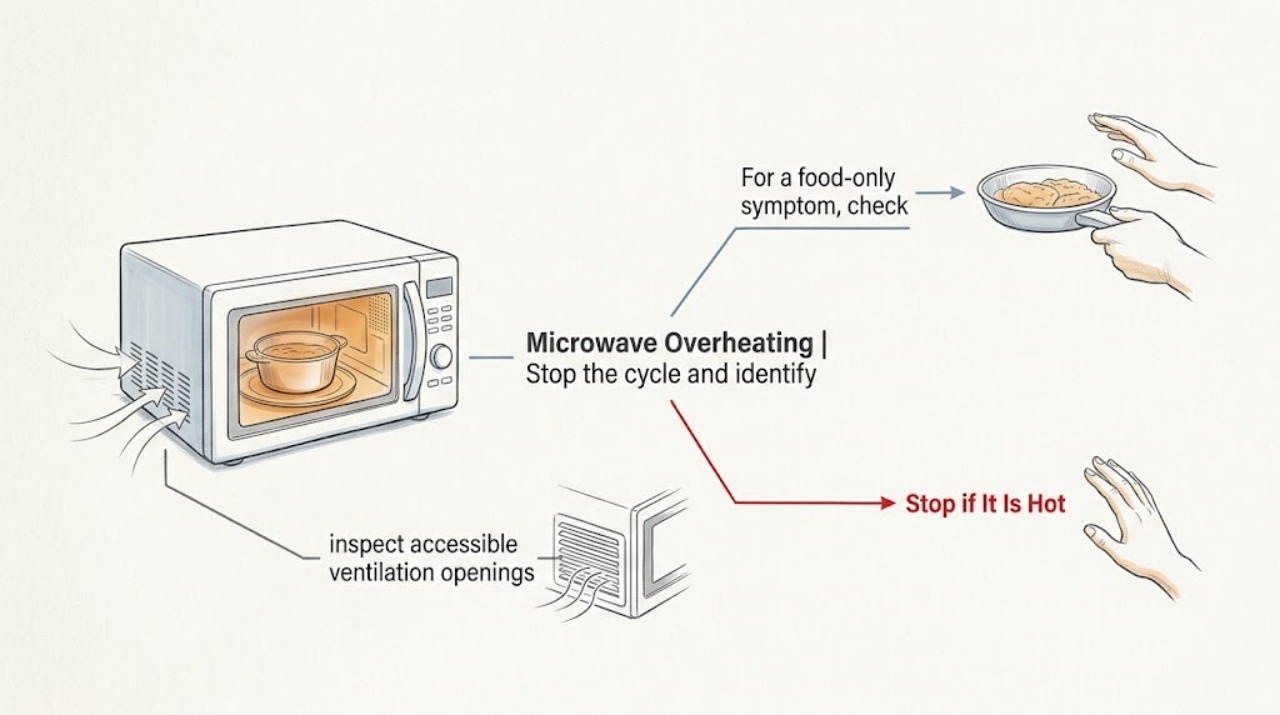
First determine whether the food or the microwave cabinet is overheating. Stop the cycle for smoke, scorching, sparks, a hot plug, or a damaged door. For a food-only problem, check cooking time, power, load size, and ventilation openings; do not operate the microwave empty or remove its cover.
Before you begin
Safety first
- Never run a microwave empty, bypass its interlocks, or open the outer cabinet.
Work through in order
Diagnostic checks
Use only checks that match the exact appliance or system and its official guide.
-
Check 1
Stop the cycle and identify where excess heat appears: in the food/container, around the cavity, at the exterior vents, at the plug, or with smoke/arcing.
Expected result: Only the food is overcooked, or the cavity/exterior/cord is unusually hot or smoking.
Next step: For smoke, arcing, a hot plug, or abnormal cabinet heat, leave the unit off and arrange service. Do not touch a damaged cord.
Why this matters
Why: Cooking settings and load can overheat food; cabinet heat, smoke, sparks, or cord heat needs an immediate stop and service assessment.
-
Check 2
For a food-only symptom, check the selected time and power, portion size, food weight, and whether the container is suitable; compare them with the exact LG manual.
Expected result: The cycle used more time/power or a smaller load than intended, or the settings match the manual.
Next step: Correct only the documented time/power/load method and monitor. Do not compensate for a cabinet or cord that is heating.
Why this matters
Why: LG notes that food size, weight, frozen state, and cooking method affect reheating; matching settings without an explanation warrants a controlled service check.
-
Check 3
With the microwave stopped and cool, inspect accessible ventilation openings and the cavity for food buildup; clean only by the LG method and never run the oven empty.
Expected result: Ventilation openings are blocked or food residue is present, or the openings are clear and the symptom returns.
Next step: Clear only accessible external blockage and residue. Arrange qualified service for returning overheating or any internal damage.
Why this matters
Why: LG's manual warns that blocked ventilation can contribute to poor operation, and food buildup can cause noise and heating problems; recurrence after cleaning needs service.
Use your observations
Decision map
Find the observation that best matches what you see, then follow the next safe action.
-
PATH 01Next step
What you see
Only a small or frozen food load is overcooked or uneven
Do this next
Adjust the documented cooking method and use suitable cookware; do not repeatedly extend the cycle.
-
PATH 02Next step
What you see
The outer cabinet, vent area, plug, or cord becomes unusually hot
Do this next
Stop using the microwave and arrange qualified appliance/electrical service.
-
PATH 03Next step
What you see
Smoke, sparks, a scorched cavity, or strong burning smell occurs
Do this next
Stop immediately, disconnect power only if safe, and request service; never open the cabinet.
Helpful context
Understand the symptom
Heat in the food is expected; heat at the cabinet is not
Overcooked food can result from settings or load changes, while a hot enclosure, burning smell, or blocked ventilation can signal a safety or appliance problem. Observe the location and timing of heat before any further test.
When checks do not resolve it
Need a professional?
Report whether heat was in the food, cavity, exterior vents, plug, or cord and whether smoke/arcing occurred.
Safety scope: Never run a microwave empty, bypass its interlocks, or open the outer cabinet.
Common questions
FAQ
How can I tell whether the food or microwave is overheating?
Stop and identify where heat is concentrated. Food-only overheating may be a setting/load issue; cabinet, vent, plug, or cord heat requires service.
Is it safe to keep testing after smoke or sparks?
No. Stop immediately, disconnect power only if safe, and arrange qualified service. Do not operate the microwave empty or open its cover.
Read the exact guide
Official sources
- LG Microwave - Things to CheckLG USA Support · LG microwave food buildup and ventilation-related noise/heating checks
- LG Microwave Owner's ManualLG Electronics · LG microwave cooking, ventilation, and safety troubleshooting
- New LG Microwave Burning Smell or Noise: Causes and SolutionsLG USA Support · LG microwave burning smell, smoke, and service escalation
- LG Microwave - Why is My Microwave Not Heating Properly?LG USA Support · LG microwave food load, frozen food, and heating checks
Community feedback
Share a repair observation
Share a plain-text repair observation. Accepted observations are published automatically; this page may take a moment to update.