
On this page
Start here
Quick answer
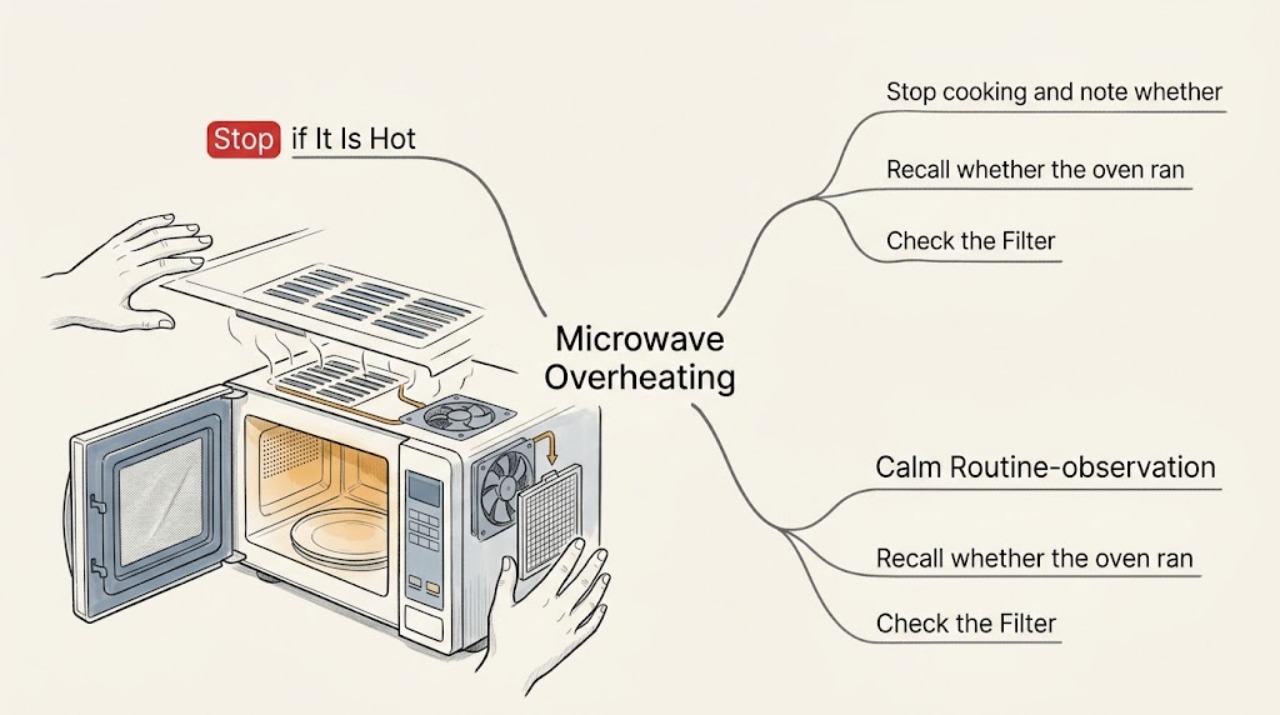
Stop the Panasonic microwave if the cabinet, food, or cavity becomes abnormally hot, smoke appears, or the fan does not run. After it is cool and safe, check whether it was operated empty, whether vents or filters are blocked, and whether cookware or food caused the symptom. Do not remove panels; recurring overheating requires authorized service.
Before you begin
Safety first
- Do not operate an empty oven, remove covers, bypass thermal protection, or test high-voltage parts.
Work through in order
Diagnostic checks
Use only checks that match the exact appliance or system and its official guide.
-
Check 1
Stop cooking and note whether the heat is in the food, the cavity, the outer cabinet, or around the vents; allow the appliance to cool without touching hot surfaces.
Expected result: Only food is overheated, the cavity/cabinet is unusually hot, or smoke/odor is present.
Next step: Do not resume operation for smoke, odor, or abnormal cabinet heat; arrange service.
Why this matters
Why: Food overheating can reflect time or power; excessive cavity/cabinet heat or a warning suggests airflow or internal protection concerns.
-
Check 2
Recall whether the oven ran empty or with too little moisture and whether the container or wrapping contained metal.
Expected result: The cavity was empty, metal was present, or food and cookware were ordinary microwave-safe items.
Next step: Discard damaged cookware/food and keep the unit out of service after abnormal heating.
Why this matters
Why: Panasonic says empty operation can heat the cavity abnormally, while metal can arc and create heat; ordinary items shift attention to ventilation or controls.
-
Check 3
When fully cool and unplugged only if safe, inspect the external air openings and accessible filters for dust or blockage; do not disassemble the cabinet.
Expected result: Airflow is blocked, a filter is dirty, or vents are clear.
Next step: Clean only the manual-approved accessible area and request service if the fan is silent or overheating returns.
Why this matters
Why: Restricted airflow can prevent heat from leaving; clear vents make an internal fan or thermal fault more likely.
-
Check 4
Record any H97/H98 or other error indication and whether the fan runs, without repeatedly restarting the microwave.
Expected result: An error or fan failure appears, or the unit completes a cool cycle normally.
Next step: Provide the code and fan behavior to authorized service.
Why this matters
Why: Panasonic identifies certain error indications and fan failure as service conditions; one normal cycle does not justify repeated stress testing.
Use your observations
Decision map
Find the observation that best matches what you see, then follow the next safe action.
-
PATH 01Next step
What you see
Only the food overheated with normal cavity and airflow
Do this next
Use the model cooking guide and a smaller monitored test after the unit is confirmed safe.
Why this path and its safety boundary
Why it matters: Time, power level, or food moisture may explain the result.
-
PATH 02Next step
What you see
The empty cavity or metal cookware caused abnormal heat or sparks
Do this next
Do not reuse damaged cookware or resume until the cavity is inspected if damage is visible.
Why this path and its safety boundary
Why it matters: The operating material/load was unsafe for microwave mode.
-
PATH 03Next step
What you see
The fan does not run or overheating returns after vents are clear
Do this next
Stop use and arrange authorized service.
Why this path and its safety boundary
Why it matters: An internal airflow or thermal-control fault remains possible.
Helpful context
Understand the symptom
Find what overheated
An overheated food item is different from a hot cavity, a hot cabinet, or a fan that does not operate. Treat smoke, odor, and repeated thermal shutdown as stop-use symptoms.
When checks do not resolve it
Need a professional?
Call authorized service for repeated overheating, a failed fan, persistent error, smoke, burning odor, visible cavity damage, or a hot cabinet after ordinary loads.
Safety scope: Do not operate an empty oven, remove covers, bypass thermal protection, or test high-voltage parts.
Have this ready
- Provide model number, load/cookware, heat location, fan/vent condition, error code, and odor/smoke history.
Common questions
FAQ
Can a microwave overheat if it is empty?
Yes. Panasonic says an empty cavity can heat abnormally because there is no food or liquid to absorb energy. Do not repeat the test.
Should I replace a microwave fan myself?
No. A failed fan or repeated overheating requires authorized service with the cabinet closed.
Read the exact guide
Official sources
- Panasonic Operating Instructions NE12521/NE12523/NE217521/NE217523/NE21521/NE21523Panasonic · Only models covered by this operating-instructions family; use the exact model manual for other ovens
- Panasonic - Troubleshooting Questions for Safe Usage and Operation of Microwave OvensPanasonic · Panasonic microwave ovens
- Panasonic - Troubleshooting - Microwave power, fan or motor problems.Panasonic · Panasonic microwave ovens; exact procedures vary by model
Community feedback
Share a repair observation
Share a plain-text repair observation. Accepted observations are published automatically; this page may take a moment to update.