
On this page
Start here
Quick answer
The LG WM6998HVA is a ventless all-in-one washer-dryer that uses Inverter HeatPump technology, so the drying air and moisture are handled differently from a vented dryer. A little warmth or condensation when the door is opened is not the same as water escaping into the room, but a persistent rise in room humidity deserves an external check. First confirm the full model and that the installation matches the WM6998HVA manual; do not add an unapproved exhaust duct, cut the cabinet, or move a stacked or otherwise inaccessible unit. With the appliance cool, document whether moisture is only on the door, whether clothes remain very wet, whether the drain or water supply is restricted, and whether there is a floor puddle. Use only the model's accessible lint/condenser care and visible hose checks. Stop for a leak, smoke, burning odor, abnormal heat, damaged electrical parts, or recurring poor drying and arrange qualified LG service.
Before you begin
Safety first
- Do not add an unapproved exhaust, cut or seal cabinetry, move a stacked or inaccessible WM6998HVA, open heat-pump or electrical panels, touch refrigerant tubing, loosen pressurized hoses, bypass safety devices, or replace a pump, condenser, sensor, compressor, valve, or control from humidity alone. Stop immediately for a leak, water near electrical parts, smoke, burning odor, abnormal heat, sparking, repeated power trips, or a hot or damaged cord or outlet.
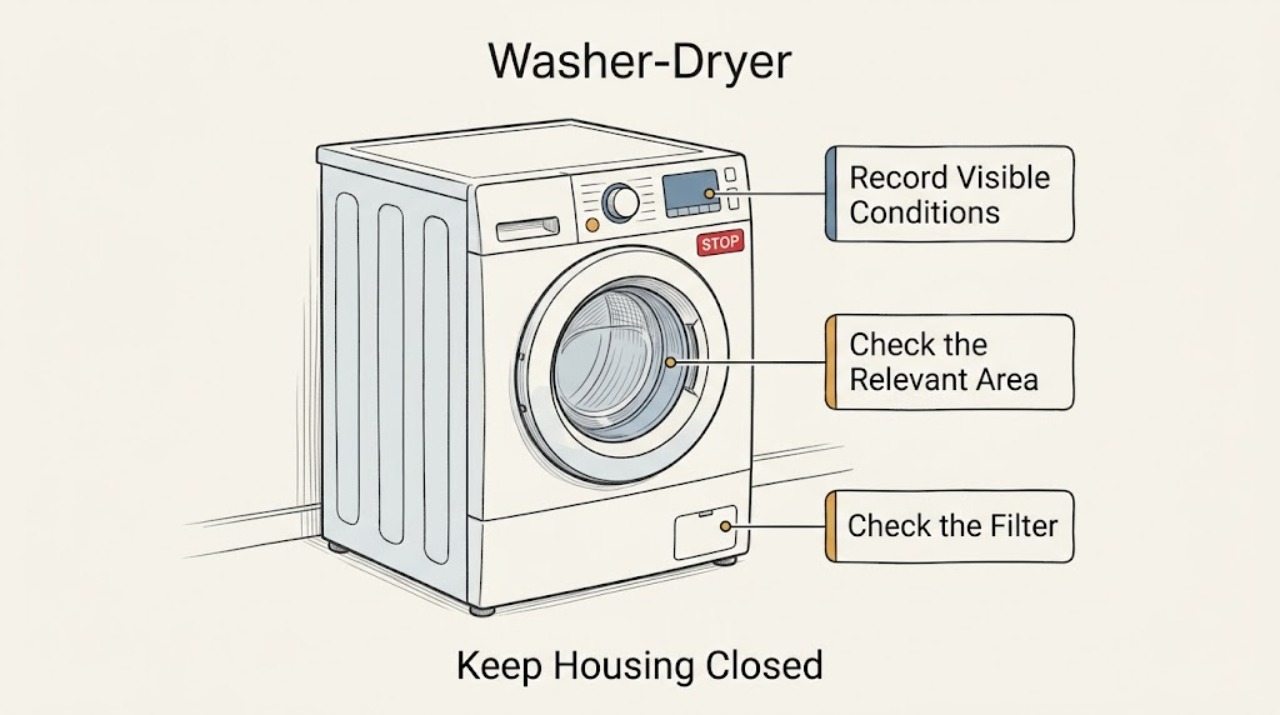
Work through in order
Diagnostic checks
Use only checks that match the exact appliance or system and its official guide.
-
Check 1
Read the rating label without moving the appliance and record the complete model, including the WM6998HVA suffix and the market or region. Record the cycle, load size, whether the moisture was noticed during drying or only after opening the door, and whether the door was opened mid-cycle.
Expected result: The label and cycle are clear, the model or suffix is incomplete, or the moisture event occurred only after the door was opened.
Next step: Use the exact WM6998HVA manual and preserve the cycle details. If the label is incomplete, photograph it for service rather than using another LG combo's clearance, control, or filter procedure.
Stop if: Do not move a stacked or tightly installed unit, alter cabinetry, or add an exhaust duct to solve the humidity report.
Why this matters
Why: LG provides a dedicated WM6998HVA support entry and says its product documents are model-specific. Moisture noticed only after opening can be condensation from hot humid drum air, while an uncertain model cannot safely inherit a different combo's installation or maintenance steps.
-
Check 2
With the unit cool and idle, localize the moisture using a dry cloth and a simple written record: wipe the door glass, inspect the visible front and floor, and note whether moisture returns on the glass, appears at a hose or drain area, or forms a puddle. Do not probe behind panels or run a cycle with water near electrical parts.
Expected result: There are only droplets or fog on the inside of the door, the floor and visible connections stay dry, or water is present on the floor or at a connection.
Next step: For door-only condensation, wipe it and avoid opening the door during drying. For a puddle or wet connection, stop the appliance, close the water supply only if safely accessible, isolate power only from a dry accessible position if safe, protect the floor, and arrange qualified service.
Stop if: Do not keep cycling a leaking unit, loosen a hose, remove a panel, or reach under the appliance while it is energized or wet.
Why this matters
Why: LG describes condensation on the door during drying as a normal consequence of hot humid air. A floor puddle or wet connection is not the same observation and can indicate a leak or drainage problem, which takes priority over drying optimization.
-
Check 3
Check only the user-accessible drying-care points named for the WM6998HVA: the top or front lint-filter area and any condenser-filter access shown in the exact manual. When cool, remove lint as directed and refit the filter fully; do not remove a protective grille or open the heat-pump cabinet unless the model manual explicitly makes that a user task.
Expected result: The accessible filter is visibly loaded or not seated, the manual's filter layout differs, or the accessible filter is clean and drying still leaves the room humid or clothes wet.
Next step: Clean and refit only the accessible filter according to the WM6998HVA manual, then record whether the next safe, appropriately sized load behaves differently. If the exact access or care instruction is unavailable, stop at observation and use service.
Stop if: Do not dismantle the heat-pump circuit, touch refrigerant tubing, remove internal covers, or select a replacement component from humidity alone.
Why this matters
Why: LG identifies an ezLintFilter and Auto Cleaning Condenser for this model, and its product page says lint can be removed after each load. A dirty or incorrectly seated user filter can reduce drying performance, but a clean filter does not prove a condenser, sensor, compressor, or control failure.
-
Check 4
Inspect the visible water-supply valves and hose routing without disconnecting anything. Confirm the cold-water tap is open and the hoses are not visibly kinked or reversed, using the labels and WM6998HVA manual; do not assume a dry cycle is independent of water supply.
Expected result: The cold supply is closed or restricted, the visible hoses are kinked or appear reversed, or the visible supply is normal but the room remains humid and drying is poor.
Next step: Correct only an obviously closed accessible valve or visible routing issue when the area is dry and the manual allows it. If a connection leaks, is inaccessible, or the problem persists with normal supply, stop and arrange model-specific service.
Stop if: Do not loosen pressurized fittings, use a meter, alter plumbing, or keep running the machine to force a diagnosis.
Why this matters
Why: LG explains that combo drying can use water to condense moisture and that restricted cold supply or reversed hoses can reduce condensation efficiency. A normal visible supply only clears that external branch; it does not identify an internal valve, condenser, or control part.
-
Check 5
From the accessible side only, observe the drain hose route and the end connection for a kink, standing water, or a visibly high loop that conflicts with the WM6998HVA installation instructions. Do not pull the appliance forward or disconnect the hose; if the unit is stacked or enclosed, photograph the accessible section instead.
Expected result: The visible hose is kinked, forms a water-trapping loop, or shows backflow or wetness, or the route is inaccessible and the appliance still has poor drying or excess humidity.
Next step: Have the drain route corrected to the exact WM6998HVA installation instructions by an installer or qualified service provider. If there is backflow, a leak, or an inaccessible stacked installation, stop using the affected function until it is assessed.
Stop if: Do not lower, cut, disconnect, or re-plumb a wet hose yourself, and do not move a heavy or stacked appliance for this check.
Why this matters
Why: LG's combo drying guidance links incomplete drainage or a water-trapping drain route with steam or moisture-management problems and poor drying. That is an installation or drainage branch, not proof that a drain pump or heat-pump part needs replacement.
-
Check 6
Compare the load and cycle with the WM6998HVA manual's dry-load guidance. Use a smaller, well-spun load with thick items unfolded, and note whether the room humidity, cycle behavior, and final moisture improve without opening the door during drying. Do not run repeated long tests if there is abnormal heat, odor, smoke, or a leak.
Expected result: A smaller, properly spun load dries better and the room symptom improves, or even a suitable load remains wet while humidity rises or the cycle behaves abnormally.
Next step: Keep within the exact manual's load and cycle limits when the machine is otherwise safe. If the symptom persists, preserve the cycle name, load, moisture location, temperature/odor observations, and any display message for qualified LG service.
Stop if: Do not compensate for persistent humidity by adding an unapproved vent, running the appliance unattended, or repeatedly testing a suspected fault.
Why this matters
Why: LG says combo drying capacity is lower than washing capacity, that overloading or folded thick garments can leave laundry wet, and that heat-pump drying warms more slowly than gas or resistance drying. Improvement with a suitable load supports a load or cycle branch; no improvement after external checks keeps an internal or installation fault open.
Use your observations
Decision map
Find the observation that best matches what you see, then follow the next safe action.
-
PATH 01Next step
What you see
Moisture is limited to fog or droplets on the inside of the door after or during drying, with no floor water and no abnormal odor or heat.
Do this next
Keep the door closed during the cycle, wipe the glass when the unit is cool, and monitor whether the room symptom remains after the cycle. Escalate if condensation is accompanied by a puddle, recurring poor drying, abnormal heat, or an error.
Why this path and its safety boundary
Why it matters: LG describes condensation on the door as normal when hot humid air from drying meets the cooler door surface. Opening the door interrupts drying and can extend the cycle, so this pattern does not by itself show a room leak or failed heat-pump component.
-
PATH 02Next step
What you see
The room becomes humid while clothes remain unusually wet, the cycle is very long, or the symptom improves with a smaller load but not at the expected load.
Do this next
Document the load and cycle, keep the load within the exact manual's dry guidance, and complete only the visible water, drain, and filter checks. If the pattern persists, arrange qualified LG service rather than ordering a condenser, sensor, pump, or control.
Why this path and its safety boundary
Why it matters: The result is more consistent with a drying-performance branch than with door condensation alone. LG points to load size, water supply, hose routing, drain path, and accessible filters for combo drying; those checks do not identify a particular internal part.
-
PATH 03Next step
What you see
There is a floor puddle, a wet supply or drain connection, water before a cycle, or visible backflow; the unit is stacked, enclosed, or otherwise inaccessible for a safe hose inspection.
Do this next
Stop the machine, close the water supply if safely reachable, isolate power only from a dry accessible position if safe, keep people away from wet electrical areas, and arrange qualified appliance/plumbing service or an installer assessment. Do not move the unit yourself.
Why this path and its safety boundary
Why it matters: This pattern changes the decision from drying optimization to leak, backflow, or installation safety. LG advises closing the inlet valve and requesting inspection when a washer fills while not in use, and water near an appliance can create an electrical hazard.
-
PATH 04Safety boundary
What you see
The visible filters, supply, drain route, load, and door behavior are normal, but humidity remains high or the appliance produces abnormal heat, burning odor, smoke, sparking, repeated tripping, or a recurring display message.
Do this next
Stop using the drying function; for smoke, sparking, burning odor, hot or damaged electrical parts, or fire, leave the area and use local emergency procedures as appropriate. Otherwise arrange qualified LG appliance service and provide the full model, cycle, moisture location, and observations.
Why this path and its safety boundary
Why it matters: A normal external check cannot rule in or rule out an internal heat-pump, water, sensor, motor, control, or wiring fault. Smoke, odor, heat, water, or electrical symptoms override ordinary troubleshooting.
Safety stop: No repeated reset, live test, panel removal, refrigerant work, bypass, or part replacement from the symptom alone.
Helpful context
Understand the symptom
Why a ventless heat-pump combo changes the humidity question
LG lists the WM6998HVA as a ventless all-in-one washer-dryer with Inverter HeatPump technology, not a conventional exhaust dryer. LG's heat-pump guidance explains that damp drum air is warmed through a heat exchanger and that drying can feel slower than a gas or resistance-heated dryer. That mechanism makes the first question where the moisture is appearing: condensation on the door after opening, damp laundry after a long cycle, moisture at the drain path, or actual water on the floor. It does not justify assuming that the heat pump, condenser, sensor, or control has failed.
Keep the model and installation boundary visible
WM6998HVA has a model-specific LG support page and Owner's Manual. Use the full rating-label model, including any suffix, when checking the manual or requesting service. The product is ventless, but ventless does not authorize adding a makeshift exhaust hose or changing cabinetry. Do not pull a heavy, stacked, or tightly installed appliance forward just to inspect its rear; document what is visible and have an installer or service provider assess inaccessible clearances and hose routing.
Separate normal condensation from a room or floor moisture problem
LG says hot, humid air during drying can create condensation on the door window, and that opening the door during a cycle interrupts drying and may increase the cycle time. LG also notes that all-in-one units can leave a small amount of condensed vapor or water in the drum after drying. Those observations are different from a puddle, a wet supply or drain connection, water appearing before a cycle, or humidity that remains high while drying performance deteriorates. The latter patterns should move the decision toward an installation, drainage, or service check rather than repeated cycles.
When checks do not resolve it
Need a professional?
Arrange qualified LG appliance service or an installer assessment when the model or installation cannot be confirmed, the drain or supply route is inaccessible, a floor leak or backflow is present, humidity and poor drying persist after the manual-approved external checks, or the appliance shows an error, abnormal heat, odor, smoke, or electrical symptom.
Safety scope: Do not add an unapproved exhaust, cut or seal cabinetry, move a stacked or inaccessible WM6998HVA, open heat-pump or electrical panels, touch refrigerant tubing, loosen pressurized hoses, bypass safety devices, or replace a pump, condenser, sensor, compressor, valve, or control from humidity alone. Stop immediately for a leak, water near electrical parts, smoke, burning odor, abnormal heat, sparking, repeated power trips, or a hot or damaged cord or outlet.
Have this ready
- Provide the complete WM6998HVA rating-label suffix and region, installation context (including whether stacked or enclosed), cycle and load, whether the door was opened during drying, where moisture appeared, filter/supply/drain observations, any puddle or odor, and every display message.
Common questions
FAQ
Is it normal for the LG WM6998HVA to make the room humid?
The WM6998HVA is ventless and uses heat-pump drying, so it does not operate like a vented dryer. LG says humid air can create condensation on the door during drying, especially when the door is opened. A persistent room-humidity increase, wet floor, or worsening drying result should not be dismissed as normal; localize the moisture and check the accessible water, drain, load, and filter conditions in the exact manual.
Should I install a vent hose or cut a cabinet opening?
No. LG identifies the WM6998HVA as a ventless combo. Do not add a non-approved exhaust or alter the cabinet. If the installation space or hose route is enclosed or inaccessible, have the exact installation assessed by an installer or qualified service provider.
Could the water supply cause excess humidity or poor drying?
It can affect drying performance. LG's combo guidance says water is used in the drying process on applicable systems and that restricted cold supply or reversed hoses can reduce condensation efficiency. Check only the accessible valves, labels, and visible hose routing; do not disconnect a pressurized connection or infer a failed valve from the symptom.
What if there is water on the floor?
Stop the appliance and treat floor water as a leak or backflow problem, not ordinary door condensation. Close the water supply only if safely accessible, isolate power only from a dry accessible position if safe, keep clear of wet electrical areas, and arrange qualified appliance or plumbing service. Do not move a stacked unit or remove panels to find the source.
Read the exact guide
Official sources
- WM6998H_A 5.0 cu. ft. Mega Capacity Smart WashCombo™ All-in-One Washer/DryerLG Electronics USA · Official specification sheet names the WM6998H_A family and explicitly lists WM6998HVA as the Graphite Steel model; it identifies the internal heater, dry modes, lint filter, Auto Cleaning Condenser, 120 V electrical requirement, dimensions, and product weight.
- Long Dry Time - Washer / Dryer Combo UnitLG USA Support · Opened official LG combo guidance, presented as general combo-unit support rather than a replacement for the WM6998HVA manual; it covers water taps, hose orientation, inlet filters, drain pump/filter maintenance, load size, and spin-before-dry behavior.
- [LG Front Load Washer] Water remains in the drumLG USA Support · Opened official LG guidance categorized for washer-dryer combos and washers; it describes small residual water or condensed vapor after drying, drain backflow, and the need to close the inlet valve/request inspection when filling occurs while idle. Exact WM6998HVA access remains governed by its manual.
- [LG Dryer][14kg] Water droplets fall when the product door is opened during dryingLG USA Support · Opened official LG guidance categorized for dryers and washer-dryer combos; it supports the narrow observation that hot humid drying air can condense on the door, not a claim that every room-humidity event is normal.
- LG Washer Dryer Combo - Troubleshooting Poor Drying PerformanceLG USA Support · Opened official LG combo guidance marked for washer-dryer combos and washers; it describes water-free and general combo drying branches, but explicitly notes that images/content may differ by model, so WM6998HVA manual confirmation remains required.
- [LG dryer drying time] [Electric heat pump] The drying time is longLG USA Support · Opened official LG guidance categorized for washer-dryer combos; it explains the heat-exchanger path, slower warming relative to gas or resistance dryers, and humidity/temperature sensor timing, while noting that exact content can vary by model.
- LG WM6998HVA.ASSEEUS: Support, Manuals, Warranty & MoreLG Electronics USA · Exact LG support entry for WM6998HVA.ASSEEUS; links the Owner's Manual, User Guide, Warranty, and Specification documents and identifies model-specific support routing.
- 5.0 cu. ft. All-In-One WashCombo™ - WM6998HVALG Electronics USA · Exact LG product page for WM6998HVA; identifies the ventless design, Inverter HeatPump technology, ezLintFilter, condenser filter, and all-in-one washer-dryer form.
Community feedback
Share a repair observation
Share a plain-text repair observation. Accepted observations are published automatically; this page may take a moment to update.