
On this page
Start here
Quick answer
If an LG FH4A8FDH2N washer-dryer has produced flames, smoke, or fire, treat it as a fire and electrical incident, not a repair or reset. Leave the area and call emergency services if there is any active flame, smoke, heat, or rekindle risk. Do not restart the appliance, open its panels, move it, or try to identify a failed part. Only if the fire is fully out and the electrical isolation point is safely reachable without approaching damage should power be isolated; otherwise keep clear and wait for responders or a qualified professional. Preserve the exact model and serial information, photographs from a safe distance, purchase and service records, and the fire or incident report. LG's opened product page identifies FH4A8FDH2N as a 9 kg wash/6 kg dry washer-dryer, but the opened LG warranty terms do not promise a replacement and specifically list fire damage among exclusions; ask LG, the seller, and the insurer for a written case decision for the actual market and serial number.
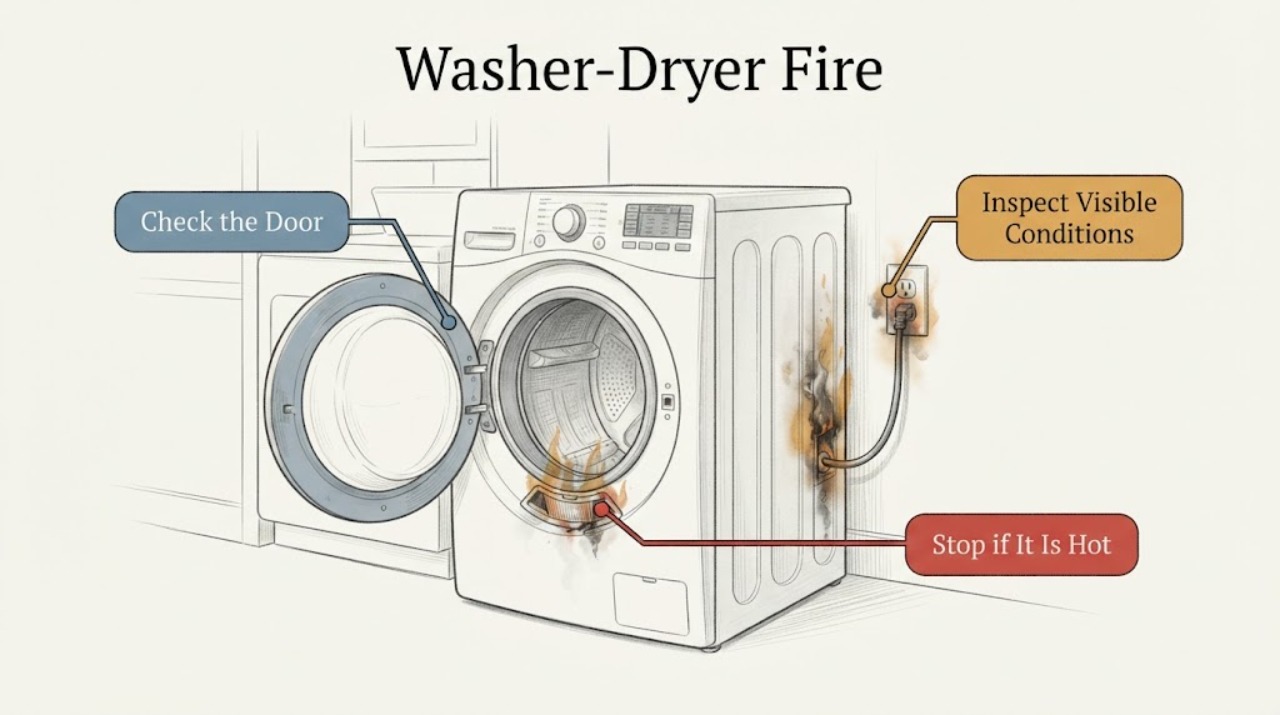
Work through in order
Diagnostic checks
Use only checks that match the exact appliance or system and its official guide.
-
Check 1
If there is any flame, smoke, glowing material, unusual heat, gas or chemical odor, or a possibility of rekindle, leave the area, keep other people away, and call the local emergency service. Do not open the door, spray the appliance, move it, or attempt to extinguish a fire unless you are trained and the situation is clearly within the limits of your local emergency guidance.
Expected result: The fire is active, smoke or heat is present, the appliance is smoldering, or the scene is not confirmed safe; alternatively, responders have confirmed the incident is controlled and the appliance is cool enough to approach from a safe distance.
Next step: For active, smoky, hot, or uncertain conditions, stay out and follow responders. Only after the scene is declared safe proceed to the external documentation and isolation boundary below; do not restart the appliance to reproduce the event.
Stop if: Stop immediately and retreat if smoke, heat, flame, crackling, odor, or renewed activity appears.
Why this matters
Why: Active or uncertain fire conditions take priority over diagnosis, power isolation, replacement discussions, or evidence collection. A controlled scene still contains an electrically and thermally damaged appliance that must not be treated as usable.
-
Check 2
After the incident is fully out and only from a dry, unobstructed position, look for external damage to the plug, cord, wall outlet, nearby wiring, water connections, and floor. Do not touch melted insulation, wet components, soot, the back of the machine, or an energized-looking outlet. If power isolation is clearly reachable without approaching damage, switch off the appliance at its accessible isolator or breaker; otherwise leave it for responders or a qualified electrician.
Expected result: The cord, plug, outlet, or appliance is burned, melted, wet, loose, sparking, or otherwise damaged, or the isolation point cannot be reached without contact with the damaged scene; alternatively, a professional has isolated the circuit and confirmed it is safe.
Next step: Keep the appliance out of service and have the circuit and appliance assessed by qualified electrical/appliance professionals. Do not tape a cord, reset a breaker repeatedly, remove a cover, or connect a replacement cord yourself.
Stop if: Stop if the outlet is hot, smoking, sparking, wet, or inaccessible without entering the damaged area.
Why this matters
Why: Damage or moisture can leave shock and fire hazards even after visible flames stop. CPSC says damaged cord insulation requires the appliance to be unplugged and not used until properly replaced, and smoke or sparks require qualified repair or replacement.
-
Check 3
Without moving or dismantling the appliance, photograph the scene and the machine from a safe distance. Capture the display if still visible, the full rating label, model FH4A8FDH2N, serial number, plug and outlet, visible burn locations, water or detergent evidence, and the sequence of events. Save the purchase receipt, delivery or installation record, prior service invoices, and any fire-department or incident report; do not clean soot or discard parts before the insurer or investigator advises.
Expected result: The model/serial and incident evidence are legible and preserved, or a label, receipt, photograph, or report is missing or unreadable.
Next step: Store copies in more than one safe location and provide the evidence to the insurer, fire authority, seller, and LG support as requested. If the label is unreadable, record where it was located and do not guess the model or date.
Stop if: Stop evidence collection if it requires touching the appliance, entering a contaminated or unstable area, or restoring power.
Why this matters
Why: The exact model and serial establish the product and market record, while photographs and reports preserve facts that may be lost during cleanup. The opened LG support material requests product serial information and proof of purchase for service or warranty handling.
-
Check 4
Ask LG or an LG-authorized service channel for an incident case using the complete serial number and market, and ask the seller and insurer to state separately whether they require inspection, quarantine, collection, or written approval before disposal. Describe the event as a fire or suspected fire and provide the evidence package; do not authorize a routine repair or parts replacement before the fire investigation and coverage decision are recorded.
Expected result: LG, the seller, insurer, or fire authority requests inspection or retains the appliance, or no party has yet provided a written next step.
Next step: Follow the written hold/inspection instruction and keep the appliance isolated. If no written instruction exists, keep it out of service and request one before moving, scrapping, or repairing it; use a qualified fire/electrical/appliance professional for any inspection.
Stop if: Stop any service or disposal process that would destroy evidence or require powering, opening, or moving the burned appliance without written clearance.
Why this matters
Why: A replacement, refund, repair, or claim outcome depends on the actual market, serial number, cause investigation, ownership/coverage terms, and evidence—not simply on the product name. LG's opened UK terms state that replacement units or parts may be new or remanufactured service exchanges when covered, while also listing fire damage among exclusions; this is not a promise that this incident qualifies.
-
Check 5
Do not use a reset, Smart Diagnosis session, wash cycle, dry cycle, replacement cord, or substitute part on the fire-damaged unit. If a professional later declares the scene safe, give that professional the exact model/serial, photos, code history if any, cycle and load details, and the isolation status; the professional—not the code or a web forum—must decide whether the appliance is repairable or should be replaced.
Expected result: The appliance remains damaged or its cause is undetermined, or a qualified professional has completed a documented safety and repairability assessment.
Next step: Keep the unit isolated until the written assessment and LG/seller/insurer decision are complete. If the assessment cannot establish safe repairability, treat the unit as a replacement/claim decision rather than attempting DIY repair.
Stop if: Stop and escalate for any renewed odor, heat, smoke, arcing, water intrusion, or uncertainty about the circuit or appliance condition.
Why this matters
Why: Fire damage can involve hidden wiring, insulation, controls, drum components, or the building supply. A working display or a cleared error would not prove the appliance is safe, and the opened LG terms do not establish automatic replacement for fire damage.
Use your observations
Decision map
Find the observation that best matches what you see, then follow the next safe action.
-
PATH 01Next step
What you see
Flames, smoke, heat, or rekindle risk is present, or the incident has not been declared controlled.
Do this next
Leave the area, keep others away, and call emergency services. Do not approach, restart, spray, open, or move the washer-dryer.
Why this path and its safety boundary
Why it matters: This is an emergency scene, not an appliance troubleshooting situation; people and fire safety override all repair or replacement steps.
-
PATH 02Next step
What you see
The fire is out, but the plug, cord, outlet, appliance, floor, or nearby wiring is burned, wet, hot, sparking, or inaccessible.
Do this next
Keep clear and have responders or a qualified electrician isolate and assess the circuit. Do not reconnect power, patch the cord, or open the appliance.
Why this path and its safety boundary
Why it matters: The visible fire may be over while an electrical or thermal hazard remains; damage cannot be cleared by a reset or visual confidence.
-
PATH 03Next step
What you see
The scene is controlled and safe to document, but the exact serial, market, purchase evidence, or incident report is incomplete.
Do this next
Preserve safe photographs and request the missing records from the owner, seller, fire authority, LG, or insurer. Do not guess the serial, warranty status, cause, or replacement entitlement.
Why this path and its safety boundary
Why it matters: LG and coverage decisions cannot reliably be tied to the correct unit or terms without those records; the exact model page alone does not establish replacement eligibility.
-
PATH 04Next step
What you see
The model/serial and evidence are preserved, and LG, the seller, or the insurer has requested inspection or given a written repair/replacement decision.
Do this next
Follow the written hold, inspection, collection, or claim instructions and keep the machine isolated. Authorize work only through qualified professionals after evidence requirements are satisfied.
Why this path and its safety boundary
Why it matters: The case can move through the documented incident and coverage process, but a replacement is still conditional on the actual market, serial, cause, and terms.
Helpful context
Understand the symptom
A washer-dryer that has caught fire is not a normal fault-code or parts-selection problem. The immediate decision is whether people and the building are safe. Once the incident is controlled, the next decision is isolation and evidence preservation, followed by a written LG/seller/insurer determination. Do not let a service visit turn into an unrecorded teardown before the incident has been documented.
The exact FH4A8FDH2N product is an older LG washer-dryer platform shown on LG regional pages. Regional support and warranty rules differ, and LG's opened UK terms do not promise replacement after fire; they require the original purchase evidence and list fire damage as an exclusion. That is why the remedy must be decided from the serial number, market, incident record, and coverage terms rather than from the model name alone.
When checks do not resolve it
Need a professional?
Call emergency services for any active flame, smoke, heat, rekindle risk, or unsafe scene. After the incident is controlled, use qualified electrical and appliance professionals for isolation and inspection; contact LG, the seller, and the insurer with the exact serial and evidence before moving, repairing, scrapping, or replacing the unit. Do not restart, open panels, enter diagnostics, bypass safety devices, patch a damaged cord, or select parts from the model name or an unverified cause.
Common questions
FAQ
Can I reset the LG FH4A8FDH2N after it caught fire?
No. Do not restore power, run Smart Diagnosis, or retry a wash or dry cycle on a fire-damaged appliance. A qualified professional must first establish that the appliance and supply circuit are safe and repairable.
Will LG automatically replace an FH4A8FDH2N that caught fire?
Do not assume that. LG's opened UK warranty terms describe conditional replacement units or parts for covered cases but also list fire damage among exclusions and require proof of purchase. Ask LG, the seller, and the insurer for a written decision tied to the actual market and serial number.
What should I keep before the burned washer-dryer is removed?
Keep safe-distance photographs, the exact model and serial, purchase and service records, the event timeline, and any fire or incident report. Do not clean, dismantle, move, or discard the appliance until the insurer, fire authority, seller, or LG says evidence may be released.
Read the exact guide
Official sources
- LG FH4A8FDH2N Product SupportLG Greece · LG Greece's exact FH4A8FDH2N support page.
- LG FH4A8FDH2N 1-9 kg / 1-6 kg True Steam 6 Motion Direct Drive washer-dryerLG Norway · LG Norway's exact FH4A8FDH2N product page and regional product status.
- Warranty Information - Support & Help | LG UKLG UK · LG UK's current warranty terms and coverage conditions.
- 9KG/6KG Eco Hybrid Washer Dryer with TRUESTEAM™ and 6 Motion DD - FH4A8FDH2NLG UK · LG UK's exact FH4A8FDH2N washer-dryer product page.
- CPSC Guide to Home Wiring HazardsU.S. Consumer Product Safety Commission · U.S. government electrical-safety guidance for damaged appliance cords, plugs, smoke, sparks, and overheating.
Community feedback
Share a repair observation
Share a plain-text repair observation. Accepted observations are published automatically; this page may take a moment to update.