
On this page
Start here
Quick answer
LG ThinQ is a connected-appliance feature name, and “2-in-1” describes a product class rather than a complete model number. Find the model from the appliance label before using a model-specific cycle or dispenser instruction. For smelly clothes in a new apartment, first note when the odor appears: if it is mainly during or after drying while the drain hose remains in the drain, LG says temperature differences can allow sewer gases to rise through the hose; if the empty drum, door seal, or dispenser also smells musty, moisture, detergent residue, or microorganisms are more likely. Remove laundry promptly, ventilate the drum and dispenser, clean only user-accessible parts, and run the exact model’s Tub Clean or documented equivalent with a dedicated washer cleaner according to its label. Do not mix cleaners or use a chlorine or acidic cleaner on a cycle where LG warns it may discolor or corrode the appliance. If the odor remains after the model-appropriate cleaning path, or there is a leak, burning smell, smoke, or electrical concern, stop and arrange qualified service.
Before you begin
Safety first
- Do not open panels, reach behind the drum, bypass the door lock, alter shared apartment plumbing, or combine bleach, acidic cleaner, vinegar, detergent, or other chemicals. Stop for smoke, burning odor, sparking, damaged wiring, a repeated breaker trip, a leak, or strong sewer gas.
Work through in order
Diagnostic checks
Use only checks that match the exact appliance or system and its official guide.
-
Check 1
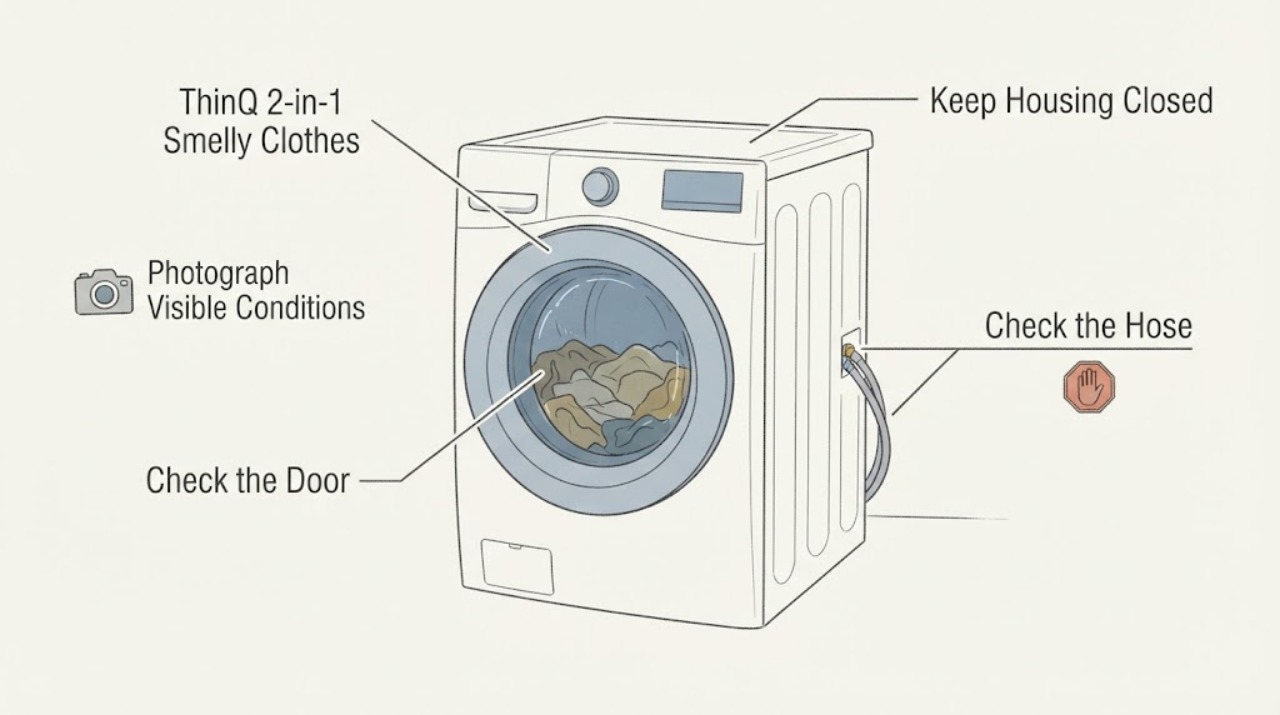
Photograph the complete LG model and serial label, and record whether the appliance is one all-in-one drum or a stacked WashTower. For a front-load unit, check the label around the front panel behind the door; for a WashTower, check inside the washer and dryer doors. Keep the ThinQ app name separate from the model number.
Expected result: A complete model and appliance layout are identified, or only “ThinQ 2-in-1” is available.
Next step: Use the complete model's LG manual for any model-specific operation. Until it is known, limit the work to the external, symptom-level checks below and do not copy a button sequence from another LG combo.
Stop if: Do not open panels, bypass a door lock, move a water-filled appliance, or order a model-specific part from the ThinQ name alone.
Why this matters
Why: LG lists multiple 2-in-1 and single-unit laundry products with different model numbers and controls. The current description is not enough to select a cycle, cleaner location, filter procedure, or exact drain instruction.
-
Check 2
Run the odor split with no laundry in the drum: note whether the smell is strongest only during or after drying, whether the drain hose remains in the apartment drain, and whether the empty drum, door seal, or dispenser also smells. Do not start a cycle if there is smoke, a burning odor, a leak, or damaged electrical equipment.
Expected result: The odor tracks drying with the drain hose connected, or it is present in the empty washer and its damp contact areas, or it is limited to clothing while the empty appliance smells normal.
Next step: For a drying-linked odor, document the drain setup and follow the exact model's installation guidance; for a musty empty drum, continue with ventilation and model-appropriate tub cleaning; for clothing-only odor, review detergent, softener, load storage, and the apartment drain with the landlord or plumber as appropriate.
Stop if: Do not deliberately expose yourself to strong sewer gas, run a drying cycle to reproduce a burning smell, or pour chemicals into the drain or washer to mask the odor.
Why this matters
Why: LG specifically associates a hose left in the drain during drying with possible sewer-gas rise. An odor in the empty drum or residue-bearing areas makes washer moisture or buildup more plausible; an odor limited to clothes does not prove an appliance fault.
-
Check 3
With the appliance empty and off, ventilate the drum and dispenser. Remove laundry promptly after any completed cycle, leave the door open as the installation permits, and clean the accessible dispenser or drawer with lukewarm water and a soft brush if the exact model's design allows removal. Use only the recommended HE detergent amount and do not exceed the dispenser's MAX line.
Expected result: The musty smell or visible residue is concentrated in the gasket, drum, or dispenser, or those areas are clean while only washed clothing smells.
Next step: If residue is found, rinse and dry the accessible area, correct the documented detergent amount, and then use the exact model's tub-clean procedure. If the machine is clean but clothing still smells, keep the washer out of the diagnosis until the load and drain path are checked.
Stop if: Do not scrape or remove a fixed gasket, reach behind the drum, or use an unapproved solvent or mixed cleaning solution.
Why this matters
Why: LG says trapped moisture, detergent residue, and excess detergent or softener can support odor-causing microbes or leave buildup. A clean empty machine shifts attention toward the load, product dosage, storage, or apartment drain rather than proving an internal washer failure.
-
Check 4
After confirming the complete model, empty the drum and run only the documented Tub Clean cycle or the exact manual's equivalent with a dedicated washing-machine tub cleaner used at the package-recommended amount. If the model has no Tub Clean cycle, do not substitute a guessed cycle; find the model manual first.
Expected result: The matching manual identifies a Tub Clean or equivalent, and the odor improves, or the cycle is absent, leaks, produces abnormal foam, or the odor remains.
Next step: Ventilate and dry the appliance after the completed cycle. For an existing musty smell, LG's cleaning guidance allows repeated Tub Clean treatment on its stated schedule; if the odor persists after that model-appropriate path, arrange qualified service. For a leak or abnormal foam, stop the cycle and do not add more cleaner.
Stop if: Never mix chlorine bleach, acidic cleaner, vinegar, detergent, or other chemicals in the drum or dispenser. Use one product only as its label and exact LG manual allow.
Why this matters
Why: LG's general guidance uses an empty drum and a dedicated cleaner, but it warns that excess cleaner or excessive bubbles can cause leaks and that controls vary by model. Improvement supports removable residue or microbial buildup, not a guarantee that hidden contamination or a drain problem is gone.
-
Check 5
If the smell is linked to drying and the drain hose remains in the apartment drain, compare the setup with the complete model's installation instructions without pulling a hose that could spill water. Record whether the smell is also present at the standpipe or drain opening when the washer is not running, and report a suspected building-drain odor to the landlord or a qualified plumber.
Expected result: The odor is confined to the drain path or appears only during drying, or the drain area smells normal while the empty appliance remains musty.
Next step: Follow the exact installation manual and have the landlord or plumber correct a building drain or standpipe problem. If the drain setup is correct but the washer-dryer still smells after the documented cleaning path, arrange qualified LG appliance service.
Stop if: Do not alter a shared apartment drain, remove plumbing traps, or continue drying when sewer gas, smoke, burning odor, or a leak creates an unsafe environment.
Why this matters
Why: The first pattern makes an installation or building-drain source more likely than a tub-cleaning failure; the second keeps appliance residue or inaccessible contamination in the differential. This observation does not identify a plumbing defect by itself.
Use your observations
Decision map
Find the observation that best matches what you see, then follow the next safe action.
-
PATH 01Next step
What you see
The complete model is still unknown, and the appliance is described only as LG ThinQ 2-in-1.
Do this next
Capture the rating label and use only the symptom-level ventilation, odor classification, and safety checks until the matching manual is found.
Why this path and its safety boundary
Why it matters: The product identity is incomplete; model-specific cycle names, cleaner placement, filter access, and installation limits cannot be safely assigned.
-
PATH 02Next step
What you see
The odor is strongest during or after drying while the drain hose is connected to the apartment drain, and the empty drum is not notably musty.
Do this next
Stop using the drying function until the complete model's installation guidance is checked, and ask the landlord or a qualified plumber to assess the drain path if the odor persists.
Why this path and its safety boundary
Why it matters: This pattern is consistent with LG's documented possibility that temperature differences can let sewer gases rise through the drain hose; it does not prove a failed appliance part.
-
PATH 03Next step
What you see
The empty drum, door seal, or dispenser is musty or visibly coated, and the odor improves after the model-appropriate empty-drum Tub Clean procedure.
Do this next
Continue the manual's maintenance schedule, remove laundry promptly, and ventilate the drum and dispenser after use. Do not mix cleaners or exceed the product label amount.
Why this path and its safety boundary
Why it matters: Moisture, detergent residue, or microbial buildup is more likely than a proven electrical or sealed-system fault, although improvement does not rule out inaccessible contamination.
-
PATH 04Next step
What you see
The odor remains after the exact model's documented cleaning path, or a tub-clean cycle leaks, creates abnormal foam, or is followed by a burning smell, smoke, electrical problem, or water leak.
Do this next
Stop the affected cycle and arrange qualified LG appliance service; for a suspected apartment drain or sewer-gas source, notify the landlord or a qualified plumber. Keep the model label, odor timing, drain setup, and cleaning product information for the provider.
Why this path and its safety boundary
Why it matters: The owner-level cleaning branch has not resolved the problem or a safety boundary has been crossed; the smell cannot be assigned to mold or a drain without inspection.
Helpful context
Understand the symptom
Why the apartment and the label matter
“LG ThinQ 2-in-1” does not identify one washer-dryer manual. LG uses ThinQ across products and lists distinct WashCombo model numbers, so photograph the rating label before selecting a cycle, filter, or dispenser location. The label also helps separate an all-in-one WashCombo from a stacked WashTower, which can have different controls and maintenance access. Use only the instructions that match the complete model and market.
Separate a drain odor from a dirty washer
LG's washer-dryer odor guidance calls out a specific apartment-plumbing clue: when the drain hose remains connected during drying, temperature differences may let sewer gases rise through the hose. That pattern is different from a musty odor that is present in an empty drum, door seal, or detergent drawer. A garment-only odor with a clean-smelling empty appliance points more toward the detergent, softener, load, or the building drain path than proof of a failed washer-dryer.
Use a dedicated cleaning path, without mixing chemicals
LG recommends an empty drum for Tub Clean and a washer tub cleaner used according to the product label. Its general guidance says to ventilate the door and dispenser after cleaning, and its odor guidance warns that chlorine bleach or acidic washing-machine cleaners may discolor or corrode the appliance on the Tub Clean cycle. Because the complete model is not known here, do not infer a bleach compartment, amount, cycle name, or alternate button sequence from another LG unit.
When checks do not resolve it
Need a professional?
Arrange qualified LG appliance service when the complete model is known but the odor remains after its documented cleaning path, when a tub-clean cycle leaks or behaves abnormally, or when the smell is accompanied by a component or electrical symptom. Contact the landlord or a qualified plumber when the odor tracks the apartment drain or standpipe.
Safety scope: Do not open panels, reach behind the drum, bypass the door lock, alter shared apartment plumbing, or combine bleach, acidic cleaner, vinegar, detergent, or other chemicals. Stop for smoke, burning odor, sparking, damaged wiring, a repeated breaker trip, a leak, or strong sewer gas.
Have this ready
- Provide the full model and serial information, whether the unit is an all-in-one or WashTower, the exact odor timing, whether the drum and dispenser smell empty, drain-hose position during drying, detergent and cleaner products used, any visible residue or leak, and the result of the model-matched cleaning cycle.
Common questions
FAQ
Is LG ThinQ 2-in-1 a complete model number?
No. LG uses ThinQ as a connected-appliance feature and lists distinct model numbers for its WashCombo and other laundry products. Photograph the rating label and use the matching manual before choosing a cycle, dispenser location, or part.
Why do clothes smell only after the drying portion in a new apartment?
LG says that a drain hose connected to the drain during drying can allow sewer gases to rise through the hose because of temperature differences. Check the timing and drain setup, and involve the landlord or a qualified plumber if the odor follows the apartment drain.
Can I mix bleach, vinegar, and a washing-machine cleaner to remove the smell?
No. Use one dedicated cleaner only as the package and exact LG manual allow. LG warns that chlorine bleach or acidic washing-machine cleaners may discolor or corrode the appliance on the Tub Clean cycle, and mixed chemicals can create a hazardous reaction.
Read the exact guide
Official sources
- LG Washer | Troubleshooting Detergent Left in the DispenserLG · Opened official LG support guidance for external dispenser checks only; LG notes dispenser designs vary by model.
- LG Front Load Washing Machine | Leaks During Tub CleanLG · Opened official LG guidance for the safety boundary around tub-clean products; it does not identify the assigned incomplete model's exact cleaner amount.
- How To Find My LG Model and Serial NumberLG · Opened official LG support guidance to locate the complete model before applying model-specific instructions.
- LG Washer Dryer | Strange Smell After DryingLG · Opened official LG washer-dryer guidance; it applies as general symptom-level guidance and explicitly says images/content may differ by model.
- LG Washing Machine | Troubleshooting Musty OdorsLG · Opened official LG guidance for broad odor classification and safe, model-limited hygiene actions; it is not a substitute for the incomplete model's manual.
- LG SIGNATURE Ventless Washer/Dryer Combo - WM9998HBALG · Opened official LG product page to show that the assigned label thinkq 2 in 1 corresponds only to a ThinQ 2-in-1 product description, while an LG all-in-one is identified by a complete model number such as WM9998HBA; it does not establish that the assigned description maps to that model.
- LG Washer | How to Clean the Tub of Your LG Washing MachineLG · Opened official LG general maintenance guidance; cycle name and controls must still be matched to the complete model.
Community feedback
Share a repair observation
Share a plain-text repair observation. Accepted observations are published automatically; this page may take a moment to update.