
On this page
Start here
Quick answer
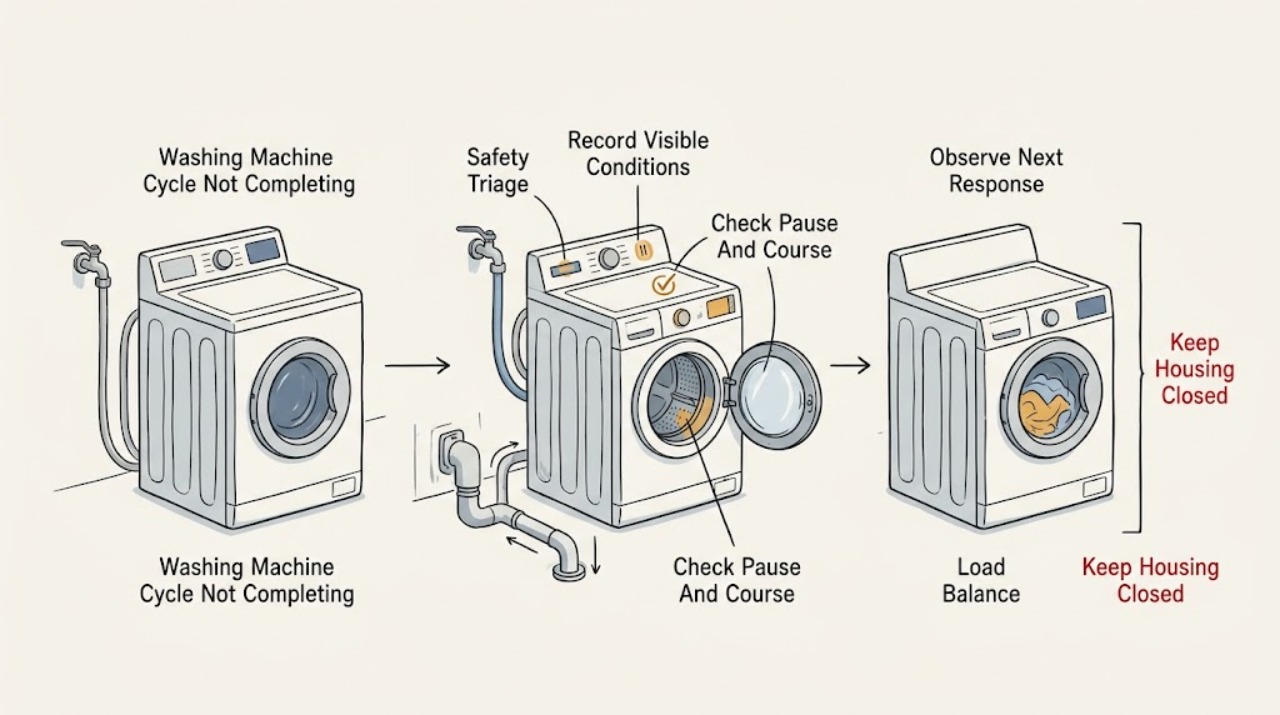
When an LG washer does not complete a cycle, first write down the exact stage, elapsed time, water level, display code, and whether the machine is paused, powered off, filling, draining, or repeatedly redistributing the load. A pause can stop operation, a soak or wash-only selection can intentionally leave water until a later cycle, and an unbalanced load can extend or stop spin. A pinched or incorrectly routed drain hose, clogged filter on applicable models, excess suds, or a blocked household drain can also prevent completion. Check the door or lid without forcing it, confirm water supply and hose routing, and use the exact model's documented drain or spin procedure. LG describes one model-directed reset after safe isolation, but a reset is not a repair. Stop for water near electricity, a leak, hot or damaged plug, smoke, burning smell, sparks, severe vibration, or repeated breaker trips, and do not restart until qualified service assesses the washer.
Before you begin
Safety first
- This article supports ordinary-access observations and exact-model manual procedures only. Do not operate after an electrical, fire, flood, heat, or severe mechanical warning; do not handle wet or hot electrical parts, force a lock or filter, open the cabinet, bypass safety devices, or test live circuits.
Work through in order
Diagnostic checks
Use only checks that match the exact appliance or system and its official guide.
-
Check 1
Stop the washer normally if it responds and keep hands and feet dry; from a safe position identify smoke, flame, burning or melting smell, sparks, a hot or discolored plug/outlet, damaged cord, water near electricity, severe movement, or a tripped breaker.
Expected result: Classify the event as an electrical/fire warning, water near power, severe mechanical movement, or a cycle symptom without any immediate safety warning.
Next step: If safe without touching wet or damaged equipment, isolate power at the breaker or unplug by the intact plug while standing clear; follow local emergency procedures for smoke or fire and obtain qualified help. Continue only with dry, non-invasive observations when no warning exists.
Stop if: Do not touch wet power parts, unplug through standing water, pull a damaged cord, repeatedly reset a breaker, or restart after smoke, sparks, burning odor, melting, a hot connection, severe vibration, or repeated trips.
Why this matters
Why: A safety warning takes priority over completing the cycle. It can indicate an electrical, mechanical, or flood hazard and is not an ordinary pause or error-code branch.
-
Check 2
Record the selected cycle and options, the remaining-time display, elapsed time, water level, door/lid state, drum movement, pump sound, and any code or blinking indicator before changing settings.
Expected result: Note whether the washer is paused, powered off, filling, agitating, rinsing, redistributing, draining, spinning, waiting for a locked door, or completely idle; capture the exact code without guessing its meaning.
Next step: Use the full model number to open the corresponding LG manual or support page and follow only the documented procedure for the recorded stage and code. Do not add a generic code meaning from another model.
Stop if: Do not open panels, cancel a hot or full tub, force a locked door/lid, or keep cycling through modes when the cause is accompanied by an odor, leak, heat, smoke, sparks, or a breaker event.
Why this matters
Why: The stage narrows the path: fill symptoms point to water supply or door/lid conditions, a drain-stage pause points to hose/filter/pump/plumbing or suds, repeated spin attempts point to balance, and a code requires the exact LG model's code guidance.
-
Check 3
Check whether Pause/Start is active and whether the selected LG course is Soak, Wash-only, Rinse-only, Spin-only, or another option that intentionally changes when draining or completion occurs; use the exact manual's normal resume or finish control.
Expected result: Record a paused cycle, a documented soak or wash-only course, an ordinary course, or a cycle that remains stuck after the correct control is used.
Next step: Resume or select the documented drain/spin function only once when the floor and electrical area are dry and there is no safety warning. Do not add detergent or restart the entire wash just to see whether it advances.
Stop if: Do not force the door/lid, bypass a lock, or resume a full or hot tub when there is a leak, water near power, severe vibration, smoke, odor, sparks, or a tripping breaker.
Why this matters
Why: A pause or course selection can make the washer appear incomplete without a hardware failure. If the correct course remains stopped, an error appears, or water does not drain when the documented finish/drain action is used, continue to the water and drain branches.
-
Check 4
If the washer is stuck during fill or never reaches the next stage, inspect from a dry safe position whether both water supply valves are open, inlet hoses are kinked, and the door or lid is fully closed; do not remove an inlet valve.
Expected result: Record normal water flow, no flow from one side, a kinked hose, an open-door/lid indication, an inlet error, or water leaking at a hose connection.
Next step: Correct only an obvious external valve or hose position with power isolated and the area dry, following the exact manual; service is needed for an inlet fault, persistent code, leak, or inaccessible connection.
Stop if: Do not loosen a pressurized hose, reach behind a wet washer, bridge the door/lid switch, or run with a leak toward the outlet or cord.
Why this matters
Why: Insufficient water or a door/lid condition can hold a cycle in fill. A leak or wet electrical area changes the problem to a safety and flood response rather than a fill adjustment.
-
Check 5
With power isolated and the water area dry, inspect the visible drain hose for a kink, crushing, submersion, freezing, a low or excessively high route, or a loose connection; observe whether the standpipe or laundry tub backs up when water is discharged.
Expected result: Classify the path as clear and correctly routed, restricted or crushed, submerged or misrouted, leaking, backing up at the household drain, or hidden behind the appliance.
Next step: Correct only an obvious external hose position or kink according to the exact model's instructions; stop using the washer and obtain plumbing or appliance service for backup, concealed restrictions, recurring return flow, or a leak.
Stop if: Do not pull a full washer, disconnect a hot or pressurized hose, pour chemical drain cleaner into the washer path, seal the drain opening, or operate while water can reach electricity.
Why this matters
Why: LG says a restricted, frozen, submerged, or incorrectly positioned hose can prevent draining and cause a top-load washer to stop. Backup at the home drain indicates a plumbing restriction or return path rather than necessarily a failed washer pump.
-
Check 6
After the washer stops safely and the door/lid can be opened normally, inspect whether the load is tightly packed, a single heavy or bulky item is on one side, or the washer is rocking; redistribute a safe load only as the manual permits.
Expected result: Record a balanced ordinary load, a large blanket/rug or single item, clothing bunched on one side, severe shaking, or a washer that is not level or is contacting nearby objects.
Next step: Pause only when the manual allows, redistribute or reduce the load, and use an appropriate spin setting once if there is no safety warning. Leveling or floor problems that remain require the manual's installation guidance or service.
Stop if: Do not lift a full washer, reach into a moving drum, continue after violent movement, bypass the lid/door lock, or use a smaller load to conceal recurring mechanical heat or noise.
Why this matters
Why: LG explains that imbalance can make the washer repeatedly redistribute or reduce/stop spin to prevent damage, extending the cycle and leaving clothes wetter. Severe vibration or a machine that walks is not safe to keep testing.
-
Check 7
Review the detergent type and measured amount, the load size, and whether visible excess suds remain; do not add more detergent or water while the cycle is incomplete.
Expected result: Record the specified HE detergent and amount, excess or non-HE detergent, visible foam, a normal detergent amount, or an unexplained slow cycle without suds.
Next step: Use only the exact model's documented no-detergent or suds-removal procedure when the washer is dry and otherwise safe; reduce the detergent for future loads. If water remains or the problem repeats, arrange service.
Stop if: Do not add detergent, pour water into the machine, run repeated cycles to clear foam, or dismiss an electrical, flood, heat, smoke, odor, or vibration warning as a suds issue.
Why this matters
Why: LG notes that excessive suds can prevent proper rinsing and spin and can slow or prevent draining. Suds do not explain smoke, electrical heat, a leak near power, severe vibration, or a pump that is silent or grinding.
-
Check 8
Only if the exact LG model documents an accessible drain-pump filter or residual-water hose, switch off and unplug it, cool any recently heated water, prepare a shallow container and cloth, and follow that model's draining and filter-cleaning procedure.
Expected result: Record residual water draining normally, lint or a small object in the filter, a clean filter, a filter that will not turn, water leaking after reseating, or no documented filter access.
Next step: Remove only debris the exact manual identifies as user-accessible, fully reseat the filter and stopper, and verify the area is dry. If draining remains poor or any part cannot be safely accessed, leave the washer isolated and request service.
Stop if: Do not open a filter with hot or pressurized water, use tools to force it, reach into a wet pump, run with a loose filter/stopper, or apply a front-load procedure to another design.
Why this matters
Why: A blocked filter can limit pump flow on applicable models. A seized filter, concealed object, leak, or model without user access requires service; forcing a cap or opening a cabinet can create damage and a flood.
-
Check 9
If the exact manual permits one safe Drain/Spin or Spin Only observation and there is no leak, hot water, electrical warning, or severe vibration, observe the drain outlet and listen from outside the closed washer.
Expected result: Record normal water flow and spin, weak/intermittent flow, a hum without flow, grinding or clicking, silence at the drain command, immediate return to balance attempts, or a code.
Next step: Stop the observation at the first abnormal noise, odor, vibration, leak, electrical event, or failure to drain and provide the result to service. Do not restart the entire wash to reproduce it.
Stop if: Do not run repeated Drain/Spin tests, probe the pump, reach into the tub, remove a panel while powered, or continue after smoke, burning smell, sparks, hot connection, severe movement, or a breaker trip.
Why this matters
Why: Normal flow shifts attention to course selection, load balance, or suds. Weak flow or a hum without movement points to a restriction or pump issue; grinding, silence, recurring imbalance, or a code requires model-specific service rather than repeated tests.
-
Check 10
Only when there has been no leak, hot water hazard, smoke, odor, spark, damaged connection, severe vibration, or breaker event, use the exact LG support/manual's single reset procedure after power isolation; then record whether the same stage, code, or symptom returns.
Expected result: Record a normal completion, immediate repeat at the same stage, a new or recurring code, a drain/spin failure, or a breaker trip or safety warning.
Next step: If the symptom returns, keep the washer out of service and provide the model, cycle, stage, time, code, water level, hose/filter checks, load, suds, and reset result to LG or a qualified technician.
Stop if: Do not repeat resets, bypass a safety, test live wiring, open the cabinet, or restart after smoke, burning smell, arcing, water near power, hot connection, severe vibration, or repeated breaker trips.
Why this matters
Why: A successful reset only shows that the control state changed; it does not prove the washer is repaired. A recurring stage or code points to water supply, drain, balance, lock, sensor, pump, motor, or control diagnosis.
Use your observations
Decision map
Find the observation that best matches what you see, then follow the next safe action.
-
PATH 01Safety boundary
What you see
The washer is paused, or the selected course is Soak, Wash-only, Rinse-only, or another documented course that changes when draining or completion occurs, with no safety warning.
Do this next
Resume or use the exact model's documented Drain/Spin or completion control once, then reassess the stage; stop if the washer remains stuck or develops a code or safety symptom.
Why this path and its safety boundary
Why it matters: The control state or selected course may explain why the cycle has not reached End.
Safety stop: Do not force the door/lid, add detergent or water, or resume with water near electricity, a leak, hot water, severe vibration, smoke, odor, sparks, or a breaker event.
-
PATH 02Safety boundary
What you see
The washer stops during fill, shows an inlet/door-related indication, or does not advance after the door/lid is correctly closed.
Do this next
Check accessible valves, hose kinks, and the door/lid position according to the exact manual; service a persistent code or inaccessible inlet/lock problem.
Why this path and its safety boundary
Why it matters: Water supply, hose restriction, door/lid sensing, or a model-specific code may be holding the cycle.
Safety stop: Do not bridge the lock, loosen wet or pressurized hoses, or operate after a leak, smoke, odor, hot connection, sparks, or water near power.
-
PATH 03Safety boundary
What you see
Water remains after the drain stage, the pump hums without visible flow, the hose is restricted, the home drain backs up, or the model's applicable filter is clogged.
Do this next
Isolate power, cool hot water, correct only a documented external hose issue, or clean an accessible filter exactly as the manual directs. Arrange service for a full tub, concealed obstruction, pump fault, backflow, or inaccessible filter.
Why this path and its safety boundary
Why it matters: The drain path, pump filter, pump, or household plumbing is preventing completion; the machine may also remain locked for safety.
Safety stop: Do not open a wet or hot filter, use chemical drain cleaner, force the door, probe the pump, or run repeated drain tests.
-
PATH 04Safety boundary
What you see
The washer repeatedly tumbles or redistributes, shakes, displays an imbalance indication, or stops during spin with a large, small, single, or bulky load.
Do this next
Pause only when safe, redistribute or reduce the load, check ordinary-access leveling, and use the appropriate spin setting once; arrange service if severe movement or recurrence continues with a balanced load.
Why this path and its safety boundary
Why it matters: Load distribution, floor level, spin selection, or a restricted drain can extend or prevent completion to limit vibration and damage.
Safety stop: Do not keep running a violently shaking washer, lift it while full, bypass the lock, or use load changes to mask mechanical noise, heat, odor, smoke, sparks, or electrical trips.
-
PATH 05Safety boundary
What you see
Excess foam is present or regular/over-measured detergent was used and draining or spinning is slow.
Do this next
Use the exact model's safe no-detergent or suds-removal direction once and correct detergent measurement on future loads; service a full tub or recurring failure.
Why this path and its safety boundary
Why it matters: Suds can slow or stop rinsing, draining, and spinning and can make the cycle appear incomplete.
Safety stop: Do not add more detergent or water, run repeated cycles, or ignore a leak, hot electrical connection, burning smell, smoke, sparks, severe vibration, or breaker trip.
-
PATH 06Safety boundary
What you see
The washer powers off, shows a code, or the cycle returns to the same stage after one documented safe reset.
Do this next
Record the exact code, model, stage, and conditions and request LG or qualified service when the code or power-off repeats.
Why this path and its safety boundary
Why it matters: The code and exact model may identify a supply, drain, lock, balance, sensor, motor, or control path; a reset alone does not establish a repair.
Safety stop: Do not guess across models, repeatedly reset, open the console, test live wiring, or restart after smoke, odor, sparks, hot connection, water near power, severe vibration, or a breaker trip.
Helpful context
Understand the symptom
A cycle can be waiting, protecting the washer, or actually stalled
A washer that appears stuck during fill, wash, rinse, drain, or spin needs a stage-specific check. LG notes that pausing can halt operation and that the washer may turn off after remaining paused, while load imbalance can make the machine redistribute laundry and extend the spin. A wash-only or soak course can also stop before draining by design. Record the stage and display before treating the symptom as a failed control.
Drain and spin problems often share the same symptoms
Wet clothes, a locked door, a long remaining time, and a cycle that never reaches End can all follow incomplete draining. LG's support guidance separates hose height and kinks, pump-filter condition on applicable models, excessive suds, large or single-item loads, and household drain behavior. The model determines whether a service-panel filter is accessible; do not apply a front-load procedure to a top-load machine or open a panel that the manual does not identify.
Reset only after the cause is safe to investigate
A documented power reset can clear a temporary control state, but it cannot correct a blocked drain, unbalanced load, damaged lock, failing pump, or unsafe electrical connection. If the washer has water near power, a damaged cord, a hot connection, smoke, a burning smell, sparks, severe vibration, or a breaker trip, isolate it only from a dry safe position and stop. Repeated resets can erase useful evidence and re-energize a fault.
Safety boundary
Stop conditions
- Stop for water near the cord, plug, outlet, control, or wet floor; isolate power only from a dry safe position and do not touch wet electrical parts.
- Stop for smoke, flame, burning or melting odor, visible sparks or arcing, a hot/discolored plug or outlet, damaged cord, severe vibration, or repeated breaker trips.
- Do not force or bypass the door/lid lock, reach into a moving or wet mechanism, open the cabinet or console, or test live wiring.
- Do not open a hot or pressurized filter/hose, use chemical drain cleaner, add water or detergent manually, or run with a loose filter or stopper.
- Do not repeat Drain/Spin cycles or power resets after a full tub, pump hum without flow, grinding, persistent code, or any electrical, flood, heat, odor, smoke, or mechanical warning.
Only after diagnosis
Potential parts
- drain pump or drain-pump filter assembly
Consider this category only when the exact model documents the component and diagnosis confirms a blocked, damaged, or failed pump/filter after safe external checks.
Confirm the full model and exact assembly; do not infer fit or force access to a wet pump from an incomplete cycle alone. - washer drain hose assembly
Consider this category only if the exact model's hose is cracked, crushed, leaking, frozen, or cannot be restored to its documented routing.
Confirm the exact model, hose ends, routing, and household drain requirements before replacement; isolate water and power first. - door or lid lock assembly
Consider this category only after model-specific diagnosis links a persistent lock or cycle interruption to a failed lock once water and drain conditions are safe.
Confirm the exact model and technician diagnosis; never bypass or defeat the lock as a way to complete a cycle.
When checks do not resolve it
Need a professional?
Arrange LG or qualified appliance/plumbing/electrical service when the cycle repeatedly stops at the same stage, a code returns, the drain hose and household drain are clear but water remains, the applicable filter or pump cannot be safely accessed, a door/lid stays locked with water, a balanced load still cannot spin, or there is any leak, hot connection, odor, smoke, spark, severe vibration, or breaker trip.
Safety scope: This article supports ordinary-access observations and exact-model manual procedures only. Do not operate after an electrical, fire, flood, heat, or severe mechanical warning; do not handle wet or hot electrical parts, force a lock or filter, open the cabinet, bypass safety devices, or test live circuits.
Common questions
FAQ
Why does my LG washing machine stop before the cycle finishes?
Write down the stage first. A pause or course option may intentionally stop, while a fill issue, drain restriction, excess suds, unbalanced load, locked door/lid, code, or power interruption can stop the cycle. Use the exact model manual and do not guess from a code belonging to another model.
Can an LG washer stop during spin because of an unbalanced load?
Yes. LG says clothing can shift to one side and the washer may redistribute or stop spinning to prevent damage. Pause only when safe, redistribute a large or single item, and check ordinary-access leveling; severe shaking, recurring imbalance, or a full tub requires service.
Can a soak or wash-only cycle leave water in an LG washer?
Some LG courses intentionally stop after a particular operation without draining. Confirm the selected course in the exact manual and use its documented Spin, Rinse + Spin, or Drain function once when safe. Do not force the door/lid or run it with water near electricity.
What should I check if an LG washer is stuck on draining?
Check the accessible drain hose for kinks, crushing, freezing, submersion, or incorrect routing and observe the household drain for backup. If the model documents a pump filter, isolate power, cool the water, and follow that filter procedure. A full tub, hum without flow, leak, or inaccessible obstruction needs service.
Can too much detergent keep an LG washer from completing?
Yes. Excessive suds can slow or prevent draining and spinning. Use the detergent type and amount specified for the exact model and follow its no-detergent or suds-removal instruction once if safe. Do not use suds to explain away smoke, electrical heat, a leak, severe vibration, or a breaker trip.
Can I force open an LG washer door when the cycle is stuck?
No. A door can remain locked while water is present or the drum is not safe to open. Use only the exact model's safe drain and unlock procedure; never pry or bypass the lock. Arrange service if water remains or the lock does not release after a documented drain.
Should I reset an LG washer that stops mid-cycle?
Only when there is no leak, hot water hazard, water near power, smoke, odor, sparks, damaged connection, severe vibration, or breaker trip. LG documents a single reset sequence for some mid-cycle power-off symptoms. If the same stage, code, or safety symptom returns, stop use and request diagnosis rather than repeating resets.
Read the exact guide
Official sources
- LG Washing Machine - Washer Powered off Mid-CycleLG USA Support · LG USA support article covering washers and washer-dryer combinations; controls and exact reset steps vary by model.
- Appliance and Electrical Fire SafetyU.S. Fire Administration · Government fire-safety guidance for major appliances including washers; it does not diagnose an LG washer.
- [LG washing machine washing] The tub does not spin after water is supplied.LG USA Support · LG support guidance for washer course selection; exact controls and options vary by model.
- LG Washer - Troubleshooting Washer Does Not Drain or Spin (Clothes Too Wet)LG USA Support · LG USA support guidance; images and procedures may differ by model, so the exact manual controls access and settings.
- [LG Front Load Washer] Spinning takes too longLG USA Support · LG support article for front-load washers; exact model filter access and cycle controls vary.
- LG top load washing machine drain - Water is not drained during washing and the washing machine stops.LG USA Support · LG support article for top-load washers; guidance and images may differ by model.
Community feedback
Share a repair observation
Share a plain-text repair observation. Accepted observations are published automatically; this page may take a moment to update.