
On this page
Start here
Quick answer
Do not pull, pry, or bypass a locked LG washer door. The interlock is expected while the drum is moving, while water remains, after a power interruption, or while a hot wash is cooling. From a dry, safe position, pause or cancel the cycle as the exact model directs, wait for the drum to stop and cool, and check whether water remains. If water is present, use only the model-specific drain or spin-only procedure. If CL or another code is displayed, record it and use the exact model manual rather than guessing. A door that stays locked after a safe drain and cool-down, a returning code, a leak, damaged glass or gasket, smoke, burning smell, sparks, or repeated power trips requires the washer to remain out of service and qualified repair.
Before you begin
Safety first
- Safe user checks are limited to waiting, reading the display, using the exact model's normal pause or drain controls, and inspecting loose visible obstructions. Interlock, pump, wiring, control, emergency-release, and panel work require the exact manual and qualified service.
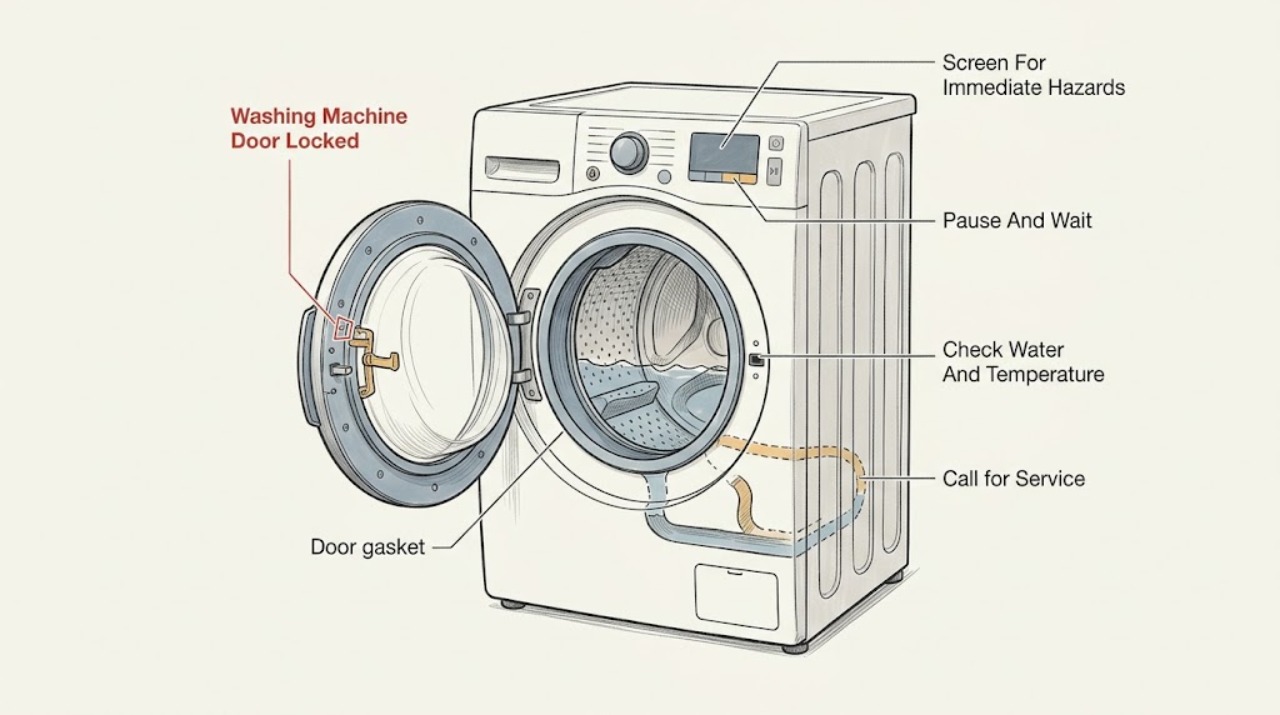
Work through in order
Diagnostic checks
Use only checks that match the exact appliance or system and its official guide.
-
Check 1
From a dry position, stop handling the door and check whether the drum is moving, water is on the floor or near the outlet, the washer or cord is hot or damaged, or there is smoke, a spark, or a burning smell.
Expected result: Record whether any water is near electrical parts, whether the drum is still moving, whether the glass or gasket is broken, and whether there is smoke, arcing, a hot plug, or a repeated protection trip.
Next step: Keep the washer out of service. If power can be isolated without touching wet or damaged parts, do so; otherwise move away and arrange qualified appliance or electrical help. Use emergency help for fire or immediate danger.
Stop if: Do not touch a wet plug or outlet, reach through pooled water, move the washer, open the door, or retry a cycle while an electrical, flooding, glass, smoke, or burning hazard is present.
Why this matters
Why: Movement, hot water, flooding, broken glass, smoke, burning odor, arcing, or electrical damage is a safety boundary rather than a routine locked-door condition.
-
Check 2
If the area is dry and there is no hazard, press Pause or the model's documented Cancel control once and wait without pulling the door until the drum stops and the lock indicator clears.
Expected result: Note whether the control responds, the drum stops, a lock click is heard, the washer begins draining, or the display remains in the same state.
Next step: If the lock releases, open the door normally. If it does not, continue by checking water and the displayed indication; do not repeat the controls indefinitely.
Stop if: Do not pull, pry, kick, wedge, or bypass the door, and do not put a hand inside while the drum moves or the lock remains engaged.
Why this matters
Why: A running or recently paused cycle can keep the interlock engaged until movement and the safe unlock sequence finish. No response after the documented control action points toward water level, control lock, power, latch, or control trouble.
-
Check 3
Look through the door glass and note whether water remains; also note whether the last cycle used hot water or the glass and drum still feel warm, without touching a hot surface or opening the door.
Expected result: Classify the drum as empty and cool, empty but hot, partly or fully filled, or unknown because the display or glass cannot be read.
Next step: Wait for a hot drum to cool. If water remains and the machine is safe to operate, use the exact model's drain-only or spin-only procedure; if water will not drain, arrange service.
Stop if: Do not force the door, drain by disconnecting hoses, or access a pump filter with hot water, an energized washer, or water near electrical parts.
Why this matters
Why: Water in the tub keeps the door locked, and a hot drum can delay a safe release. An empty, cool drum after a completed cycle shifts attention toward the control-lock, latch, sensor, or control path.
-
Check 4
Only when the washer is dry, stable, free of electrical warnings, and the manual permits it, select the exact model's Drain, Spin Only, or equivalent cycle to remove residual water; follow the manual for any pump-filter access rather than improvising.
Expected result: Record whether water drains completely, the drain pump sounds normal, an OE or related code appears, the hose is visibly kinked, or the door unlocks after the drain sequence.
Next step: If the drain fails, stop and arrange repair after recording the code and hose condition. If draining succeeds but the door stays locked, continue to the control-lock and visible latch checks.
Stop if: Do not run another wash load, open the pump area with residual hot water, reach into the pump, or remove panels or hoses as a test.
Why this matters
Why: A completed drain followed by unlock supports water level as the lock condition. No drain, an OE code, or a kinked or frozen hose points to a drain-path fault; a persistent lock after an empty drum needs service assessment.
-
Check 5
Read the display exactly, including CL, dL, OE, PF, beeps, and the stage at which the lock occurred; if CL or a lock icon is present, use only the button combination printed in the exact LG manual and hold it once for the documented interval.
Expected result: Record the complete code, model identifier, whether the controls respond after the one documented Child Lock action, and whether the same indication returns.
Next step: If the lock clears, confirm the door closes normally before a later cycle. If the code remains or returns, keep the washer out of service and provide the exact code and model to qualified repair.
Stop if: Do not enter a service mode, jumper the interlock, repeatedly reset to suppress a code, or remove the console or wiring.
Why this matters
Why: CL can be a control-lock state and model instructions differ. A door or drain code may reflect a closure or water condition, while PF can follow a power interruption; a returning or unexplained code is evidence for service, not for bypassing the lock.
-
Check 6
After the drum is empty, cool, and stationary, inspect the visible door glass, strike, gasket, hinge area, and latch opening for a loose garment, debris, a fold, crack, tear, or obvious misalignment without inserting a tool.
Expected result: Classify the area as clear and undamaged, blocked by a loose visible item, or visibly damaged or unable to close normally.
Next step: Remove only a loose visible obstruction by hand, close the door gently, and follow the manual's single retry. Arrange repair for any damage, misalignment, or persistent lock.
Stop if: Do not force the hinge, pull the gasket from its channel, insert tools into the lock, bypass the interlock, or operate the washer with cracked glass or a damaged seal.
Why this matters
Why: A loose obstruction or gasket fold can prevent normal closure and latch feedback. Cracked glass, a torn seal, bent strike, loose hinge, or damaged lock can create injury or leak risk and cannot be corrected safely by pressing harder.
-
Check 7
Only after water is absent, the drum is cool, the machine is dry, and no hazard is present, perform the exact model's single power reset as described by LG; then document the result instead of repeating the reset.
Expected result: Record whether the display returns normally, the lock releases, an error returns immediately, or the washer remains unresponsive or locked.
Next step: Keep the washer out of service and arrange qualified appliance repair. Provide the model, exact code, cycle stage, water and temperature observations, drain result, visible damage, and reset result.
Stop if: Do not repeatedly cycle power, run a test load, open panels, test live wiring, or replace a lock or control part from the symptom alone.
Why this matters
Why: A one-time recovery after a brief interruption can clear a temporary control state. A persistent lock or recurring code after the safe reset indicates a drain, latch, interlock, sensor, or control fault that needs diagnosis.
Use your observations
Decision map
Find the observation that best matches what you see, then follow the next safe action.
-
PATH 01Safety boundary
What you see
Water is near power, the drum is moving with a damaged door, or there is smoke, a spark, burning odor, hot plug, broken glass, or repeated power interruption.
Do this next
Keep away, isolate power only when safely reachable, and use qualified appliance or electrical help; use emergency help for fire or immediate danger.
Why this path and its safety boundary
Why it matters: The immediate risk is greater than the locked-door symptom.
Safety stop: Do not touch wet electrical parts, open the door, move the washer, or retry a cycle.
-
PATH 02Safety boundary
What you see
The cycle is active or recently paused, the drum is moving or stopping, and no water or electrical hazard is present.
Do this next
Use Pause or the documented Cancel control once and wait for the drum to stop and the lock to release.
Why this path and its safety boundary
Why it matters: The interlock is likely performing its normal injury-prevention function.
Safety stop: Do not pull or bypass the door while movement continues.
-
PATH 03Safety boundary
What you see
Water is visible in the drum, the washer stopped while filling or draining, or OE is displayed.
Do this next
Keep the door closed and use only the exact model's drain or spin-only procedure; arrange service if water does not drain.
Why this path and its safety boundary
Why it matters: The lock can remain engaged until the tub is safely empty; LG associates OE with a no-drain condition.
Safety stop: Do not force the door or open a filter or hose with hot water, unsafe power, or flood risk.
-
PATH 04Safety boundary
What you see
The drum is empty or nearly empty but remains hot after a high-temperature cycle.
Do this next
Wait for the drum to cool, then check the lock without forcing it.
Why this path and its safety boundary
Why it matters: LG indicates that a hot drum can delay a safe unlock.
Safety stop: Do not handle hot glass, open the door against resistance, or add a new cycle.
-
PATH 05Safety boundary
What you see
CL or a lock icon is displayed, or the issue followed a brief power interruption and the washer is otherwise dry and safe.
Do this next
Use the exact manual's Child Lock or recovery procedure once, then record any returning indication.
Why this path and its safety boundary
Why it matters: A control-lock state or power event may explain unresponsive controls or a delayed release; the exact model determines the clearing sequence.
Safety stop: Do not guess a button combination, enter diagnostic mode, or repeatedly reset the machine.
-
PATH 06Safety boundary
What you see
The drum is empty and cool, the safe drain and control steps are complete, but the door remains locked or a code returns; or the latch, hinge, gasket, strike, or glass is damaged.
Do this next
Keep the washer out of service and arrange qualified appliance repair with the model, code, cycle stage, and observations.
Why this path and its safety boundary
Why it matters: A persistent interlock, drain, sensor, alignment, or control fault needs model-specific diagnosis.
Safety stop: Do not pry, bypass, remove panels, test live wiring, or choose a replacement part from the locked-door symptom alone.
Helpful context
Understand the symptom
A locked LG door can be a normal safety state
The door interlock prevents access to a moving drum and can remain engaged when the tub contains water. A pause does not guarantee an instant release: the control may need to stop movement and complete a safe sequence. A recent power interruption can also leave the door locked until the machine is powered and ready again. Do not use a wire, tool, emergency-release shortcut, or force to defeat the interlock.
Water and heat determine the next safe check
Look through the glass or use the normal display to decide whether water is still in the drum. If water is present, keep the door closed and follow the exact model's drain-only or spin-only instructions. LG's drain guidance warns that residual water may be hot, so pump-filter access is not a casual first step. After a hot cycle, wait until the drum is cool before expecting the lock to release.
CL and other codes are model-specific clues
CL generally identifies Child Lock or a control-lock state on LG washers, but the button combination varies by model. A displayed dL, OE, PF, or other code must be recorded exactly and checked against the correct manual; code meanings and procedures are not interchangeable across washer designs. If a code returns after its one documented user sequence, stop troubleshooting and arrange service.
Inspect only what is visible and safe
When the washer is cool, stationary, dry around the controls, and the door is accessible, look for a garment caught in the gasket, debris at the strike, a torn seal, cracked glass, or obvious misalignment. Remove only a loose visible obstruction without tools. A damaged latch, hinge, lock, gasket, cord, or cabinet is a service finding; do not remove panels or test the interlock with the machine energized.
Safety boundary
Stop conditions
- Stop immediately for smoke, burning smell, sparks, arcing, a hot plug, damaged cord, repeated power trips, or a damaged control area.
- Stop for water near an outlet or other electrical part; do not touch wet power connections or pooled water and do not move the washer.
- Do not open a locked door while the drum moves, water remains, or glass, hinge, gasket, or latch damage could cause injury or a flood.
- Do not pry, drill, wire, jumper, or otherwise bypass the door interlock; do not remove panels or test live wiring.
Only after diagnosis
Potential parts
- door lock or interlock assembly
Consider only after service confirms the drum is empty, the door is aligned, and the interlock does not release or engage as commanded.
Confirm the exact LG model and revision before any part decision; do not bypass the interlock. - drain pump or pump-filter assembly
Consider only when water remains or a model-specific drain code persists after safe hose and user-access checks.
Pump access can expose hot water and electrical hazards; model fit and safe installation require qualified diagnosis. - door gasket, strike, hinge, or latch hardware
Consider only when visible inspection or service confirms a damaged or misaligned door-sealing or latching component.
Do not force the door or pull the gasket from its channel; confirm model-specific fit and installation requirements. - water-level sensor or control assembly
Consider only after service rules out a normal hot, water-filled, Child Lock, drain, and door-obstruction condition and confirms a sensing or control fault.
No control or sensor should be selected from a locked-door symptom alone; do not test energized wiring.
When checks do not resolve it
Need a professional?
Arrange qualified repair for a persistent locked door, a returning door or drain indication, unsafe residual water, visible door or seal damage, or any electrical warning. Keep the washer out of service until assessed.
Safety scope: Safe user checks are limited to waiting, reading the display, using the exact model's normal pause or drain controls, and inspecting loose visible obstructions. Interlock, pump, wiring, control, emergency-release, and panel work require the exact manual and qualified service.
Have this ready
- Provide the exact LG model, displayed code and icon, cycle and temperature setting, whether water was visible, drain result, time since any power interruption, door and gasket observations, and the result of the one documented reset.
Common questions
FAQ
Why is my LG washing machine door still locked after the cycle?
The washer may still be stopping, cooling, draining, or holding the interlock after a power interruption. Check for water, wait for the drum to cool, and use the exact model's pause or drain instructions. Do not force the door.
Can I force open a locked LG washer door?
No. A locked door can indicate movement, hot water, residual water, or a fault. Pulling or bypassing it can cause injury, broken glass, or flooding. Use only the model-specific safe procedure and arrange service if it does not release.
What should I do if water is inside my LG washer?
Keep the door closed. If the machine and surrounding power are dry and safe, follow the exact model's Drain or Spin Only procedure. Stop for hot water, a leak, unsafe power, or a drain that will not complete.
What does CL mean on an LG washer?
CL commonly indicates Child Lock or control lock. The clearing buttons vary by model, so use the lock-marked combination in the exact manual once. Do not enter a service mode or bypass the interlock.
When should a locked LG washer be serviced?
Arrange repair when the door stays locked after a safe drain and cool-down, a code returns, the latch or gasket is damaged, water will not drain, or the washer has smoke, burning odor, sparks, a hot plug, or repeated power trips.
Read the exact guide
Official sources
- [LG Front Load Washing Machine] [Signature] Door Won’t OpenLG USA Support · LG's general front-load guidance; screen labels and steps can differ by model.
- LG Washing Machine - Water Not Draining (OE Error)LG USA Support · LG washer drain guidance; filter and hose access differ by model.
- LG Front Load Washing Machine - How to Enable or Disable CL (Child Lock)LG USA Support · LG front-load support article; the button combination varies by model and the exact manual controls.
- LG Washer - Recovering From a Locked WasherLG USA Support · LG support guidance; exact controls and timing vary by washer model.
- LG Top Load Washer - Error Code ListLG USA Support · Use only as evidence that codes and procedures vary by product model; the exact LG washer manual takes precedence.
Community feedback
Share a repair observation
Share a plain-text repair observation. Accepted observations are published automatically; this page may take a moment to update.