
On this page
Start here
Quick answer
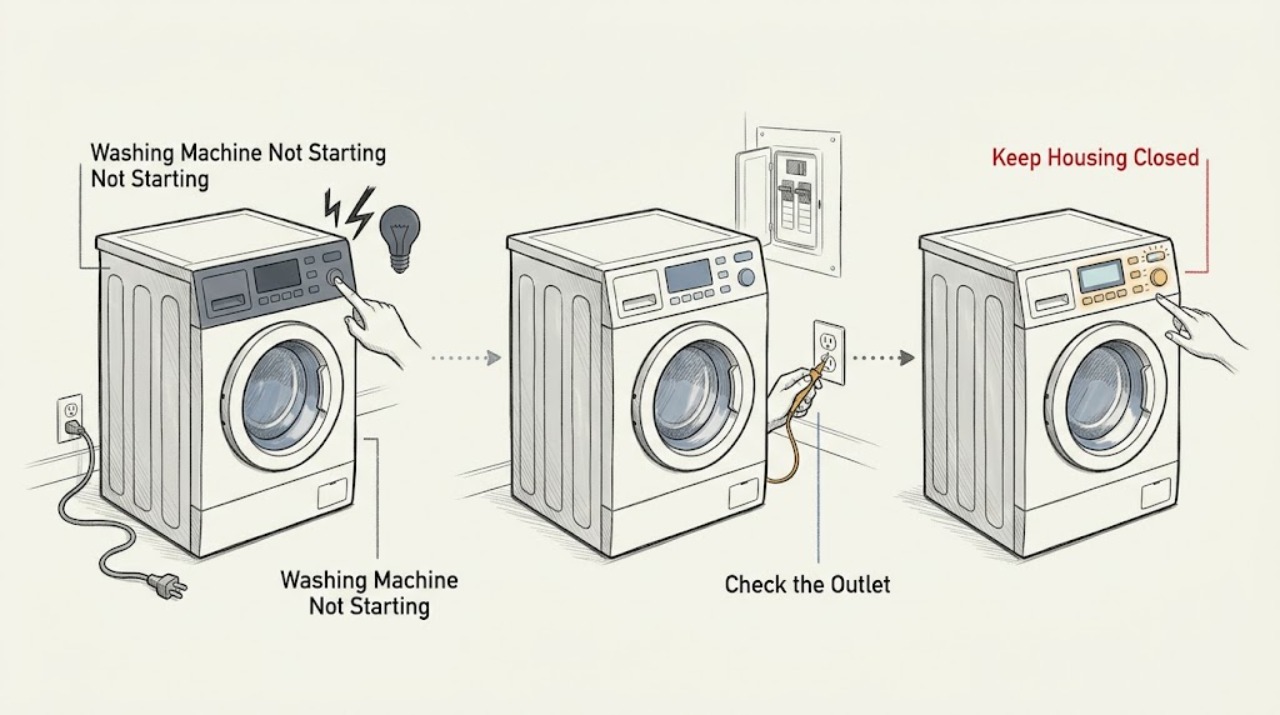
First separate an LG washer with no display or response from one whose display works but which will not begin a cycle. If the area is dry and there is no leaking water near electrical parts, smoke, burning smell, sparks, a hot outlet, damaged cord, or repeated tripping, check that the washer is plugged directly into a sound wall outlet and inspect the household breaker or GFCI as safely accessible. If the panel lights, close the front door or top lid fully, clear only visible clothing from the latch area, turn off Child or Control Lock, cancel Delay Wash or Delay Start, choose a valid cycle, and press Start using the model's required touch duration. A fill or drain condition can also prevent the sequence from progressing, while a door-lock, power, inlet, drain, balance, or motor code must be interpreted for the exact model. Use one LG-documented reset only after the low-risk checks and only with no safety sign; if the washer remains dead, the code returns, the lock will not engage, or there is water, heat, odor, smoke, arcing, or a repeated trip, stop and arrange LG service.
Before you begin
Safety first
- This article covers ordinary visual checks, accessible hose and latch observations, load redistribution, and exact model-documented controls only. Do not bypass locks, work on live wiring, open the cabinet or tub, force a filter with hot water present, or dismantle electrical, water, motor, pump, valve, sensor, or control components.
Work through in order
Diagnostic checks
Use only checks that match the exact appliance or system and its official guide.
-
Check 1
Before pressing Start again, look from a safe, dry position for leaking water, water near the plug or controls, smoke, burning or electrical odor, sparks, a hot or damaged outlet, damaged cord or glass, repeated breaker trips, or severe movement.
Expected result: Record a dry stable appliance with no warning signs, or identify water location, heat, odor, smoke, sparks, damage, or repeated electrical protection.
Next step: If a hazard is present, stop the cycle and keep people away. If the area can be reached without stepping in water, close the water taps and isolate power using a safe dry method; otherwise leave the area and obtain emergency or qualified service. Continue only when no hazard is present.
Stop if: Do not touch a plug or control while standing in water, continue a leaking or smoking washer, use a hot outlet, or repeatedly reset a tripping circuit.
Why this matters
Why: Any warning sign changes the task from ordinary start troubleshooting to a safety stop. Water contacting electrical equipment can create shock risk; smoke, burning odor, sparks, a hot outlet, or repeated trips can indicate an electrical or fire fault.
-
Check 2
With the washer off, press Power normally and classify the response as no display, intermittent display, display with a code, or a responsive panel that accepts settings but does not start.
Expected result: Record whether the panel is completely blank, whether only some indicators respond, whether PF or another code appears, and whether Start or cycle selection is accepted.
Next step: Follow the no-power or powered-no-start branch below and preserve the exact display and response for LG support.
Stop if: Do not remove panels, interpret an intermittent display as safe, or keep operating after odor, heat, smoke, sparks, water exposure, or repeated trips.
Why this matters
Why: No display focuses the next check on the direct outlet, GFCI, breaker, power strip, cord, and internal power path. A responsive display shifts attention to Control Lock, Delay, door or lid recognition, cycle selection, Start timing, and the displayed code.
-
Check 3
For a blank or intermittent panel, confirm the cord is fully seated in a direct wall outlet and inspect the plug and outlet face for looseness, discoloration, moisture, or heat; if safe, check the GFCI or breaker without opening the electrical panel.
Expected result: Record a normal direct connection, a tripped GFCI or breaker, a power outage, an outlet that does not power another ordinary device, or a washer that stays dead while the outlet works.
Next step: Restore only an accidentally tripped GFCI or breaker once, if there is no hazard and the household instructions permit it. If it trips again, the outlet is hot or damaged, or the washer remains blank, leave it off and contact an electrician or LG service.
Stop if: Do not open the panel or outlet, test live wiring, use a power strip or extension cord as a workaround, repair the cord, or reset protection repeatedly.
Why this matters
Why: LG identifies a tripped breaker, faulty outlet, outage, power strip, or loose connection as common no-power paths. A working outlet with a dead washer requires service rather than an internal electrical test.
-
Check 4
If the panel lights but buttons seem inactive, look for CL or a lock indicator, use the exact model manual to locate the Control or Child Lock combination, and press Power or Start with the model's required deliberate touch duration.
Expected result: Record CL or a lock indicator, a beep or indicator change when the documented lock control is used, a normal response to a deliberate Start press, or a panel that remains unresponsive.
Next step: Turn off the lock only through the documented control, then select the cycle and make one normal start attempt. If the display remains unresponsive or the function returns, request model-specific service.
Stop if: Do not force buttons, wet the panel to improve touch response, bypass a lock, enter an undocumented service mode, or open the console.
Why this matters
Why: LG says Control Lock can disable buttons other than Power and can remain active through a power cycle; the lock button combination varies. LG also says some touch models require a sustained press for Start, so a quick touch may not be recognized.
-
Check 5
With the drum stopped, inspect the visible front-door gasket or top-lid opening for clothing or debris at the latch, close the door or lid normally, and observe whether the lock indicator engages when the documented cycle is started.
Expected result: Record a clean closure and lock, an obstruction, a door or lid that will not align, residual water behind a locked front door, damaged glass or latch, or a dE/dL/door code that returns.
Next step: Clear only a visible obstruction and make one normal restart attempt. If the lock will not engage, the door is damaged, water remains, or the code returns, leave the door closed and request LG service.
Stop if: Do not pry or force a locked door, hold or bypass the lock switch, reach into a moving drum, or open the door with hot or high-level water present.
Why this matters
Why: A washer can refuse to begin or spin when it cannot confirm a closed door or lid. A persistent lock code, damage, or retained water points to a door, lock, drain, or control condition that should not be forced.
-
Check 6
Select a normal cycle from the exact model's control sequence, check that Delay Wash or Delay Start is not active, confirm the displayed options are accepted, and press Start as the model requires.
Expected result: Record a delay indicator or countdown, a cycle that is selected but waiting, a Start action that begins the sequence, or a panel that accepts no cycle or Start input.
Next step: Cancel the delay only as the manual permits and make one monitored start attempt. If the washer still does not begin, record the sequence and continue to the code and water-path checks.
Stop if: Do not force a selector, repeatedly press Start, override a delay with an undocumented combination, or run a cycle with a damaged door or panel.
Why this matters
Why: LG documents that cycle selection precedes options and Start, that available modifiers vary by model, and that Delay Wash intentionally postpones starting. A valid cycle with no response after the correct Start action suggests a door, supply, control, or stored fault.
-
Check 7
Photograph and transcribe every displayed character, then record the model, front-load or top-load design, selected program, load, and stage when the washer stopped or refused to start.
Expected result: Record no code, an incomplete or alternating code, or a repeatable code such as IE, OE, UE, LE, dE, FE, PF, CL, or another model-specific notification.
Next step: Use the exact model's LG error-code page for the matching code and only perform the corresponding low-risk check; do not infer a part from the code alone.
Stop if: Do not guess an incomplete code, copy a procedure from another model, erase the display with repeated resets, or enter service mode.
Why this matters
Why: LG error-code meanings and available procedures vary by product model. The program stage changes the likely path: IE concerns filling, OE draining, UE balance, LE rotation, dE or dL door recognition, FE overfill, PF power, and CL control lock on supported models.
-
Check 8
If the washer appears to start but waits at filling or draining, inspect accessible water taps and inlet hoses for an open supply, kink, damage, or leak, and inspect the accessible drain hose for a kink, pinch, or obvious routing problem; do not open a filter with hot or pressurized water present.
Expected result: Record normal supply and hose routing, a closed tap or kink, no water entering, retained water, slow drainage, a leaking hose, or an IE/OE-related code.
Next step: Restore only an accidentally closed tap or safely straighten an accessible hose, then make one model-appropriate test. If water remains, a hose leaks, the code returns, or a filter procedure is unclear, stop and request service.
Stop if: Do not loosen a pressurized hose, handle hot standing water, use drain chemicals, force a filter cap, or continue with an overflow or leak.
Why this matters
Why: An inlet or drain condition can prevent the next program stage and look like a no-start. LG associates IE with inadequate filling and OE with drainage, but a clear path with a returning code can indicate a valve, pump, sensor, or control fault.
-
Check 9
For UE, LE, or a stalled start with no safety sign, pause until the drum is safe, redistribute or reduce an obvious load, remove only a clearly visible foreign object if the exact model permits it, and then use one documented LG reset or power recovery.
Expected result: Record an uneven or overloaded load, a visible object, a stable empty or corrected load, a code that clears, or a code that returns immediately or after the retry.
Next step: Run only one monitored, model-appropriate test after the correction. If the washer still will not start, spins abnormally, or shows the code again, stop further retries and arrange LG service.
Stop if: Do not reach into moving parts, force rotation, bypass a lid or door safety, repeat resets to suppress the code, or continue after smoke, burning smell, violent movement, or a trip.
Why this matters
Why: LG links UE with imbalance and LE with motor strain or a foreign object on supported models. A single documented reset can clear a temporary electronic or motor state, but a returning code, grinding, humming, or failed movement requires diagnosis.
-
Check 10
If the washer remains blank or powered but inactive after the applicable checks, prepare the model, code, program stage, load, outlet result, lock state, water observations, and one-reset result for LG support or a qualified appliance technician.
Expected result: Record no response, a persistent code, an immediate re-trip, a door or lid that cannot lock, a cycle that starts then stops, or any recurring leak, noise, heat, odor, or movement.
Next step: Keep the washer out of use when the symptom is recurrent or unsafe and submit the complete record through LG's official repair or support path.
Stop if: Do not dismantle panels, test live wiring, replace a control or lock from the symptom alone, or keep operating an appliance with water, smoke, burning smell, sparks, heat, or repeated trips.
Why this matters
Why: A remaining fault may involve the supply, door lock, inlet or drain system, motor, sensor, user interface, or main control. The public user-level checks cannot safely distinguish internal parts.
Use your observations
Decision map
Find the observation that best matches what you see, then follow the next safe action.
-
PATH 01Safety boundary
What you see
Water reaches electrical equipment, the outlet is hot, there is smoke, burning smell, arcing, damaged cord or glass, repeated breaker trips, overflow, or violent movement.
Do this next
Stop the cycle and keep people away. If safe without standing in water, close the taps and isolate power using a dry accessible method; otherwise leave the area and obtain emergency or qualified service.
Why this path and its safety boundary
Why it matters: The no-start symptom is secondary to an electrical, water, fire, or mechanical safety event.
Safety stop: Do not touch the plug or controls through water, run another test, force the door, or repeatedly reset the circuit.
-
PATH 02Safety boundary
What you see
The panel is completely blank or Power gives no response, with no immediate hazard.
Do this next
Check the direct wall connection and household protection once as safely allowed; if the outlet works but the washer remains dead, request electrical or LG service.
Why this path and its safety boundary
Why it matters: The outlet, GFCI, breaker, power strip, cord, outage, or washer power path is more likely than a cycle-selection issue.
Safety stop: Do not open panels, use an extension as a workaround, test live wiring, repair the cord, or repeatedly reset protection.
-
PATH 03Safety boundary
What you see
The display works but buttons or Start do not respond, or CL, a lock indicator, or a delay indicator is present.
Do this next
Use the exact model manual to clear the lock or delay and press Start as documented, then make one normal attempt.
Why this path and its safety boundary
Why it matters: Control Lock, Delay Wash, model-specific touch timing, or an incomplete cycle state can prevent a normal start.
Safety stop: Do not bypass a lock, force controls, enter service mode, or repeatedly press Start.
-
PATH 04Safety boundary
What you see
The washer powers on but the front door or top lid will not close or lock, or dE/dL and related notifications appear.
Do this next
Inspect only the visible latch area, close normally, and use one documented restart; service is required for a returning code, damage, or retained water.
Why this path and its safety boundary
Why it matters: The appliance may not recognize the door or lid, may retain water, or may have a lock or control fault.
Safety stop: Do not pry or bypass the lock, force the door, or open it with hot or high-level water present.
-
PATH 05Safety boundary
What you see
The cycle is selected but waits while filling or draining, or IE, OE, E02, E03, or E21 is displayed.
Do this next
Check accessible taps and hose routing, then use only the exact model's safe drain or filter procedure; arrange service if the path is clear but the code returns.
Why this path and its safety boundary
Why it matters: A water supply, inlet hose, drain hose, pump filter, pump, or excessive-suds condition may block the next stage.
Safety stop: Do not loosen pressurized connections, open a filter with hot water, use chemicals, or continue an overflow or leak.
-
PATH 06Safety boundary
What you see
UE, LE, AE, or a related rotation notification appears, or the drum starts and stops with an uneven load or abnormal movement.
Do this next
Pause safely, redistribute or reduce the load, inspect only visible accessible areas with power off if the model permits, and make one monitored retry.
Why this path and its safety boundary
Why it matters: Load balance, unsuitable load, visible foreign object, motor strain, or a mechanical fault may prevent normal starting or spinning.
Safety stop: Do not force the drum, reach into moving parts, hold the washer down, or continue after grinding, smoke, burning smell, violent movement, or a recurring code.
-
PATH 07Safety boundary
What you see
The model or code is uncertain, the washer remains inactive after the applicable check and one reset, or a fault recurs.
Do this next
Keep the washer out of use as appropriate and contact LG support or a qualified technician with the complete observation record.
Why this path and its safety boundary
Why it matters: A generic procedure cannot safely distinguish an internal supply, lock, valve, pump, sensor, motor, interface, or control fault.
Safety stop: Do not guess a part, copy another model's procedure, open the appliance, or suppress the symptom with repeated resets.
Helpful context
Understand the symptom
Start by separating no power from no start
A completely dark panel and a panel that lights but does not begin washing are different paths. Record whether Power responds, whether the display shows a code or lock icon, whether a cycle can be selected, and whether the washer clicks, fills, drains, or locks the door after Start. LG's guidance is model-sensitive, so keep the exact model number and do not copy a button sequence from another washer.
Control lock, delay, and touch timing can look like a fault
LG says Control Lock can leave most buttons unavailable even after the washer is powered off and on, and the button combination varies by model. Some touch-control models require a deliberate press rather than a quick brush for Power or Start. A Delay Wash or Delay Start setting can intentionally postpone the cycle. Confirm the state on the panel and use the exact owner's manual before assuming the control has failed.
Door, water, and error-code checks are connected
The washer may not start or spin until the door or lid is recognized as closed and locked. If the program stops while filling or draining, an inlet or outlet condition can block the next stage. An error display is a routing clue, not a universal part diagnosis: IE, OE, UE, LE, dE, FE, PF, CL, and related codes vary by model and need the matching LG instructions.
Safety boundary
Stop conditions
- Stop immediately for leaking water near electrical equipment, a hot or damaged outlet, smoke, burning or electrical odor, sparks, damaged cord or glass, repeated trips, overflow, hot water, or violent movement.
- Do not pry, force, tape, or bypass a locked door or lid; do not reach into a moving drum or open a drain path with hot or pressurized water present.
- Do not open electrical panels, test live wiring, dismantle the cabinet or tub, enter undocumented service mode, or replace parts based only on a generic symptom or code.
- Do not use extension cords or improvised power strips as a workaround, mix drain or cleaning chemicals, or continue a cycle with a leak or overflow.
- Do not repeat resets to hide a persistent no-start condition. Use the exact LG model guidance and arrange qualified service when the code or fault returns.
Only after diagnosis
Potential parts
- door or lid lock assembly
Consider this category only when the exact model's door or lid closes normally but the lock notification returns and a qualified diagnosis confirms the lock fault.
Confirm the exact LG model and revision; never bypass or substitute a safety lock. - inlet valve or inlet hose
Consider this category only when taps and accessible hoses have normal supply and routing but an inlet condition persists and a technician confirms a valve or hose fault.
Match the exact model and connection requirements; do not work on a leaking or pressurized connection. - drain pump or drain-path component
Consider this category only when the exact model's safe hose and filter checks are complete and a recurring outlet condition is diagnosed as a pump or drain-path fault.
Confirm the exact model and residual-water procedure; do not open the drain path with hot or pressurized water present. - main control or user-interface component
Consider this category only after supply, control-lock, delay, door, inlet, drain, load, and one documented reset checks are complete and a qualified diagnosis identifies the control fault.
Do not order from the symptom or code alone; exact model diagnosis and fitment are required.
When checks do not resolve it
Need a professional?
Arrange LG or qualified appliance service when the outlet works but the washer remains blank, the panel works but Start does not begin a cycle after the documented lock, delay, door, cycle, and one-reset checks, a code returns, the door or lid will not lock, inlet or drain paths are clear but the cycle will not progress, or diagnosis would require panels, wiring, valves, pumps, sensors, motors, locks, or controls. Use urgent help for smoke, sparks, burning odor, water contacting electrical equipment, overflow, severe vibration, damaged glass, a hot outlet, or repeated circuit trips.
Safety scope: This article covers ordinary visual checks, accessible hose and latch observations, load redistribution, and exact model-documented controls only. Do not bypass locks, work on live wiring, open the cabinet or tub, force a filter with hot water present, or dismantle electrical, water, motor, pump, valve, sensor, or control components.
Common questions
FAQ
Why is my LG washer completely blank?
Check the direct wall connection and inspect the GFCI or breaker only from safe access. If the outlet works but the washer remains blank, or protection trips again, stop resetting it and arrange electrical or LG service.
Why does my LG washer have lights but not start?
Check Control Lock, Delay Wash or Delay Start, the selected cycle, required Start touch timing, and the front door or top lid. Record any code and make only one documented restart attempt; a persistent no-start needs service.
Can Control Lock stop an LG washer from starting?
Yes. LG says Control Lock can leave most buttons inactive and can remain on through a power cycle. Use the exact model manual to identify the lock control and turn it off; do not bypass it.
Why does an LG washer wait after I press Start?
A selected delay can intentionally postpone the cycle, and some models briefly sense the load before adding water. Confirm the display and model instructions. If the door will not lock, water leaks, or a code returns, stop and request service.
When should I stop trying to start an LG washer?
Stop for water near electrical equipment, a hot outlet, smoke, burning odor, sparks, damaged cord or glass, overflow, severe vibration, or a repeated breaker trip. Do not force the lock or keep resetting the machine; use emergency or qualified LG service as appropriate.
Read the exact guide
Official sources
- [LG Front Load Washer] Power issueLG USA Support · Official LG USA guidance for front-load washers; images and controls can vary by model.
- LG Washer - Circuit Breaker is TrippedLG USA Support · Official LG USA guidance for household washers; local electrical safety requirements also apply.
- LG Washer – Troubleshooting an Electrical or Burning Rubber SmellLG USA Support · Official LG USA guidance for washers and washer-dryer products; exact model and hazard conditions control.
- LG Washer - Troubleshooting Unresponsive Washer ButtonsLG USA Support · Official LG USA Help Library guidance for household washers; the lock control varies by model.
- LG Washing Machine: The Power/Start button is not workingLG USA Support · Official LG USA guidance for touch-control washer models; exact model behavior can differ.
- LG Washer - How to Select and Start a CycleLG USA Support · Official LG USA guidance for household washers; available modifiers vary by model.
- LG Washer – Why Won’t My LG Washing Machine Power On?LG USA Support · Official LG USA Help Library guidance for household washers; exact model instructions and qualified electrical service control.
- LG Front Load Washer - Error Code List(New)LG USA Support · Official LG USA Help Library guidance for front-load washers; exact model documentation controls.
- LG Washer – Troubleshooting Washing Machine Drum Not SpinningLG USA Support · Official LG USA Help Library guidance for household washers; the exact model controls cycle details.
- [LG Top Load Washer] Error Code ListLG USA Support · Official LG USA Help Library guidance for top-load washers; exact model documentation controls.
- Powers On By ItselfLG USA Support · Official LG USA guidance for household washers; Delay Wash availability and controls vary by model.
- LG SupportLG USA Support · Official LG USA consumer support portal.
Community feedback
Share a repair observation
Share a plain-text repair observation. Accepted observations are published automatically; this page may take a moment to update.