
On this page
Start here
Quick answer
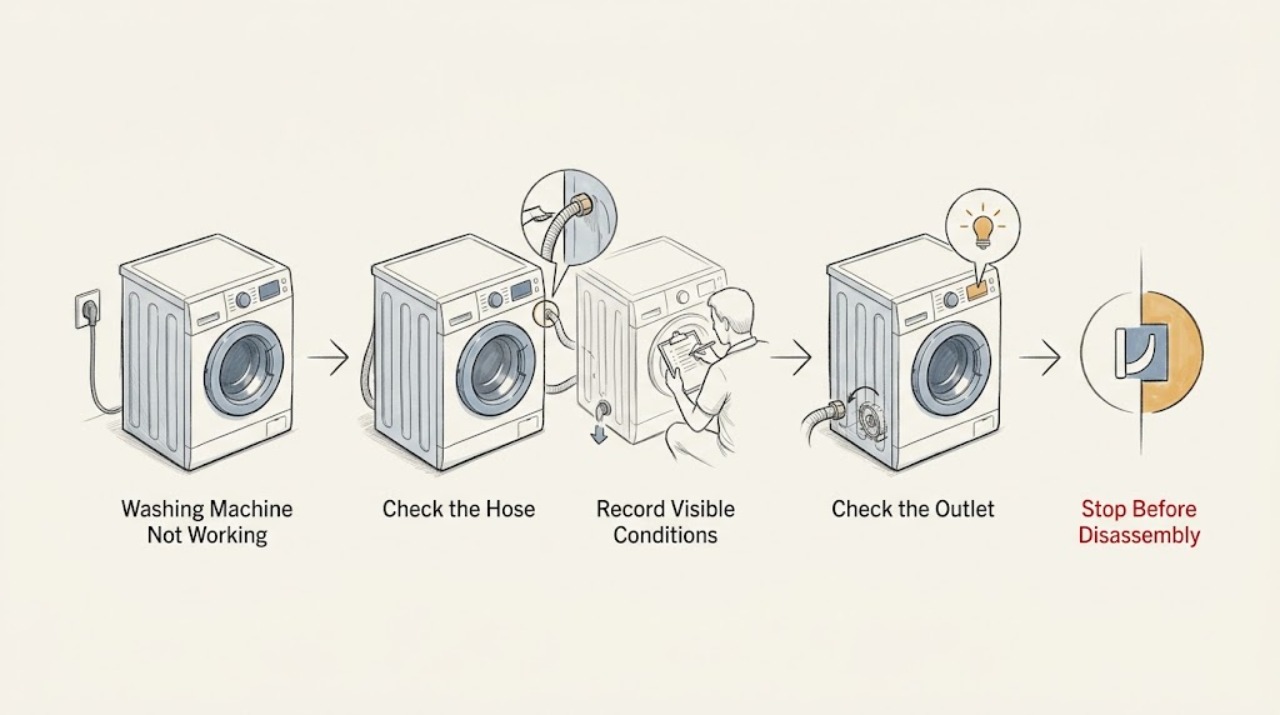
First describe what ‘not working’ means on the LG washer: no display, an unresponsive Power or Start control, a door that will not lock, no water entering, a cycle that stops with water inside, or a tub that will not spin. Record the exact model and any code, then check only the accessible outlet, breaker, controls, door, water taps and hoses, drain path, load, and model-specific filter. LG says Control Lock can leave most buttons inactive, a touch Start button may need a deliberate press, and a factory reset is a model-supported step after power is disconnected. Do not reach into a moving tub, bypass a door lock, work on live wiring, or keep running a leaking or electrically unsafe washer. Stop for smoke, burning smell, sparks, water contacting electrical parts, repeated breaker trips, a damaged cord, uncontrolled filling, or severe mechanical noise; leave the washer out of service and arrange qualified repair.
Work through in order
Diagnostic checks
Use only checks that match the exact appliance or system and its official guide.
-
Check 1
Stop the washer and check for smoke, burning or electrical odor, sparks, a hot or damaged cord, water around the outlet or controls, uncontrolled filling, a strong leak, or severe grinding and banging. Do not restart it to reproduce any of those symptoms.
Expected result: There is no hazard sign, or there is smoke, odor, sparking, water contact, uncontrolled water, repeated tripping, or abnormal mechanical noise.
Next step: With no hazard, continue to identify the failed stage. With any hazard, stop use, close the water taps if it is safe to do so, isolate power only from a dry safe position, and arrange the appropriate qualified or emergency response.
Stop if: Stop immediately for smoke, flames, exposed conductors, water contacting energized equipment, repeated breaker trips, or severe impact/grinding noise.
Why this matters
Why: A fire, shock, wet-appliance, flood, or mechanical-breakup risk takes priority over restoring a wash cycle.
-
Check 2
Record the full LG model and serial information, whether the display is lit, the exact code or icon, whether the door is locked, whether water is inside, and the last stage completed. Use LG's model-specific support and error-code guidance before choosing a reset or cycle.
Expected result: The washer is completely dark, the display is active but controls are ignored, a door or water code appears, or the cycle stopped during fill, wash, drain, or spin.
Next step: Follow the branch matching the observed state and exact model. Do not infer a failed part from the word ‘not working’ alone.
Why this matters
Why: The same broad complaint can represent an electrical supply fault, Control Lock, door interlock, water path, drain restriction, imbalance, motor, or control problem.
-
Check 3
For a dark or intermittently powered washer, confirm the cord is fully seated directly in a suitable wall outlet, check the accessible GFCI or breaker, and test the outlet with a small known-working appliance only if the area is dry and safe. Do not use a power strip or extension as a diagnostic workaround.
Expected result: The outlet is dead, the breaker or GFCI has opened, the cord or outlet is damaged, the washer returns after one safe reset, or the outlet works but the washer remains dark.
Next step: If the household supply is at fault, use qualified electrical help. If one safe reset restores the washer and no protection event recurs, continue to the control check; if it remains dark, arrange LG or qualified appliance service.
Stop if: Do not open the outlet, touch wet electrical equipment, use an improvised fuse, or repeatedly reset a breaker.
Why this matters
Why: LG identifies a disconnected cord, faulty outlet, power outage, GFCI, or breaker as common no-power causes; a working outlet with a dark washer shifts the issue to the appliance.
-
Check 4
If the display is lit but buttons do not respond, dry the panel and hands, look for CL or another Control Lock indicator, and use only the exact model's designated unlock buttons. Select a valid cycle and press Power and Start/Pause with the deliberate hold described for the model.
Expected result: The lock clears and controls respond, a Start press was not registered, an error remains, or the panel stays unresponsive after the model-specific unlock attempt.
Next step: If controls respond, continue to the door and water checks. If they do not, perform only the single documented reset after making the washer safe, then request service if the panel remains unresponsive.
Stop if: Do not pry buttons, spray liquid onto the panel, bypass a lock, or open the console.
Why this matters
Why: LG says Control Lock can leave most buttons inactive and that touch-type Power/Start controls may require a deliberate press; a persistent unresponsive panel indicates a control or power fault.
-
Check 5
With the tub stopped, inspect the door or lid opening for clothing or an object caught in the gasket or latch, then close it gently as the model requires. Check that both accessible water taps are open, hoses are connected and not kinked, and there is no leak; close the taps if a connection leaks.
Expected result: The door or lid locks and the cycle begins, a dE/dL-style indication remains, a hose is kinked or disconnected, water does not enter, or water is leaking.
Next step: Correct only an obvious closure or hose-position issue permitted by the manual. If the lock does not engage, water does not enter, or any leak persists, stop the cycle and arrange service.
Stop if: Do not force or bypass the door lock, disconnect a pressurized hose while the tap is open, or run the washer with a leak.
Why this matters
Why: LG links door-lock errors to closure, obstruction, latch, or lock conditions and inlet errors to the tap, hose, or water path. A leak changes the task to water containment and safe shutdown.
-
Check 6
If the washer stops with water inside or leaves clothes wet, keep the door or lid closed until the tub is safe, inspect the accessible drain hose for a kink or displacement, and use only the model's drain or Spin Only procedure. Check for excess suds and use the detergent type and amount specified by LG for the model.
Expected result: Water drains normally, the hose is kinked or incorrectly positioned, the tub remains full, the load has excessive suds, or an OE/related drain code appears.
Next step: Correct only an accessible hose position or detergent-use issue and run one model-supported drain/spin check. If the tub will not drain, water leaks, or the code returns, stop and request service.
Stop if: Do not reach into standing water, remove a pump cover while powered, use improvised siphoning, or keep adding cycles to a full tub.
Why this matters
Why: LG attributes wet clothes and incomplete cycles to drain restrictions, hose placement, imbalance, or excess suds; a full tub can also keep a door locked and should not be opened by force.
-
Check 7
If the washer fills and washes but will not spin, pause it safely and redistribute an obviously tangled or unbalanced load without reaching into a moving tub. Confirm the machine is stable and level from the outside, then use the model's Rinse/Spin or Spin Only test only when there is no leak or hazard.
Expected result: The spin completes after redistribution, the washer rocks, the load is overloaded, an LE/UE or similar code appears, or the tub remains still with a normal load.
Next step: Use the exact model's load and leveling limits. If the tub does not spin, makes grinding or impact noise, or repeatedly shows a rotation code, leave the washer out of service and arrange repair.
Stop if: Do not reach into a moving tub, remove panels, pull out a trapped object while powered, or run repeated spin tests with severe vibration.
Why this matters
Why: LG associates rotation errors with overload, imbalance, foreign objects, or a motor/drive problem. A successful redistribution points to load/setup; a persistent no-spin state needs diagnosis.
-
Check 8
Write down the exact error code, icon, and cycle stage before clearing anything. After the washer is safe, dry, and stopped, perform at most one reset exactly as the model support page or manual describes, then restart one suitable cycle only if no hazard or standing-water condition remains.
Expected result: The code clears and the cycle completes, the same code returns, an electrical over-current or motor code appears, or the washer remains unresponsive.
Next step: Leave the washer off when a code returns or a cycle still fails, and provide service with the model, code, stage, water state, and observations from the prior checks.
Stop if: Stop for recurring errors, overfill, leak, motor over-current, smoke, heat, sparks, or repeated breaker trips.
Why this matters
Why: LG states that codes vary by model and that recurring codes can indicate a component malfunction requiring inspection; repeatedly clearing a code does not repair the cause.
-
Check 9
After a safe external correction, run one short, supervised model-supported cycle with the correct load. Watch for normal fill, lock, tumbling, drain, and spin behavior without opening the door or adding detergent during motion.
Expected result: The cycle completes normally, or it stops again, leaks, remains full, fails to spin, shows a code, smells hot or burnt, or trips protection.
Next step: If the symptom returns, turn the washer off, close water taps if safe, isolate power from a dry safe position, and arrange qualified service with the model and full symptom history.
Stop if: Stop immediately for water near electrics, smoke, burning odor, sparks, severe vibration, uncontrolled filling, or repeated power trips.
Why this matters
Why: One successful cycle supports a corrected setup or temporary state but does not justify internal repair. Any returning symptom is a service boundary.
Use your observations
Decision map
Find the observation that best matches what you see, then follow the next safe action.
-
PATH 01Next step
What you see
Smoke, burning smell, sparks, damaged cord, water contacting electrical parts, uncontrolled filling, severe leak, or repeated breaker trips is present.
Do this next
Stop use, do not restart, close the water taps if safe, and isolate power only from a dry safe position. Arrange the appropriate qualified or emergency response; do not touch a wet plugged-in appliance.
-
PATH 02Next step
What you see
The display and controls are completely dark.
Do this next
Check the accessible cord, outlet, GFCI, and breaker once in a dry safe area. If supply is good but the washer remains dark, use qualified electrical or appliance service.
-
PATH 03Next step
What you see
The display is on but buttons are ignored or CL/control lock is shown.
Do this next
Dry the panel and use the exact model's Control Lock release and deliberate Start command. A persistent unresponsive panel needs service.
-
PATH 04Next step
What you see
The door or lid will not lock, no water enters, or a door/inlet code appears.
Do this next
Check for an obstruction, closure, open tap, kinked hose, or visible leak using the model instructions. Do not bypass the lock or run with a leak; request service if the condition persists.
-
PATH 05Next step
What you see
Water remains in the tub, the cycle stops during drain, or clothes are wet.
Do this next
Keep the door closed, inspect the accessible drain hose, use the model's drain/spin option, and address detergent excess only as specified. A full tub, leak, or returning drain code requires service.
-
PATH 06Next step
What you see
The washer fills but will not spin, rocks violently, or displays a rotation/imbalance code.
Do this next
Stop motion, redistribute only a safe load, and check stability from outside. Persistent no-spin, grinding, or severe vibration is a drive or mechanical service boundary.
-
PATH 07Next step
What you see
An error returns after one model-specific reset or the washer still does not complete a cycle.
Do this next
Leave the washer out of service and provide the exact model, code, stage, water state, and power/door/drain/spin observations to qualified LG appliance service.
Helpful context
Understand the symptom
Define the failed stage first
‘Not working’ can mean no power, controls that do not respond, a door that will not lock, no water, no drain, no spin, or a cycle that stops. Note the exact display, code, stage, and whether water is inside. LG's error pages are model-dependent, so do not treat a code from one washer as a universal diagnosis.
Keep water and electricity separate
Disconnect power before any permitted filter or hose check, keep hands and the floor dry, and close the water taps before addressing a leak or hose. Never bypass the door lock or test internal wiring. If water reaches electrical parts, the cord is damaged, a breaker trips again, or the washer smells burnt, stop and use qualified service.
Only after diagnosis
Potential parts
- door lock or lid interlock
Only consider this category if the exact model does not recognize a correctly closed door or lid after the obstruction and Control Lock checks.
Confirm the complete model and qualified diagnosis before ordering or replacing an interlock. - water inlet valve or hose component
Only consider this category if the taps and hoses are open, connected, and unobstructed but the exact model still reports an inlet fault.
Use model-specific diagnosis and fitment; close the taps before any hose work. - drain pump or drain-path component
Only consider this category if the accessible hose and detergent/load conditions are correct but the tub will not drain or a drain code returns.
Do not access a pump with standing water or power connected; confirm exact model compatibility. - drive motor or control component
Only consider this category after supply, lock, load, drain, and safe reset checks leave a persistent no-spin or motor error.
Drive and control systems vary by model; use qualified diagnosis and exact fitment.
Common questions
FAQ
Why does my LG washing machine have power but not start?
Check whether Control Lock is active, the door or lid is fully closed, a valid cycle is selected, and Start/Pause has received the model-specific deliberate press. If an error remains or the controls stay unresponsive after one safe reset, leave the washer off and arrange service.
What should I do if my LG washer stops with water inside?
Keep the door or lid closed, stop the cycle safely, and inspect the accessible drain hose for a kink or displacement. Use only the model's drain or Spin Only procedure. Do not reach into standing water or remove a pump cover while powered; a full tub, leak, or returning drain code needs service.
How do I reset an LG washing machine that is not working?
Record the exact code and cycle stage first. After the washer is stopped, dry, and safe, use only the reset procedure for the exact model; LG describes a power-off, unplug or breaker, Start/Pause hold, and restart sequence for some models. Do not keep resetting a washer with smoke, leaks, electrical trips, severe noise, or a returning error.
Read the exact guide
Official sources
- LG Washer - Troubleshooting Washer Does Not Drain or Spin (Clothes Too Wet)LG USA Support · LG washer drain, spin, hose, imbalance, detergent, and incomplete-cycle troubleshooting
- CPSC Urges Flood Victims to Take Steps to Prevent CO Poisoning, Electrocution, Explosion and FiresU.S. Consumer Product Safety Commission · Wet-appliance electrical safety and gas-leak emergency guidance
- LG Front Load Washer - Error Code List(New)LG USA Support · LG washer model-dependent door, inlet, drain, rotation, motor, overfill, and error-code guidance
- LG Washer - Troubleshooting Washer Unresponsive Washer ButtonsLG USA Support · LG washer Control Lock, error indication, reset, and unresponsive-button troubleshooting
- LG Washer – Why Won’t My LG Washing Machine Power On?LG USA Support · LG washer power, outlet, GFCI, breaker, cord, and no-power troubleshooting
Community feedback
Share a repair observation
Share a plain-text repair observation. Accepted observations are published automatically; this page may take a moment to update.