
On this page
Start here
Quick answer
Start by confirming that this Liebherr freezer actually has an IceMaker option and that the IceMaker is switched on, its drawer is completely closed, and the freezer is connected to power and water. Check the accessible water shut-off, hose, and filter for an interruption or leak, and confirm the freezer is cold enough for the exact model. A newly installed or restarted unit may need time to make its first batch, and a water line may need to be bled by a qualified installer. Do not remove panels, work on live parts, bypass a safety control, or dismantle the water valve. If the IceMaker remains inactive after the model-specific checks, the freezer is not holding temperature, a fault display appears, or water is leaking, stop and arrange qualified Liebherr appliance service.
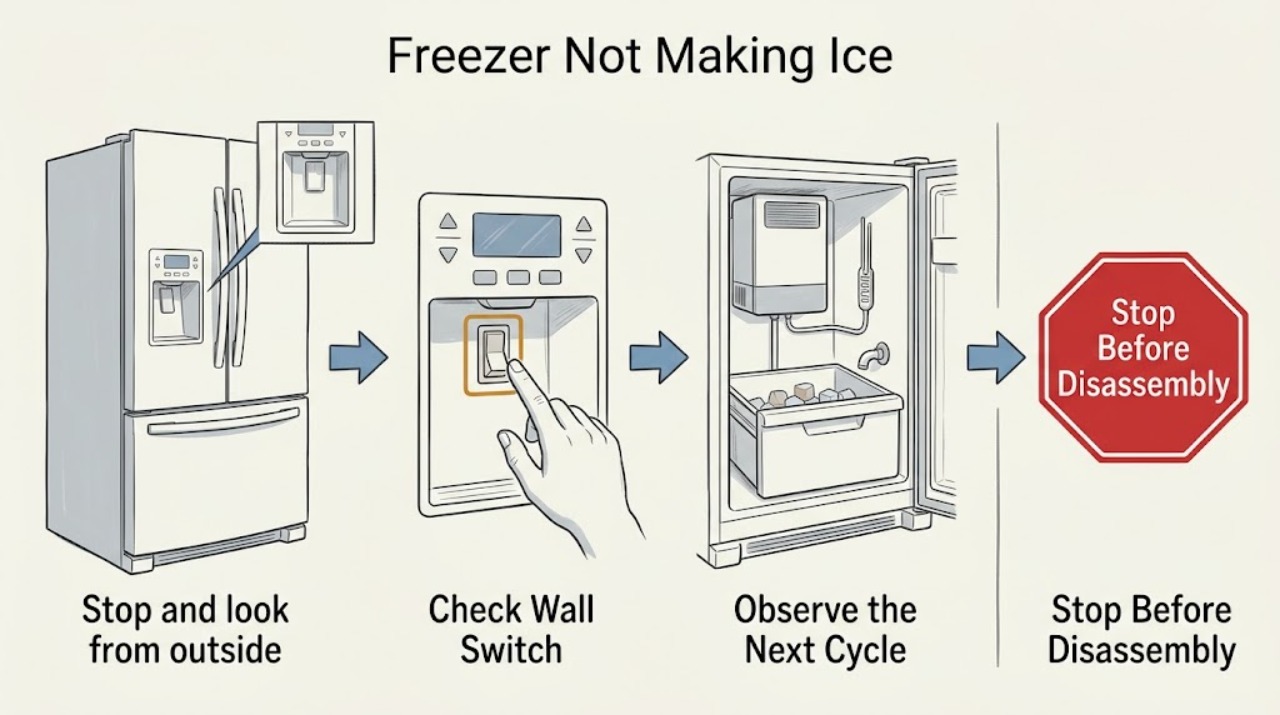
Work through in order
Diagnostic checks
Use only checks that match the exact appliance or system and its official guide.
-
Check 1
Stop and look from outside for a water leak, pooled water, damaged cord, burning smell, unusual electrical noise, heavy frost obstructing the drawer, or a freezer that is warming food; do not pull out a built-in unit or open a cover.
Expected result: A safety or food-storage hazard is present, or the freezer is intact, cold, and dry.
Next step: For a leak, electrical hazard, or unsafe temperature, stop the IceMaker and obtain qualified appliance or electrical help. Protect food according to local food-safety guidance. If no hazard is present, continue by identifying the exact model and IceMaker controls.
Stop if: Stop immediately for smoke, sparking, burning odor, exposed wiring, uncontrolled water, a hot cord, or a freezer that cannot safely preserve food.
Why this matters
Why: A leak, electrical hazard, or warming freezer is more urgent than an ice-production test; a cold and dry appliance permits limited external checks.
-
Check 2
Using the exact Liebherr operating instructions, verify that the IceMaker option exists, the IceMaker is switched on, its indicator or LED shows the expected state, and the IceMaker drawer is seated and completely closed.
Expected result: The IceMaker is off, the drawer is not fully closed, the unit lacks this option, or the indicator and drawer state appear correct.
Next step: Correct only an obvious off setting or drawer position described by the manual, then allow the appliance to operate normally. Do not force the drawer or tray if it binds.
Stop if: Stop for a jammed tray, damaged drawer rails, broken latch, or any need to bypass a drawer or door interlock.
Why this matters
Why: An off IceMaker, open drawer, or non-IceMaker freezer cannot produce cubes; a correct state shifts attention to temperature and water supply.
-
Check 3
Read the freezer temperature display and confirm the freezer compartment is switched on, the door closes and seals normally, ventilation openings are not blocked, and the IceMaker was not just activated or restarted.
Expected result: The freezer is warmer than the model permits, the door or vents are compromised, the unit has just started, or the freezer appears cold and stable.
Next step: Correct only an accessible door, food-loading, or ventilation issue described by the manual and allow the freezer to stabilize. If temperature does not recover or a temperature alarm persists, arrange service.
Stop if: Stop if the freezer cannot hold temperature, food is thawing, the door seal is damaged, or frost blocks airflow and would require unsafe disassembly to remove.
Why this matters
Why: Ice production depends on adequate freezing conditions; a warm compartment, blocked airflow, or a recent startup can explain no ice without proving an IceMaker part failed.
-
Check 4
Inspect the accessible water shut-off, visible hose connections, and filter indicator or filter seating for a closed connection, kink, interruption, or leak; do not disconnect a pressurized hose or move the appliance to reach the rear.
Expected result: The water connection is closed, the hose or filter shows an obvious external issue, a leak is present, or the accessible water path appears normal.
Next step: Correct only a clearly closed shut-off or manual-approved filter seating issue. If a filter is due for replacement, use the exact manual and contain drips. If the water supply is open but production does not resume, call service.
Stop if: Stop for a leaking or swollen hose, a valve that will not close, water near electrical parts, or any need to pull out a built-in appliance.
Why this matters
Why: An interrupted water supply can leave an enabled and cold IceMaker empty; a normal visible path does not rule out an internal valve, filter, or pressure fault.
-
Check 5
If the freezer was recently installed, reconnected, or moved, check the installation record and exact instructions for whether the water line was bled and connected by a qualified installer; do not bleed or alter the line yourself unless the manual explicitly permits it.
Expected result: The line was not bled or its installation is uncertain, the unit was recently restarted, or the installation is established and the water supply is stable.
Next step: Ask the qualified installer to verify the connection and bleed the line where required. If the installation is sound, allow the model's first-production period and then arrange service if no cubes appear.
Stop if: Stop for an unknown plumbing connection, a loose fitting, water damage, or any request to open a solenoid valve or appliance panel.
Why this matters
Why: Air or an installation connection problem can prevent the first fill even though the IceMaker is enabled; an established water connection shifts attention to the IceMaker or control itself.
-
Check 6
After the safe checks, use only the exact manual's IceMaker activation, drawer-close, or cleaning-position procedure, then observe whether the IceMaker indicator changes and whether water or cubes appear during one supervised test period.
Expected result: The indicator and production return, the IceMaker remains inactive, water enters but no cubes form, or a fault display or abnormal sound appears.
Next step: If the test fails or a fault appears, stop testing and arrange qualified Liebherr service. Record the exact model, time since activation, indicator state, freezer temperature, water observations, and sound or leak details.
Stop if: Stop for a jammed mechanism, grinding, electrical smell, water spray, recurring fault display, or any need to remove panels or test live components.
Why this matters
Why: A successful supervised cycle supports a state or supply explanation; persistent inactivity, a fill-without-freeze result, or a fault indication points toward internal water, refrigeration, motor, sensor, or control diagnosis.
Use your observations
Decision map
Find the observation that best matches what you see, then follow the next safe action.
-
PATH 01Next step
What you see
The appliance leaks, smells burnt, sparks, has a damaged cord, or is not keeping food frozen.
Do this next
Arrange qualified service and follow the exact model guidance.
Why this path and its safety boundary
Why it matters: Stop the IceMaker and obtain qualified service; do not restore power or water while the hazard remains, and protect food using appropriate food-safety guidance.
-
PATH 02Next step
What you see
The IceMaker is switched off, the freezer is off, or the IceMaker drawer is not completely closed.
Do this next
Arrange qualified service and follow the exact model guidance.
Why this path and its safety boundary
Why it matters: Use the exact manual to enable the IceMaker and seat the drawer; do not force a jammed drawer or bypass an interlock.
-
PATH 03Next step
What you see
The freezer is warm, was recently started, or the IceMaker was just activated.
Do this next
Arrange qualified service and follow the exact model guidance.
Why this path and its safety boundary
Why it matters: Correct only accessible door, ventilation, or control-state issues and allow the model's normal stabilization or first-production period; persistent warm temperatures need service.
-
PATH 04Next step
What you see
The water connection is closed, interrupted, kinked, filtered incorrectly, or leaking.
Do this next
Arrange qualified service and follow the exact model guidance.
Why this path and its safety boundary
Why it matters: Use the manual to correct an obvious accessible connection issue and contain drips. An uncertain or internal water fault requires a qualified installer or appliance technician.
-
PATH 05Next step
What you see
The freezer was recently installed or the water line was not bled by the qualified installer.
Do this next
Arrange qualified service and follow the exact model guidance.
Why this path and its safety boundary
Why it matters: Have the qualified installer verify and bleed the water line as required by the exact installation instructions; do not open the water system yourself.
-
PATH 06Next step
What you see
The IceMaker is enabled, the drawer is closed, the freezer is cold, and water is available, but no cubes form after the model's normal production period.
Do this next
Arrange qualified service and follow the exact model guidance.
Why this path and its safety boundary
Why it matters: Stop repeated tests and arrange qualified Liebherr appliance service for internal valve, tray, motor, sensor, refrigeration, or control diagnosis.
Helpful context
Understand the symptom
Confirm the IceMaker is present and enabled
Liebherr offers different freezer configurations, so first confirm from the rating plate and the exact operating instructions that your appliance includes an IceMaker. The control, LED, drawer position, and cleaning or reset procedure vary by model. A dark IceMaker indicator or a drawer used for storage can explain an apparent failure without an internal defect.
Separate a production delay from a supply fault
No ice immediately after installation, a long shutdown, or activation does not necessarily mean the mechanism has failed. Check that the freezer is cold enough according to its manual, that the drawer is fully closed, and that the water connection is open. If the line was newly installed, air in it may need to be removed by the qualified installer rather than by opening the appliance.
Use only accessible checks
Inspect the visible hose, shut-off area, filter indicator, and floor for leaks without moving a heavy built-in appliance or disconnecting a pressurized line. Do not remove a rear cover, probe a valve, force the ice tray, or change a model-specific water-supply setting without the manual. IceMaker faults can involve water, refrigeration, or control hardware.
Stop when the evidence points inside the appliance
Arrange service if the IceMaker is enabled and supplied but still makes no ice, the freezer temperature is not stable, a fault code appears, or the appliance leaks or makes an abnormal sound. Give the technician the exact model and serial information, the IceMaker indicator state, the time since activation, water observations, and what happened during any safe test.
Only after diagnosis
Potential parts
Only after the exact model and a qualified diagnosis identify an internal water restriction or valve fault; no-ice symptoms alone do not select a part.
Only if the IceMaker is enabled, cold, supplied, and a qualified technician identifies the failed mechanism or control.
Only when a temperature or airflow diagnosis confirms that the freezer cannot maintain the required condition; do not replace a refrigeration part from the ice symptom alone.
When checks do not resolve it
Need a professional?
The IceMaker stays enabled and the drawer is closed but no ice appears after the exact model's normal production period., The freezer is not cold enough, temperature alarms persist, or food is thawing., The water connection is open but filling does not resume, or the hose, filter, or valve leaks., The appliance was installed without a confirmed water-line bleed or the plumbing connection is uncertain., The IceMaker tray is jammed, a fault display appears, or the mechanism makes grinding or abnormal sounds., Diagnosis would require opening panels, testing live parts, bypassing a lock, or handling the sealed refrigeration system.
Common questions
FAQ
Why is my Liebherr freezer not making ice?
The IceMaker may be off, the drawer may not be completely closed, the water connection may be closed or interrupted, the freezer may not be cold enough, or the unit may still be within its startup period. Check those model-specific conditions before assuming an internal failure.
How long should a Liebherr IceMaker take to make ice after startup?
The waiting period depends on the model and temperature. Liebherr operating instructions for some IceMaker-equipped freezers note that first cubes can take time after activation, so use the exact manual rather than treating an immediate empty drawer as a failure.
Can an open IceMaker drawer stop ice production?
Yes. Liebherr instructions state that the IceMaker produces cubes only when its drawer is completely closed. Seat it normally according to the manual, but do not force a jammed drawer or bypass its interlock.
What should I check if the Liebherr IceMaker has no water?
Check the accessible water shut-off and visible hose or filter condition for an interruption or leak. If the line was recently installed, it may need to be bled by the qualified installer. Do not disconnect a pressurized line or open the appliance.
Should I replace the IceMaker or water valve first?
No. No ice can result from control state, drawer position, temperature, water supply, filter, installation air, or internal hardware. Record the model and observations and have the exact fault diagnosed before choosing a part.
Read the exact guide
Official sources
- Use and Care ManualLiebherr · Opened official Liebherr use-and-care manual for an IceMaker-equipped freezer; exact model controls and options take precedence.
- TroubleshootingLiebherr · Opened official Liebherr instruction manual; it is a model-specific example and must not override the user's exact manual.
Community feedback
Share a repair observation
Share a plain-text repair observation. Accepted observations are published automatically; this page may take a moment to update.